Helen watched the soil meter drop, knowing the food bank shelves were emptying just as fast.
"It is reading at six point two," Helen said.
She tapped the glass face of the soil meter with a dirt-caked fingernail. The needle trembled, dipping slightly lower before settling back. Six point two. Too acidic. The brass probes were jammed deep into the raised bed, right where her prize heirloom tomatoes were supposed to root.
"You are calibrating it wrong," a voice called out.
Helen did not turn around. She kept her eyes on the dial, her jaw tightening. "The machine does not require calibration, Steve. It requires soil that has not been poisoned by whatever you are brewing on your side of the string."
She pointed at the thin neon pink mason line staked into the dirt, separating Plot Four from Plot Five. Her side was a grid. Perfectly spaced rows of dark, loamy earth, prepped for the season. Plot Five was a disaster. It looked less like a garden and more like a landfill that had been entirely surrendered to weeds.
Steve walked over to the string. He was wearing steel-toed boots that had lost their leather finish years ago, covered in a thick layer of grey dust. He wiped his forehead with the back of a canvas glove.
"It is not poison," Steve said. "It is a localized organic breakdown. I am feeding the microbial network."
"You are hoarding garbage," Helen said.
She finally stood up. Her knees popped loudly in the humid afternoon air. The Kenora summer had arrived early, heavy and wet, sitting on the small town like a wet wool blanket. Her lower back throbbed. She pressed her hands against her lumbar spine and stretched backward, wincing as a sharp pain shot down her left leg.
"It is compost," Steve said.
"It is rotting cabbage," Helen corrected. She stepped closer to the pink string. "And yesterday it was eggshells. Last week it was grass clippings that you dumped right against the barrier. The runoff is seeping under the wood. You are altering the pH of my soil."
Steve laughed. It was a short, dry sound. He took off his gloves and tucked them into his back pocket. "Plants like to fight a little, Helen. It makes the fruit sweeter. If you pamper them, they get weak."
"I am not raising children," Helen said. "I am trying to produce three hundred pounds of usable produce for the food bank."
That shut him up. The food bank was the only reason they were out here in ninety-degree heat in the middle of June. The Kenora Community Pantry had issued a public plea two weeks ago. Their shelves were bare. Pasta, rice, canned beans—all gone. Fresh produce was a luxury they had not seen since last September. The community garden was supposed to supply the fresh intake, but participation had dwindled. Now, it was mostly just Helen, Steve, and a few retirees who grew flowers instead of food.
Steve broke the silence. "I know what you are doing. I am doing the same thing. But my yield is going to be higher because I am not strangling my roots in a sterile grid."
"Your yield," Helen said, her voice dropping an octave, "is going to be a collection of stunted, diseased vines because you refuse to weed."
Before Steve could respond, a heavy diesel engine roared into the gravel parking lot behind them. They both turned. A rusted blue dump truck was backing up, its reverse alarm beeping in a steady, obnoxious rhythm. BEEP. BEEP. BEEP.
The truck stopped right at the edge of Plot Five. The hydraulic lift engaged with a loud whine.
"Steve," Helen said. Her stomach turned over. A cold sweat broke across her neck. "What is in the truck?"
"Nutrients," Steve said.
"Steve."
The tailgate swung open. A massive, steaming pile of dark brown matter cascaded out of the bed, slamming onto the dirt of Plot Five with a wet, heavy thud. The impact sent a cloud of dust and steam rolling across the pink string, coating Helen's boots and her perfectly measured soil.
Helen choked on the dust, coughing into her elbow. She waved her hand in front of her face. The heat radiating off the pile was intense.
"Are you insane?" Helen yelled over the idling truck engine.
"It is aged manure," Steve yelled back, grinning. "From the dairy farm out on Highway 17. Pure gold."
"It is raw!" Helen shouted. She marched right up to the string, ignoring the heat. "That is going to burn everything within ten feet! You are going to cook my seedlings!"
"It is fine!" Steve said. He stepped over the pile, grabbing a pitchfork leaning against a fence post. "I am going to turn it in. It just needs to breathe."
"You are an absolute liability," Helen said, her hands shaking.
"And you are a control freak," Steve fired back, driving the pitchfork into the steaming pile.
"Excuse me," a voice interrupted.
Helen spun around. Martha was standing at the edge of the gravel, holding a clipboard against her chest. Martha was the head of the garden committee, a woman who treated the community plots like a military installation. She wore a wide-brimmed straw hat and a deeply unhappy expression.
"Martha," Helen said, forcing her shoulders to drop. "Steve is dumping uncomposted manure—"
"I do not care about the manure right now, Helen," Martha said. She stepped carefully onto the grass path, avoiding the dust cloud. She stopped a few feet away, her eyes darting between Helen and Steve.
Steve leaned on his pitchfork. "What is going on, Martha?"
Martha looked at her clipboard, then back up. Her throat swallowed hard. "The city council met this morning. They are cutting the water subsidy for the garden."
Helen stared at her. The buzzing of a cicada in the nearby oak tree suddenly sounded deafening. "What do you mean, cutting the subsidy?"
"I mean they are shutting off the main line on August first," Martha said. Her voice was flat, devoid of its usual authority. "Unless we can prove the garden is an essential municipal asset. And right now, it costs them more to water this acreage than it generates in community value."
Steve dropped the pitchfork. It hit the dirt with a dull thud. "We provide food for the pantry. That is essential."
"Not enough food," Martha said. She tapped a pen against the clipboard. "The council wants metrics. They want volume. The only way we keep the water running—and keep the land from being sold to developers—is if we hit the emergency agricultural grant threshold by the end of July."
Helen's chest tightened. She did the math in her head instantly. "The grant threshold is a thousand pounds of produce. The entire garden only produced six hundred pounds all of last year."
"I know," Martha said.
"We only have a month and a half," Steve said. He took a step forward, leaving the steaming pile behind. "Nothing is even in the ground yet. We have seeds. We have starters. A thousand pounds by August is impossible."
"Then the garden closes," Martha said. She looked directly at Helen. "And the pantry gets nothing for the winter. The council said if we can double our projected harvest, they will approve the grant and lock in the land trust. But we have to show a unified plan. They are not funding individual hobby plots anymore."
Helen felt a distinct dropping sensation in her gut. She looked at Martha, then slowly turned her head to look at Steve.
"What do you mean, unified plan?" Helen asked.
"The grant requires consolidated acreage to qualify as a micro-farm," Martha said. She did not look up from the clipboard. "Plot Four and Plot Five are the largest contiguous spaces. The city wants them merged into a single operational unit. One harvest goal. One management plan."
Helen stared at the pink mason line. "You want me to merge my plot with him?"
"If you want the water to stay on, yes," Martha said. She turned around and began walking back toward the parking lot. "I need the paperwork signed by Friday. Good luck."
Helen stood completely still. The cicada kept buzzing. The heat from the manure pile washed over her ankles. She looked at the soil meter still sticking out of the ground. Six point two.
Steve walked up to the pink string. He reached down, grabbed the stake, and pulled it out of the ground. The neon line went slack, dropping into the dirt.
"Well," Steve said. "I guess we are mixing the soil."
Helen closed her eyes. "Do not touch my tomatoes."
They spent the first three days fighting over the grid.
Helen refused to abandon her structural layout. She spent hours measuring the distance between rows with a wooden yardstick, driving new stakes into the ground, and running white cotton twine to establish clear boundaries. Steve watched her from the far side of the merged plot, leaning against his rusty wheelbarrow.
"You are compacting the soil every time you walk down those aisles," Steve said on Wednesday afternoon.
Helen did not look up. She was on her hands and knees, pressing a small trench into the earth with a hand trowel. "I am creating access paths. If you cannot reach the plants, you cannot harvest them."
"You reach them by stepping carefully," Steve said. He walked over, his heavy boots sinking into the freshly turned dirt. He pointed at a patch of bare soil between her tomato rows. "Look at all this wasted space. You could fit radishes in here. Basil. Marigolds to keep the nematodes away. You are leaving bare earth to bake in the sun."
"I am giving the roots room to breathe," Helen said, slapping the trowel against her thigh to knock the dirt off.
"Roots do not breathe air, Helen. They drink water. And bare soil evaporates water faster than a parking lot."
She stood up, her knees aching with a familiar, dull burn. She wiped the sweat from her forehead with the back of her wrist. The humidity was oppressive, trapping the heat close to the ground. "If you plant radishes under my tomatoes, the radishes will steal the nitrogen. I need the tomatoes to fruit, not just grow leaves."
"They share the nutrients," Steve insisted. He reached into his pocket and pulled out a handful of seeds, tossing them casually onto the bare earth Helen had just smoothed out.
"Stop that!" Helen yelled, lunging forward. She grabbed his wrist. His skin was hot and slick with sweat. She realized she was holding onto him tightly and immediately let go, stepping back. Her heart beat rapidly against her ribs.
"Do not throw random seeds into my rows," she said, her voice shaking slightly.
Steve looked at his hand, then at her. "They are clover seeds, Helen. They fix nitrogen into the soil. I am trying to help your tomatoes."
Helen stared at the tiny brown specks scattered across the dark dirt. She felt a flush of heat rise in her cheeks that had nothing to do with the sun. She looked away, picking up her yardstick. "Just... stay on your half of the planting schedule."
"There is no 'my half' anymore," Steve said softly. "We have a thousand pounds to hit. We are already behind."
He was right. By the end of the first week, they had mapped out the entire plot. Even with both spaces combined, mathematically, hitting a thousand pounds of harvested weight by August first was a staggering task. Tomatoes were heavy, but they took time. Zucchini would produce volume, but they needed water, and the city was already rationing the pressure.
On Friday morning, Helen arrived at the garden at 6:00 AM. The air was cool, the sun barely cresting over the tree line at the edge of the property. She found Steve already there, but he was not in the garden. He was walking out of the dense woods bordering the back fence, carrying a large canvas sack.
Helen set her thermos on the wooden picnic table. "What are you doing in the woods?"
Steve walked over and dropped the sack onto the table. It made a damp, heavy sound. "Supplementing the harvest."
He opened the bag and pulled out a handful of broad, green leaves with reddish stems. He dropped them on the table.
"What is that?" Helen asked, stepping closer.
"Wild sorrel," Steve said. He pulled out another handful. "And ramps. Wild garlic. There is a whole patch of it down by the creek. Must be fifty pounds of it just sitting there."
Helen frowned. "We cannot submit weeds to the food bank."
"They are not weeds," Steve said. He picked up a leaf of the sorrel and held it out to her. "Eat it."
Helen took a step back. "Absolutely not. It has dirt on it."
"Dirt is just minerals," Steve said. He wiped the leaf against his shirt and held it out again. "Try it. Seriously."
Helen looked at the leaf, then at Steve's face. His eyes were bright, entirely focused on her. She hesitated, then reached out and took the leaf. It felt slightly rubbery between her fingers. She brought it to her mouth and took a small bite.
A sharp, bright acidity burst across her tongue. It tasted like green apple and lemon, cutting right through the morning heat. Her eyes widened.
"Right?" Steve smiled. "It is a perennial. It comes back every year. People pay twenty dollars a pound for this at the farmers market in the city. The food bank can use it for salads, soups. It counts toward the weight."
Helen chewed the leaf slowly. She looked down at the canvas sack. "How much is down there?"
"Enough to cover the gap in our lettuce yield," Steve said. He leaned against the table. "I can show you where the patch is. We can harvest it together this afternoon."
Helen nodded slowly. "Okay. Yes. We can do that."
Later that day, the sky turned a strange, bruised purple. The radio in Helen's car had been issuing weather alerts all morning. A low-pressure system was moving down from the north, dragging a bizarre, unseasonal cold front with it. By four o'clock, the temperature had plummeted twenty degrees.
Helen was in the greenhouse, organizing seed packets, when Steve ran in. He looked panicked.
"The radio just said it is going to drop to thirty-four degrees tonight," Steve said, out of breath. "Frost warning."
Helen dropped the seed packets. "That is impossible. It is late June."
"It is an Arctic dip. It is happening," Steve said. He ran a hand through his hair, leaving a streak of mud across his forehead. "My pepper seedlings are out. The tomatoes are completely exposed. They will all die."
Helen did not hesitate. "Where are the tarps?"
"In the shed. But we do not have enough to cover everything."
"Get the tarps," Helen ordered, moving past him. "I will get the five-gallon buckets from the compost station. We cover the tomatoes with the buckets, wrap the peppers in the tarps. Move!"
They worked frantically for two hours as the sun went down and the wind picked up. The air bit at Helen's exposed arms. She dragged heavy plastic buckets across the dirt, slamming them down over the fragile green tomato stalks, praying she was not snapping the stems in the dark. Steve was running back and forth with rolls of black plastic sheeting, securing them over the raised beds with heavy rocks.
Helen's fingers were numb. She knelt in the dirt, struggling to pull a piece of twine tight around a bundle of plastic. Her hands shook from the cold.
Suddenly, Steve was kneeling next to her. He reached out and placed his large, warm hands over hers. The heat transferred immediately into her freezing skin.
"Let me tie it," he said quietly.
Helen froze. She looked down at his hands covering hers. Her breath plumed in the cold air between them. She slowly pulled her hands back, letting him take the twine.
"Thank you," she whispered.
Steve finished the knot and pulled it tight. He looked up at her, his face inches from hers in the dark. "We got them all. They are covered."
Helen swallowed hard. The wind howled through the trees, but down in the dirt, behind the plastic sheeting, it was completely still. "Let us hope it is enough."
The cold snap broke three days later, replaced by a suffocating, stagnant heat wave. The plants had survived the frost, but the garden was now facing a different threat.
Helen sat in a faded green nylon lawn chair. The fabric was frayed at the edges, sagging heavily under her weight. Next to her, sitting in an identical blue chair, was Steve. Between them sat a red metal thermos and two ceramic mugs.
It was 1:00 AM.
The only light came from the moon, casting long, pale shadows across the garden beds. The air was thick with mosquitoes. Helen slapped the back of her neck, feeling the smear of blood and a dead insect under her palm. She wiped her hand on her jeans with a quiet sigh.
"You are moving too much," Steve whispered.
"I am being eaten alive," Helen whispered back.
"If you move, he will see us."
"He is a raccoon, Steve, not a sniper."
Steve shifted in his chair, the metal frame squeaking loudly in the quiet night. "He is smart. He bypassed the chicken wire, dug under the root barrier, and specifically targeted the sugar pumpkins. He knows what he is doing."
Helen looked out over the dark garden. The pumpkins were crucial. They were dense, heavy, and grew fast. Losing them would cost them at least fifty pounds of harvest weight. Two nights ago, something had gotten in and shredded three vines, leaving the immature green fruit hollowed out in the dirt. Tonight, they were waiting to catch the thief in the act to figure out how it was bypassing the perimeter.
Helen reached for the thermos. She unscrewed the cup, poured a measure of black coffee, and handed it to Steve in the dark. Their fingers brushed. She pulled her hand back quickly, pouring a second cup for herself.
The coffee was bitter, tasting slightly faintly of old metal from the thermos lining, but it was hot and kept her awake.
"Why do you care so much?" Steve asked suddenly. His voice was low, barely carrying over the sound of the crickets.
Helen took a sip from her mug. "About the pumpkins?"
"About the food bank," Steve said. He leaned his elbows on his knees, holding the mug in both hands. "Most people out here just want to grow some cheap lettuce. You are out here at one in the morning defending vegetables like it is a military operation. You stress over every single ounce of yield."
Helen stared straight ahead at the dark outlines of the tomato stakes. She felt a tight knot form in the center of her chest. She did not want to answer. She took another slow sip of coffee.
"You do not have to tell me," Steve said, sensing her hesitation.
"We ate a lot of ketchup soup," Helen said quietly.
The crickets continued their steady rhythm.
"When I was nine," Helen continued, her voice flat, "my dad lost his job at the mill. My mom worked retail, but it barely covered the rent. By Thursday, the cupboards were always empty. She used to go to the diner downtown, steal packets of ketchup from the tables, bring them home, and boil them in water. She called it tomato bisque."
Steve did not say anything. He just sat still, listening.
"We relied on the pantry," Helen said. She traced the rim of her ceramic mug with her thumb. "But the pantry never had anything fresh. It was always boxed macaroni, canned beans, instant potatoes. Things that fill your stomach but make you feel heavy. Make you feel sick after a while. I remember seeing a fresh apple at school once, in another kid's lunchbox. I stared at it so long the teacher thought I was going to steal it."
She looked over at Steve. His face was shadowed, but she could see the outline of his jaw tense.
"When I got older," Helen said, "and got a decent job, I promised myself I would never eat ketchup soup again. And I promised I would grow things. Real things. From the dirt. So when the pantry posted that they were out of food... I just pictured some nine-year-old kid in town eating a bowl of hot red water. I cannot let that happen."
Steve let out a slow breath. He set his mug down on the grass.
"Kraft dinner," Steve said. "Without the milk or butter. Just the powder mixed with water. It gets clumpy."
Helen looked at him, surprised.
"My mom was single," Steve said. He leaned back in his chair, looking up at the sky. "She worked nights. I had to make my own dinners. The pantry kept us alive. But you are right. You feel the lack of the earth in your body. You feel the lack of green."
He turned his head to look at her. The moonlight caught the reflection in his eyes. "That is why I leave the soil messy. That is why I throw the seeds everywhere. Because I want things to grow wildly. I want abundance. I want so much food that it rots on the vine because we cannot eat it fast enough. I hate the grid, Helen, because the grid feels like rationing."
Helen felt her breath hitch. The knot in her chest slowly unraveled. She looked at his messy, chaotic half of the garden, then at her neat, measured rows. For the first time, she did not see a ruined plot. She saw a desperate attempt to create life out of nothing.
"I am sorry I yelled at you about the compost," Helen said softly.
Steve smiled. "I am sorry I dumped raw manure near your tomatoes. It was a tactical error."
A sudden rustle in the bushes near the fence line snapped their attention back.
Steve sat up straight. "Did you hear that?"
Helen put her mug down. "By the north corner."
They both stood up slowly. Steve reached into his pocket and pulled out a heavy tactical flashlight. He clicked the button. A blinding beam of white light cut across the darkness, illuminating the chain-link fence.
There, squeezed halfway under a bent section of the bottom rail, was a massive raccoon. It froze in the beam of light, a half-eaten green pumpkin clutched in its front paws.
"Hey!" Steve yelled, stepping forward.
The raccoon dropped the pumpkin, scrambled backward, and squeezed out under the fence, disappearing into the woods.
Steve walked over to the fence and shined the light down. "He dug a trench right under the concrete footing. Smart bastard."
Helen walked up beside him. She looked at the ruined pumpkin on the ground. "We need to block that hole tomorrow with cinder blocks."
"Yeah," Steve said. He turned off the flashlight. The darkness rushed back in, thicker than before.
Before either of them could move back to the chairs, a low rumble echoed across the sky. It sounded like a heavy truck rolling over a wooden bridge. Helen looked up. The moon had vanished. A thick, fast-moving blanket of black clouds was rolling over the tree line.
The wind shifted instantly. The oppressive humidity broke, replaced by a sudden, violent gust of cold air that whipped Helen's hair across her face.
"Storm," Steve said, his voice tight.
A jagged flash of lightning lit up the entire sky, followed immediately by a crack of thunder that vibrated in Helen's teeth. Then, the sky simply opened up.
It was not a gradual rain. It was a physical assault. Heavy, fat drops of water slammed into the dry dirt, kicking up the smell of ozone and dust. Within seconds, Helen was completely soaked. Her cotton shirt clung to her back.
"Get to the greenhouse!" Steve yelled over the roar of the downpour.
He grabbed her arm, pulling her away from the fence. The ground was already turning to mud under their boots. Helen stumbled as her foot slipped on a wet patch of grass, but Steve held on tight, keeping her upright.
They ran down the center aisle, passing the tomato stakes that were already swaying violently in the wind. Helen watched in horror as a heavy gust snapped one of the wooden stakes cleanly in half. A large tomato plant collapsed into the mud.
"Leave it!" Steve yelled as she tried to stop. "You cannot fix it now!"
They reached the small, plastic-wrapped greenhouse at the edge of the property. Steve yanked the wooden door open, shoved Helen inside, and slammed it shut behind them.
The noise inside the greenhouse was deafening as the rain hammered against the thick plastic roof. Helen stood in the center of the cramped space, gasping for breath. Water dripped from her nose and chin. She wiped her eyes, looking at Steve.
He was leaning against the door, his chest heaving. His shirt was plastered to his skin. He looked out the small, dirty window in the door.
"It is a microburst," Steve said, his voice barely audible over the rain. "It is tearing the beds apart."
Helen stepped up to the window next to him. Through the blurred, streaked plastic, she could see the garden bending under the weight of the water and wind. The pink mason line they had used to divide the plots had snapped, whipping wildly in the air.
She pressed her hand against the cold plastic. The harvest. The grant. The food bank. Everything they had built over the last month was drowning in the mud.
Morning broke with a cruel, bright stillness. The sky was a pale, flawless blue, entirely indifferent to the destruction below.
Helen stepped out of her car into the gravel parking lot. The air was thick with the heavy, metallic scent of standing water and crushed vegetation. She did not want to look, but she forced her eyes toward the plots.
The garden was a graveyard.
The wooden stakes holding the heirloom tomatoes had splintered, leaving the heavy vines dragged down into the thick brown mud. The sugar pumpkins were submerged in a wide puddle that had formed in the center of the beds. Steve's carefully scattered clover was washed away, leaving deep, eroded gouges in the topsoil.
Steve was already there. He was standing in the middle of Plot Five, ankle-deep in the mud. He held a broken tomato stake in his hand. His shoulders were slumped.
Helen walked over slowly. The mud sucked loudly at her boots with every step.
"Steve," she said softly.
He did not turn around. "It is gone, Helen. At least half the crop is snapped at the base. The roots are exposed. The rot is going to set in by tomorrow with this heat."
He dropped the wooden stake. It splashed into the mud.
"We are not going to hit a thousand pounds," Steve said. His voice was entirely hollow. The fight had drained out of him. "We are not even going to hit four hundred. The city is going to shut off the water. The land will be sold. It is over."
He turned and started walking toward the edge of the plot, heading for his truck.
Panic flared in Helen's chest. "Where are you going?"
"I am going home," Steve said, not stopping. "I am done."
"No," Helen said.
She lunged forward, ignoring the deep mud. She caught up to him and grabbed his forearm. Her fingers dug hard into his wet sleeve.
"Let go, Helen," Steve said, refusing to look at her.
"I will not," Helen said. Her voice was shaking, but it was loud. "You do not get to quit. You do not get to walk away because the weather threw a tantrum. You promised abundance. You promised me we were not going to let the pantry starve."
"Look around!" Steve yelled, spinning to face her. His eyes were red. "There is no abundance! It is mud! We cannot fix this by ourselves!"
"Then we do not do it by ourselves," Helen said.
She let go of his arm and pulled her phone out of her pocket. The screen was cracked, smeared with dirt. She dialed a number from her contacts and put it on speaker.
It rang twice.
"Hello?" an older, raspy voice answered.
"Mr. Yates," Helen said, her voice steadying. "It is Helen from the community garden. The storm wrecked the main plots. We need to salvage the root vegetables and prop up the surviving vines before the sun bakes the mud hard."
There was a pause on the line. "Helen, I am seventy-two years old. My knees do not bend like that anymore."
"I do not need you to bend your knees, Arthur," Helen said. "I need you to sit in a chair and wash the mud off the carrots. Call Mrs. Hillings. Call the Petersons. Tell them the food bank is going to go under if we do not get this crop out of the ground today. I need everyone who has ever planted a flower in this lot to be down here in twenty minutes."
Another pause. Then, a heavy sigh. "I will call Mabel. We will be there."
Helen hung up. She looked at Steve. He was staring at her, his mouth slightly open.
"Pick up your trowel," Helen said.
They started arriving thirty minutes later. First came Mr. Yates in his ancient Buick, carrying a stack of plastic buckets. Then Mrs. Hillings walked over from the adjacent neighborhood, wearing bright yellow rubber boots and carrying a bundle of wooden splints. By nine o'clock, twelve people were standing in the mud.
They were the isolated seniors, the hobbyists, the people who usually stayed in their own small corners of the garden. Helen stood on the edge of the raised bed and directed the chaos.
"Arthur, set up a wash station by the spigot!" Helen shouted over the noise of the crowd. "Mabel, take the splints and start tying up the tomato vines that are bent but not broken. Do not pull too hard on the main stalk. Steve!"
Steve looked up from the mud where he was digging out buried zucchini.
"Take the Peterson brothers and harvest the wild sorrel down by the creek," Helen ordered. "Get every single leaf you can carry."
Steve smiled. It was a small, exhausted smile, but it was real. "You got it."
The day became a blur of aching muscles, sweat, and dirt. Helen knelt in the mud for hours, digging her bare hands into the heavy soil to gently extract the surviving carrots and potatoes. Her fingernails were packed solid with black earth. Her lower back screamed in protest with every movement, but she did not stop.
Every time a bucket was filled, someone ran it over to Mr. Yates, who washed the produce and dropped it onto a massive blue tarp they had laid out on the grass.
By four in the afternoon, the sun began to dip lower, casting long, golden shadows across the ruined beds. The garden was empty of salvageable food.
Helen stood up slowly, pressing both hands against her lower back. She walked over to the blue tarp.
Martha was standing there with her clipboard and a hanging industrial scale hooked to a wooden frame. Steve was standing next to her, his clothes entirely ruined, his face smeared with brown dirt.
"Well?" Helen asked, her voice cracking from dehydration.
Martha looked up from her clipboard. She pushed her glasses up her nose. "The tomatoes took a massive hit. You lost a lot of water weight."
Helen felt her stomach sink.
"But," Martha continued, tapping her pen. "The root vegetables were incredibly dense. And whatever those wild leaves are that Steve brought up from the creek weighed in at almost sixty pounds alone. Total weight is one thousand, forty-two pounds."
Helen stopped breathing. She stared at the numbers scribbled on the clipboard.
"You hit the grant threshold," Martha said quietly. A rare, genuine smile touched the corners of her mouth. "I will file the paperwork in the morning. The water stays on. The pantry gets the food."
A cheer erupted from the group of seniors sitting in the lawn chairs nearby. Mr. Yates raised a plastic cup of water in the air.
Helen felt a sudden, overwhelming wave of exhaustion hit her. Her knees buckled slightly. Before she could fall, Steve stepped forward and caught her by the waist.
"I got you," he murmured, his arm strong and steady around her.
Martha packed up her scale and the crowd slowly began to disperse, exhausted but triumphant. The heavy boxes of produce were loaded into the back of Steve's truck to be driven to the pantry.
As the last car pulled out of the gravel lot, the sky began to darken again. Another low rumble of thunder echoed in the distance.
"Rain is coming back," Steve said, looking up.
Helen nodded. She was too tired to speak. She let him guide her toward the small plastic greenhouse. They stepped inside just as the first heavy drops began to hit the roof.
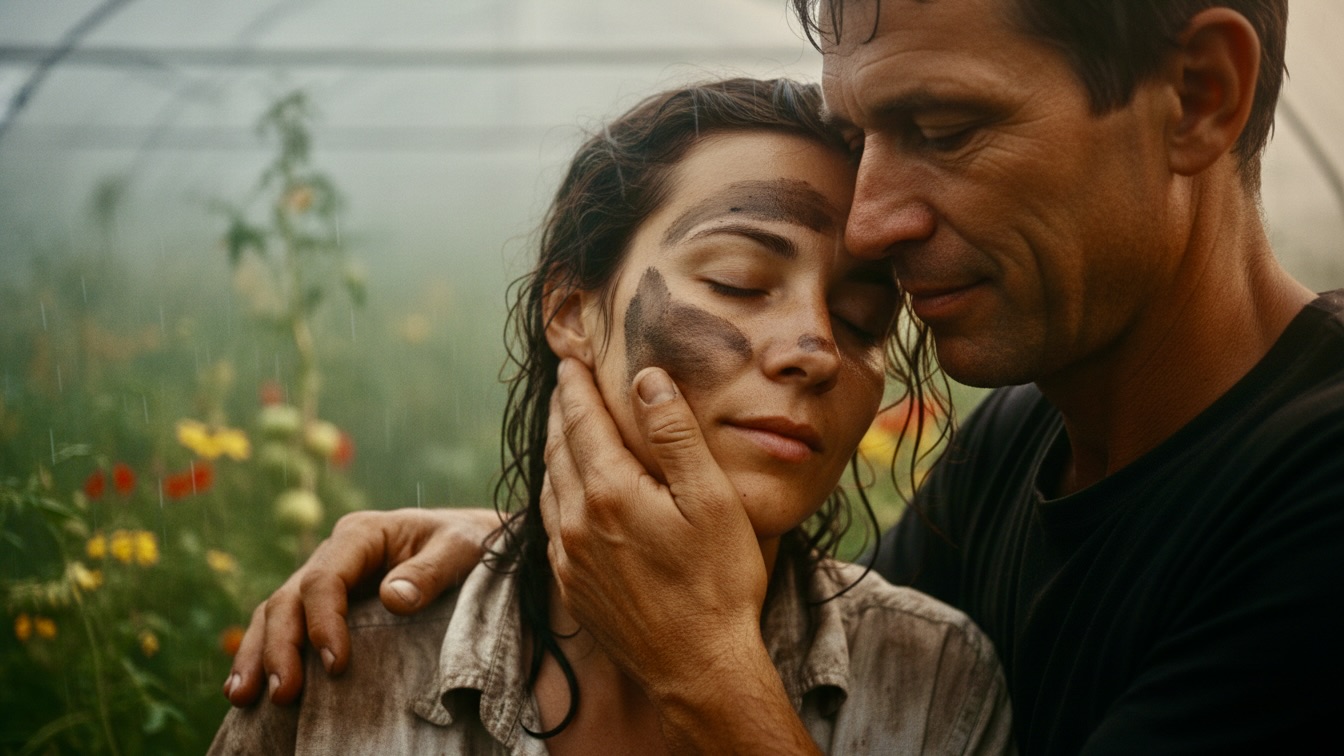
It was warm inside the greenhouse. The air smelled of damp potting soil and the faint, sharp tang of tomato leaves. They stood in the center, listening to the rain pick up its rhythm against the plastic tarp.
Steve looked down at her. His hand was still resting on her waist. He slowly moved his hand up, his thumb brushing a streak of mud off her cheek. His touch was incredibly gentle, a stark contrast to his rough, calloused fingers.
Helen looked up into his eyes. The exhaustion in her body vanished, replaced by a sudden, intense heat that had nothing to do with the summer air. She noticed the small lines around his eyes, the way his chest rose and fell with his breathing.
"We did it," Steve whispered.
"We did," Helen breathed.
He did not ask. He just leaned in, closing the space between them. Helen met him halfway.
The kiss tasted like sweat, rain, and the faint bitterness of morning coffee. It was messy and desperate, entirely uncalibrated. Steve's arms wrapped entirely around her, pulling her against his chest. Helen reached up, sliding her hands into his damp hair, uncaring about the mud on her fingers.
The rain hammered down on the thin plastic roof above them, threatening to tear the structure apart, but neither of them pulled away.
When they finally separated, they were both breathing heavily. Steve rested his forehead against hers.
"Your soil pH is still wrong," Steve whispered, a smile in his voice.
Helen laughed, a quiet, breathless sound. "Shut up and kiss me again."
Outside, the wind howled, and the pink string buried in the mud finally washed away entirely.
“Outside, the wind howled, and the pink string buried in the mud finally washed away entirely.”


