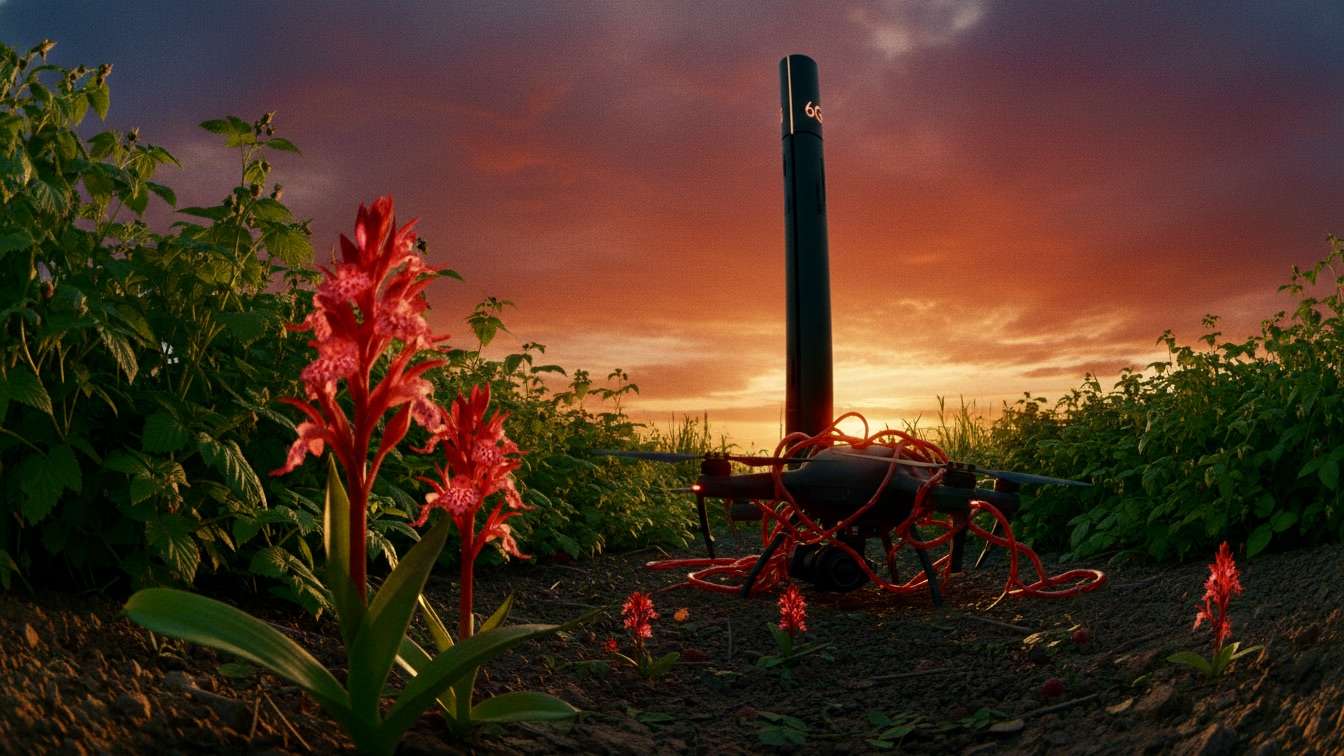
Jason uncovers a parasitic orchid network in Minnitaki Lake that is siphoning data from the town's quantum mesh.
Jason wiped the sweat from his eyes. It was ninety-four degrees in Minnitaki Lake. The air didn't move. It just sat there, thick and smelling like wet dirt and hot asphalt. He shifted the weight of his tool kit. The strap dug into his shoulder, leaving a red mark on his skin that he knew would itch later. He hated the summer here. The humidity turned everything into a slow-motion struggle. He kicked the gate of the community garden. It groaned on its hinges. The sound was too loud in the midday silence.
He headed toward the compost heaps at the back. That’s where the 6G relay was buried. It was a sleek, black needle of carbon fiber and circuitry, looking out of place among the rotting squash and grass clippings. The town council called it 'invisible infrastructure.' Jason just called it a pain in the neck. It had been glitching for three days. The whole north side of the lake was down to 3G speeds, and the local teenagers were starting to look like they might riot. He knelt in the dirt. The ground was hard-packed and dusty. He pulled his diagnostic tablet from his bag. The screen was cracked in the corner, a spiderweb of glass that caught the sun and blinded him for a second.
"Piece of junk," he muttered. He tapped the screen. The interface loaded slowly. The signal from the relay was spiking in weird, jagged patterns. It wasn't a standard hardware failure. It looked like a leach. Something was drawing power and data at the physical layer. He looked down at the base of the relay. That’s when he saw them. A cluster of Spotted Coralroot orchids. They were weird-looking things. No leaves. No green. Just these upright, fleshy red stems with white flowers that had tiny purple spots. They looked like something that should be underwater, not growing in a pile of dirt near a 6G tower.
He reached out to touch one. The stem felt cool. That was wrong. In this heat, everything should be warm. He pulled his hand back. The flowers seemed to pulse. It was subtle. A tiny flicker of red light deep inside the stem, timed with the spikes on his tablet. He checked the data again. The relay wasn't just malfunctioning. It was being tapped. The orchids were wrapped around the subterranean fiber lines. Their roots—if you could even call them roots—were fused with the shielding of the cables. He had never seen anything like it. It was biological, but it was behaving like hardware.
"Don't touch those," a voice said. Jason jumped. He turned around to see Koda standing by the raspberry brambles. Koda was the garden supervisor. He was older, with skin like tanned leather and a permanent scowl. He was holding a rusted trowel. He looked like he had been living in the garden for a week. His clothes were stained with mud, and he had a smear of something green on his cheek. Koda didn't look like he cared about the 6G network. He looked like he was protecting a crime scene.
"They're messing with the relay," Jason said. He pointed at the red stems. "I have to clear them out. They're probably causing a short." Koda stepped closer. He didn't look at Jason. He looked at the flowers. "They've been acting up since the solar flare last week," Koda said. His voice was low. "I saw the grass die. Look." He pointed his trowel at a circle of brown, dead lawn around the orchid cluster. The transition from lush green to dead yellow was a perfect circle. It looked like a burn mark. Like the plants were sucking the life out of the ground around them to fuel whatever they were doing.
Jason looked back at his tablet. The data packets were scrolling past now. They weren't just noise. They were encrypted. He recognized the header format. It was the town’s localized quantum mesh protocol. The orchids were reading the mail. "Koda, these things are tapping the network," Jason said. He felt a chill that had nothing to do with the heat. "They're not just plants. They're running code." Koda didn't look surprised. He just gripped his trowel tighter. "I told the council something was wrong," he said. "They didn't listen. They just want their Netflix to load faster."
Jason stood up. He felt exposed. The garden was quiet, but it didn't feel peaceful anymore. It felt like he was standing on top of a giant, breathing machine. He could hear the low hum of the relay, but there was another sound beneath it. A soft, wet clicking. It was coming from the orchids. They were communicating. Not with scent or pollen, but with bits and bytes. He looked at the red stems. They were more vibrant now. The twilight was starting to bleed into the sky, and the orchids were glowing. A soft, rhythmic red light that matched the heartbeat of the town's data. He needed to call this in, but his phone was dead. He looked at the relay. The status light was blinking amber. The system was failing. And the garden was just getting started.
"We need to get out of here," Jason said. He started packing his tools. He didn't want to be near the red light when the sun went down. Koda didn't move. He just watched the flowers. "It’s too late for that," Koda whispered. "They're already in the mesh. They're everywhere now." Jason looked at the fence. The shadows were getting longer. The raspberry brambles seemed to reach out toward him. He felt the paranoia set in. Every rustle of a leaf sounded like a command. Every shadow looked like a drone. He grabbed his bag and headed for the gate, but his feet felt heavy. The ground felt like it was pulling at him. The orchids were pulsing faster now. The whole garden was starting to glow.
Jason sat in his truck, the AC blasting. It didn't help. He was still sweating. He stared at the tablet. The data logs were a mess. He’d managed to pull a few raw packets before the relay went totally dark. It wasn't just interference. It was a structured harvest. The Spotted Coralroot wasn't destroying the data. It was archiving it. He saw bits of local government emails, snippets of private texts, even fragments of the town's utility grid commands. The orchids were acting like a massive, organic hard drive. He tapped his fingers on the steering wheel. This wasn't natural evolution. This was an exploit.
He looked through the windshield. The garden sat there, a dark patch in the middle of the suburb. From here, it looked normal. Just a bunch of overgrown vegetables and some tired-looking flowers. But he knew what was under the dirt. He saw Koda still standing by the relay. The man hadn't moved in twenty minutes. He looked like a statue. Jason checked his phone. Still no signal. The 'No Service' icon felt like a death sentence. He lived on his phone. Everyone did. Without the mesh, Minnitaki Lake was just a bunch of people sitting in the dark, wondering why their smart fridges stopped working.
He saw a black sedan pull up to the garden gate. Councilman Johnston stepped out. He was wearing a suit that cost more than Jason’s truck. He looked out of place in the dirt. He was holding a handkerchief to his face, probably trying to block out the smell of the compost. Johnston was the guy who pushed for the 6G installation. He called it 'The Digital Renaissance of the North.' Now, he looked like he was attending a funeral. Jason got out of the truck. The heat hit him like a physical blow. He walked over to the fence.
"Jason," Johnston said. He didn't look happy. "The Mayor is breathing down my neck. The whole town is offline. What’s the status?" Jason pointed at the garden. "The relay is toast. Something is leaching the power. Specifically, the orchids." Johnston looked at the red stems. He scoffed. "Plants? You’re telling me the multi-million dollar network was taken down by some weeds? Don't be ridiculous. It’s a hardware failure. Replace the module."
"It's not that simple," Jason said. He held up his tablet. "Look at the power draw. The orchids are fused with the cables. If I pull them out, I’ll rip the fiber. And they’re not just sitting there. They’re processing data. They’ve encrypted the local mesh. I can't even get a handshake protocol to work." Johnston’s face went pale. He didn't understand the tech, but he understood the word 'encrypted.' That meant a security breach. And security breaches meant lawsuits.
"Pave it," Johnston said. His voice was cold. "I’ll get a crew out here tonight. We’ll rip the whole garden up. Pour six inches of concrete over the whole thing. We can relocate the relay to the water tower." Koda stepped forward then. He had been listening. "You can't do that," Koda said. His eyes were wide. "This is a new form of life. You can't just pave over it because your internet is slow. Look at them. They’re adapting. They’re using the solar flare energy to bridge the gap between biology and silicon."
Johnston didn't care about biology. He cared about his re-election. "It’s a hazard, Koda. It’s interfering with emergency services. We have people who can't call 911 because of your little science project. I'm calling the paving contractor. We’ll be here in an hour." He turned and walked back to his car. He didn't look back. Jason watched him go. He knew Johnston was serious. The man loved concrete. It was his solution to everything. If a problem was too complicated, bury it in cement.
Jason looked at Koda. The older man looked devastated. "He's going to kill them," Koda said. "He doesn't understand what they are. They're not just weeds, Jason. They're a backup. A biological backup of everything we've put into the air. Every photo, every word. They're storing it in the mycelium. The whole forest could be one giant server by next year." Jason looked at the dead grass circle. It was bigger than it had been ten minutes ago. The orchids were hungry. They were expanding their reach. The power lines for the streetlights were next. He could see the wires humming above them.
"Koda, if they keep drawing power like this, they’ll blow the transformer," Jason said. He felt the weight of the situation. He was just a tech. He wasn't supposed to be deciding the fate of a new species. But he also didn't want the town to burn down. "I need to try and isolate the signal. If I can mask them, maybe the council will think they're dead. We need time to figure out what they’re actually doing."
Koda nodded slowly. "The raspberry brambles," he said. "They're thickest there. We can hide the equipment in the center. But we have to move fast. I can hear them. The orchids. They’re getting louder." Jason didn't hear anything but the wind, but he didn't argue. He went back to his truck and grabbed his portable jammer. It was a grey box with a bunch of antennas. He’d built it for testing interference, but it could also create a dead zone. If he could wrap the orchids in a signal-proof bubble, maybe they’d stop feeding. Or maybe they’d just get hungrier. He didn't know. He just knew he couldn't let Johnston pave the garden yet.
The sun dipped below the horizon, leaving the sky a bruised purple. The streetlights should have flickered on, but the town stayed dark. The silence was heavy. Usually, you’d hear the hum of AC units and the distant drone of TVs. Now, there was nothing. Just the sound of crickets and the frantic clicking coming from the garden. Jason and Koda were deep in the raspberry bushes. The thorns tore at Jason’s t-shirt. He didn't care. He was focused on the jammer. The screen was glowing a dim blue, illuminating their faces.
"The emergency services are offline," Jason whispered. He checked his tablet again. "The 911 dispatch center just lost its primary and secondary links. The orchids are intercepting the microwave relays now. They’re not just in the ground. They’re pulling signals out of the air." He showed Koda the screen. It was a visualization of the local EM field. The garden was a massive sinkhole. Everything was being sucked into the center, spiraling down into the root systems of the Spotted Coralroot.
"They're uploading us," Koda said. He was sitting on a plastic crate, his hands trembling. "I’ve been watching the data. It’s not just random bits. It’s a narrative. They’re taking the town’s history. The birth records, the property deeds, the old photos in the cloud. They’re building a library. A biological archive. Why would they do that?" Jason shook his head. "Maybe they know something we don't. Maybe the world is failing, and they're the only ones who can save the data. It's like a seed bank, but for information."
Suddenly, a low hum filled the air. It wasn't the orchids. It was mechanical. High-pitched and precise. Jason looked up through the leaves. A drone was hovering over the garden. It was about the size of a trash can lid, matte black, with no visible markings. It had a gimbal-mounted camera that was scanning the ground. A bright green laser swept across the orchids, mapping the cluster in three dimensions. This wasn't a police drone. This was corporate.
"Biotech," Jason hissed. He grabbed Koda’s arm and pulled him deeper into the shadows. "Someone else noticed the signal spike. They’re here to harvest." The drone descended lower, its rotors kicking up dust and dead leaves. A mechanical arm extended from its belly, tipped with a collection tube. It was going for the central cluster. The 'smart' orchids. If they took the plants, they took the data. And Jason had a feeling they wouldn't be gentle about it.
"We have to stop it," Koda said. He reached for his trowel. "No," Jason said. "That thing is probably armed. Or at least it has a direct link to a security team. If we break it, they’ll just send ten more. We need to make them think the experiment failed." He adjusted the settings on the jammer. He needed to create a feedback loop. If he could flood the orchids with garbage data, the biotech firm would see a corrupted signal. They’d think the plants were just a glitch, a biological dead end.
He started typing. The code was messy, but he didn't have time for elegance. He injected a noise floor into the orchids' frequency. The red stems began to pulse erratically. They flickered like a dying neon sign. The drone paused. It hovered about five feet above the ground, its camera spinning. It was confused. The data it was seeing didn't match its parameters. The laser light flickered from green to red. It was a diagnostic error.
"It's working," Jason whispered. But the orchids didn't like the noise. The clicking sound grew louder, turning into a high-pitched screech. The ground beneath them began to vibrate. Jason felt it in his teeth. The plants were fighting back. They were trying to filter out the jammer's signal. He saw the red light spreading through the soil. It wasn't just the orchids anymore. The grass, the brambles, even the trees at the edge of the garden were starting to glow with a faint, bioluminescent pulse. The whole ecosystem was part of the network.
"Jason, look," Koda pointed at the drone. The mechanical arm was shaking. The drone’s sensors were being overwhelmed by the sheer volume of data the plants were pushing out. It was like trying to drink from a firehose. The drone wobbled in the air. Its rotors sputtered. Then, with a sudden pop and a flash of blue sparks, it dropped. It hit the ground with a heavy thud, its camera lens shattered. The orchids immediately began to grow over it. Small, red filaments coiled around the landing gear, pulling the machine into the dirt.
"They're eating it," Jason said. He was terrified, but he couldn't look away. The plants weren't just storing data anymore. They were scavenging. They were taking the drone's circuitry and integrating it into their own structure. Within minutes, the matte black casing was barely visible under a layer of red vines. The clicking sound stopped. The silence returned, but it was different now. It felt heavy. It felt like the garden was watching them, waiting for their next move.
The headlights of the paving crew’s trucks appeared at the end of the street. They were bright, cutting through the dark like searchlights. Jason knew they didn't have much time. Johnston would be with them, ready to bury the evidence. He looked at the jammer. It was running hot. The plastic casing felt soft under his hands. He had to make the signal permanent. He had to hide the orchids in plain sight.
"Koda, we need to move the jammer into the center of the brambles," Jason said. "If we bury it there, the signal will be masked from the surface. The council will think the interference is gone. They’ll see the relay come back online, and they’ll leave the garden alone." Koda nodded. He looked tired. The events of the night had aged him. But he had a look of grim determination. He grabbed a shovel from the shed. "I’ll dig the hole. You keep that thing running."
They crawled through the raspberry bushes. The thorns were relentless, scratching Jason's arms and face. He could feel the blood trickling down his cheek, but he didn't stop. He held the jammer like it was a holy relic. They reached the center of the brambles, a small clearing where the tallest orchids grew. These ones were nearly three feet high. They weren't just red; they were a deep, bruised purple. They were pulsing with a slow, steady light. It looked like a heartbeat.
Koda started digging. The soil was full of thick, white roots. They looked like fiber optic cables. Every time the shovel hit one, a spark of blue light flickered in the dirt. The orchids seemed to shiver. Jason watched the trucks pull up to the gate. He could hear the heavy rumble of the engines. Men were shouting. The sound of a jackhammer starting up echoed through the neighborhood. They were starting on the sidewalk. They’d be at the garden in minutes.
"Hurry," Jason said. Koda threw a final clod of dirt aside. "Done. Put it in." Jason placed the jammer in the hole. He set the timer for a continuous loop. The blue light of the screen illuminated the white roots. He felt a strange urge to touch them, to connect with the network. He shook it off. He wasn't ready to be part of the archive yet. He covered the jammer with dirt and smoothed it over with dead leaves. To anyone looking, it was just another patch of ground.
They crawled back to the edge of the garden just as Johnston and the crew reached the gate. The councilman looked triumphant. He was pointing a flashlight at the relay. "See?" he shouted over the noise of the trucks. "The signal is back! The interference cleared up as soon as we brought the heavy equipment in. It was probably just some atmospheric anomaly. But we're still paving it. I’m not taking any chances."
Jason stepped out from the shadows. He looked like he’d been in a fight. His clothes were torn, and his face was smeared with dirt and blood. "Wait!" he yelled. Johnston turned his flashlight on Jason. He squinted. "Jason? What the hell happened to you? And where is that crazy gardener?"
"The signal is back because I fixed the relay," Jason lied. His voice was steady. "The orchids... they died. Look at them." He pointed at the cluster near the tower. Without the jammer's interference, and with the new noise loop running underground, the orchids looked dull. The red light had faded. They looked like wilted weeds. "The heat killed them. There's no need to pave. You’d just be wasting the town's budget on a problem that solved itself."
Johnston walked over to the relay. He checked his phone. Five bars. The 6G was screaming fast. He looked at the orchids. He kicked one with his expensive shoe. The stem snapped. No light came out. It just looked like a dead plant. He sighed, a sound of disappointment. He really wanted to use that concrete. "Fine," he said. "But if that signal drops even one bar, I’m bringing the steamroller. You hear me?"
"I hear you," Jason said. He watched as Johnston waved the crew away. The trucks backed out of the street, their backup beepers fading into the distance. The neighborhood went quiet again. The streetlights flickered and then stayed on. The power was back. The town was 'connected' again. But Jason knew better. He knew the connection was a lie. The real network was beneath his feet.
Koda came out of the bushes. He looked at the broken orchid. He knelt down and gently pressed the snapped stem back into the dirt. "They'll heal," he said. "They're already rebuilding the link." Jason looked at his hands. They were stained with the red sap of the plants. It didn't wash off. It looked like ink. He looked at the garden. It was dark now, but he could still feel the pulse. A slow, rhythmic vibration that matched his own heart.
They were the guardians now. The only two people in Minnitaki Lake who knew that the town was being watched, archived, and saved by a bunch of red flowers. Jason knew his life was different now. He wouldn't just be fixing relays. He’d be tending the server. He’d be checking the roots. He looked at Koda. The older man smiled. It was a small, sad smile. "Welcome to the library, Jason," Koda said. "Try not to make too much noise."
Jason sat down on the grass. The heat was finally breaking. A cool breeze blew off the lake, carrying the scent of pine and water. He closed his eyes. He could hear the clicking again. It was faint, but it was there. A million bits of data moving through the soil. The town was sleeping, but the garden was wide awake. It was whispering in the dark, and for the first time in his life, Jason was actually listening.
“Underneath the soil, the jammer's light flickered once and turned deep, pulsing red.”


