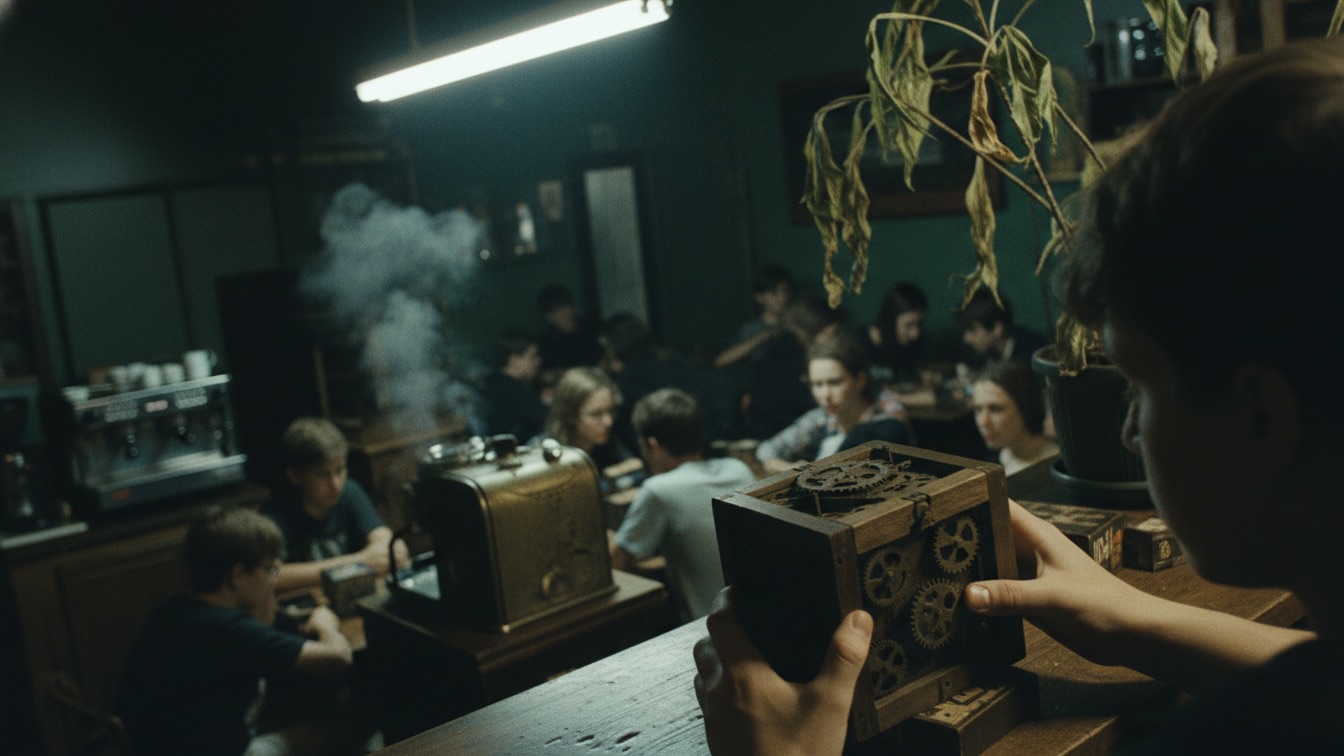
A Winnipeg café becomes a secret hub for analog communication after the government bans all social media and technology.
The air inside the café was thick with the smell of cheap espresso and the specific, paper-dry scent of a thousand cardboard boxes. Peter wiped the counter for the fifth time in ten minutes. It didn't need it. The laminate was already stripped of its shine by years of aggressive cleaning and spilled soda. Outside, the Winnipeg summer was doing its best to melt the pavement. The heat didn't just sit; it pressed against the windows like a physical weight, making the glass feel hot to the touch. Inside, the air conditioning was a lost cause. It hummed a low, dying tune in the corner, managing only to move the humid air around rather than cool it.
Every table was full. It was only 4:00 PM on a Tuesday, but the place was packed with teenagers who had nowhere else to go. A year ago, they would have been in their bedrooms, scrolling through feeds until their thumbs went numb. Now, they were here. The ban had changed everything. No TikTok. No Instagram. No AI chatbots to tell them what to think or how to feel. The government had pulled the plug on the digital world, claiming it was for national security, but mostly it just felt like a massive, collective grounding. So, they came to Peter’s. They sat over worn copies of Settlers of Catan and Ticket to Ride, their faces lit not by blue light, but by the flickering overhead fluorescents.
"You’re hovering again," a voice said. Peter didn't look up to know it was Nia. She was sitting at the bar, her laptop—now a glorified typewriter since the internet was restricted to government-approved portals—open in front of her. She worked in logistics, which meant she spent her days tracking crates of grain and machinery moving across the prairies. She was the café’s most consistent regular, mostly because she liked the noise.
"I’m not hovering," Peter said, finally putting the rag down. "I’m observing. There’s a difference."
"The difference is about ten percent less creepiness," Nia replied. She reached for her coffee, which was mostly ice at this point. "They’re just kids, Pete. They’re not going to start a riot over a game of Monopoly. Though, honestly, that game is designed to destroy friendships, so maybe keep an eye on table four."
Peter looked at table four. Four fifteen-year-olds were staring intensely at a game of Risk. They weren't talking. They were just... there. It was the silence that got to him. Even with the café full, the vibe was muted. It was a generation that had forgotten how to make noise without a microphone. "It’s too quiet," Peter muttered. "It’s weird. I used to complain when they were loud. Now I’d give anything for one of them to just scream for no reason."
"The internet was their scream," Nia said, her fingers tapping a rhythm on her keyboard. "Now they’re just holding it in. It’s like the whole city is holding its breath. Have you been down to the river today?"
Peter shook his head. "Too hot. Why?"
"It’s gross," Nia said, making a face. "The thaw didn't just bring the mud this year. The Red is full of those 'zombie' trout. They’re just floating there, half-dead, bumping into the docks. It smells like a wet basement and old fish. Something is definitely off with the water. The city says it’s just the heat, but people are talking."
"People are always talking," Peter said. He moved to the espresso machine to pull a shot he didn't need. The machine hissed, a sharp, violent sound in the relative quiet of the room. He felt a bead of sweat roll down his neck. The café felt smaller than usual. The walls, lined with shelves of games, seemed to be leaning in.
"Speaking of talking," Nia lowered her voice, leaning over the counter. "I got a notification on the manifest today. Something weird is coming your way. A shipment. It was supposed to go to the university’s cultural studies department, but the routing got flagged and redirected. To here."
Peter frowned. "I didn't order anything. I can barely afford the rent on this place as it is. What kind of shipment?"
"It’s coming from the Strait of Hormuz," Nia said. "Labeled as 'Cultural Exchange Peace Goods.' But the weight is all wrong for books or textiles. And the shipping company? It’s a shell. I looked into it before the filters blocked me. It’s been rerouted three times in the last forty-eight hours. It should be here by tonight."
"I’m not signing for something I didn't order," Peter said. "That’s how you get a visit from the inspectors. I already have to report my player counts every week. I don't need more heat."
"It’s already in the system, Pete. If you reject it, it goes to a government warehouse for 'inspection.' And we both know what that means. It’ll disappear, and you’ll get a fine for 'clogging the logistics chain.' Just take it. We’ll see what’s inside after I close out my shift."
Peter looked at the kids in his café. They were the last remnants of a social world that was being systematically dismantled. He looked back at Nia. Her eyes were sharp, expectant. She liked a puzzle. He liked his life simple. But 'simple' had left the building the day the screens went dark.
"Fine," Peter sighed. "But if it’s a bomb, I’m blaming you."
"If it’s a bomb, we won’t have time to blame anyone," Nia said, her mouth twitching into a half-smile. "That’s the beauty of it."
She went back to her typing, and Peter went back to his rag. The afternoon dragged on. The sun stayed high, a blinding white disc in a pale blue sky. The shadows in the café began to stretch, but they didn't feel like normal shadows. They felt heavy. Dense. Like they were made of something more than just a lack of light. Peter found himself glancing at the back door every few minutes, waiting for the sound of a delivery truck, waiting for the peace goods to arrive and break the silence.
The delivery truck arrived just as the sun was beginning to dip behind the brutalist concrete of the nearby apartment blocks. It wasn't a standard courier van. It was a heavy, unmarked box truck that looked like it had seen better days in a much more violent climate. The driver didn't say a word. He just lowered the liftgate and rolled a single, massive wooden crate onto the sidewalk. He handed Peter a digital pad, Peter signed it without looking, and the truck was gone before the dust had even settled back into the cracks in the pavement.
"Well," Nia said, appearing at Peter’s shoulder. "That wasn't suspicious at all."
"Help me get this inside," Peter said, his voice strained. The crate was about three feet on each side, bound in heavy steel straps. It smelled faintly of salt and something metallic, like old pennies left in a jar. As they pushed it through the door and into the storage area behind the counter, the kids at the tables looked up. For the first time all day, there was a ripple of genuine curiosity in the room.
"What’s in the box, Pete?" one of the regulars, a tall kid named Sam, asked. He was holding a handful of plastic army men from a game of Risk.
"New inventory," Peter lied. "Go back to invading Australia, Sam. It’s the only strategy that works."
They got the crate into the back room and shut the door. The storage area was cramped, filled with extra chairs and boxes of expansion packs. Peter wiped his forehead. The heat in here was even worse, trapped by the lack of windows.
"Do you hear that?" Nia whispered.
Peter froze. He leaned closer to the crate. At first, there was nothing. Then, a faint, dull sound. Thump. Thump. Thump. It was rhythmic, steady, and incredibly low-frequency. It wasn't a mechanical ticking. It sounded organic, like a heartbeat muffled by layers of wet wool.
"Is there something alive in there?" Peter asked, pulling back.
"From the Strait of Hormuz? In this heat?" Nia shook her head. "Nothing would survive the transit. But it’s definitely moving. Look at the dust on the lid."
Peter looked. The fine layer of Winnipeg grit on the wood was vibrating. The rhythm was perfect. Sixty beats per minute. A clock? A pump? A heart? The 'shadow mass' Peter had felt earlier seemed to coalesce around the box. The light in the room shifted, turning a sickly, jaundiced yellow that didn't match the sunset outside.
"We should call someone," Peter said, though he knew he wouldn't.
"Who? The cops? The inspectors?" Nia crossed her arms. "They’ll just lock the doors and put us in a holding cell while they 'investigate' for six months. No. We open it. Now."
"I don't have a crowbar."
"Use the heavy-duty stapler remover and the hammer from the junk drawer," Nia commanded. "I’ll get the flashlight."
Outside the back room, the café had gone quiet again. The unnatural silence of the city seemed to be leaking through the walls. Peter thought about the zombie trout in the Red River, their vacant eyes staring at nothing as they floated in the sludge. He felt a sudden, sharp pang of dread. The world was changing. It wasn't just the tech ban. It was the environment, the politics, the very air they breathed. Everything was becoming heavier, more opaque.
He returned with the tools. The hammer felt cold in his hand despite the heat. He positioned the flat head of the staple remover under one of the steel straps.
"On three?" Nia asked, her voice tight.
"Just do it," Peter said.
He hammered the tool under the strap. The sound was deafening in the small room. Clang. Clang. The rhythmic thumping from inside the box didn't stop. It didn't speed up. It just kept going, indifferent to his efforts. Peter felt a surge of adrenaline. He pried the first strap back with a screech of metal on wood. Then the second. Then the third.
He paused, his chest heaving. "Nia, if this is something we can’t unsee, I want it on the record that I wanted to go to the movies instead."
"The movies are all government propaganda documentaries now, Pete. This is better. Open it."
Peter hooked his fingers under the edge of the lid. It was heavier than it looked. He strained, his muscles tensing, and with a groan of protesting wood, he flipped the lid back. It hit the floor with a dull thud.
They both leaned in, Nia shining the flashlight into the depths of the crate.
It wasn't a bomb. It wasn't a body. It wasn't even 'peace goods' in any traditional sense.
The crate was filled to the brim with thousands of small, intricate wooden cubes. They were dark, almost black, carved from a wood Peter didn't recognize. Each one was about the size of a die, but they were covered in tiny, moving gears and sliding panels. And they were all moving. The gears were turning, the panels were sliding, and the collective friction of thousands of tiny wooden parts was creating the rhythmic thudding sound.
"Puzzles?" Nia reached in and picked one up. It was surprisingly heavy. "They’re like Rubik’s cubes, but... mechanical."
"Why would someone ship thousands of wooden puzzles from a war zone to a board game café in Winnipeg?" Peter asked. He picked one up too. The wood felt warm, almost vibrating in his palm. It was weirdly satisfying to hold.
"Wait," Nia said, shining her light onto the underside of the lid. Taped there was a thick envelope made of heavy, yellowed paper. She pulled it down and tore it open. Inside was a single sheet of vellum and a small, brass key.
"What’s it say?" Peter asked.
Nia scanned the page. Her brow furrowed. "It’s not a letter. It’s a set of instructions. But not for a game I’ve ever seen. It’s all logic gates and sequence chains. 'Align the third axis to the solar noon. Rotate the base until the click matches the pulse.'"
"It’s a manual for the puzzles," Peter said.
"No," Nia whispered, her eyes widening as she read further. "It’s not a manual. It’s a key. These aren't puzzles, Peter. They’re devices. Look at the way the gears mesh. If you set them a certain way..."
She began to fiddle with the cube in her hand, her fingers moving with the practiced ease of someone who spent her life looking for patterns in logistics data. Click. Slide. Click.
Suddenly, the rhythmic thumping in the crate changed. It didn't stop, but it shifted into a different tempo. A more complex one.
"Nia, stop," Peter said, a chill running down his spine despite the sweat. "You don't know what you’re doing."
"I think I do," she said, her voice breathless. "Peter, these aren't just toys. They’re analog. No chips, no electricity, no signals for the government to track. They’re for sending messages. It’s an encryption system. You set the gears to a certain code, you pass the cube to someone else, and they use the key to read the configuration."
"Analog encryption," Peter breathed. "In a world without the internet, this is..."
"This is everything," Nia finished.
Just then, the front door of the café chimed. It was a sharp, cheerful sound that felt completely wrong for the moment. Peter looked at the security monitor he kept behind the counter. A man in a crisp, grey suit was standing at the bar. He wasn't a regular. He had a lanyard with a laminated ID card hanging from his neck.
"Inspector Zennie," Peter whispered. "He’s early."
Peter felt his stomach drop. Inspector Zennie was a legend in the neighborhood, but not the good kind. He was the guy who had shuttered the library’s computer lab and confiscated the local high school’s robotics kit. He was the face of the 'Digital Purity Act.' He moved with a slow, deliberate precision that made Peter think of a predator that didn't need to hurry because it knew the exits were already blocked.
"Stay here," Peter hissed to Nia. "Cover the crate. Use the old Twister mats."
"Peter, he’s going to notice the noise," Nia whispered, already scrambling to throw the plastic sheets over the vibrating box.
"I’ll handle it. Just stay quiet."
Peter stepped out of the back room, closing the door firmly behind him. He wiped his hands on his apron and tried to summon his 'customer service' face. It felt more like a grimace.
"Inspector Zennie," Peter said, walking toward the bar. "A bit late for a routine check, isn't it? We’re just about to close."
Zennie didn't look up immediately. He was poking at a stack of board games on the counter. He picked up a box of Scrabble, turning it over in his gloved hands. "The summer heat is quite oppressive this year, don't you think, Peter? It makes everyone... restless. The river is a mess. The trout are dying. It’s a time for cleaning up. For clearing out the rot."
"It’s just the weather, Inspector," Peter said, his voice steadier than he felt. "Can I help you with something?"
Zennie finally looked at him. His eyes were a pale, washed-out blue, like the sky right before a storm. "We received a report of a delivery. An unscheduled shipment from a high-risk zone. The Strait of Hormuz, specifically. A crate of 'peace goods.'"
Peter’s heart hammered against his ribs, mimicking the thumping in the back room. "Oh, that. Yeah. It was a mistake. Some university stuff. I was just about to call the logistics office to have it picked up."
"Is that so?" Zennie smiled, but it didn't reach his eyes. "Because my records show the delivery was accepted and signed for. By you. Ten minutes ago."
He started to walk around the counter. Peter stepped in his way, blocked by the narrow gap. "It’s just books and stuff, Inspector. I haven't even had a chance to look at it. If it’s a security concern, I’m happy to let you take it... tomorrow. When the office is open."
Zennie stopped. He was inches from Peter. He smelled of peppermint and something sterile, like a doctor’s office. "The safety of the province isn't something that waits for office hours, Peter. You know the rules. Any physical media entering the city from a non-sanctioned zone must be audited immediately. Especially in a place like this. A 'refuge,' as the kids call it."
He looked over Peter’s shoulder at the teenagers in the café. They were all watching now. The game of Risk was forgotten. The air in the room felt electric, charged with the collective anxiety of a generation that had learned to fear anyone in a suit.
"What’s that sound?" Zennie asked, tilting his head.
Peter’s blood ran cold. The thumping. Even through the door, the rhythmic vibration of thousands of wooden gears was audible if you knew what to listen for.
"The AC," Peter said quickly. "It’s on its last legs. I keep telling the landlord it’s going to blow, but you know how it is."
"It sounds... organic," Zennie said. He pushed past Peter. He didn't use force, just a steady, inevitable pressure that Peter couldn't resist without making a scene. He walked toward the back room.
"Inspector, wait!" Peter called out.
Zennie reached for the doorknob. Peter's mind raced. He saw Nia’s face in his mind—her logistics manifest, her laptop, the way she had looked at the puzzles. She was in there. If Zennie found her with the crate, they were both done.
Suddenly, a loud crash echoed from the other side of the café.
Table four had collapsed. Sam, the tall kid, was standing over a pile of broken wood and scattered game pieces. He looked shocked, his hands up in the air. "I’m so sorry, Pete! I just... I leaned on it too hard!"
Zennie paused, his hand still on the knob. He turned to look at the mess. The diversion was perfect. The kids at the other tables immediately began to chatter, moving to help Sam, creating a wall of noise and movement.
"The furniture in this city is as reliable as the weather," Zennie muttered. He turned back to the door, but the moment of tension had been broken.
"I’ll take that box now," Zennie said. "For the safety of the province."
"Sure," Peter said, his voice tight. "Let me just... clear the way. It’s a mess back there."
He opened the door for Zennie.
Nia was gone. The crate was there, but it was covered in a dusty old tarp. The thumping was muffled, but still present.
Zennie walked over to the crate and pulled back the tarp. Peter held his breath.
Inside the crate were hundreds of bright, red-and-white boxes.
Monopoly.
They were old, battered sets, some with the plastic wrap half-torn. There were no wooden puzzles. No gears. No rhythmic thumping. Just the familiar, depressing sight of the world’s most frustrating board game.
Zennie reached in and picked up a box. He opened it. A handful of play money and a silver thimble fell out. He frowned. "This is it? Monopoly?"
"Like I said," Peter said, feeling a wave of dizzying relief. "Cultural exchange. I guess they wanted to share the joys of capitalism with the Strait of Hormuz."
Zennie stared at the box for a long time. He looked back at Peter, his eyes narrowing. He knew something was wrong. He could feel it. The shadow mass in the room was still there, thickening around the edges of his vision. But there was nothing to seize. Nothing to report.
"The manifest said the weight was four hundred pounds," Zennie said quietly.
"Board games are heavy, Inspector. All that cardboard adds up."
Zennie dropped the Monopoly box back into the crate. "We’ll be watching this location, Peter. More closely than before. Don't think for a second that I don't know what you’re trying to do here."
"I’m just running a café, Inspector."
"You’re running a sanctuary for the obsolete," Zennie said. He turned on his heel and walked out, his shoes clicking on the linoleum like a countdown.
Peter waited until the front door chimed again. He waited until he heard the sound of Zennie’s car pulling away. Then, he sank onto a stack of chairs, his legs shaking.
"Nia?" he whispered.
"Up here," a voice came from the ceiling.
Nia was perched on top of the industrial shelving, hidden by a stack of oversized 'Giant Jenga' boxes. She dropped down, landing lightly on her feet.
"Where are they?" Peter asked. "The puzzles?"
Nia pointed to the corner. She had moved the puzzles into a dozen different empty game boxes—Risk, Clue, Stratego—and tucked them into the shelves. She had worked with the speed of someone who dealt with high-volume inventory for a living.
"The thumping?" Peter asked.
Nia pulled a small, wooden cube from her pocket. She had set the gears to a different position. The noise had stopped. It was silent.
"I figured out the 'mute' setting," she said, a wild, triumphant look in her eyes. "But more importantly, I figured out the first message."
"Message? From who?"
"From whoever sent these," Nia said. She held up the vellum sheet. Under the instructions, she had used a pencil to shade in a hidden relief. Words began to emerge.
The river is rising. The fish are a sign. Talk in the dark.
"They’re coming for the communication next, Pete," Nia said. "Not just the tech. The words themselves. These puzzles... they’re the only way we’ll be able to talk without them hearing."
Peter looked at the boxes of 'peace goods' hidden among the games. He looked at the teenagers outside, who were now quietly resetting the broken table. They were the ones who would use these. They were the ones who would learn the gears and the clicks.
"The government isn't just banning social media," Peter realized. "They’re trying to kill the very idea of a private thought."
"Then we give them a thousand ways to think in secret," Nia said. She handed him a puzzle. "Ready to play?"
The rest of the summer was a blur of heat and whispered secrets. The Red River continued to be a graveyard for the 'zombie' trout, the water turning a deep, bruised purple that the city officials refused to explain. People stayed indoors, the streets of Winnipeg eerily quiet during the day. But at night, Peter’s café was a different world.
It wasn't just a place for games anymore. It was a school.
Peter and Nia didn't hand out the puzzles to everyone. They were careful. They looked for the ones who were restless, the ones who stared at the blank screens of their phones with a specific kind of hunger. They started with Sam.
"It’s a game," Peter had told him, sliding a wooden cube across the table. "But the rules change every night. You have to listen for the click. When you find it, you pass it to the person at the next table."
Sam had taken to it with an intensity that was almost frightening. Within a week, he had taught five other kids how to 'read' the gears. They sat in the corners of the café, their heads bent together, their fingers moving in a synchronized dance of clicks and slides. To an outsider, it looked like they were just obsessed with a new fad. To Peter, it looked like a revolution.
They were sending messages. Simple things at first—times to meet, warnings about inspector patrols, news from the 'outside' that Nia managed to scrape from her logistics channels. The puzzles were perfect. They were untraceable. They left no digital footprint. If an inspector took one, it was just a piece of wood. Unless you had the key—the specific sequence of rotations—the message remained locked inside the mechanical heart of the cube.
One evening, late in August, the heat finally broke. A massive thunderstorm rolled in from the west, the sky turning a deep, ominous green. The rain didn't just fall; it hammered against the city, washing the grime from the streets and flooding the already swollen river.
Peter and Nia stood by the front window, watching the lightning illuminate the empty street. The café was closed, but the usual group of 'players' was in the back, working through a new shipment of 'peace goods' that Nia had managed to intercept.
"Zennie hasn't been back in weeks," Peter said. "I think he bought the Monopoly story."
"He didn't buy it," Nia said, her eyes fixed on the rain. "He’s just waiting. He’s like the river, Pete. He’s building up pressure. The more we grow, the more he’ll have to push back. I saw a report today. They’re starting to ban 'complex mechanical devices' in the capital. It’s only a matter of time before they come for the puzzles."
"Let them come," Peter said, surprised by the hardness in his own voice. "There are thousands of these things in the city now. Sam says they’ve started making their own. They’re using old clock parts and scrap wood. You can’t ban a tree, Nia."
"They’ll try," she said. She turned away from the window and looked at him. "Are you scared?"
Peter thought about it. His stomach was tight, a constant knot of anxiety that hadn't unraveled since the crate arrived. He was tired. He was broke. He was a criminal in the eyes of a government that had forgotten what it was like to be young.
"Yeah," he said. "I’m terrified. But for the first time in years, I don't feel like I’m just waiting for the world to end. I feel like I’m part of whatever comes next."
Nia smiled. It was a real smile this time, bright and sharp. She reached out and took his hand. Her palm was calloused from hours of fiddling with wooden gears. "The fish were just the first sign, Pete. The world is shedding its skin. It’s going to be messy. It’s going to be loud. But at least we’ll be able to talk to each other while it happens."
A loud crack of thunder shook the building. The power flickered, then died. The café plunged into darkness.
Peter didn't move. He didn't reach for a flashlight. He just listened.
From the back room, he heard it. The sound of a dozen wooden cubes clicking in unison. A rhythmic, mechanical heartbeat that filled the silence. It wasn't the sound of a shadow mass or a dying river. It was the sound of a hundred kids, working in the dark, building a world that couldn't be shut off with a switch.
They walked to the back door and stepped out into the rain. The air was cool for the first time in months. They walked down toward the Red River, the water churning and white-capped in the storm. The 'zombie' trout were gone, washed away by the flood. In their place, the water felt alive, powerful, and utterly indifferent to the laws of men.
Peter looked out at the dark horizon. The city was a silhouette of cold concrete and dead screens. But below the surface, in the basements and the board game cafés, the gears were turning. The analog resistance was just beginning, and the summer was finally over.
“As the power failed, the rhythmic clicking of a thousand wooden gears in the darkness proved that the city was no longer truly silent.”


