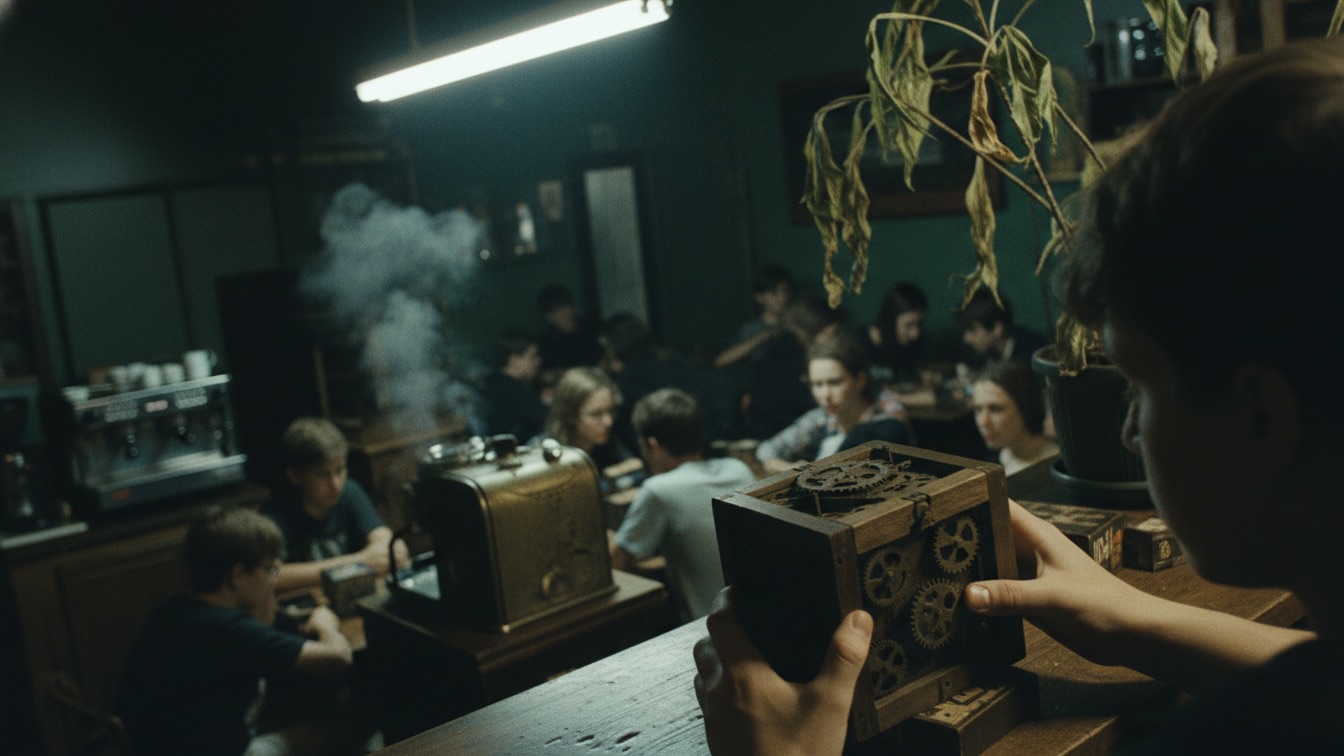
In a sweltering, post-digital Winnipeg, Peter operates a board game café that serves as a sanctuary for teenagers displaced by a government ban on the internet and social media. The atmosphere is oppressive, marked by record-breaking heat and a mysterious ecological decay symbolized by "zombie trout" in the Red River. Nia, a regular customer and logistics worker, warns Peter that a suspicious shipment from the Strait of Hormuz has been rerouted to his address. When the heavy wooden crate arrives, it emits a rhythmic, heartbeat-like thumping that suggests something organic or mechanical is contained within.
The tension peaks when Inspector Zennie, a cold enforcer of the Digital Purity Act, arrives to seize the unauthorized shipment. Through a quick-thinking diversion by a regular named Sam and Nia’s logistical expertise, the mysterious contents are hidden and replaced with innocuous Monopoly sets. After Zennie departs, Nia reveals that the crate contained thousands of intricate, mechanical wooden puzzles. These devices are actually analog encryption tools, allowing for private communication that the government cannot track or intercept.
As the summer heat finally breaks with a violent thunderstorm, the café transitions from a mere social club into the epicenter of an underground resistance. Peter and Nia begin training the youth to use the wooden cubes to send coded messages, bypassing the state's surveillance. The story concludes with a sense of grim hope, as the "analog network" begins to spread through the city. Peter realizes that while the government can ban technology, it cannot stop the fundamental human drive to communicate and organize in secret.
The narrative explores the tension between state-mandated digital isolation and the inherent human need for connection. By removing the internet, the government has attempted to "ground" a generation, yet this act only forces social interaction into tactile, physical spaces like Peter’s café. The board games serve as a metaphor for this shift, representing a return to structured, face-to-face engagement that requires presence rather than performance. The "digital void" left by the ban is not filled with peace, but with a heavy, expectant silence that suggests the populace is merely waiting for a new way to speak.
Environmental decay serves as a powerful secondary theme, mirroring the rot within the political structure. The "zombie trout" in the Red River represent a world that is half-dead, stagnant, and suffocating under the weight of administrative control. The oppressive Winnipeg heat acts as a psychological pressure cooker, heightening the characters' anxiety and making the eventual storm feel like a necessary, albeit violent, catharsis. This connection between the dying natural world and the restricted social world suggests that the "Digital Purity Act" is an affront to the natural order of human expression.
The most prominent theme is the rise of analog resistance as a response to high-tech authoritarianism. The wooden puzzles represent a technology that is "obsolete" yet invincible because it lacks a digital footprint. This theme highlights the irony that the government's focus on digital surveillance has left it vulnerable to ancient methods of encryption. The wooden gears and mechanical clicks symbolize a revolution that is grounded in the physical world, emphasizing that true privacy may only be possible when one disconnects from the grid entirely.
Peter is a man defined by his cautious nature and a deep-seated desire for stability in a world that has become increasingly volatile. As the owner of the café, he acts as a reluctant guardian for a generation that has lost its primary mode of expression. He is plagued by a psychological sense of "leaning walls" and claustrophobia, which reflects his fear of government overreach and his own perceived powerlessness. His constant wiping of the counter is a compulsive behavior, a futile attempt to maintain order in an environment where the "laminate" of his old life is being stripped away.
Throughout the chapter, Peter undergoes a transformation from a passive observer to an active participant in the resistance. Initially, he is terrified of "the heat" and the potential for a visit from the inspectors, preferring to keep his life simple and compliant. However, his interaction with Nia and the arrival of the puzzles force him to confront the reality that simplicity is no longer an option. By the end of the story, his internal "shadow mass" of anxiety has been replaced by a hardened resolve. He accepts his role as a criminal in the eyes of the state, finding a new sense of purpose in the rhythmic clicking of the mechanical cubes.
Nia serves as the intellectual catalyst of the story, possessing a sharp, analytical mind that thrives on identifying patterns within chaos. Her work in logistics provides her with a systemic view of the world, allowing her to see the movement of goods as a language of its own. Unlike Peter, she does not fear the "noise" or the complexity of the puzzles; instead, she is energized by them. Her psychological makeup is characterized by a high degree of agency and a lack of deference to authority, which makes her the natural leader of the café’s clandestine operations.
She is the bridge between the old digital world and the new analog future. Her ability to quickly decode the vellum instructions and "mute" the rhythmic thumping of the crate demonstrates her mastery over information systems, regardless of their medium. Nia represents the resilience of human intelligence, suggesting that expertise in one field can be repurposed to subvert oppressive structures. Her smile at the end of the narrative is not one of comfort, but of predatory triumph, signaling her readiness to fight the coming war for the "idea of a private thought."
Inspector Zennie is the personification of the state’s sterile and predatory authority. He is described with sensory details that emphasize his lack of humanity—the smell of peppermint and the sound of clicking shoes like a countdown. Psychologically, Zennie operates through intimidation and the projection of inevitability. He does not need to use physical force because he embodies the "Digital Purity Act," moving with a deliberate precision that suggests he already knows the outcome of every encounter.
His obsession with "clearing out the rot" reveals a fascist mindset that views non-conformity and unauthorized physical media as a biological threat to the province. He views the café not as a business, but as a "sanctuary for the obsolete," a term that betrays his contempt for anything that cannot be tracked or controlled by the state. Although he is temporarily fooled by the Monopoly diversion, his parting warning indicates that he is a persistent threat. He represents the ever-present shadow of surveillance that the resistance must constantly navigate.
The pacing of the chapter is masterfully controlled, beginning with a slow, atmospheric build that emphasizes the lethargic heat and the "muted" vibe of the café. This creates a sense of stagnation that makes the sudden arrival of the truck and the subsequent confrontation with Zennie feel jarring and high-stakes. The author uses the rhythmic "thump" of the crate as a metronome for the narrative tension, accelerating the reader's pulse alongside Peter’s own anxiety. The transition from the sweltering afternoon to the violent evening storm mirrors the shift in the plot from secrecy to active defiance.
Sensory details are employed to ground the speculative elements of the story in a gritty, tactile reality. The smell of "cheap espresso," the "paper-dry scent of cardboard," and the "metallic" odor of the crate create a vivid, unpolished world. The use of light is particularly effective, shifting from the "blinding white disc" of the sun to the "sickly, jaundiced yellow" of the storage room, and finally to the "ominous green" of the storm. These shifts in lighting reflect the moral and psychological ambiguity of the characters' situation as they move deeper into the underground.
The narrative voice is observant and slightly cynical, fitting the perspective of a man who has seen his world dismantled. However, this cynicism is balanced by moments of profound psychological insight, such as the description of the internet as the "scream" of a generation. The prose is lean but evocative, avoiding unnecessary exposition by letting the environment and the characters' reactions tell the story of the digital ban. By focusing on the "analog" nature of the resistance—the wood, the gears, and the rain—the author creates a stylistic contrast to the "blue light" of the lost digital age, emphasizing the return to a more primitive, yet more honest, form of human existence.


