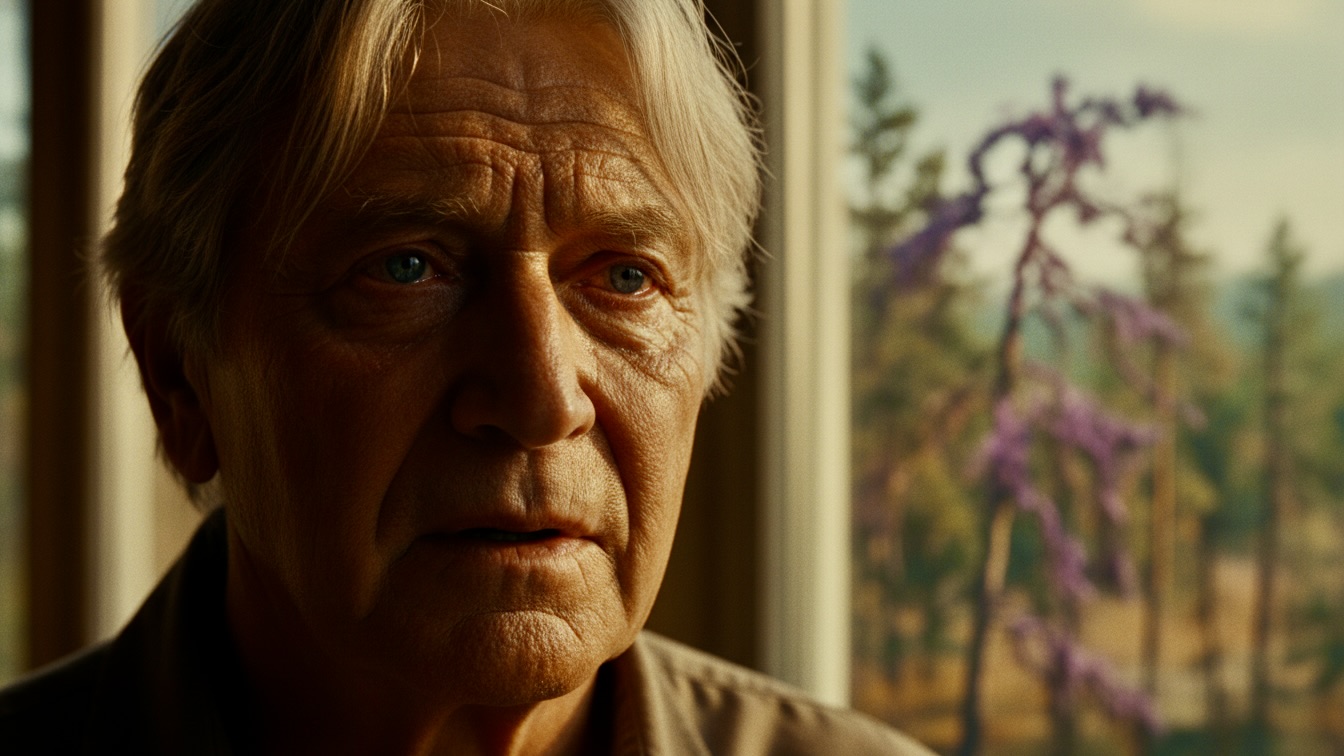
Eddie returns to the forest he mapped forty years ago, only to find the trees standing in terrifying silence.
The brass borer bit into the trunk with a sound like a bone snapping under a boot. Eddie didn't flinch, though his knuckles, swollen with seventy-two years of use, throbbed in the July heat. He leaned his weight into the handle, feeling the dry resistance of the spruce. It shouldn't have been this easy to turn. A healthy tree offered a fight, a sappy, stubborn pushback that made the metal squeal. This one just yielded, crumbling into the hollow bit like sawdust. He pulled the core sample out, a thin cylinder of history held between his shaking fingers. It was bone-dry. No moisture. No life. Just a series of tight, panicked rings at the end of a long, slow decline.
"You're going to give yourself a stroke before we even reach the ridge, Eddie," Simon said, her voice cutting through the unnatural stillness of the grove. She was standing ten feet away, leaning against a granite outcropping that looked more hydrated than she did. She was fifty-four, with skin the color of well-oiled leather and eyes that had seen enough ecological collapses to fill a library of tragedies. She wasn't looking at the tree. She was looking at her tablet, her thumb flicking across a map that showed a sea of red pixels. "The lidar already told us what's happening. You don't need to manually violate every tree in the county."
"The lidar tells you what the canopy looks like from a thousand feet up, Simon," Eddie grunted, wiping a bead of sweat that had stalled in the deep canyon of his brow. "It doesn't tell you the texture of the failure. It doesn't tell you how the wood feels when it gives up. You can't put a soul into a data point."
"I can't put a soul into a peer-reviewed paper either," she shot back, though there was no real heat in it. "But I can put a carbon-sequestration deficit in there. I can put a mortality rate. And right now, the mortality rate is screaming. Put the borer away. Callum is already at the three-mile marker, and if he finds a rare lichen, he’s going to tweet about it before he actually logs the coordinates."
Eddie looked at the core sample again. He didn't have his spectacles on, but he knew the patterns. He’d mapped this specific stand in 1984. Back then, the trees were giants, their needles a deep, aggressive green that seemed to swallow the light. Now, the light didn't feel swallowed; it felt reflected, bouncing off the sickly gray-green needles in a way that made the whole forest feel like it was made of plastic. The silence was the worst part. Usually, a spruce forest in July was a riot of sound—chickadees, the wind through the high branches, the constant hum of insects. Today, the only sound was the rasp of his own breath.
"It’s too quiet, Simon. Even for a drought."
She finally looked up from her screen. She squinted, her gaze scanning the upper branches. "The insects are gone. That’s the threat you’re feeling. They know the sap pressure is too low. There’s nothing left for them to drink. If the bugs leave, the birds follow. It’s not a mystery, Eddie. It’s physics."
"It’s more than physics," he muttered, tucking the core sample into a labeled glass tube with the precision of a jeweler. "It’s a resignation. I’ve seen forests burn, and I’ve seen them drown. But I’ve never seen one just... stop. Like it forgot how to be a forest."
Simon pushed off the rock, her joints echoing the dry snap of the wood Eddie had just bored into. "Well, fortunately for the planet, we aren't here to write poetry. We’re here to find out if the aquifer is actually empty or if the trees are just being dramatic. My money is on the aquifer. Your old 1980s maps are about as useful as a VHS tape right now. The water table isn't where it used to be. It’s retreated into the basement."
"I know where the water is," Eddie said, his voice dropping an octave. He patted the heavy brass compass hanging from his belt, a relic of an era before GPS. "And I know where it isn't. This ridge used to weep. You couldn't walk ten feet without getting your boots soaked. Look at the ground, Simon. It’s cracking like an old dinner plate."
She looked down at the parched earth, then back at him. Her expression softened for a microsecond—the kind of look you give a grandfather who insists he can still drive at night. "Let’s just get to the tower. Callum says he found something ‘concerning.’ Given that he thinks a broken shoelace is a tragedy, I’m hoping it’s just a dead deer. I don't think I have the emotional bandwidth for a total ecosystem collapse before lunch."
Eddie started walking, his knees clicking in a rhythmic, irritating meter. He didn't use a trekking pole; he used a thick branch of mountain mahogany he’d carved himself. Every step felt like a negotiation with the terrain. The heat didn't just sit on him; it pressed, a physical weight that made the horizon shimmer with a greasy, distorted light. He kept his eyes on the ground, watching for the subtle shifts in soil color that used to indicate a hidden spring. There were none. Just the endless, uniform gray of dust.
They crested the first rise an hour later, the sun now a blinding white hole in the sky. The light had a strange, bleached quality to it, stripping the color out of the landscape until everything looked like a faded photograph. Eddie stopped to catch his breath, his chest heaving. He hated being seventy-two. In his head, he was still the man who could hike twenty miles with a forty-pound pack and a surveying transit. In reality, he was a collection of failing gaskets and rusted hinges.
"Don't you dare die on me," Simon said, stepping over a fallen log that disintegrated under her boot like charcoal. "I am not dragging you back to the trailhead. I will bury you right here under a pile of dry needles and tell your wife you went out fighting a bear."
"My wife would know I was lying," Eddie wheezed, leaning heavily on his staff. "The only bear I could fight these days is a gummy bear. And even then, it’d be a stalemate."
Simon laughed, a sharp, barking sound that felt out of place in the eerie quiet. She checked her watch—a sleek, black thing that probably cost more than Eddie’s first car. "Callum is three hundred yards ahead. He’s stopped. He’s at the old observation platform. He says the light is 'behaving weirdly.'"
"Behaving weirdly?" Eddie echoed, frowning. "What is he, a cinematographer or a biologist? Light doesn't behave weirdly. It follows the laws of optics. It’s either obstructed, refracted, or reflected."
"He’s twenty-nine, Eddie. To him, anything that isn't a TikTok filter is 'weird.' But he sent a photo. Look."
She held out the tablet. Eddie squinted, pulling his face close to the screen. The image showed the valley below them, but it looked wrong. There was a haze, but it wasn't the blue-gray of woodsmoke or the white-gold of heat. It was a sickly, bruised purple, clinging to the floor of the valley like a heavy liquid. It didn't seem to be moving, even though the wind was picking up. It sat there, stagnant and opaque.
"Is that a fire?" Eddie asked, his heart doing a nervous little skip in his chest.
"No smoke," Simon replied. "Sensors aren't picking up any particulates. It’s just... a shift. Like the air is vibrating at a different frequency. Let’s move. I don't like the look of it."
As they moved higher, the vegetation changed. The spruce gave way to stunted pines, their needles twisted into agonizing shapes. These trees were the survivors, the ones that had lived through the droughts of the late nineties and the infestations of the early two-thousands. But even they looked defeated. Their bark was peeling away in large, papery flakes, revealing wood that was pitted and scarred.
Eddie stopped to touch a trunk. The wood felt unnaturally warm, as if it were holding onto the heat of the sun long after it should have dissipated. He pressed his ear against the bark, a habit from his youth. He used to tell his students that if you listened closely enough, you could hear the xylem humming as it pulled water from the earth.
Now, there was only a hollow, echoing void. It was the sound of a drum with no skin.
"Eddie, come on," Simon called out from further up the trail. She was moving faster now, driven by a professional anxiety that he recognized all too well. It was the frantic pace of someone who knew the data was about to get much worse.
He pushed himself forward, his boots crunching on the dry needles. The sound was deafening in the silence. Every step felt like a violation of a funeral. He looked at the sky, expecting to see a hawk or even a vulture circling the dying grove, but the air was empty. Not even a fly buzzed around the sweat on his neck. The world had been vacuumed clean of its minor players.
They reached the platform—a rickety wooden structure built in the fifties that had somehow survived decades of winter storms. Callum was standing at the railing, his binoculars pressed so hard against his face that his eyes would surely be bruised later. He didn't turn when they approached.
"Tell me it’s a localized refraction event, Callum," Simon said, her breath coming in short, sharp bursts. "Tell me the atmospheric pressure is just doing something funky with the heat haze."
Callum finally lowered the binoculars. His face was pale, despite the hundred-degree heat. "I can't tell you that, Simon. Because the haze isn't in the air. It’s in the trees."
Eddie pushed past them to the railing. He looked down into the valley, and his breath hitched. The purple haze wasn't a mist floating above the forest. It was the forest itself. Millions of needles, all turning the color of a fresh bruise at the exact same moment. It wasn't a slow transition; it was a synchronized failure.
"The chlorophyll is breaking down," Eddie whispered, his voice cracking. "But not into yellow or brown. It’s something else. It’s a chemical reaction I’ve never seen."
"It looks like iodine," Callum said, his voice trembling. "Like the trees are being cauterized from the inside out."
Simon was already back on her tablet, her fingers flying. "I’m getting a reading from the soil sensors we dropped last month. The pH levels are spiking. It’s like the earth is turning into lye. Eddie, what could cause that? A spill? A leak?"
Eddie looked out over the vast expanse of the valley. This was thousands of acres. No spill could do this. This was a subterranean shift, a geological shrug that was poisoning everything it touched.
"The deep water," Eddie said, his eyes fixed on the purple horizon. "The fossil water we thought was sealed off. Something has cracked the seal. The old salts, the ancient minerals... they’re being pushed up. The trees aren't thirsty, Simon. They’re being poisoned by the very thing that was supposed to keep them alive."
Simon looked at him, her eyes wide with a mixture of horror and professional curiosity. "You mean the aquifer is... toxic?"
"It’s not toxic," Eddie said, his hand gripping the railing until his knuckles turned white. "It’s just prehistoric. It’s water that hasn't seen the surface in ten million years. And it’s not meant for anything living in the twenty-first century."
The descent into the valley was a slow-motion nightmare. The light continued to shift, the sun dipping lower but the heat refusing to break. It felt as if the valley were a giant kiln, baking everything within its walls. As they got closer to the purple-tinged trees, the physical reality of the change became undeniable. The needles weren't just colored differently; they had changed texture. They were brittle, almost crystalline, snapping off in the wind and falling to the ground with a sound like broken glass.
"Don't touch them," Eddie warned as Callum reached out toward a low-hanging branch. "We don't know what the mineral concentration is. You might get a chemical burn just from the sap."
Callum pulled his hand back as if the tree had hissed at him. "This is impossible. A change this fast? It violates every model we have for forest mortality. It should take years for a mineral toxicity to manifest like this."
"Nature doesn't read your models, Callum," Simon snapped, though she was busy taking high-resolution photos of the crystalline needles. "And nature doesn't give a damn about your timeline. If the pressure in the deep aquifer spiked—maybe from that minor tremor we had last week—it could have flooded the root zones in a matter of hours."
"The tremor?" Eddie asked, pausing to wipe sweat from his eyes. "That 2.1? That was nothing. A truck driving by makes more noise."
"A 2.1 at the surface is nothing," Simon countered. "A 2.1 at five thousand feet down, right on a fault line that’s been dormant since the Pliocene? That’s a key turning in a lock. You know better than anyone, Eddie. This whole mountain range is just a stack of cards. You pull one from the bottom, and the top starts to wobble."
They reached a small clearing where a seasonal stream used to run. In Eddie's memory, this place was a lush ribbon of green, filled with ferns and moss. Now, the streambed was a jagged scar of white salt. The water was gone, but it had left its ghost behind—a crust of minerals so thick it looked like snow.
Eddie knelt by the edge of the dry bed, his knees groaning in protest. He pulled a small trowel from his pack and scraped at the white crust. It was hard, like ceramic. He held a piece up to the light, observing the way it glittered with an oily, unnatural sheen.
"Look at the crystallization," he said, his voice low. "This isn't just salt. This is a cocktail of heavy metals. Lead, arsenic, maybe even some uranium isotopes. Things that have stayed buried for eons. The earth is vomiting, Simon. And we’re standing in the middle of the sick."
"We need to get out of here," Callum said, his voice rising in pitch. "If the soil is this hot, the air might not be safe either. My lungs feel... tight."
"That’s anxiety, Callum," Simon said, though she checked her handheld air monitor anyway. "The air is fine. Hot as hell, but fine. But Eddie is right. If this is coming from the deep aquifer, then the entire watershed for three counties is at risk. This isn't just a dead forest. This is a dead future."
Eddie stood up, his face etched with a grim determination. "We need to get to the old borehole. The one the mining company put in back in the seventies before the EPA shut them down. It’s another half-mile down the trail. If the water is surging, that’s where it’ll be most obvious. It’s the path of least resistance."
"The mining borehole?" Simon frowned. "That thing was supposed to be capped with ten feet of concrete."
"Concrete cracks," Eddie said. "Especially when the earth decides it wants to breathe."
They pushed on, the trail becoming increasingly difficult to navigate. The fallen needles made the ground slick, like walking on a floor covered in marbles. The purple hue of the forest was becoming more intense, the light reflecting off the crystalline needles in a way that made Eddie’s head throb. It was like being inside a fractured prism.
Every few minutes, the ground would emit a low, vibrating hum—a sound so deep it was felt in the marrow of the bones rather than heard in the ears. It was the sound of immense pressure, of something massive trying to find a way out.
"Did you feel that?" Callum asked, stopping dead in his tracks. "The ground... it’s moving."
"It’s not moving, it’s settling," Simon said, though she looked just as unsettled as he did. "The water is displacing the air in the sub-strata. It’s like a giant radiator bleeding out."
"It’s more than that," Eddie said. He was looking at a group of trees fifty yards away. As he watched, one of them—a massive spruce that must have been two hundred years old—suddenly shuddered. There was no wind, no warning. The tree simply tilted, its root system ripping out of the parched earth with a sound like a thunderclap. It crashed to the ground, shattering into a thousand purple fragments upon impact.
"The roots are dissolving," Eddie whispered. "The minerals are eating the lignin. The trees aren't just dying; they’re losing their structural integrity."
"We need to move. Faster," Simon said, her voice dropping its sarcastic edge. She grabbed Callum by the arm and pulled him forward. "Eddie, if those trees start coming down like dominoes, we’re done. This whole valley is a kill zone."
Eddie didn't need to be told twice. He pushed his body harder than he had in decades, his breath coming in ragged gasps. The heat was a physical barrier, a wall of shimmering air that he had to fight through with every step. His vision began to swim, the purple needles blurring into a sea of violet static.
He focused on the brass compass at his belt. It was the only thing that felt real, the only thing that hadn't changed in forty years. It was a weight, a tether to a world that made sense.
They reached the borehole site ten minutes later. The clearing was a scene from a fever dream. The concrete cap, which Eddie remembered as a massive, immovable block, had been shattered into chunks the size of car tires. In its place was a geyser—not of water, but of a thick, shimmering slurry that pulsed with a rhythmic, heartbeat-like cadence. It wasn't spraying into the air; it was oozing, a slow-motion eruption of ancient, toxic earth.
"My god," Callum whispered, dropping his binoculars into the dust.
The slurry was a deep, iridescent black, shot through with streaks of that same bruised purple. It flowed over the ground, consuming the dry needles and the parched soil, leaving a trail of smoking, crystallized earth in its wake.
"It’s not just water," Simon said, her voice trembling as she held her sensor toward the flow. "It’s a supercritical fluid. The pressure down there... it’s turned the water into something between a liquid and a gas. It’s carrying everything with it. Heavy metals, sulfur, salts... it’s a subterranean purge."
Eddie walked toward the edge of the flow, his boots crunching on the newly formed crystals. He could feel the heat radiating from the slurry, a dry, searing heat that made his skin feel like it was shrinking.
"Eddie, get back!" Simon shouted. "We don't know what the outgassing is!"
He didn't listen. He stood at the edge of the black ooze, looking down into the throat of the earth. He saw the history of the mountain being vomited out, the ancient foundations being liquidated and discarded. It was a terrifying sight, but it was also, in its own horrific way, beautiful. It was the earth reasserting itself, shedding the skin of the modern world in favor of something much older and much more indifferent.
"It’s beautiful, isn't it?" he murmured, his voice lost in the low hum of the geyser.
Simon was at his side a second later, grabbing his shoulder and yanking him back. "It’s a catastrophe, Eddie! If this reaches the river, it’s over. Every farm, every town downstream... they’ll be drinking this."
Eddie looked at her, his eyes clear and terrifyingly calm. "It’s already reached the river, Simon. Look at the flow. This has been happening for days. We’re just the first ones to see it."
As if to confirm his words, the ground beneath them gave a violent lurch. A crack appeared in the earth, snaking away from the borehole and disappearing into the purple forest. The hum intensified, rising to a scream that tore through the silence of the summer afternoon.
The scream of the earth was a sound that defied description. It wasn't the sound of wind or water, but the sound of stone being ground into powder. Eddie felt the vibration in his teeth, a jarring, metallic resonance that made his head spin. The crack in the ground widened, a jagged mouth opening to swallow the parched soil.
"Run!" Simon yelled, her voice barely audible over the roar. She grabbed Callum, who seemed frozen in a state of catatonic shock, and began dragging him back toward the ridge.
Eddie followed, but his legs were heavy, his muscles screaming in protest. He looked back over his shoulder and saw the black slurry begin to rise, the geyser growing taller and more violent. It was no longer an ooze; it was a fountain of liquid history, spraying fifty feet into the air and raining down on the dying trees. Where the slurry hit the purple needles, they didn't just break; they dissolved, the forest melting into a landscape of obsidian and violet glass.
"The ridge!" Eddie shouted, pointing toward the high ground. "We have to get above the flow!"
They scrambled up the steep incline, their hands clawing at the dry earth. The ground was hot to the touch, the subterranean heat rising to meet the summer sun. Eddie felt a sharp pain in his chest, a tightening that he knew wasn't just from the exertion. His heart was struggling to keep pace with the chaos. He pushed through it, his mind focused on a single thought: be someone who still tries.
They reached a rocky outcrop a hundred feet above the borehole. From this vantage point, the scale of the disaster was fully visible. The valley was no longer a forest; it was a wound. The black slurry was spreading rapidly, following the natural contours of the land, heading straight for the canyon that led to the main river.
"We have to call it in," Callum stammered, his hands shaking as he fumbled with his satellite phone. "We have to tell them to close the intakes at the dam."
"The signal is dead," Simon said, staring at her own device. "The ionization in the air... the slurry must be highly conductive. It’s creating a localized electromagnetic field. We’re cut off."
Eddie sat down on a rock, his chest heaving. He watched the black river below. It was moving with a purposeful, predatory grace. It was the antithesis of the life he had spent his career studying. It was sterile, ancient, and utterly final.
"The dam is twenty miles away," Eddie said, his voice surprisingly steady. "Even if we could get a signal, they couldn't move fast enough. The flow will reach the reservoir by nightfall."
"Then what do we do?" Callum asked, looking at Eddie with a desperate, youthful hope that made Eddie’s heart ache. "There has to be a way to stop it. A diversion? A blast?"
Eddie looked at the boy, then at Simon. He saw the same desperation in her eyes, though she was better at hiding it behind a mask of clinical detachment. They were looking at him because he was the elder, the one who had mapped this land before they were born. They expected him to have an answer. But the only answer Eddie had was one of history.
"In 1922," Eddie began, his voice taking on the cadence of a storyteller, "there was a surge in the lower aquifer. Not like this, but enough to turn the wells sour. The old-timers, the ones who lived here before the mining companies arrived, they didn't try to stop it. They knew you couldn't fight the weight of the mountain."
"Eddie, this isn't the time for a history lesson," Simon snapped, though she didn't look away.
"They didn't stop it," Eddie continued, unperturbed. "They guided it. There’s an old drainage tunnel, three hundred yards from here. It was built during the first silver rush in the 1880s. It leads to the dry lake bed on the other side of the ridge. The lake bed is a natural basin, a salt flat with no outlet. If we can open the sluice gate at the tunnel entrance, we can divert the flow. It won't save the forest, but it’ll keep the slurry out of the river."
Simon looked down at the valley, then back at Eddie. "A tunnel from the 1880s? It’ll be collapsed, Eddie. It’ll be a tomb."
"It’s cut through solid granite," Eddie said, standing up with a groan. "The tunnel will be there. The question is the sluice gate. It’s made of cast iron. It might be rusted shut, or it might be the only thing in this valley that’s still holding together."
"How do you know about this?" Callum asked, his eyes wide.
"I found it in '84," Eddie said, a faint smile touching his lips. "I was mapping the old mine workings. I thought it was just a curiosity. A relic. I never thought I’d actually need to find it again."
They moved along the ridge, the heat becoming more oppressive as the afternoon wore on. The air was thick with the sound of the geyser, a constant, rhythmic thumping that felt like the pulse of a dying giant. The purple forest below them continued to collapse, tree after tree shattering into violet dust.
They found the tunnel entrance hidden behind a screen of dead brush. It was a dark, square hole in the side of the mountain, framed by rotting timbers. The air coming from the tunnel was cold—a sharp, jarring contrast to the baking heat of the valley.
"I’m not going in there," Callum said, backing away.
"You’re staying here to watch the flow," Simon said, her voice firm. "If it starts to crest the ridge, you scream. Eddie and I are going to find the gate."
Eddie pulled a small flashlight from his pack. The beam was weak against the absolute blackness of the tunnel, but it was enough. He stepped inside, his boots splashing in a shallow pool of water that had collected near the entrance. This water was clear and cold—the last remnants of the mountain’s clean blood.
Simon followed him, her hand on his shoulder. They walked in silence, the only sound the steady drip of water from the ceiling. The tunnel was narrow, the walls slick with moisture. After fifty yards, they reached a massive iron gate, its surface covered in a thick layer of rust. A heavy wheel was mounted to the wall beside it, connected to a series of gears that looked like they hadn't turned in a century.
"This is it," Eddie said, his voice echoing in the small space.
He grabbed the wheel and pulled. It didn't move. He adjusted his grip, leaning his entire weight into the iron rim. His muscles burned, his heart hammered against his ribs like a trapped bird.
"It’s no use," Simon said, joining him at the wheel. "It’s fused. We need a lever. We need a miracle."
"We need to try," Eddie gasped, his face turning a dangerous shade of purple. "Help me. On three."
They pulled together, their breaths synchronized in the darkness. For a long, agonizing moment, nothing happened. Then, a sharp, metallic crack rang out, echoing through the tunnel like a gunshot. The wheel turned a fraction of an inch.
"Again!" Eddie shouted.
They pulled again, the gears groaning in protest. Slowly, painfully, the wheel began to spin. Above them, they could hear the heavy iron gate begin to rise, its movement marked by a series of rhythmic clunks.
Suddenly, the sound of the geyser outside changed. The roar became a hiss, followed by a violent rushing sound. A wave of the black slurry slammed into the tunnel entrance, the force of it shaking the very foundations of the mountain.
"It’s working!" Simon cried out, her face illuminated by the weak flashlight beam. "It’s diverting!"
The black slurry poured into the tunnel, a dark, steaming tide that filled the space with a terrifying speed. It didn't touch them yet—the gate was designed to channel the flow into a deeper shaft—but the heat was already rising, the cold air of the tunnel being pushed out by the ancient, toxic breath of the earth.
They backed away from the gate, watching as the iridescent black liquid roared past them, disappearing into the depths of the mountain. It was a victory, but a hollow one. They had saved the river, but the forest—Eddie's forest—was being fed into the dark.
They scrambled back toward the entrance, the heat at their backs. As they burst out into the blinding summer light, they saw Callum standing at the edge of the ridge, his face transformed by a look of pure, unadulterated terror.
"Eddie! Simon!" he screamed, pointing toward the borehole.
The geyser had stopped. But the ground where it had been was no longer there. A massive sinkhole was opening, a dark, circular void that was rapidly expanding, swallowing the clearing, the mining equipment, and the very trail they had used to arrive.
And it was heading straight for the tunnel entrance.
“The ground beneath Eddie’s boots gave way, and for a heartbeat, he was weightless above a void that had been waiting ten million years to open.”


