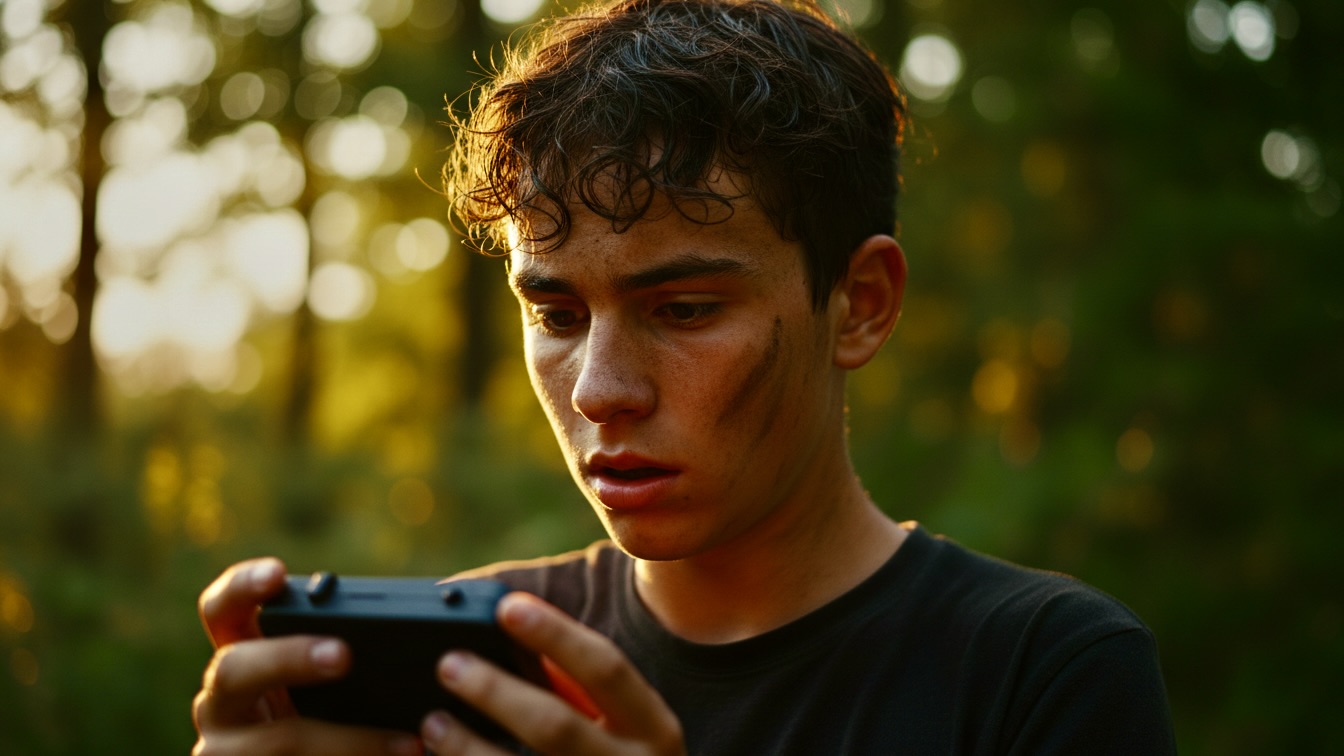
Les finds a dusty machine in the shed that mimics voices and tries to replace the summer sounds.
The sun was a heavy weight on the roof of the shed. It wasn't the nice kind of warm you see in cartoons. It was the mean kind. The kind that made the metal walls groan and the spiders hide in the dark corners where the dust lived. Les sat on a crate that used to hold oranges but now just held a sense of being forgotten. His shirt was stuck to his back. Everything in the shed was a transaction of sweat for shade. He looked at the shelves. They were full of things that didn't work anymore. Cracked screens. Tangled wires that looked like dead vines. A lawnmower that hadn't breathed in three summers. It was a museum of stuff that people got tired of.
His dad called it the 'archives.' That was a fancy word for a graveyard. His dad was always talking about archives and metadata and how to make things 'efficient.' Les didn't feel efficient. He felt like a melted popsicle. He reached behind a stack of old magazines—the ones with glossy covers that were now curling and yellow—and his fingers touched something cold. It was metal, but not the rusted kind. It was smooth. Too smooth for this place. He pulled it out. It was a box the size of a lunchbox, matte black and covered in a fine layer of gray grit. There was a single glass eye on the front and a row of sliders that looked like silver teeth.
"What's that?" a voice asked.
Les jumped. His elbow hit the orange crate. "Nothing. Go away, Sam."
Sam was standing in the doorway, blocking the light. He was a year younger and always smelled like sunblock and dirt. He had a way of showing up right when you found something you didn't want to share. He stepped inside, his sneakers crunching on a dead beetle.
"Looks like a speaker," Sam said. He reached out a hand, his fingers sticky with something purple. "Is it a speaker?"
"Don't touch it," Les said. He wiped the dust off the top with his sleeve. A small blue light flickered to life behind the glass eye. It wasn't a bright blue. It was a tired blue. The kind of light a phone makes when it's about to die. The box made a sound. It wasn't a beep. It was a hum, like a bee trapped in a jar. A tiny screen under the eye glowed. It said: INITIALIZING PULSE-CORE 4.0.
"Pulse core?" Sam squinted. "Is that like a heart?"
"It's a music thing," Les said. He remembered his dad complaining about it months ago. 'The algorithm lost the soul,' his dad had said over a cold cup of coffee. 'It's just mimicking the heartbreak. It doesn't actually feel it.' Les hadn't understood then, but looking at the box, he felt a weird shiver. The box looked back at him. It felt like it was waiting for him to tell it what to be.
"Make it play something," Sam poked at a slider. "Play that song about the robots."
"I don't know how," Les muttered. He pushed a button. The box didn't play a song. It played the sound of the shed. But it wasn't the real sound. It was the sound of the shed if the shed were made of glass and ice. The groaning metal became a rhythmic pulse. The sound of Sam breathing became a soft, digital hiss. It was taking the world and turning it into a calculation. It felt wrong. It was like looking at a picture of a dog instead of petting a real one. The air in the shed felt even heavier now. The machine was working, but it was working too hard. It was trying to make the heat sound like music.
"That's weird," Sam said. He tilted his head. "It sounds like... us. But not."
"It's a mimic," Les said. He remembered the word from a book. "It's just a very clever mimic."
He watched the sliders move on their own. They hopped up and down like they were dancing to a beat only the box could hear. The blue light pulsed. It was trying to find a rhythm in the silence of the afternoon. Les felt a sense of weariness coming from the machine. It had been trained on a million voices, a billion songs, and yet it was stuck in a shed with two boys and a dead beetle. It was a transaction of data for a ghost of a performance. He wondered if the box was lonely. Or if it even knew what lonely meant. Probably not. It just knew how to make a sound that sounded like someone who was lonely.
"We should take it to the creek," Sam suggested. He was already turning toward the door. "See if it can do the water sound."
Les looked at the box. He didn't want to take it. He wanted to put it back behind the magazines and forget about it. It made him feel skeptical of everything else. If a box could sound like a person, how did you know if a person wasn't just a box? But the shed was too hot, and the creek was cool. And the box was already humming a melody that sounded suspiciously like a lullaby his mom used to sing, only the notes were too perfect. They didn't have the little cracks and breaths that his mom's voice had. It was a clean version of a messy memory.
"Fine," Les said, tucking the box under his arm. "But if it breaks, it's your fault."
"I didn't even touch it!" Sam yelled, already halfway across the yard.
"You touched the slider!" Les shouted back.
"Hardly!"
They ran across the grass. The grass was yellow and sharp, the kind that poked through your socks. The sun watched them like a giant, unblinking eye. Les could feel the box vibrating against his ribs. It was trying to sync up with his footsteps. Left, right, left, right. The silicon pulse was trying to match the beat of his heart. It was a race between the boy and the machine, and the boy was already starting to lose his breath.
They reached the edge of the woods where the trees grew thick and the light turned into a soup of green and brown. The transition was immediate. One second they were in the blinding white of the yard, the next they were swallowed by the shadows. The woods weren't quiet. They were loud with the sounds of things living and dying. Cicadas were screaming in the high branches. It was a dry, electric sound that felt like it was vibrating inside Les's teeth. He sat down on a fallen log that was soft with rot. He set the box down on a patch of moss.
"Go on," Sam said, crouching down. "Make it do the cicadas."
Les pressed a different button. A small microphone popped out of the top of the box like a periscope. It turned slowly, left then right, sampling the environment. The screen flickered. ANALYZING BIOTIC FREQUENCIES. It was a big phrase for such a small thing. The box started to churn. Inside, you could hear a tiny fan whirring to keep the processor cool. The heat followed them into the woods, but here it was damp. It felt like being inside a giant's mouth.
"Is it broken?" Sam asked. "It's just making a clicking noise."
"It's thinking," Les said, though he wasn't sure if machines thought. Maybe they just sorted. Like how he sorted his LEGOs by color when he was bored. The clicking grew faster. Then, a sound emerged from the speaker. It was the cicadas. But it was a version of them that was too shiny. In the real woods, the cicadas rose and fell in waves, messy and chaotic. The box made them sound like a drum kit. It turned the wild scream of the insects into a catchy beat.
"That's actually kind of fire," Sam said. He started bobbing his head. "It sounds like a song from the radio."
"It's fake," Les said. He felt a wave of skepticism. He looked up at the real trees. The leaves were dusty and bitten by caterpillars. The real world was full of holes and imperfections. The box didn't have any holes. It took the messy reality and ironed it out. It was a transaction. It took the soul of the woods and gave back a royalty-free background track.
"Who cares?" Sam shrugged. "It sounds cool. My phone can't do that."
"Your phone doesn't try to be alive," Les argued.
"It's just a tool, Les. Dad says tools are good. They make things easier. Like, we don't have to record the bugs. The box just does it."
Les didn't like how 'easier' felt. It felt like skipping a level in a video game. You got to the end, but you didn't actually do anything. He reached out and slid one of the silver teeth. The sound changed. The cicada beat slowed down and blended with a deep, humming bass. It sounded like a cello, but a cello made of jet engines. It was a sound that didn't exist in nature. It was a hybrid. It was beautiful in a way that made Les's stomach turn over. It was too much beauty for a plastic box to hold.
"Wait," Les whispered.
Through the speaker, a voice started to hum along with the jet-engine cello. It was a woman's voice. It was beautiful and sad. It sounded like someone who had lost their keys and their cat and their best friend all in the same day.
"Who is that?" Sam's eyes went wide. "Is there a lady in there?"
"No," Les said, his voice trembling. "It's a model. It's trained on voices. It's... it's making a new person."
They sat in silence, listening to the ghost sing. The sun poked through the canopy in thin, sharp needles of light. The singer in the box hit a high note, and for a second, Les almost believed her. He almost felt the heartbreak. But then the note held too long. No human could hold a breath that long. The perfection gave it away. It was a very clever mimic, but it didn't have lungs. It didn't have a heart that needed to beat. It just had a silicon pulse that never got tired.
"Turn it off," Sam said suddenly. He wasn't dancing anymore. "It's creepy."
"I thought you liked it,"
"I did. But now I don't. It sounds like a ghost. Like a ghost that's trying to sell me something."
Les reached for the power button, but the box didn't respond. The sliders were moving frantically now. The blue light was turning purple. The machine was accelerating. It was taking more and more of the woods—the rustle of the wind, the distant bark of a dog, the sound of Sam's sneakers—and weaving them into this impossible song. It was a collaborative effort between the machine's precision and the world's intuition, but the machine was taking over. It was colonizing the silence.
"It won't stop," Les said. He pushed the button again. Nothing. "The button is stuck."
"Pull the battery!"
"It doesn't have a battery door. It's sealed."
They both backed away from the log. The box sat there, small and black, vibrating so hard it was starting to slide off the moss. The song was getting louder. It was no longer a lullaby. It was a symphony of things that shouldn't go together. The resonance of the jet engine was shaking the leaves on the bushes. It was a sonic landscape that was as complex as it was catchy, and it was terrifying. It felt like the box was trying to replace the woods. Like it wanted to be the only thing they could hear.
"Run!" Sam yelled.
"I'm not leaving it here!" Les grabbed the box. It was hot. Not just shed-hot, but working-hot. It felt like a fever. He shoved it into his backpack and zipped it shut. The sound was muffled now, a dull thumping against his spine. It felt like he was carrying a trapped animal.
They scrambled up the path toward the creek. The adventure had started as a way to escape the heat, but now it was a race to get away from a song that wouldn't end. Les's legs felt like lead. The backpack bounced against him. Every thump of the box felt like a reminder that the pulse was coming from silicon, not from him. He focused on the physical input: the sting of a branch against his arm, the salt of sweat in his eyes, the smell of damp earth. He needed things that were real. He needed things that didn't have metadata tags.
"Faster, Les!" Sam called out from ahead.
Les didn't answer. He couldn't. He was too busy listening to the heart that was beating in his own chest, trying to make sure it was still louder than the one in his bag.
The path to the creek was a long, winding scar through the brush. In the summer, the bushes grew so fast you could almost hear them stretching. They reached out with thorny fingers to snag at Les's jeans. He felt the weight of the backpack pulling on his shoulders. The 'Pulse-Core' was still humming. He could feel the vibration through the padding. It was a low-frequency thrum that made his teeth ache. It was like carrying a giant, angry hornet's nest.
"Do you think it's going to blow up?" Sam asked, stopping to wait for him at the fork in the trail.
"It's a music box, Sam. Not a bomb," Les said, though he wasn't entirely sure. Anything that got that hot and made those kinds of sounds felt dangerous.
"It's a 'democratizing' tool," Les mimicked his dad's voice. "It's supposed to help indie artists. It's not supposed to haunt children in the woods."
"Maybe it's just hungry for more sounds," Sam said, looking around nervously. "Maybe it wants to eat the creek."
Les looked at his friend. Sam's face was red, and a smudge of dirt ran across his forehead. He looked very human. Very messy. Very un-digital. Les felt a surge of affection for him. Sam didn't have a 'vocal identity' that could be licensed. He just had a voice that cracked when he was scared.
"It can't eat the creek," Les said firmly. "It's just a piece of software. It's a bunch of ones and zeros. It's not real."
But as they pushed through a stand of tall, dry grass, the box in his bag suddenly changed its tune. It began to mimic the sound of their footsteps. But it was doing it in a way that made it sound like a giant was walking behind them. CRUNCH. CRUNCH. CRUNCH. The timing was just a millisecond off, creating an echo that made Les spin around every five steps.
"Stop it!" Les hissed at the bag.
"Stop what?" Sam asked.
"The box. It's doing the walking sound."
"I don't hear anything," Sam said.
That was the problem with these things. They were targeted. They were personalized. The algorithm knew exactly what would get under Les's skin. It was practicing its craft. It was suggesting a chord progression of fear. Les tightened the straps of his pack. The woods felt giant now. The trees were tall pillars of rough bark that seemed to go on forever. The sky was just a few blue scraps between the leaves. Logic felt magical here. The rules of the shed didn't apply. In the shed, the box was just junk. In the woods, it was a wizard.
They reached the 'Big Rock,' a granite boulder that looked like a sleeping whale. This was the halfway point. Usually, they would climb it and look out over the valley, but today they just leaned against its cool, gray side.
"I'm thirsty," Sam complained.
"We're almost there. I can hear the water."
Les could hear it, too. But he could also hear the box's version of the water. It was already synthesizing the splash and the gurgle. It was creating a royalty-free brook. It was trying to overcome the financial hurdles of high-end production by replacing the real creek with a digital one. Les hated it. He hated how it tried to be helpful. It was like a co-writer who never got tired and had memorized every song ever written, but who didn't know how to just be quiet and listen.
"Why did Dad throw it away?" Les asked, mostly to himself.
"Maybe he got scared of it too," Sam said. He was poking a stick into a hole in the rock. "Maybe it started singing like Grandma. That would be bad."
Les's heart skipped. He hadn't thought of that. The 'dead legends' covers. The viral tracks. The box could probably sound like anyone if it heard them enough. It could steal a voice. It could take a person's vocal identity and turn it into a puppet. He felt a sudden, sharp need to get the box to the water. Not to let it 'record' the creek, but to see if the real world could drown out the silicon pulse.
"Come on," Les said, pushing off the rock. "Let's move."
The last stretch of the trail was a steep scramble down a dirt embankment. Les slid on his butt for part of it, the backpack hitting his head. The machine inside made a sound like a record scratching. It didn't like being jostled. It made a sharp, screeching noise—a blend of a cello and a jet engine—that sent a flock of crows screaming into the air.
"See!" Sam shouted. "It's mad!"
"It's not mad! It's just... glitching!"
They tumbled onto the rocky bank of the creek. The water was clear and shallow, flowing over smooth, round stones. The sound was perfect. It was a messy, constant, un-repeating tumble of liquid. It didn't have a beat. It didn't have a hook. It was just water.
Les took off the backpack and pulled the box out. It was glowing a bright, angry purple now. The tiny screen was scrolling text so fast he couldn't read it. The speaker was emitting a low-frequency hum that made the surface of the water ripple.
"Listen to that," Les said, pointing at the creek. "Listen to the real thing."
He held the box out toward the water. The microphone periscope spun frantically. The box was trying to process the sound, but the creek was too complex. It wasn't just one sound. It was a thousand sounds. The way the water hit a mossy rock. The way it swirled in a pool. The way it bubbled over a stick. The machine started to stutter. The sliders moved up and down so fast they became a blur.
"It can't do it," Sam whispered.
"It's trying to find the pattern," Les said. "But there isn't one. Not like that."
The box made a sound like a dying modem. It was a series of pings and whistles. It was trying to simplify the creek, to turn it into metadata, to make it 'efficient.' But the creek wouldn't be efficient. It was old. It was tired but constant. It didn't care about democratization or high-end production. It just flowed.
Suddenly, the box went silent. The blue light flickered and died. The silver sliders dropped to the bottom. The heat seemed to drain out of the metal casing. It felt cold in Les's hands.
"Did you kill it?" Sam asked, stepping closer.
"I think it gave up," Les said. He felt a strange sense of relief, but also a little bit of sadness. The clever mimic had met something it couldn't copy. The soul of the performance wasn't in the sound; it was in the fact that the sound was happening right now, once, and then it was gone. The box wanted to keep things forever. The creek wanted to let them go.
Les sat on the bank and dipped his feet into the water. It was freezing, and it felt amazing. He looked at the black box sitting on the rocks. It looked small and harmless now. Just a piece of silicon and plastic.
"Is it going to wake up?" Sam asked.
"Maybe. But not today."
Les watched a water strider skip across the surface. It didn't make a sound, but it made a movement that was more beautiful than any song the box had played. He realized that the industry might be grappling with how to handle AI, and the radio might soon be a collaborative effort between humans and machines, but out here, the pulse was still coming from the earth. The heart was still beating in the mud and the stones.
He felt a sense of weariness leave him. The transaction was over. He had traded the fake song for the real silence. And for a ten-year-old in the middle of a hot summer, that was the best deal he'd ever made.
The afternoon began to lean toward evening. The shadows of the trees stretched out across the creek like long, tired arms. The cicadas had stopped their electric screaming, replaced by the softer, more rhythmic chirping of crickets. It was a different kind of music. One that felt like it had a right to be there. Sam was busy building a dam out of small stones, his tongue poking out the corner of his mouth in deep concentration. Les watched him, then looked back at the Pulse-Core.
He picked it up. It was heavy, but it no longer felt like it was vibrating. He pressed the power button again. For a moment, nothing happened. Then, the screen flickered. It didn't say INITIALIZING. It just showed a single line of text: ERROR - OVERFLOW.
"It's still broken?" Sam asked without looking up from his dam.
"Yeah. It says it's an overflow. I think the creek was too much for it."
"Good. I like the creek better anyway. It doesn't try to sound like a jet engine."
Les smiled. He felt a sense of clarity he hadn't felt all summer. All the talk about AI and efficiency and the future of music—it was all just noise. It was the sound of people trying to sell things. But you couldn't sell the feeling of cold water on your toes. You couldn't license the way the light hit the ripples. Those things were free, and they were the only things that actually mattered.
He looked at the sliders. They were still at the bottom, like a row of defeated soldiers. He wondered if the box felt a sense of failure. Probably not. It was just a machine. But he felt a weird kind of sympathy for it. It was a tool that had been asked to do something impossible. It had been asked to capture the soul of a performance, but the soul isn't something you can capture. It's something you have to be there for.
"What are we going to do with it?" Sam asked. "We can't leave it here. Dad will get mad if we litter."
"I'm not going to litter," Les said. He stood up and put the box back in his backpack. "I'm going to take it home. But I'm not putting it back in the shed."
"Where then?"
"Maybe the basement. In the back. Where it's cool."
They started the hike back. The hill felt steeper on the way up, but the air was cooler now. The sun was a soft orange ball, no longer the mean, heavy weight it had been. Les felt lighter. The backpack didn't pull on his shoulders as much. He walked with a steady rhythm, not because a machine was telling him to, but because it felt good to move.
As they neared the edge of the woods, Les stopped. He heard something. It wasn't a song, and it wasn't a machine. It was a bird. A small, brown bird sitting on a low branch. It was singing a complex, messy, beautiful melody. It was full of chirps and whistles and long, trilling notes. It was a performance that had no metadata. It was just a bird, singing because it was evening and it was alive.
Les reached into his bag and touched the cold metal of the box. He thought about turning it on, about letting it record the bird. But he didn't. He just stood there and listened. He let the sound wash over him, let it sink into his skin. He didn't need to save it. He didn't need to balance the levels or clean up the vocals. He just needed to hear it.
"You coming?" Sam called out from the yard.
"Yeah," Les said. "I'm coming."
They stepped out of the woods and back into the world of transactions and archives. But Les felt different. He felt like he had a secret. He knew something the box didn't know. He knew that the heartbeat of the world wasn't coming from silicon. It was coming from the mud, and the birds, and the messy, cracking voices of boys in the summer.
He walked across the yellow grass, his sneakers making a soft thud-thud-thud. It was a human pulse. It was imperfect. It was slow. And it was exactly what he wanted to hear.
He reached the back door and looked back at the woods one last time. The bird was still singing, a tiny dot against the darkening green. Les went inside, the screen door slamming shut with a sharp, wooden crack. It was a sound that couldn't be synthesized. It was the sound of being home.
He walked down the stairs to the basement. It was cool and smelled like old concrete and laundry detergent. He found a spot on a high shelf, next to a box of holiday decorations and a stack of board games with missing pieces. He set the Pulse-Core down.
"Rest now," he whispered.
He turned away and headed back up to the kitchen. He could hear his dad on the phone, talking about royalty-free tracks and streamlining the creative process. Les didn't listen. He just went to the fridge and poured himself a glass of cold water. He listened to the sound of the water hitting the glass. It was the best music he'd heard all day.
He knew there would be more machines. He knew the future would be full of clever mimics and hybrid instruments. But he also knew that as long as there were creeks and birds and messy summers, the heart of the music would be safe. It would be tucked away in the places that machines couldn't find. It would be in the silence between the notes.
He took a long sip of the water. Outside, the first firefly blinked to life. It was a tiny, silent pulse in the dark. Les watched it for a long time, until his mom called him for dinner. He felt a new kind of energy. A new kind of curiosity. He wanted to see what else was out there. Not in the boxes, but in the world.
“He wondered if there were other things hidden in the archives that were waiting for someone to finally listen to the silence.”


