A malfunctioning border drone mistakes a mother bear for a smuggler in the heat of a locked-down summer.
Klaus sat behind the counter of his outfitting shop. The air was thick and heavy. It was the kind of heat that made you feel like you were wearing a wet wool blanket. Outside, the sun beat down on Iron Lake. The water looked like a sheet of hot lead. Nothing moved. Even the flies seemed too tired to buzz. Klaus looked at his ledger. The pages were mostly blank. There were no tourists this summer. There were no fishermen. The border was a wall of invisible signals and angry politicians. Trade wars had turned the north into a giant cage. "Business is not merely slow," Klaus said to the empty room. "It is deceased. It has joined the choir invisible." He picked up a rag and wiped the glass of a display case. Inside were expensive lures that nobody would ever buy. The hooks were shiny and sharp. They looked like tiny, cruel smiles. Klaus felt a deep weariness in his bones. He was sixty, but today he felt like a hundred. Every transaction in his life had led to this silence.
High above the trees, a faint hum disturbed the air. It was a sound Klaus had grown to hate. It was the sound of a Sentinel. The drones were white and sleek. They looked like flying eggs with cameras for eyes. They belonged to the border patrol. They were looking for smugglers. They were looking for people tapping into the energy pipelines that ran like veins under the earth. "You are a very loud bird," Klaus muttered. He stepped out onto the porch. The wood groaned under his boots. The paint was peeling in long, dry strips. The hum grew louder. He looked up and saw the white speck against the blue sky. It moved with a jerky, robotic grace. It was watching. It was always watching. The drone didn't care about the heat. It didn't care about the quiet. It only cared about its programming. To the drone, the forest was just a map of targets and threats. Klaus felt small under its mechanical gaze. The world felt tiny when you realized everything was being recorded by a machine in the clouds.
Then the sky changed. It wasn't a normal summer storm. The air started to taste like metal. Klaus felt the hair on his arms stand up. A strange, deep blue color washed over the clouds. It looked like ink spilled in a bucket of water. "The atmosphere is becoming quite agitated," Klaus remarked. He held onto the porch railing. The metal felt hot, then suddenly cold. Then came the lightning. It wasn't yellow or white. It was a bright, shocking blue. It didn't crackle. It hummed. The blue bolts arched across the sky like crooked fingers. One bolt hit the Sentinel. There was a sound like a giant tearing a sheet of metal. The drone sparked. It spun in a wild circle. It looked like a wounded toy. It trailed a thin line of black smoke as it dipped toward the trees. Klaus watched it fall. It disappeared into the thick green of the boreal forest. A second later, a muffled thud echoed across the lake. The hum was gone. The silence that followed was even heavier than before.
Klaus didn't move for a long time. He just stood there, breathing in the smell of scorched air. He knew that drone was expensive. He also knew it was dangerous. A crashed machine was a problem. If the border patrol thought someone had shot it down, they would send more. They would send soldiers. They would send trouble. Klaus went back inside and grabbed his heavy canvas jacket. He didn't need it for the heat, but the forest was full of thorns and thick brush. He took his radio and a large wrench. "I shall investigate this mechanical tragedy," he told himself. He walked down the steps and toward the tree line. The ground was soft and spongy. The moss felt like walking on a giant loaf of bread. He could hear the cicadas screaming in the trees. It was a loud, vibrating noise that filled his head. He pushed through the first layer of pine branches. The needles scratched at his face. The forest was dark and crowded. It felt like the trees were leaning in to listen to his footsteps.
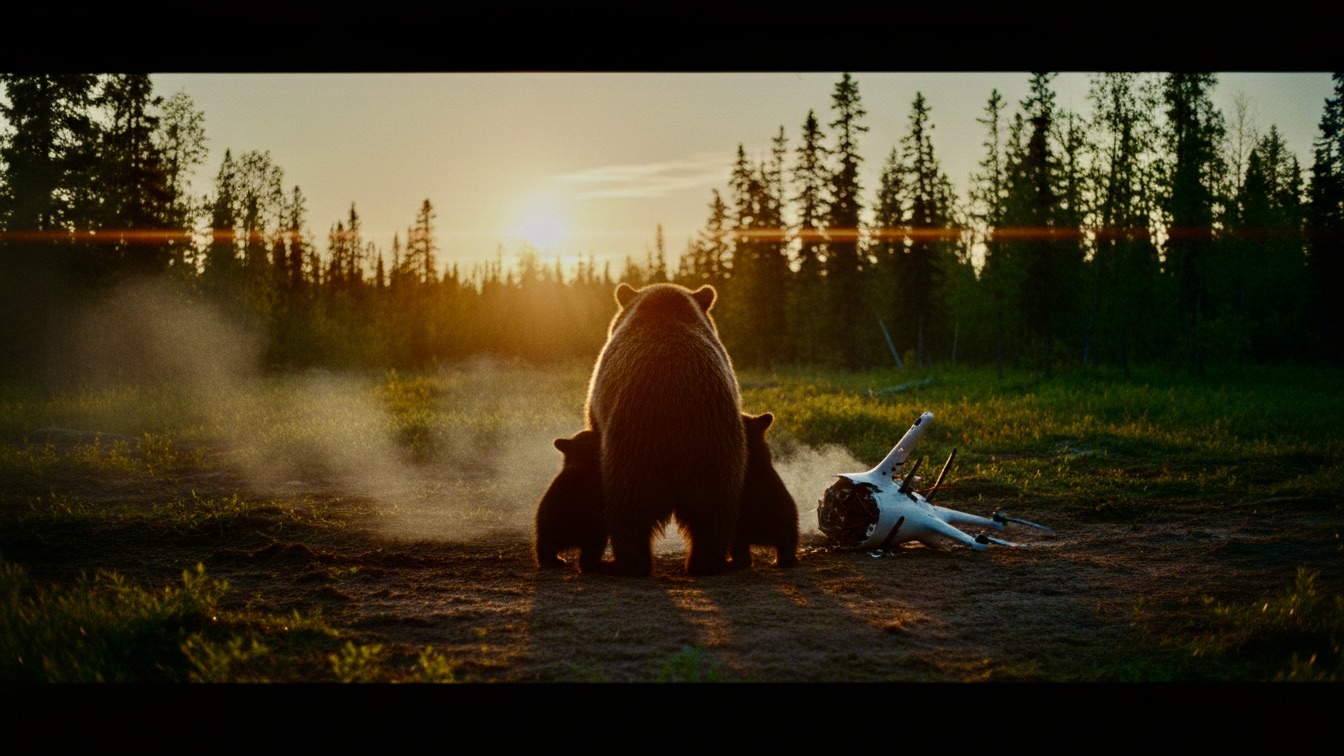
He walked for nearly an hour. The heat made his shirt stick to his back. He followed the smell of burning plastic. It was a sharp, chemical scent that didn't belong in the woods. It made his nose twitch. Finally, he reached a clearing. The drone had carved a path through the saplings. It lay in a heap of broken white plastic and tangled wires. It was still smoking. One of its camera lenses was cracked. It looked like a dead eye. But then, a small red light began to blink on its side. It made a clicking sound. Click. Click. Click. Klaus slowed down. He saw movement on the other side of the wreckage. A large, dark shape was sniffing the smoke. It was a sow bear. She was massive. Her fur was thick and dusty. Behind her, two small cubs were playing with a piece of the drone's broken wing. "Oh, this is a most unfortunate gathering," Klaus whispered. He froze. The bear didn't see him yet. She was curious. She nudged the drone with her nose. The machine clicked again, louder this time. The red light turned into a steady, angry glow.
Klaus felt a cold shiver despite the heat. The drone wasn't dead. Its AI was rebooting. He could hear the sound of a cooling fan spinning up. It sounded like a tiny jet engine. The drone's cracked lens turned toward the bear. A small speaker on the machine crackled. "Identify yourself," a flat, digital voice said. The bear growled. She didn't like the sound. She didn't like the smell. She stood up on her hind legs. She looked like a mountain of fur and muscle. The drone's sensors flared. A screen on its side flashed a warning in bright red letters: BIOLOGICAL HAZARD DETECTED. TARGET ACQUIRED. Klaus realized the machine's brain was broken. The blue lightning had fried its logic. It didn't see a bear. It saw a threat. It saw a smuggler. It saw something it was programmed to destroy. "Madam Bear, I strongly suggest you depart," Klaus said, his voice trembling slightly. But the bear didn't leave. She was protecting her cubs. And the drone was preparing to fight. The forest felt very small now. It was just Klaus, the bear, and a broken robot in the middle of a hot summer afternoon.
The sow bear let out a low, vibrating huff. It was a sound that traveled through the ground and into Klaus’s boots. She didn't understand the white box, but she understood the threat. Her cubs sensed her tension and scurried behind her, their small black noses twitching. The drone continued its mechanical reset. Its internal gyroscopes whirred, trying to level the chassis against the uneven mud of the swamp. "Your presence is unauthorized," the drone stated. The voice was distorted, sounding like it was underwater. Klaus stayed perfectly still. He knew that any sudden movement would draw the machine's attention. He watched as the drone’s secondary sensor array—a row of glowing orange dots—began to sweep the area. It was scanning for thermal signatures. It was building a tactical map of the clearing. To this machine, the beautiful, ancient forest was just a series of data points and potential obstacles.
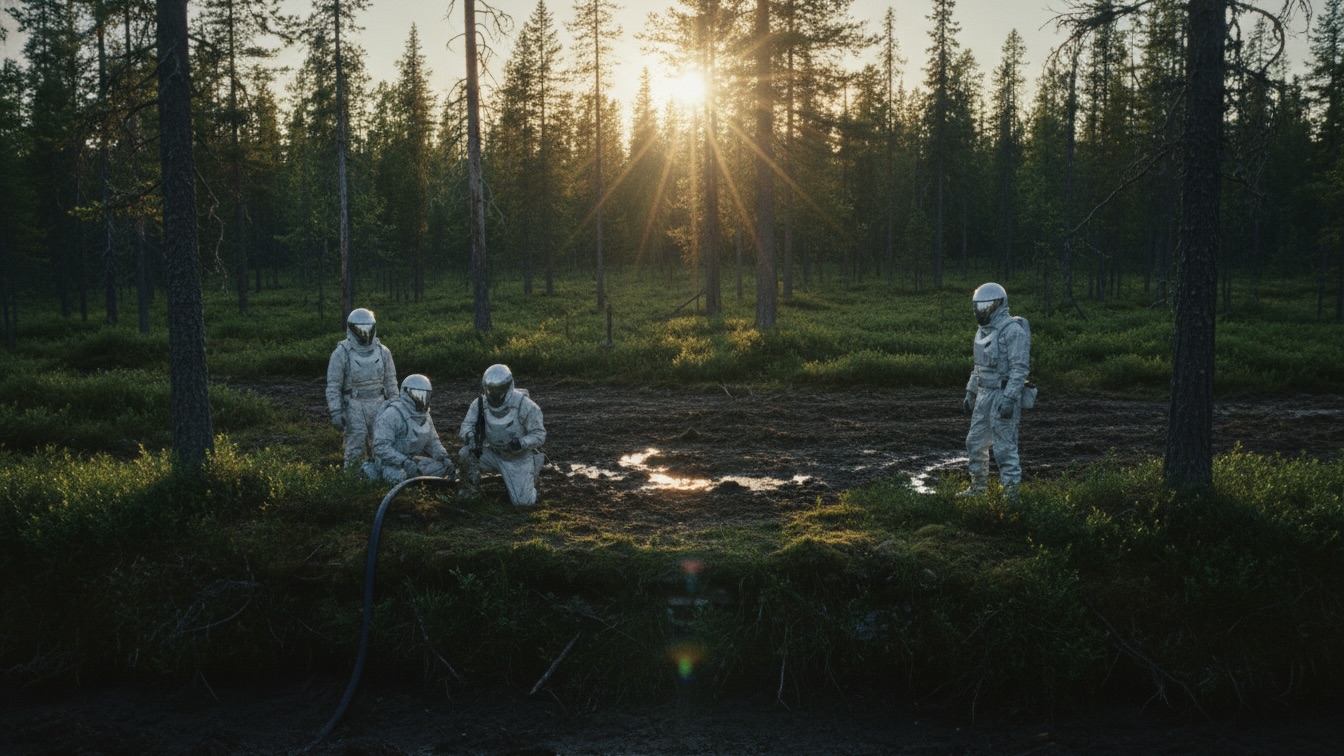
From the thicket behind Klaus, the sound of a sputtering engine broke the tension. A quad bike, its plastic fenders held together by duct tape and hope, burst into the clearing. The rider was a woman in a faded green uniform. She wore a wide-brimmed hat and a look of deep, professional annoyance. This was Sarah-Jane, the conservation officer for the district. She pulled the quad to a halt and killed the engine. The silence that followed was brief. "Klaus," she said, her voice a theatrical rasp. "I might have known I would find you at the center of this technological disaster. Salutations to you in this wretched humidity." She didn't look at Klaus. Her eyes were fixed on the drone. She climbed off the quad, her joints popping. She carried a long, matte-black dart gun over her shoulder. "This machinery is quite bothersome," Klaus replied. "It has decided that our friend the bear is a high-value energy smuggler. The logic circuits are profoundly confused."
Sarah-Jane spat on the ground. "It’s cheap spyware from the Valley. They build these things in air-conditioned labs and then expect them to survive a northern summer. It’s literal trash, Klaus. It’s a glorified delivery bot with a bad attitude." She stepped closer, her boots squelching in the mud. The drone's lens swiveled toward her. "Warning," the machine chirped. "Interference with enforcement assets is a federal offense. Please vacate the perimeter." Sarah-Jane ignored it. She looked at the sow, who was now pawing at the ground, tearing up clumps of moss and earth. "She’s going to charge that thing," Sarah-Jane whispered. "And when she does, that bucket of bolts is going to defend itself. We need to move the cubs, but she won't budge while that light is blinking. It’s poking at her brain. These Sentinels emit a low-frequency hum that animals can’t stand. It’s like a needle in the ear."
Klaus looked at the drone. He could see the heat shimmering off its casing. The blue lightning had left scorch marks that looked like spider webs across the white plastic. "Can you not simply deactivate it with your official codes?" Klaus asked. Sarah-Jane laughed, a dry, cynical sound. "My codes? The border patrol doesn't share their toys with the likes of me. I’m just the person who has to clean up the mess when their ‘smart’ tech kills a moose. This thing is on a closed loop now. It’s disconnected from the main grid, which means it’s running on its most basic, aggressive instincts. It’s in 'Enforcement Mode.' That means it sees the whole world as a crime scene." She adjusted her hat. The sun was directly overhead now, baking the clearing. The smell of the swamp—decaying leaves and stagnant water—was thick and cloying. It felt like the forest was holding its breath.
Suddenly, the drone changed its tone. The clicking stopped. A high-pitched, warbling pulse began to radiate from its underbelly. It was so sharp that Klaus felt his teeth ache. The sow bear reacted instantly. She let out a roar that shook the remaining leaves on the trees. She began to spin in circles, snapping at the air. Her eyes were wide and clouded with panic. She wasn't just angry; she was being tortured by the sound. She swung a massive paw, narrowly missing one of her cubs. "The machine is inducing a frenzy!" Klaus shouted over the noise. "It is a biological weapon now!" Sarah-Jane raised her dart gun. "I have to sedate her before she hurts the little ones. If she stays in this state, she’ll exhaust her heart in this heat. But the drone... if I fire, it might see it as an attack."
Klaus watched the drone. He saw a small panel slide open on its top. A tiny antenna extended, pointing straight up at the sky. A green light began to flash at the tip. "Sarah-Jane!" Klaus yelled. "Look at the uplink! It is calling for assistance!" Sarah-Jane’s face went pale. She knew what that meant. In the current trade war, 'assistance' didn't mean a repair crew. It meant a kinetic strike—a high-speed projectile dropped from a satellite to 'neutralize' a compromised asset and its 'hostiles.' The drone had tagged the bear as the hostile. "We have maybe ten minutes," Sarah-Jane said, her theatrical tone replaced by a grim, hard edge. "Maybe less. If we don't shut that thing down, this entire clearing is going to become a hole in the ground. And the bear will be the first thing to go. This is the world we live in, Klaus. A graveyard of toys and we’re the ones buried in it."
The high-frequency pulse grew louder, a piercing shriek that seemed to vibrate the very marrow of Klaus’s bones. The sow bear was now in a full-blown panic. She crashed through the thicket, her heavy body snapping saplings as if they were toothpicks. Her cubs were huddled under a fallen log, their small whimpers lost in the mechanical din. Sarah-Jane moved with a desperate, practiced grace. She knelt in the muck, the mud soaking through her trousers. She aimed the dart gun at the sow’s massive shoulder. "I must be precise," she muttered. "If I miss, the drone will categorize me as an active combatant. My life is already a series of poor choices; I should prefer not to end it as a target for a satellite."
Klaus watched the drone. It was hovering now, just a few inches off the ground, its broken landing gear scraping against the rocks. It looked like a giant, angry insect. "The machine is scanning your weapon!" Klaus warned. He saw the drone's lens zoom in on Sarah-Jane. A small red laser dot appeared on her chest. The machine was calculating. It was deciding if she was a friend or a foe. In its current, glitched state, there were no friends. Sarah-Jane pulled the trigger. The dart hissed through the air and buried itself in the sow’s flank. The bear roared, a sound of pure, primal confusion. But the drone reacted faster. It interpreted the dart as a projectile attack. A small hatch on its side popped open, and a pressurized canister fired. A thick, electrified stun-net expanded in the air, drifting toward Sarah-Jane.
"Move!" Klaus screamed. He lunged forward, grabbing Sarah-Jane by the collar of her uniform and pulling her behind the quad bike. The net hit the metal frame of the vehicle with a loud thwack. Blue sparks danced across the handlebars. The smell of ozone filled the air, sharp and stinging. Sarah-Jane gasped, her eyes wide. "That thing just tried to net me!" she shouted. "It’s literally trying to arrest me for doing my job!" Klaus looked over the seat of the quad. The drone was recalibrating. Its antenna was still pulsing green. The kinetic strike was getting closer. He could almost feel the weight of the satellite hovering miles above them, its cold, mechanical eye locked onto their coordinates.
"We must disable the power source," Klaus said. He felt a strange surge of energy. His weariness was gone, replaced by a sharp, cold focus. "The battery pack is located on the underside, near the cooling intake. If I can reach it, I can pull the emergency release." Sarah-Jane looked at him like he was insane. "Klaus, the ground is a swamp of muskeg and half-melted ice from the permafrost. You’ll be stuck in the mud. The drone will see you coming a mile away. It has three-hundred-and-sixty-degree vision." Klaus gripped his heavy wrench. "It is distracted by the bear. And it will be distracted by you. You have flares in your emergency kit, do you not? Use them. Create a spectacle. Be as theatrical as you have ever been."
Sarah-Jane grinned, though it was a worried expression. "A spectacle? Klaus, you are asking me to perform for a robot. Very well. I shall give it a show it will never forget." She reached into the back of the quad and pulled out two magnesium flares. She struck them both at once. Brilliant, blinding red light erupted in the clearing. The smoke was thick and acrid. She began to dance around the quad, waving the flares in wide arcs. "Look at me, you overpriced toaster!" she yelled. "I am the violation of your perimeter! I am the hazard!" The drone’s head-unit spun toward her. Its sensors were overwhelmed by the intense heat and light of the flares. It began to stutter, its digital voice repeating the word "Error" over and over again.
Klaus didn't wait. He dropped to his belly. The mud was cold and slimy. It felt like a thousand tiny insects were crawling over his skin. He began to crawl toward the drone. The muskeg was thick, and he had to pull himself forward using the roots of the trees. Every inch was a struggle. He could feel the weight of the mud trying to pull him down. Above him, the drone hissed and whirred, its sensors blinded by Sarah-Jane’s flares. The sow bear had finally slumped to the ground, the sedative taking hold. She lay near her cubs, her breathing heavy and ragged. Klaus reached the edge of the drone’s chassis. He could see the internal components glowing with a faint, sickly light. He reached up, his fingers slick with mud, and found the latch for the battery compartment. It was hot—so hot it scorched his skin. He didn't let go. He couldn't. The green light on the antenna was now a solid, unblinking glare. The strike was authorized. The countdown had begun.
Klaus’s fingers burned as he fumbled with the metal latch. The heat from the drone’s malfunctioning core was intense, like sticking his hand into a toaster. He could hear the machine’s internal clock ticking—a fast, electronic rhythm that signaled the end. "Come on, you piece of junk," he grunted. His voice was thick with effort. He jammed the tip of his heavy wrench into the seam of the battery door and pried. The plastic groaned and then snapped. A shower of sparks rained down on his arms, stinging like hornets. He saw the main power cell—a heavy, glowing brick of cobalt and lithium. It hummed with a dangerous, unstable energy.
Above him, the drone began to rise. Its fans kicked up a cloud of stinking swamp mud, coating Klaus in a layer of brown filth. It was trying to gain altitude, perhaps to get a better clear-line for the satellite's impact. Klaus didn't think. He reached into the guts of the machine and grabbed the battery pack. He twisted it with all his strength. The wires screamed as they were torn from their sockets. For a second, the drone’s red eye flared brighter than the sun. Its speaker let out one final, distorted shriek: "System... failure..." And then, everything went dark. The hum died. The fans slowed to a stop. The drone fell, its heavy weight pinning Klaus’s arm into the soft mud. The green light on the antenna flickered once and extinguished. The clearing fell into a sudden, shocking silence.
Klaus lay there for a moment, his chest heaving. He could feel the cold mud seeping into his sleeves. He looked up through the branches. The blue sky was clear again. The strange blue lightning was gone, replaced by the pale, hazy light of a late summer afternoon. There was no kinetic strike. No explosion. Just the sound of the wind moving through the pine needles. Sarah-Jane ran over, her flares spent and smoking in the mud. She helped him pull his arm free from under the dead machine. "You did it, Klaus," she said, her voice unusually soft. "You actually killed the monster with a wrench. That was... remarkably dramatic."
Klaus sat up and wiped the mud from his face. He looked at the sow bear. She was still asleep, her giant chest rising and falling in a steady rhythm. The cubs had crept out from under the log and were now sniffing their mother’s fur, their fear replaced by a quiet curiosity. "She will be fine," Sarah-Jane said, checking the bear's pulse with a gloved hand. "The sedative will wear off by morning. She’ll wake up with a headache, but she’ll have her cubs. And this thing..." She kicked the side of the dead drone. It made a hollow, plastic sound. "This thing is just trash now. It’s a heap of broken parts in the middle of nowhere."
They spent the next few hours dragging the heavy wreckage toward a nearby hunting blind—a small, weathered shack built of cedar planks. They didn't want the border patrol to find the crash site too easily. It would buy the bear time to move her family deeper into the forest. By the time they finished, the sun was setting. The sky turned a deep, dusty orange. The heat finally began to break, replaced by a cool breeze that smelled of damp earth and pine. They sat on the floor of the blind, watching the clearing through the small viewing slits. Klaus leaned his head against the wooden wall. He felt empty, but it was a good kind of empty. The transaction was complete. He had traded his safety for the life of the bear.
"The border is a strange place, Sarah-Jane," Klaus said. He looked at his scorched hands. "We build these walls of signal and light, and we fill the sky with eyes. We think we are in control. But the forest doesn't care about our trade wars. It doesn't care about our energy. It just wants to breathe." Sarah-Jane nodded. She was cleaning her dart gun with a piece of old flannel. "It’s a graveyard of toys, Klaus. Every year they send more. Better cameras, faster drones, smarter AI. And every year, the forest breaks them. The winter freezes their joints, and the summer melts their brains. We’re just the caretakers of the junk."
As the stars began to poke through the darkening sky, the sow bear stirred. She lifted her head, sniffed the air, and let out a long, tired yawn. She looked at the spot where the white machine had been, then turned toward her cubs. With a slow, deliberate movement, she stood up and began to walk. She didn't look back. She led her cubs into the shadows of the tall pines, disappearing into the vast, dark green of the north. Klaus watched them go until he could no longer see the sway of the branches. He felt the weight of the summer night settle over him. The world was giant again. It was wide and mysterious and old. And for now, it was quiet.
“He looked at the dead machine and wondered how many more would fall before the forest finally won.”