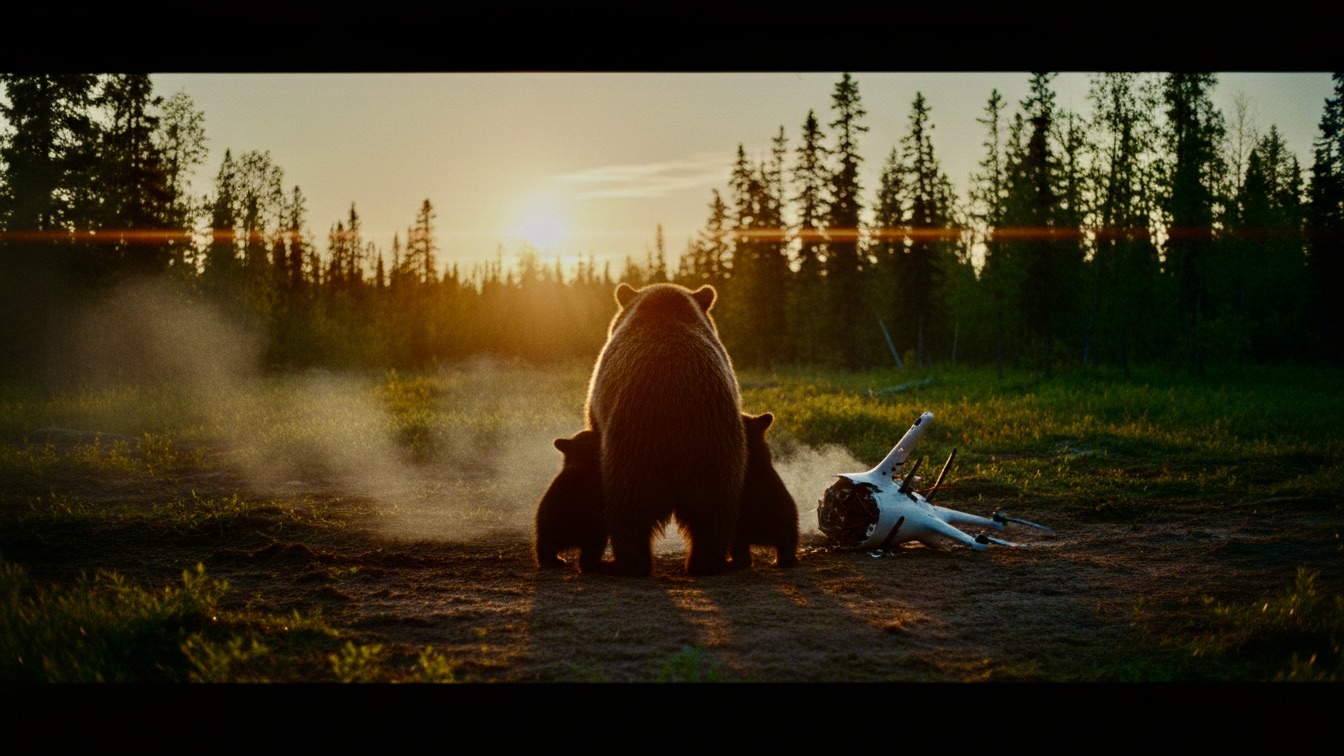
The narrative begins in the sweltering, stagnant atmosphere of Klaus’s failing outfitting shop, located near the heavily monitored border of Iron Lake. The economic isolation brought about by trade wars has left Klaus in a state of existential weariness, watching the world through the lens of a "giant cage" where even the drones are more active than the tourists. This quietude is shattered when a Sentinel drone, a tool of the border patrol, is struck by anomalous blue lightning and crashes into the boreal forest. Klaus follows the smoke into the woods, driven by a mix of curiosity and a sense of duty toward the land he inhabits.
Upon reaching the crash site, Klaus discovers a sow bear and her cubs interacting with the damaged, malfunctioning machine. The drone’s logic circuits are fried, leading it to misidentify the bear as a biological hazard and a smuggler, escalating the situation into a deadly confrontation. Sarah-Jane, a cynical and theatrical conservation officer, arrives on the scene to find the drone preparing to call in a kinetic satellite strike on the area. The two humans must coordinate a desperate plan to distract the machine and manually disable its power source.
In the climax of the story, Klaus crawls through the freezing muskeg while Sarah-Jane uses flares to overwhelm the drone’s sensors. He successfully pries the battery from the machine just as it reaches the final stages of its lethal countdown. The threat of the satellite strike vanishes, and the drone becomes a hollow shell of plastic and cobalt. As the sedative Sarah-Jane administered to the bear takes hold and then eventually fades, the animal family retreats into the safety of the pines. Klaus and Sarah-Jane are left to reflect on the futility of the high-tech border in a landscape that eventually breaks all man-made things.
The central theme of the story is the inherent conflict between technological surveillance and the indomitable, chaotic reality of nature. The drone represents a "mechanical gaze" that seeks to categorize the forest into data points, targets, and threats, stripping the landscape of its intrinsic mystery. This digital logic is shown to be fragile, as a single atmospheric event renders the machine’s sophisticated AI into a senseless, aggressive predator. The story suggests that when technology fails, it does not merely stop working; it becomes a distorted version of human intent that threatens the very environment it was meant to monitor.
Another prominent theme is the "Graveyard of Toys," an idea introduced by Sarah-Jane to describe the inevitable decay of human artifice in the northern wilderness. The forest is depicted as a digestive system for the state's failed experiments, where the winter freezes joints and the summer melts processors. This theme highlights the hubris of a society that believes it can control a border through remote-controlled eyes and satellite strikes. Ultimately, the story posits that the ancient rhythms of the forest—symbolized by the bear’s maternal instincts—will outlast the fleeting, expensive gadgets of political conflict.
The narrative also explores the psychological toll of living within a "giant cage" created by trade wars and invisible signals. Klaus feels a deep sense of obsolescence, his business "deceased" and his life reduced to a series of empty transactions. The drone’s presence acts as a constant reminder of his lack of agency, a mechanical bird that records every movement. However, the act of physically destroying the drone with a simple wrench serves as a reclamation of power. It represents a shift from being a passive subject of the state to an active protector of the natural world.
Klaus is a man defined by a profound sense of weariness and a philosophical detachment from a world that has passed him by. At sixty, he feels a century old, burdened by the silence of his shop and the oppressive heat that mirrors his internal stagnation. He views his life through a lens of failed commerce, yet he maintains a refined, almost theatrical vocabulary that suggests a hidden depth of intellect and culture. This verbal sophistication is his primary defense against the encroaching emptiness of the borderlands, a way to maintain his dignity in a world that treats him as an inhabitant of a cage.
His decision to investigate the drone crash marks a pivotal shift in his psychological state, moving him from observation to action. While he initially claims to be investigating a "mechanical tragedy," his true motivation is a deep-seated respect for the forest and a latent desire to confront the machines that haunt his sky. When faced with the bear and the malfunctioning drone, Klaus sheds his lethargy and finds a "sharp, cold focus" that he thought was lost. He risks his life in the mud, enduring physical pain and the threat of a satellite strike, to save a creature that owes him nothing.
This act of heroism is not born of a desire for glory, but from a need for a meaningful "transaction" in a life that has become bankrupt of purpose. By trading his safety for the life of the bear, Klaus reconciles his internal conflict between his identity as a merchant and his role as a steward of the land. He ends the story not as a man waiting for death, but as a witness to the enduring power of nature. His scorched hands are a physical testament to his re-engagement with reality, proving that he is still capable of making a mark on the world.
Sarah-Jane serves as a cynical, pragmatic foil to Klaus’s more contemplative nature, though she shares his penchant for theatricality. As a conservation officer, she exists in the uncomfortable middle ground between the natural world she protects and the bureaucratic state that employs her. She views the high-tech surveillance of the border with professional contempt, seeing it as "literal trash" that creates more problems than it solves. Her dialogue is peppered with a dry, dark humor that masks the frustration of a woman who is constantly cleaning up the messes left by "smart" technology.
Psychologically, Sarah-Jane is a survivor who has learned to navigate a world of poor choices and technological disasters with a grim sense of duty. She is acutely aware of her own insignificance in the eyes of the border patrol, knowing that her security codes are useless against the "closed loop" of an enforcement drone. Despite her cynical exterior, her actions reveal a deep compassion for the wildlife under her care. She is willing to perform a "spectacle" for a robot, risking being tagged as a hostile combatant, just to give Klaus a chance to save the bear.
Her relationship with Klaus is built on a shared understanding of the forest’s harsh realities and the absurdity of their situation. She acknowledges Klaus’s bravery with a softness that contrasts with her usual "theatrical rasp," showing a rare moment of genuine human connection. Sarah-Jane represents the resilience of the human spirit in a landscape dominated by cold machinery. She accepts her role as a "caretaker of junk" not with despair, but with a stoic commitment to ensuring that the living world survives the failures of the mechanical one.
The sow bear functions as the primary symbol of the forest’s primal, unyielding essence, driven by instincts that are entirely alien to the drone’s programming. She is a "mountain of fur and muscle," a creature of immense physical power whose only motivation is the protection of her cubs. Unlike the humans, she does not understand the drone as a piece of technology; she perceives it only as a source of physical and sensory torture. Her reaction to the high-frequency pulse is a "full-blown panic" that highlights the cruelty of human tools when they intersect with the natural world.
Her presence in the story creates a bridge between the stagnant life of Klaus and the chaotic energy of the forest. She is the "biological hazard" that the machine seeks to eliminate, yet she is also the life-force that the humans risk everything to preserve. When she finally wakes from her sedation and leads her cubs into the shadows, she does so without a backward glance. This lack of acknowledgement emphasizes her role as a force of nature that exists outside the human concepts of gratitude or politics. She simply is, and her survival is the only victory that truly matters in the clearing.
The narrative voice is characterized by a heavy, sensory-rich prose that effectively conveys the oppressive atmosphere of the setting. The author uses metaphors like a "wet wool blanket" for the heat and a "sheet of hot lead" for the water to establish a sense of physical and emotional stagnation. This sluggishness is contrasted with the "jerky, robotic grace" of the drone and the "bright, shocking blue" of the anomalous lightning. The transition from the slow, weary opening to the frantic, high-stakes climax is mirrored in the sentence structure, which becomes shorter and more rhythmic as the tension increases.
The use of "theatrical" dialogue for the human characters provides a unique stylistic flair that distinguishes them from the "flat, digital voice" of the machine. Klaus and Sarah-Jane speak with a level of artifice and wit that serves as a humanizing element against the sterile, error-prone logic of the drone. This linguistic contrast reinforces the theme of human agency versus mechanical programming. The drone’s repeated "Error" and its distorted commands highlight the limitations of its AI, while the humans’ ability to adapt, joke, and plan demonstrates their superior, if more fragile, intelligence.
Sensory details are used to ground the more fantastical elements of the story, such as the blue lightning and the kinetic strike. The smell of "scorched air," the taste of "metal" in the atmosphere, and the feeling of "muskeg and half-melted ice" under Klaus’s fingernails create a vivid, tactile experience for the reader. These details serve to make the "graveyard of toys" feel like a real, physical place rather than a metaphorical concept. The story concludes with a return to the quiet, vast mystery of the north, using the imagery of the darkening sky and the sway of pine branches to provide a sense of closure and peace.


