The sun refuses to set over Falcon Lake, trapping the world in a scorching, shadowless heat that never ends.
The watch on my wrist said it was eight o’clock at night, but the sky didn’t care. The sun was right there, hanging over the middle of the lake like a big, angry orange that someone had pinned to the blue wallpaper of the sky. It wasn’t moving. I’d been watching it for three hours, sitting on the edge of the porch of the ranger station, and it hadn't shifted an inch to the left or the right. It was just stuck. The light was so bright it felt like it was trying to push through my eyelids even when I closed them. It wasn't the nice kind of summer light that makes you want to go swimming. It was a heavy, mean light. It made the air feel thick, like I was trying to breathe through a warm wet towel.
Simon was sitting in his chair behind me. I could hear the creak of the wood every time he shifted. He’s my uncle, but he’s also the boss of this part of the Whiteshell. Usually, he’s got a joke or something to say about the fish, but today he was just quiet. He had a thermometer in his hand. It was one of those old ones with the red line inside. He kept tapping it, like he thought it was lying to him. I looked over my shoulder. His face was shiny with sweat, and his green ranger shirt was soaked through at the pits and the collar. He looked tired. Not the kind of tired where you just need a nap, but the kind where you feel like your bones are made of lead.
"Is it still fifty?" I asked. My voice sounded small in the heat. It didn't travel far. The air just seemed to swallow it up. Everything was too quiet. Usually, at this time, the loons are screaming at each other on the water and the crickets are starting their buzzing. But today, there was nothing. No birds. No bugs. Just the sound of the heat. If you listen really hard, heat has a sound. It’s a low hum, like a fridge that’s about to break.
"Fifty-one," Simon said. He didn't look at me. He just stared at the red line. "It’s supposed to be dinner time, Leo. It’s supposed to be getting dark. We should be seeing the stars in an hour."
"Maybe it's just a long day," I said. I knew it was a dumb thing to say, but I wanted him to tell me I was right. I wanted him to say that the sun would start moving again and we’d get our shadows back. Right now, there weren't any shadows. The sun was so high up that everything just had a tiny little dark spot right underneath it. It made the whole world look flat, like a drawing that wasn't finished.
"It’s not a long day," Simon muttered. He stood up, and the chair gave a loud groan. He walked to the edge of the porch and looked out at the trees. The jack pines were looking dusty and gray. The needles were curling up. "The world’s stopped turning, kid. Or the sun’s got a hook in us. Something’s wrong. Something’s real wrong."
I stood up too. My legs felt shaky. The porch boards were so hot they burned through the soles of my sneakers. I could smell the wood. It was a dry, scorched scent, like someone had left a piece of lumber too close to a campfire. It wasn't a good smell. It smelled like things were getting ready to catch fire. I looked at the lake. The water wasn't blue anymore. It was a weird, milky white color, reflecting that big bulb in the sky. There weren't any ripples. It looked like a big sheet of glass.
"What do we do?" I asked. I wanted a plan. Simon always had a plan. When the bears got into the trash, he had a plan. When the storm knocked down the power lines, he had a plan. But now, he just stood there with his hands on his hips, looking at a sun that wouldn't go home.
"We stay hydrated," he said, but he didn't sound like he believed it. He reached into the cooler beside his chair and pulled out a bottle of water. He handed it to me. It wasn't cold. The ice had melted hours ago. The water was lukewarm and tasted like plastic, but I drank it anyway. My throat felt like it was lined with sandpaper.
"Look at the pines," Simon said, pointing. I looked. Far off across the ridge, one of the trees was shaking. There wasn't any wind. Not even a breeze. But the tree was vibrating, its branches twitching like it was having a bad dream. Then, there was a sound. It wasn't a loud bang, more like a sharp pop. A puff of white smoke drifted up from the trunk.
"Did it just blow up?" I whispered. My heart started thumping against my ribs. Trees aren't supposed to blow up. They're just supposed to sit there.
"Sap’s boiling," Simon said. His voice was flat. "Internal pressure. The heat’s cooking them from the inside out. They’re like little pressure cookers, Leo. Once the steam gets too high, they just… pop."
We watched another one go. Pop. Then another. Pop-pop. It sounded like someone was shooting a tiny gun way off in the distance. Every time a tree popped, a little bit of the forest died. I felt like I should be crying, but I was too dry for tears. My eyes just felt itchy and hot. The light was everywhere. There was no escape from it. It was in the corners of the porch, under the eaves of the roof, everywhere.
Simon wiped his forehead with his sleeve. "We need to get inside. The cabin’s got the stone walls. It’ll stay cooler longer. But even then…"
He didn't finish the sentence. He didn't have to. I knew what he was thinking. If the sun didn't go down, the stone would eventually get hot too. Everything would get hot. The whole world was turning into an oven, and we were just the bread waiting to be baked. I followed him inside, but even the shadows in the living room felt thin and weak, like they were losing a fight against the glare outside.
We were sitting in the dark of the kitchen, or what passed for dark, when we heard the sound of a motor. It wasn't a normal truck engine. It was a high-pitched whine, like a giant mosquito. I ran to the window. Coming up the dirt track was a vehicle I’d never seen before. It was white and boxy, with big fat tires that didn't seem to mind the soft, baking sand of the driveway. On the side, there was a logo—a blue circle with a silver mountain inside.
"Who’s that?" I asked. Simon joined me at the window, squinting. He didn't look happy. He never liked visitors much, even when the world wasn't ending.
"Vultures," he spat. "Corporate scouts. They probably smelled the heat from Winnipeg."
The vehicle stopped, and the door slid open. A man stepped out, and I stared. He was wearing a suit that looked like a space suit, but thinner. It was shiny and white, with tubes running all over the chest and a little backpack that was humming loudly. He had a glass visor over his face that was tinted dark, so I couldn't see his eyes. He looked like he was from the future, or maybe just from a place that had a lot more money than us.
He walked toward the porch, his boots making heavy thud-thud sounds on the dry ground. He didn't seem to be sweating at all. Simon opened the door before the man could knock. The heat rushed into the kitchen like a physical blow, making me gasp. It was like opening the door to a furnace.
"You’re trespassing," Simon said. No hello. No nothing. Just straight to the point.
The man stopped at the bottom of the steps. He reached up and clicked something on his collar. The visor hissed and flipped up. He was younger than Simon, with short hair and a face that looked like it had never spent a day in the sun. He looked clean. Too clean.
"Name’s Marley," the man said. His voice was weird, coming through a little speaker on his chest. "I’m with Aegis Thermal. You Simon?"
"I’m the ranger," Simon said. "And the park is closed. Global emergency, in case you didn't notice the sun’s been up for thirty hours."
Marley nodded, but he didn't look worried. He looked like he was checking a list in his head. "I noticed. That’s why I’m here. We’re interested in the Whiteshell bunkers. The ones built in the fifties. The deep ones."
Simon let out a short, dry laugh. "Those are government property. And they’re empty. Just concrete and dust."
"They’re shade," Marley corrected him. He stepped up onto the porch. I shrank back behind Simon’s leg. Marley looked at me for a second, his dark eyes scanning me like I was a piece of furniture. "Real shade. Six hundred feet of granite between you and that." He pointed at the sun. "My firm wants to buy the thermal rights. We’re setting up a relocation hub."
"Relocation?" Simon barked. "You mean you’re selling spots to the rich folks who can afford your fancy fridge-suits?"
"It’s a transaction, Simon," Marley said smoothly. "The world’s changed. Night isn't coming back. Not for a long time. We’re just managing the transition. I can offer you a spot. You and the kid. Professional grade cooling. Three meals a day. All we need are the shade-maps. The old surveys of the tunnels."
Simon’s hand tightened on the doorframe. I could see his knuckles turning white. "The shade-maps stay with the station. I’m not selling the ground beneath our feet so you can turn it into a country club for people who are scared of a little sweat."
"It’s not sweat, Simon," Marley said, and for the first time, his voice lost that smooth edge. "It’s fifty-two degrees and climbing. The lake is going to start boiling off by tomorrow. The trees are already going. Look at the horizon."
I looked past Marley. The ridge was glowing. It wasn't the sun. It was fire. A line of bright orange was eating its way through the dead, dry brush. The popping sounds were getting louder, a constant staccato of exploding wood. The smoke was thick and black, rising straight up into the air because there was no wind to move it.
"You want to stay here and burn?" Marley asked. "Be my guest. But the kid deserves better than a front-row seat to a funeral."
Simon didn't say anything for a long time. He just watched the fire. I felt a cold knot in my stomach, which was weird because I was so hot. I didn't want to go with the man in the fridge-suit, but I didn't want to burn either. I looked at Simon’s face. He looked older than he had ten minutes ago. He looked like he was carrying the weight of the whole forest on his shoulders.
"Get inside, Marley," Simon finally said, his voice low. "Before your batteries die and you cook in that tin can. We’ll talk. But I’m not signing anything."
Marley smirked—a quick, sharp movement of his lips—and stepped into the cabin. He brought a smell with him. It wasn't the smell of the forest. It was the smell of cold metal and ozone, like the back of a computer. It was a fake smell. I hated it.
The fire moved faster than I thought it would. It didn't crawl; it jumped. One minute the ridge was glowing, and the next, the trees just across the clearing were turning into giant torches. The heat outside became something else—a wall of invisible fire that pressed against the windows until I thought the glass would melt.
"We have to move," Simon said. He was grabbing bags, throwing in canned beans and bottles of water. "The cabin won't hold. The roof is cedar. It’ll go up in seconds."
Marley was checking his wrist display. "My vehicle has a fire-suppression system. We can make it to the bunker entrance if we leave now."
"We aren't leaving yet," Simon said. He looked at me. "The tourists at the north campsite. They don't have a fridge-suit. They don't have a stone cabin."
Marley groaned. "Simon, the thermal load is too high. Anyone out there is already gone. Or they’re blind."
"Blind?" I asked. The word felt heavy.
"The glare," Marley said, looking at me. "Constant UV exposure. Without high-grade filters, your retinas just… sizzle. It’s like looking at a welder’s torch for ten hours straight."
I felt a shiver of fear. I’d been squinting all day, but I hadn't thought about my eyes actually burning. I looked down at the floor, suddenly afraid to look out the window.
"We’re checking the campsite," Simon said firmly. He grabbed a heavy tarp and soaked it in the sink with the last of the running water. "Leo, stay close to me. Keep your eyes down. Don't look at the sky. Don't even look at the ground if it’s reflecting."
We ran out. The air felt like it was made of needles. Every breath hurt my lungs. The ground was so hot I could feel it through the rubber of my shoes, a steady, pulsing heat that made my feet throb. We ran toward the trees, Simon leading the way with the wet tarp draped over us like a heavy, steaming blanket.
We found them about half a mile in. A group of four, huddled under a scorched silver tarp that was tied between two blackened stumps. They weren't moving. As we got closer, I saw a woman sitting up. She was wearing sunglasses, but she’d taped pieces of cardboard over the sides. She was reaching out with her hands, feeling the air.
"Who’s there?" she cried out. Her voice was cracked and thin.
"Ranger Simon," my uncle said. He knelt down beside her. "We’re here to get you out. Where are the others?"
"They can't see," she whispered. "The light… it’s so bright. Even with our eyes closed, it’s white. It’s just all white."
I looked at the others. Two men and a girl who looked about my age. They were lying flat on the ground, their faces covered with damp shirts. When the girl moved her hand, I saw her eyes. They weren't brown or blue. They were a milky, hazy color, like the surface of the lake. She was staring straight at the sun and she didn't even blink. She couldn't see anything.
"It’s global, isn't it?" the woman asked, clutching Simon’s arm. "We heard a bit on the radio before the batteries fried. They said the Earth… it just stopped."
Marley stood behind us, his suit humming. "Rotation stalled. Tidal locking. We’re on the day-side. The other half of the planet is turning into an ice cube. This is the new normal. High noon, forever."
"Shut up, Marley," Simon snapped. He started helping the men up. "We need to move. The fire-storm is coming."
A fire-storm isn't like a regular fire. It’s a monster. The heat creates its own wind, a vacuum that sucks the air out of your lungs and replaces it with ash and flame. We could hear it now—a roar like a thousand jet engines. The sky wasn't blue anymore. It was a dirty, bruised orange, filled with floating embers that looked like angry fireflies.
We stumbled through the brush, Simon and I carrying the girl between us. She was light, but the heat made every step feel like a mile. Marley led the way, his suit’s sensors finding the path through the smoke. We weren't heading for his vehicle anymore. The fire had already cut us off.
"The cave!" Simon yelled over the roar. "The old mine shaft by the cliff!"
We scrambled up a rocky slope. The rocks were so hot they blistered my palms when I slipped. I didn't scream. I didn't have the energy. We reached the opening—a dark, jagged hole in the side of the granite cliff. We tumbled inside, the darkness hitting us like a cold glass of water.
It wasn't actually cold, but compared to the outside, it felt like a freezer. We crawled deep into the throat of the cave, away from the entrance. Behind us, the world turned into a solid wall of fire. The roar was so loud the ground vibrated. A wave of heat rolled into the cave, smelling of burnt hair and old earth.
We sat there in the dark, listening to the world burn. The girl next to me was shivering, even though it was probably forty degrees in the cave. I reached out and touched her hand. It was dry and hot.
"It’s okay," I whispered. "We’re in the shade."
But as I looked back at the glowing orange mouth of the cave, I wondered if shade even mattered anymore. If the sun never went down, the heat would find us. It was just a matter of time.
Hours passed. Or maybe it was days. Without the sun moving, time didn't make sense anymore. My watch had stopped, the digital face a mess of black ink. We sat in the belly of the cave, listening to the fire outside die down into a low, hungry hiss. The lake was hissing too. I could hear the steam rising as the water receded, exposing the secrets of the bottom—old shipwrecks, piles of bleached bones, and the jagged rocks that hadn't seen the light in a hundred years.
Simon and Marley were sitting near the entrance, their silhouettes sharp against the orange glow. They were arguing again. They were always arguing.
"The shade-maps, Simon," Marley said. His suit was making a clicking sound now, a rhythmic tick-tick-tick. "My battery is at twelve percent. When it dies, the cooling stops. I need to know where the ventilation shafts for the lower bunkers are. If we can get down there, we can survive the first week."
"And then what?" Simon asked. He sounded exhausted. "We live like moles? Eating synthetic paste and waiting for a night that’s never coming?"
"There’s a transport," Marley said, his voice desperate. "A sub-arctic carrier. It’s designed to run along the terminator line—the place between the fire and the ice. If we can get to the coast, we can catch it. It’s a moving city, Simon. It stays in the twilight."
Simon laughed, a dry, hacking sound. "You’re a liar, Marley. There’s no transport. You just want those maps so you can bargain for your own life. You’d leave us all here to cook the moment you got what you wanted."
Marley lunged at him. It wasn't a hero's fight. It was two tired, thirsty men scuffling in the dirt. They rolled around, grunting, their movements slow and heavy. Marley tried to grab the leather satchel Simon had strapped to his chest, but Simon kicked him away.
"Stop it!" I yelled. My voice echoed in the cave, sounding like a ghost.
They stopped, both of them gasping for air. Marley slumped against the cave wall, his helmet falling back. He looked terrible. His skin was pale and clammy, and his eyes were sunken. Without his suit’s help, he was just a man, and the heat was winning.
"I just want to see the stars again," Marley whispered. It was the first honest thing he’d said.
Simon didn't say anything. He reached into his bag and pulled out the last liter of water. It was the water we’d been saving. He looked at it for a long time, then he looked at the blinded girl and her mother. He looked at me. Then, he looked at Marley.
He unscrewed the cap and took a tiny sip, then passed it to me. I did the same and passed it on. We shared it like a secret, a few drops of life in a world that was drying up.
Suddenly, the light changed.
It didn't get dark, not really. But the bright, stabbing orange at the mouth of the cave dimmed. It turned a sickly, bruised purple. I crawled toward the opening, Simon right behind me.
"Is it setting?" I asked, my heart leaping. "Is it finally going down?"
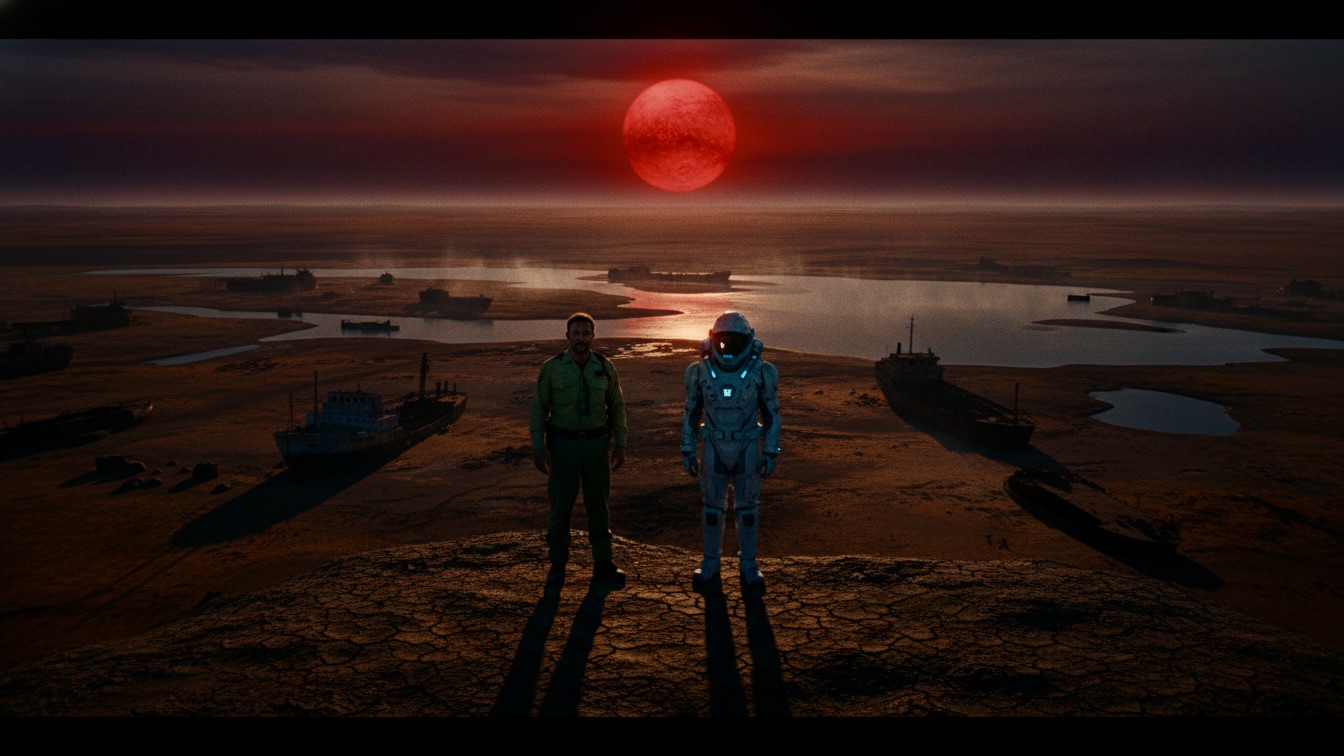
We stood at the edge of the cave. The forest was a graveyard of black skeletons. The lake was half-gone, a steaming mudflat of gray sludge. The sun was still in the same spot, but it was… flickering. It was like a lightbulb that was about to burn out. It would pulse bright, then dim, then pulse again.
"It’s not setting," Simon said, his voice full of a new kind of fear. "It’s dying."
Marley came up behind us, leaning heavily on the rock. "Solar instability. The stall wasn't just the Earth. It was the whole system. The sun’s output is dropping."
We watched as the big light in the sky flickered one last time and then turned a dull, dusty red. The heat didn't go away immediately, but the pressure of the light eased. The world felt bigger, colder, and much, much lonelier.
"What happens now?" I asked.
Simon put his hand on my shoulder. His grip was firm. "Now, it gets cold, Leo. Not the good kind of cold. The kind that doesn't end."
He looked out at the ruins of his park. The trees were gone. The water was gone. The world we knew was a memory. He reached into his satchel and pulled out the shade-maps. He looked at them for a second, then handed them to Marley.
"Lead the way, Vulture," Simon said. "Let’s see if those bunkers of yours can keep out the frost as well as the fire."
Marley took the maps, his fingers trembling. He didn't gloat. He just nodded and started checking his wrist display, looking for a way through the ashes.
We stepped out of the cave and into the red twilight. The air was still hot, but the ground was starting to crack in a different way. A low wind began to moan through the blackened ribs of the trees. It wasn't a summer breeze. It was a cold, hungry wind from the other side of the world.
I looked up at the sun. It was just a big, dark coal in the sky now, giving off just enough light to see the end of everything. I took the blind girl’s hand and followed Simon into the gray.
“The first flake of ash fell on my hand, but it didn't melt; it was followed by a crystal of ice that felt like a needle against my skin.”


