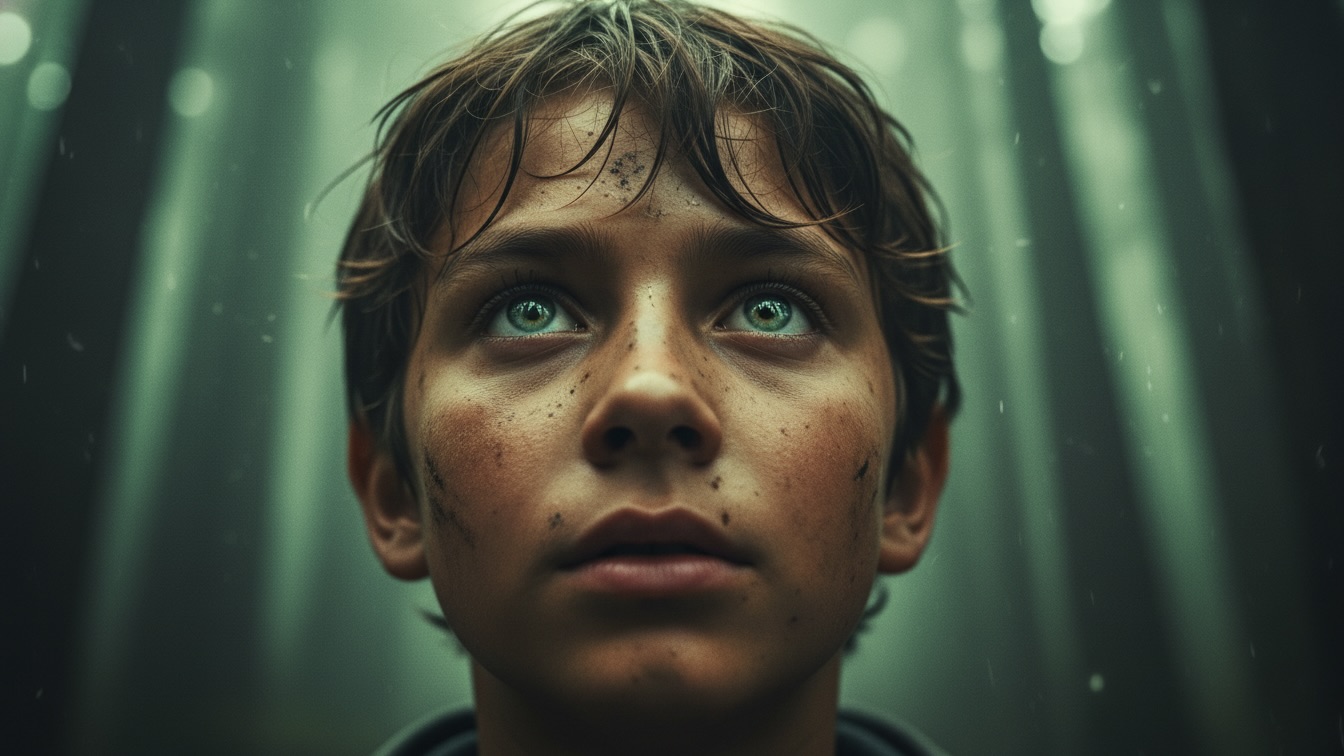
A green sky breaks the summer heat as thousands of birds fall like stones onto the Redwood floor.
The Redwoods are too tall. That is the first thing I thought when the sky broke. My name is Jay, and I am currently staring at a tree that is probably older than my great-great-great-grandpa. It is summer, and it is supposed to be hot, but under these giant trees, it is cool and dark. Sandi is behind me, poking at a mushroom with a stick. Ben is in front of me, trying to act like he knows where the trail is. He doesn't. He has the map upside down, but I am not going to tell him yet because it is funny to watch him sweat.
"We are definitely lost," Sandi said. She didn't look up from her mushroom. She is a science nerd, which usually means she knows why things happen, but right now she just looks bored. "Ben, you have been walking in a circle for twenty minutes. I have seen that same lumpy rock three times."
"It is a different rock," Ben snapped. He wiped sweat off his forehead. His face was red. "All rocks look the same in the woods. That is just how woods work, Sandi. Deal with it."
"Rocks have geological signatures," Sandi said. "That one has a crack that looks like a frowny face. We are lost."
I was about to say something witty about the frowny-face rock when the world changed. It didn't happen slowly. It wasn't like a sunset. It was like someone flipped a light switch in a dark room, except the light was the wrong color. The sky, or at least the tiny bits of sky I could see through the thick branches, turned a bright, neon green. It was the color of a lime-flavored ice pop. It was the color of glow-in-the-dark slime. It was bright enough to make my eyes ache.
"Uh, guys?" I said. My voice sounded small. "Is the sky supposed to do that?"
Ben stopped walking. He looked up. "That is not normal. Is that a chemical spill? Like, did a factory explode?"
"There are no factories for fifty miles, Ben," Sandi said. She wasn't looking at the mushroom anymore. She was looking at the green light filtering down through the needles. It made her skin look like it was rotting. "And chemicals don't turn the entire atmosphere into a glow-stick."
Then the sound started. It wasn't a bang. It was a hum. It was so low I felt it in my teeth more than I heard it in my ears. It made my stomach feel like I was on a roller coaster that was going down too fast. My watch started buzzing. I looked at it. The digital face was flickering. The numbers were spinning like a slot machine.
"My phone is hot," Ben yelled. He pulled it out of his pocket and dropped it. The screen was glowing bright white. "It is burning my leg!"
Sandi reached for her backpack, but she stopped halfway. "Listen," she whispered.
I listened. The woods are never quiet. There are always bugs buzzing or squirrels yelling at each other or birds chirping. But it went silent. Total silence. It was like someone had pressed the mute button on the whole world. Even the wind stopped. The air felt heavy, like I was standing at the bottom of a swimming pool.
Then came the thuds.
Thump. Thud. Flap-thump.
Something hit my shoulder. It was soft and heavy. I jumped back, tripping over a root. I looked down. It was a robin. It was just lying there on the brown needles. Its eyes were open, but it wasn't moving. Its wings were tucked in like it had just decided to stop flying mid-air.
Thump. Thump-thump-thump.
It started raining birds. Not just one or two. Hundreds of them. Blue jays, sparrows, hawks, even a tiny hummingbird. They were falling out of the canopy like heavy hailstones. They hit the ground with a sickening sound. They hit the branches on the way down, snapping twigs. It sounded like a thousand people clapping their hands at once, but the sound was wet and dull.
"Get under the big tree!" I screamed. I grabbed Sandi’s arm. We scrambled under the massive trunk of a Redwood that was wide enough to park a bus behind. Ben dived in after us, covering his head with his hands. A large owl hit the ground right where he had been standing a second ago. It didn't make a sound.
"Are they dead?" Ben whispered. He was shaking. I could see his hands trembling against his knees. "Are they all dead?"
Sandi crawled forward and touched the robin that had hit my shoulder. She pulled her hand back quickly. "It is still warm. But there is no heartbeat. It is like... like their internal GPS just got fried. Jay, look at the sky."
I looked up. The green wasn't just a color anymore. It was moving. It looked like curtains of light waving in a breeze we couldn't feel. It was beautiful and terrifying. It made the Redwoods look like they were underwater. Everything was green. The moss, the dirt, Ben's hair, the dead birds.
"We need to go," I said. My heart was thumping against my ribs. "We need to get back to the bus."
"The bus is five miles away," Sandi said. She was checking her compass. The needle was spinning in circles, faster and faster, until it looked like a tiny fan. "And we don't have a compass. Or phones. Or birds to tell us which way is north."
"The birds are dead, Sandi!" Ben shouted. "Nobody cares about north right now! We are in a horror movie! This is how the world ends!"
"Shut up, Ben," I said, but I didn't mean it. I was thinking the same thing. I looked at the carpet of feathers around us. The silence was back, but it was worse now because of the green light. Every shadow looked like something was hiding in it. Every rustle of a leaf made me want to scream.
I felt a weird tickle on my skin. The hair on my arms was standing straight up. Static electricity was crackling in the air. When I touched the bark of the tree, a blue spark jumped between my finger and the wood. It stung.
"Something is happening to the air," Sandi said. Her voice was clinical, but I could hear the crack in it. "The ionization levels must be off the charts. This shouldn't be happening at this latitude. This is polar stuff. This is North Pole stuff."
"Well, welcome to the new North Pole," Ben said, pointing toward the valley. "Because whatever that is, it is coming this way."
A wall of white fog was rolling through the trees, but it wasn't normal fog. It was glowing. It looked like it was made of crushed pearls. And behind it, the green sky was getting darker, turning into a deep, bruised purple. The thumping started again, but it wasn't birds this time. It was something much, much bigger.
We ran. I don't know where we were going, but staying under the bird-rain felt like a bad idea. Every step felt heavy, like my shoes were made of lead. The green light was so thick now it felt like I could reach out and grab a handful of it. We pushed through a thicket of ferns that felt like plastic. Everything felt fake.
"Wait!" Sandi yelled. She tripped over something and went down hard.
Ben and I doubled back. She wasn't hurt, but she was staring at a patch of dirt. Tangled in the roots of a fallen cedar was a drone. It was one of those expensive ones with four rotors and a high-tech camera. One of the arms was snapped, and the plastic casing was scorched, like it had been hit by lightning.
"It is a hobbyist drone," Ben said, kneeling down. "Maybe someone is nearby?"
"Look at the memory card slot," Sandi said. "The door is open."
I saw a small rectangular piece of plastic sticking out of the dirt. I picked it up. It was a micro-SD card. I looked at my phone, which was still a dead brick in my pocket. "Useless," I muttered.
"The drone has a built-in screen on the controller," Ben pointed out. He started digging around the crash site. A few feet away, partially buried under a pile of dead sparrows, was the remote. It was bulky and had a flip-up screen. Ben clicked the power button. To my surprise, it hummed to life. The screen flickered with static, then settled into a grainy image.
"It has a playback feature," Ben said. His fingers were flying over the buttons. "Let's see what it saw before it ate dirt."
We huddled together, three kids under a canopy of dying giants, watching a tiny screen. The footage started normally. It showed the tops of the Redwoods, a sea of green needles under a blue summer sky. Then, the video glitched. A flash of emerald light washed out the colors. The drone spun wildly.
"Look at the air," Sandi whispered.
In the video, the air itself seemed to be breaking. It looked like someone had thrown a handful of stones into a perfectly still pond. Circular ripples were radiating out from a point in the center of the sky. But they weren't in water; they were in the atmosphere. You could see the light bending and distorting, like a heat haze on a highway, but perfectly geometric.
"Those are pressure waves," Sandi said. "But they aren't moving like sound. They are moving like... like something is pushing through the fabric of the sky."
Suddenly, a shadow passed over the drone. It was massive. It didn't look like a plane or a bird. It was blurry, translucent, like a smudge on a lens. Then the drone just dropped. The last frame was a close-up of a redwood branch before the screen went black.
"What was that?" Ben asked. "The smudge?"
"I don't know," I said. "But it was huge."
"It is a stealth invasion," a new voice rasped.
We all screamed. Ben dropped the controller. Standing on a ridge above us was a man who looked like he had been living in the woods since the 1990s. He had a beard that reached his chest and wore a camo jacket that was more duct tape than fabric. He was holding a compound bow, and he looked absolutely terrified.
"Who are you?" I asked, my heart trying to escape through my throat.
"Doesn't matter," the man said. He scrambled down the ridge with surprising speed. "You kids shouldn't be out here. They are using the sonic weapons now. Did you see the birds? That is the frequency. It pops their little hearts like popcorn."
"Sonic weapons?" Sandi asked, her eyebrows shooting up. "Sir, the sky is green. That is an atmospheric phenomenon, not a weapon."
"That is what they want you to think!" the Hermit hissed. He grabbed my shoulder, his grip like iron. "The Chinese. Or the Russians. Or the guys from the moon. Doesn't matter. They are using stealth tech to mask the ships. The green is the exhaust. They are clearing the zone. No birds, no distractions. They want us quiet."
"We are just trying to get to the trailhead," I said, trying to pull away. He smelled like pine needles and old coffee.
"Trailhead is gone," the Hermit said. "Everything is gone. The ground is going to start moving soon. When the ships dock, the weight... it changes things. You feel that?"
I did feel it. A low vibration was coming up through the soles of my boots. It wasn't an earthquake. It was rhythmic. Thump. Thump. Thump.
"That is not a ship," Sandi said, looking at the Hermit like he was a broken calculator. "That is a low-frequency oscillation. It is too big to be a weapon. It is planetary."
"Call it what you want, girlie," the Hermit said, looking up at the green sky. "I'm going to my hole. If you want to live, you follow the water. The water knows where the gravity is still straight. Go to the gorge. It is deep. They can't see you in the deep."
He didn't wait for an answer. He turned and vanished into the ferns like a ghost.
"He was crazy, right?" Ben asked. "Tell me he was crazy."
"He was definitely crazy," I said. "But he was right about the ground moving."
I looked down at my feet. A small puddle in the hollow of a root was rippling. The water wasn't just shaking; it was jumping. Tiny droplets were flying upward, defying gravity for a split second before falling back down.
"Sandi," I said. "The water is jumping."
She knelt down, her face pale. "The local gravity constant is fluctuating. That is impossible. That is... that is physics-breaking stuff. Jay, we need to find that ranger station. They have a hardwired radio. We have to know if this is just here, or if the whole world is turning into a lava lamp."
"I vote for the ranger station," Ben said. "Anything is better than standing here waiting for my heart to pop like popcorn."
We started moving again, but the forest felt different now. It didn't feel like home. It felt like a cage. The green light was pulsing now, dimming and brightening like a slow, neon heartbeat.
The ranger station was a small log cabin perched on the edge of a cliff. Usually, it was a place where you could buy overpriced trail mix and stickers. Now, it looked like a tomb. The front door was swinging open, banging against the wall in a wind that shouldn't have been there.
"Hello?" I called out.
No answer. The interior was a mess. Papers were scattered everywhere. A half-eaten sandwich sat on the desk, turning brown. The ranger's hat was on the floor, crushed by a heavy boot.
Sandi went straight for the radio. It was a big, old-fashioned unit with a heavy mic. She flipped the switch. Static filled the room—a harsh, jagged sound that made my teeth ache. She turned the dial slowly.
"Nothing," she muttered. "Wait."
The static cleared for a second. We didn't hear a voice. We didn't hear an emergency broadcast. We heard a sound that didn't belong in the mountains. It was a long, low moan that rose in pitch, then dipped into a series of clicks and whistles.
"Whales?" Ben asked, confused. "Why are we hearing whales?"
"It sounds like a humpback," Sandi said, her eyes wide. "But it is coming from the mountains. Look at the signal strength. It is local. It is coming from the peaks."
I walked to the window. Outside, the valley was filled with that pearly fog. But above it, the mountain peaks were glowing. The green sky had settled into a steady, vibrating emerald. And then I saw the 'cloud.'
On the horizon, a massive black shape was rising. It looked like smoke, but it was moving too fast. It was a solid wall of darkness that stretched for miles, blotting out the green light.
"Is that a storm?" I asked.
Ben joined me at the window. He squinted. "It is moving against the wind, Jay. Look at the trees. The wind is blowing east. That thing is moving west."
As the black cloud got closer, the sound changed. The whale songs were drowned out by a high-pitched drone. It sounded like a billion tiny saws cutting through wood.
"Bugs," Sandi whispered, coming to the window. "It is an insect swarm. Every beetle, every fly, every moth in the state is in that cloud."
"Why are they all together?" Ben asked. "They don't do that. Bugs don't migrate in giant doom-clouds."
"They aren't migrating," I said, watching the wall of insects approach. "They are running. They are fleeing something."
The swarm hit the ranger station like a physical blow. Millions of tiny bodies slammed against the glass. The light in the room vanished as the insects covered the windows. It was like being inside a shaking box. The sound was deafening—a roar of wings and clicking carapaces.
"Get down!" I yelled.
We huddled on the floor as the cabin groaned. The insects were so thick they were being forced through the gaps in the doorframe. Dead beetles rained down on us. Ben was making a gagging sound, batting them away from his face.
And then, as quickly as it had started, the swarm was gone. The windows cleared. I looked out and saw the black cloud disappearing over the ridge behind us. The forest was stripped. The leaves on the bushes near the cabin were gone. The ferns were nubs.
"Look," Sandi said, pointing up.
Above the valley, the 'invaders' finally appeared. They weren't ships. They weren't metal. They were giant, translucent shapes drifting through the green sky. They looked like deep-sea jellyfish, but they were the size of city blocks. Long, trailing filaments hung down from their glowing bodies, brushing against the tops of the Redwoods.
"Sky-whales," I breathed.
"They are atmospheric beasts," Sandi said, her voice full of awe. "They must live in the stratosphere. The solar flare... the green sky... it must have pushed the atmosphere down. It changed the density. They aren't invading. They are just... sinking."
One of the creatures drifted directly over the cabin. It was so large it blocked out the sky. I could see internal organs glowing with a soft, blue light. It moved with a slow, rhythmic pulsing, pushing against the air like it was water.
As it passed, the ground began to heave. The weight of the creature was so immense that its gravitational pull was literally lifting the dirt. Rocks began to float. The ranger station groaned as the nails started to pull out of the wood.
"The Hermit was right!" Ben screamed. "The ground is moving!"
We watched in horror as a massive Redwood a hundred yards away was slowly uprooted. It didn't fall. It rose. It lifted into the air, its roots dripping soil, and drifted upward toward the belly of the sky-whale.
"We have to get to the gorge!" I shouted over the sound of the groaning earth. "The Hermit said the gravity is stable in the deep! If we stay here, we are going to float away!"
We scrambled out of the cabin. The world was upside down. I had to grab onto a porch railing to keep from drifting off the ground. My feet felt light, like I was walking on the moon. Every jump took me six feet into the air.
"Run!" I yelled, though it was more like leaping.
We headed for the narrow gorge at the edge of the valley. Above us, the sky-whales were grazing. Their long tentacles were wrapping around the tops of the trees, pulling them upward. It looked like a giant's garden being weeded. The 'whale songs' we had heard on the radio were echoing through the air now, vibrating in our chests. It was a beautiful, lonely sound.
"I don't want to be fish food!" Ben yelled as he floated over a fallen log.
"They aren't eating us!" Sandi replied, her voice strained. "They are just heavy! We are like ants under a boot!"
We reached the mouth of the gorge just as the gravity began to fail completely. A pile of rocks nearby lifted into the air and began to orbit each other like a tiny solar system. I grabbed a handful of Sandi's jacket and pulled her toward the rocky opening. Ben dived in after us, grabbing a jagged rock to anchor himself.
We tumbled into the darkness of a cave just as the world outside went silent and weightless.
Inside the cave, things were still weird, but at least we weren't drifting into the mouth of a sky-beast. We huddled together in the damp dark. I could hear Ben's teeth chattering.
"Is it over?" he whispered.
"No," I said. "It is just starting."
A low rumble started deep in the earth. It wasn't like the thumping from before. This was a roar. Outside, the 'gravity storm' hit. I peeked out from the cave entrance and saw something I will never forget.
The entire forest was lifting. Thousands of tons of dirt, trees, and dead birds were rising into the green sky. It looked like a reverse rainstorm. Everything was falling up. The sky-whales were hovering in the middle of it all, their blue lights flashing as they feasted on the nutrients being swept up from the earth.
"They are cleaning the planet," Sandi whispered, peering over my shoulder. "The solar flare must have ionized the upper atmosphere so much that it created a localized vacuum. It is sucking the surface up."
Suddenly, the cave went dark. A massive shadow had parked itself right in front of the gorge. One of the sky-whales had drifted down low. Its translucent skin was pressing against the cliffs. I could see the texture of its body—it looked like wet silk. A long, glowing filament drifted into the cave mouth. It moved like a snake, searching the air.
"Don't touch it," I warned.
We backed deeper into the cave. The filament touched a rock, and the rock instantly turned to white ash.
"It is high-voltage," Sandi said. "It is how they interact with the world. They are giant batteries."
We spent the next hour pressed against the back wall of the cave. The world outside was a chaos of green light and floating debris. We watched a deer float past the cave entrance, its legs kicking frantically at the empty air. It was the saddest thing I had ever seen.
"We're going to die here, aren't we?" Ben asked. He wasn't being witty anymore. He just sounded like a kid who wanted to go home.
"We aren't going to die," I said, though I wasn't sure. "The sun will come up. The flare will die down. The atmosphere will settle. These things... they don't belong here. They'll go back up."
"How do you know?"
"Because they're whales, Ben," I said. "They need the deep ocean. The stratosphere is their ocean. They are probably as scared as we are."
Slowly, the roar began to fade. The green light outside the cave started to dim, replaced by the grey smudges of early morning. The gravity came back in a series of sickening jolts. I felt my stomach drop as my weight returned. Outside, we heard the sound of a thousand things hitting the ground at once.
CRASH. THUD. BOOM.
The forest was falling back down.
We waited another hour before we dared to step outside. When we finally emerged, the world was unrecognizable. The Redwoods were still there, but they were scarred. Many had been snapped like toothpicks. The ground was covered in a thick layer of grey ash and pulverized rock. The green sky was gone, replaced by a pale, normal summer dawn.
There were no sky-whales. There were no birds. There was only silence.
"Look at the trail," Sandi said.
The path was gone, buried under three feet of debris. But in the distance, we could see the glint of the sun on the metal roof of the ranger station. It was still standing, though it looked like it had been through a war.
We started walking. It was hard going. We had to climb over fallen trunks and through piles of strange, translucent slime that the creatures had left behind. It smelled like salt and electricity.
"Do you think anyone will believe us?" Ben asked. He picked up a piece of the slime. It dissolved in his hand, leaving behind a faint blue glow.
"Probably not," I said. "They'll say it was a freak weather event. Or a gas leak. People hate the truth when the truth is this weird."
"I have the drone footage," Ben reminded us, patting his pocket. "They can't argue with the ripples."
We reached the trailhead by noon. To our shock, there were cars there. A few news vans were parked near the gate. People were walking around with dazed expressions, looking at the sky.
"Is the war over?" a reporter asked as we stumbled out of the woods.
"It wasn't a war," I said. I looked up at the blue sky. It looked so thin now. So fragile. I knew that just a few miles up, there were things the size of cities drifting in the dark, waiting for the next spark from the sun to bring them back down to us.
Sandi looked at her compass. The needle was steady now, pointing due north. "The world isn't broken," she said softly. "It is just bigger than we thought."
We walked toward the bus, our boots crunching on the dead needles. I looked back at the Redwoods one last time. They looked older. More tired. They had seen the sky fall before, and they would see it fall again.
As I stepped onto the bus, I felt a familiar tickle on my skin. I looked up. The sky was blue, but for a split second, I thought I saw a ripple, like a stone thrown into a very deep, very dark pond.
“High above the clouds, a shadow larger than a city began its slow, pulsing descent once more.”


