Format: Short Film / Anthology Episode | Est. Length: 10-12 minutes
Imagine this story as a high-concept entry in a prestige sci-fi anthology where humanity is forced to confront the incomprehensible scale of a changing planet. It is a visual journey that blends the grounded, character-driven tension of a survival thriller with the surreal, bioluminescent awe of a world where the boundaries between the stratosphere and the earth have dissolved.
Black Cloud Migration serves as a standalone episode in the anthology series The Great Shift, which chronicles the first forty-eight hours of a global atmospheric inversion. While other episodes focus on urban centers or deep-sea research stations, this story highlights the rural experience of the event, emphasizing the "Sinking" of stratospheric life-forms into the lower atmosphere. The series as a whole explores the collective human realization that Earth's biosphere is far more layered and populated than previously imagined, shifting the genre from traditional alien invasion to accidental ecological overlap.
While lost in the ancient Redwoods, three bickering teenagers witness the sky turn a toxic neon green moments before hundreds of birds suddenly drop dead from the canopy in a silent, macabre rain.
When a solar event drags massive stratospheric behemoths down to Earth, three lost teenagers must survive a localized gravity collapse in the Redwood forest. Their journey transforms from a simple hike for survival into a witness account of a planetary biological shift.
The primary theme is "Cosmic Indifference," moving away from the trope of a hostile alien invasion toward a more terrifying reality: a biological event where humanity is merely collateral damage. The sky-whales are not attacking; they are simply sinking into a denser medium, and their "destruction" of the forest is as accidental as a human stepping on grass. This theme emphasizes the fragility of human civilization when confronted with the vast, hidden ecosystems of our own planet that operate entirely outside of human concern.
The secondary theme is the "Limitations of Human Knowledge," explored through the characters' attempts to categorize the impossible. Sandi’s struggle to apply physics to a physics-breaking event and the Hermit’s attempt to frame the phenomena as a human war demonstrate how people use familiar narratives to shield themselves from the incomprehensible. The story suggests that true survival requires the ego-death of admitting that the world is far more complex and indifferent than human science or conflict can currently explain.
The stakes are primarily existential and physical, as the characters face an environment that has suddenly become incompatible with human life. The localized gravity fluctuations threaten to cast them into the upper atmosphere, while the high-voltage filaments of the sky-whales pose an immediate threat of incineration. Beyond their own lives, the trio carries the "truth" of the event in the form of drone footage, making their survival essential for humanity's future understanding of the new planetary reality.
The primary conflict is Man vs. Nature, but nature is amplified to a cosmic, incomprehensible scale. The external antagonistic force is the "Atmospheric Sinking," a phenomenon that treats humans as insignificant ants under the weight of stratospheric beasts. Internal conflict stems from the breakdown of the group's social roles under extreme stress, as their differing methods of coping—denial, scientific obsession, and raw panic—threaten to pull them apart when they most need to stay together.
Jay, Sandi, and Ben are lost in the Redwoods when a solar flare turns the sky neon green and causes a mass bird die-off, signaling a catastrophic shift in the atmosphere. They encounter a paranoid hermit who warns of "stealth weapons," but Sandi realizes they are witnessing a physics-breaking atmospheric event as the ground begins to vibrate and electronics fail. After discovering drone footage of geometric ripples in the sky, they realize something massive is pushing through the fabric of the atmosphere.
They take shelter in a ranger station as a massive "black cloud" of migrating insects—fleeing the same threat—slams into the cabin, followed by the appearance of city-sized, translucent "sky-whales." One behemoth drifts directly over them, creating a localized gravity storm that uproots the forest and pulls the landscape into the sky. The trio performs a desperate, low-gravity leap to a rocky gorge, surviving the night to emerge into a scarred, silent world that has been permanently altered by the presence of these stratospheric giants.
Jay: Jay begins the story as a detached, sarcastic teenager who uses humor to mask his lack of direction and fear of the future. As the environment becomes lethal, he is forced to shed his cynicism and take active responsibility for his friends' safety, transforming into a grounded leader. By the end of the ordeal, he has become a witness to the sublime, possessing a newfound gravity and awareness of the world's hidden, massive scales.
Sandi: A science enthusiast who relies on logic and geological signatures to navigate the world, Sandi starts the journey with a sense of intellectual superiority. Her arc is defined by the collapse of her rationalist framework as she encounters "physics-breaking" phenomena that her textbooks cannot explain. She ends the story in a state of humbled awe, accepting that the universe is far more complex and indifferent than her data suggested.
Ben: Ben starts as the group’s "tough guy" whose bravado is easily punctured by his own incompetence with a map and compass. When the sky turns green, his confidence evaporates into raw, vocal panic, representing the primal human fear of the unknown and the loss of control. By the journey’s end, his survival has stripped away his pretenses, leaving him more honest and vulnerable as he clings to the drone footage as his only proof of the impossible.
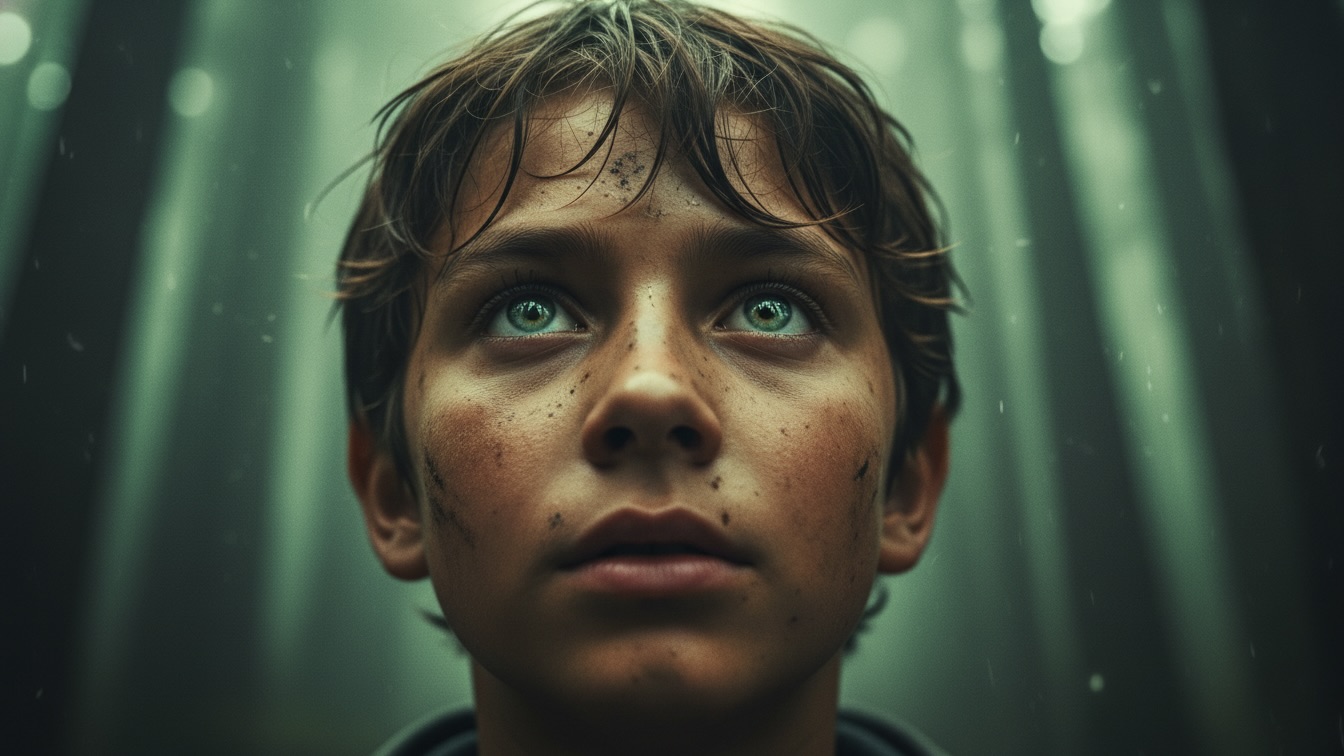
Beat 1: The Hike. Jay, Sandi, and Ben navigate the dense Redwoods, establishing their group dynamic through bickering and Ben’s poor navigation skills. The cool, dark atmosphere of the ancient forest provides a stark contrast to the impending chaos. The beat ends with the sudden, unnatural shift of the sky to a neon green hue that makes the forest look like it is rotting.
Beat 2: The Sky Breaks. The trio reacts in horror as the atmosphere ionizes, causing their electronics to malfunction and a low-frequency hum to vibrate through their teeth. Silence falls over the woods before hundreds of birds suddenly drop dead from the canopy in a "bird rain" that blankets the forest floor. They scramble for cover under a massive Redwood as the reality of the atmospheric collapse sets in.
Beat 3: The Hermit and the Drone. While seeking a way out, the group discovers a crashed drone containing footage of geometric ripples in the sky, suggesting a massive displacement of air. They are confronted by a paranoid hermit who believes the event is a military invasion, adding a layer of human instability to the environmental threat. The hermit flees toward a gorge, leaving the teens to witness the water in the forest beginning to defy gravity and jump from the soil.
Beat 4: The Ranger Station. Reaching a deserted ranger station, Sandi attempts to use a hardwired radio and picks up "whale songs" echoing from the mountain peaks. A massive black cloud of migrating insects—fleeing the same threat—slams into the cabin, temporarily plunging the interior into total darkness and deafening noise. As the swarm passes, the true "invaders" appear: city-sized, translucent sky-whales sinking from the stratosphere into the valley.
Beat 5: The Gravity Storm. One of the behemoths drifts directly over the cabin, its immense mass creating a localized gravity vacuum that begins to uproot the forest. Jay, Sandi, and Ben struggle to stay grounded as rocks and trees drift upward toward the glowing, high-voltage filaments of the sky-whale. They perform a desperate, low-gravity "leap" toward the safety of the rocky gorge as the world around them is literally pulled into the sky.
Beat 6: The Aftermath. Huddled in a cave, the trio watches the "reverse rain" of the forest floor being sucked up before the gravity eventually stabilizes and the sky-whales retreat back to the upper atmosphere. They emerge the next morning to a scarred, silent landscape covered in strange, glowing slime and pulverized debris. The episode ends as they reach the trailhead, realizing that while they survived, the world’s understanding of its own atmosphere has been permanently shattered.
The episode begins with a tone of lighthearted teenage bickering that quickly shifts into surreal dread as the "bird rain" occurs. The mood transitions into high-stakes survival horror during the insect swarm and the gravity storm, peaking with a sense of "cosmic awe" when the sky-whales are revealed. The final emotional state is one of quiet, haunting realization—a "new normal" where the characters are safe but forever changed by the scale of what they witnessed.
A full season of The Great Shift would follow the "Sinking" event as it progresses from a localized anomaly to a permanent change in Earth's climate. Early episodes would focus on the confusion and "invasion" theories—much like the Hermit’s—while later episodes would shift toward humanity's desperate attempts to adapt to a world where gravity is no longer a constant and the sky is a new ocean. The overarching narrative would track a global task force of scientists as they realize the solar flare was not a one-time event but the start of a new solar cycle.
The thematic escalation would move from "Survival" to "Coexistence." As the sky-whales become a permanent fixture of the lower atmosphere, human architecture, transportation, and daily life must be completely redesigned. The season finale would depict the first successful attempt to communicate with the beasts, revealing that they are not just animals, but the "immune system" of the planet, reacting to solar radiation to protect the surface, albeit with destructive side effects for the species living there.
The visual style is defined by "Ethereal Horror," utilizing a palette of deep forest greens and browns contrasted with the violent, artificial glow of neon emerald and electric blue. The cinematography should use wide-angle lenses to emphasize the scale of the Redwoods and the even more massive sky-whales, making the human characters appear minuscule in the frame. Tonal influences include the shimmering, distorted beauty of Annihilation and the grounded, tactile dread of Arrival.
Lighting plays a crucial role, with the "Green Sky" acting as a primary light source that flattens shadows and gives human skin a sickly, translucent appearance. The gravity storm sequences should be shot with a mix of slow-motion and handheld camerawork to convey the disorienting loss of weight and the violent return of physics. Sound design is equally vital, moving from the oppressive silence of the "mute button" forest to the bone-shaking, low-frequency moans of the sky-beasts.
The target audience consists of fans of high-concept science fiction and "New Weird" cinema, specifically those who enjoy atmospheric, slow-burn tension (ages 16-45). It appeals to viewers who appreciate stories where the "monster" is a force of nature rather than a sentient villain, fitting well within the demographic that watches anthology series like Black Mirror or Love, Death & Robots. The blend of teenage protagonists and existential dread makes it accessible to Young Adult audiences while maintaining the sophisticated themes required for adult sci-fi enthusiasts.
The pacing follows a "Rapid Escalation" structure, beginning with a slow, character-driven introduction that quickly gives way to a relentless series of escalating environmental anomalies. The runtime is divided into three distinct acts: the Arrival (the green sky and bird rain), the Encounter (the hermit and the drone), and the Event (the gravity storm and sky-whales). The tempo mimics a heartbeat, with moments of eerie, silent tension followed by bursts of high-stakes physical action, culminating in the breathless climax of the gravity collapse.
Production will require a sophisticated blend of practical and digital effects. The "bird rain" and the insect swarm should utilize practical debris and animatronic elements to provide the actors with tactile reactions, supplemented by CGI for the sheer volume of the swarms. The sky-whales themselves are the primary VFX investment, requiring a "translucent jellyfish" aesthetic that feels organic and heavy rather than mechanical, with internal bioluminescence that interacts with the forest environment.
Filming on location in a Redwood forest is essential for the scale and lighting, though the gravity storm sequences will necessitate a controlled soundstage with wire-work and gimbal sets. The "floating debris" effect can be achieved through a combination of high-speed photography and digital compositing. Special attention must be paid to the "slime" and "ash" textures in the aftermath, using biodegradable materials that react to light to maintain the "otherworldly" feel of the transformed landscape.


