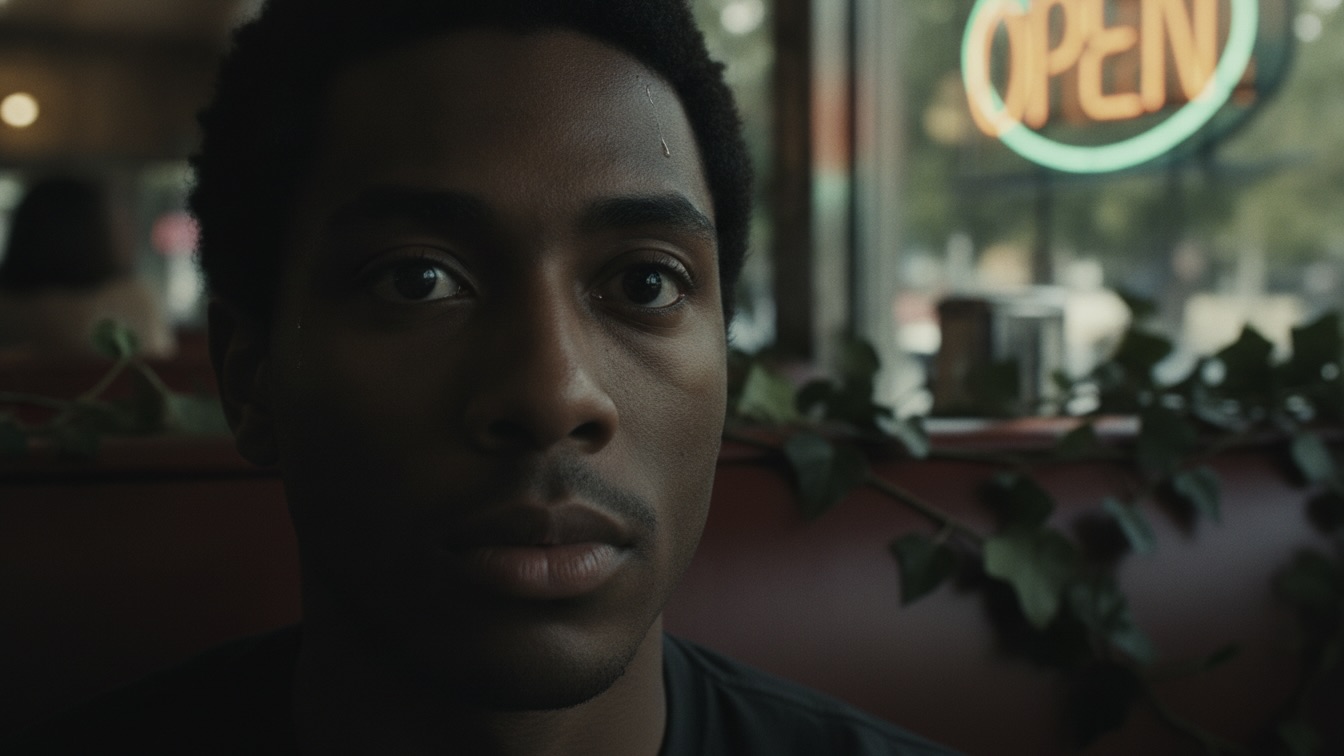
Inside a Winnipeg diner, Moses listens to Jeffrey explain why nature only spares the pure of heart tonight.
I pushed my thumbnail into the crack of the red vinyl booth, trying to peel back a flake of the dried-out material. It didn't budge. The air in the Lampshade Diner was thick with the kind of heat that doesn't move, even with the ceiling fans spinning their blades into a blur overhead. Outside, Portage Avenue was a ghost town, though the streetlights flickered with a rhythmic, frantic energy that made my teeth ache. Jeffrey sat across from me, staring at his coffee like it held a live stream of the apocalypse. He hadn't touched it in twenty minutes. The porcelain cup had a chip near the rim, a jagged little canyon that he kept tracing with his index finger. We were the only ones here, unless you counted the cook, who was just a pair of heavy boots and the occasional scrape of a spatula in the back.
"You're doing it again," Jeffrey said. He didn't look up. His voice was sandpaper on dry wood. "The fidgeting. It makes the air feel smaller, Moses. Just sit. Just be."
"I can't just be," I said, my voice cracking slightly. I cleared my throat and tried to sound like I wasn't vibrating out of my skin. "Do you hear that? The buzzing? It’s not the lights. It’s coming from the trees. I’ve never heard the elms make that sound. It’s like a server room overheating. It’s digital. It’s wrong."
Jeffrey finally looked at me. His eyes were bloodshot, the whites turned a sickly yellowish-pink by the neon sign buzzing in the window. He looked like he hadn't slept since the humidity spiked three days ago. Winnipeg summers usually felt like being trapped in a wet basement, but this was different. The green outside wasn't just growing; it was aggressive. The vines were starting to lace through the power lines. The grass in the medians was waist-high and vibrating. It felt like the city was being deleted by a forest fire made of chlorophyll.
"The trees are fine," Jeffrey lied. He knew they weren't. He saw the way the roots were buckling the sidewalk outside the diner, pushing up the concrete like a slow-motion explosion. "They're just reacting. Everything reacts when the pressure changes. You’re overthinking the feedback loop. You spend too much time looking at the screen, man. You think nature is a glitch because it doesn't have a UI."
"It’s not the UI, Jeff. It’s the intent," I said, leaning forward. My elbows slipped on the greasy surface of the table. "I saw a squirrel today. It wasn't running. It was standing on its hind legs in the middle of Main Street, just staring at the sun. It didn't blink. A bus went by, inches from its tail, and it didn't move. It was like it was downloading something. Like it was part of a mesh network and the signal was finally strong enough."
Jeffrey sighed, a long, rattling sound that ended in a cough. He reached for a sugar packet, his fingers trembling. He didn't open it. He just flipped it over and over, the grains of sugar inside making a tiny, scratching sound against the paper. It was the only sound in the diner besides the hum of the reach-in cooler.
"Listen to me," Jeffrey said, his tone shifting. The irony he usually used as a shield was gone. He looked exhausted, but there was a sharp, jagged edge to his stare now. "You’re worried about the squirrels and the trees. You’re worried about the noise. But you’re missing the point of the filter. This whole thing, this... whatever is happening outside? It’s a sorting algorithm. That’s how you’d put it, right?"
I blinked. "A sorting algorithm? For what?"
"For us," he said. He leaned in closer, and I could see the fine lines of sweat beaded on his forehead. They looked like glass beads. "It’s looking for something. Or it’s looking for the absence of something. People think they can hide behind their tech or their deadbolts, but this thing doesn't care about locks. It cares about the core. Pure hearts always win in the end, Moses. Just remember that. If you’ve got rot in the center, the trees are going to find it."
I laughed, but it felt hollow, a dry reflex that didn't reach my eyes. "Pure hearts? What is this, a Disney movie? We’re in a diner in Winnipeg, Jeff. Nobody has a pure heart. We’re all varying degrees of garbage. I stole a Snickers bar when I was eight. You cheated on your taxes in 2022. If the trees are looking for saints, we’re both getting turned into mulch by morning."
"It’s not about being a saint," Jeffrey snapped. He gripped the edge of the table, his knuckles turning white. "It’s about being... whole. Not fragmented. Not broken into a thousand different personas for a thousand different apps. It’s about being one thing. Nature hates a vacuum, but it hates a hypocrite even more. The pure heart is the one that doesn't lie to itself when the lights go out."
I looked out the window. A massive elm branch was pressed against the glass. It hadn't been that close when we sat down. The leaves were a deep, bruised purple-green, and they seemed to be pulsing. Not moving in the wind—there was no wind—but pulsing, like a lung. I could see the veins in the leaves, and they looked too much like the veins in Jeffrey’s hands. I felt a surge of nausea that had nothing to do with the greasy air. My internal clock was screaming. Every second we sat here felt like a minute wasted. I wanted to run, but where? The whole city was becoming a greenhouse for something that didn't want us there.
"You think you're pure?" I asked, my voice barely a whisper.
Jeffrey looked back at his coffee. "I think I’m trying to be. I think I’m being honest about how scared I am. That’s a start. You? You’re still trying to find a way to monetize the fear. You’re thinking about the post you’ll make if we survive this. That’s the rot, Moses. That’s the impurity the vines are going to catch on."
I pulled my hand away from the vinyl. My skin felt tacky, like I was starting to merge with the booth. The paranoia was localized now, a sharp point right between my shoulder blades. I felt like the diner wasn't a refuge anymore; it was a cage. And the thing outside was just waiting for the door to unlock.
"We should leave," I said. "We should get to your car and just drive north. Maybe it’s not this bad outside the city."
"It’s everywhere," Jeffrey said, his voice flat. "You can't outrun the summer, Moses. And you definitely can't outrun the harvest. Just sit. Drink your water. Try to be real for five minutes. It might save your life."
I picked up my glass. The water was lukewarm and tasted like iron pipes. I looked at the reflection of the neon sign in the liquid. It was flickering in a code I couldn't break. I felt the vibration in the floor then—a deep, subsonic thrum that made the silverware on the counter rattle. It wasn't a truck. It wasn't a train. It was the earth itself, stretching, waking up, and deciding that the concrete was in its way.
The sound didn't stop. It just moved into a different frequency, one that I felt in my molars. I looked over at the counter. The cook hadn't come out. The kitchen was dark except for the amber glow of the heat lamps. I wondered if he was still back there, or if he’d already been integrated into the walk-in fridge by the creeping ivy I’d seen earlier near the back exit. The diner was a time capsule of chrome and linoleum, but the grease on the walls felt like it was becoming organic, a layer of skin growing over the building’s skeleton. I wiped my palms on my jeans. The denim felt coarse and alien.
"Why Winnipeg?" I asked, trying to break the tension. "If nature is going to reboot, why start in a place that’s frozen six months of the year?"
"Because we’re vulnerable," Jeffrey said. He was finally drinking the coffee, taking small, surgical sips. "We’re isolated. We’re a hub with no spokes. When the system fails here, it doesn't ripple; it just drops. Besides, have you seen the soil? It’s rich. It’s ready. The river has been wanting to take back the forks for a hundred years. We just gave it an excuse by being so... loud."
"Loud? We’re not loud. This city is a tomb most nights."
"Not that kind of loud," Jeffrey countered. "Electronic loud. The signals. The 5G. The Wi-Fi. The constant screaming of data through the air. The trees, they don't like the noise. It messes with their internal comms. They’ve been waiting for a moment of silence to strike back. This heatwave? It’s a dampener. It’s the forest’s way of turning off our microphones."
I looked at my phone. It was dead. Not out of battery—I’d had eighty percent when we walked in—but dead-dead. The screen was a grey smear, like the liquid crystal had leaked out into the casing. I set it on the table. It looked like a black mirror, reflecting the flickering overhead lights. I felt a sudden, sharp pang of loss. Without the feed, I was just a body in a chair. I didn't know what was happening three blocks away, let alone across the world. The world had shrunk to the size of this booth, and the perimeter was closing in.
"My phone is bricked," I said.
"Good," Jeffrey replied. "Now you have to look at the room. Look at the shadows. See the way they’re moving?"
I looked. In the corner of the diner, near the jukebox that hadn't played a song since 2015, the shadows weren't behaving. They weren't cast by the furniture. They were independent entities, soft and feathery, like moss growing in the air. They seemed to be reaching for the ceiling, swaying in a wind I couldn't feel. My heart hammered against my ribs, a frantic, uneven beat. I felt a drop of sweat run down my spine, cold despite the heat. The paranoia wasn't just a feeling anymore; it was a physical presence, a static charge that made the hair on my arms stand up.
"We need to talk about the pure heart thing again," I said, my voice shaking. "What if I’m not? What if I can't be?"
"Then you're just fuel," Jeffrey said. He said it without malice, like he was explaining a simple fact of physics. "Don't take it personally. The forest doesn't hate you. It just sees you as a resource that isn't being used efficiently. You’re a collection of carbon and nitrogen that’s currently occupied by a lot of useless anxiety. It wants the carbon back."
"That’s horrifying, Jeff."
"Is it? We’ve been doing the same thing to the planet for centuries. We just call it development. This is just... redevelopment. Urban renewal on a biological scale."
He stood up then, his joints popping. He walked over to the window and pressed his forehead against the glass. He didn't flinch as the elm branch outside scraped against the pane, a sound like fingernails on a chalkboard. He stayed there for a long time, watching the darkness. I stayed in the booth, frozen. I felt like if I moved, I’d break the spell that was keeping the shadows in the corner. I watched the back of Jeffrey’s head. His hair was thinning, showing the pale, vulnerable skin of his scalp. He looked so small against the backdrop of the encroaching green.
"The streetlights are going out," he whispered.
One by one, the orange glows on Portage Avenue vanished. It wasn't a power failure; it was a systematic shutdown. I could see the vines wrapping around the bulbs, crushing the glass, snuffing out the light. The darkness that followed wasn't empty. It was crowded. It was a thick, teeming blackness that seemed to flow down the street like a river of oil. The buzzing sound grew louder, a roar of cicadas and something much larger, something that sounded like the earth itself grinding its teeth.
"Jeffrey, come back to the booth," I said, my voice rising in pitch. "Get away from the window."
"It’s beautiful, Moses," he said. He didn't move. "It’s so quiet. For the first time in my life, I can't hear the city. I can only hear the growth."
I slid out of the booth, my legs feeling like lead. I walked toward him, intending to pull him back, but I stopped halfway. The floorboards under my feet were soft. The linoleum was cracking, and tiny, white rootlets were poking through the gaps. They were reaching for my shoes, curling around the rubber soles. I jumped back, tripping over a chair. The metal chair clattered to the floor, the sound echoing like a gunshot in the silent diner.
Jeffrey turned around. His face was different. His eyes were wide, the pupils blown out until they were just black voids. There was a faint green glow coming from under his skin, tracing the path of his veins. He smiled, and it was a slow, terrifying expression that didn't involve his eyes.
"It’s starting," he said. "The test is starting. Are you ready to see what’s inside you, Moses?"
I scrambled back toward the counter, my breath coming in shallow gasps. I looked for the cook, for anyone, but the kitchen was a void. The heat lamps had finally flickered out. The only light left was the faint, dying hum of the neon 'OPEN' sign, which was now being strangled by a thick, hairy vine that had forced its way through the door frame. The air was getting harder to breathe, not because of the heat, but because it felt crowded. It felt like the oxygen was being replaced by something else, something heavier and more ancient.
"I want to go home," I sobbed. "I just want to go to my apartment."
"You don't have an apartment anymore," Jeffrey said, walking toward me with a slow, rhythmic gait. "The ivy took the brick. The moss took the bed. There’s no more 'home,' Moses. There’s only the garden. And you’re either a gardener or you’re the soil."
He reached out a hand. His fingernails were gone, replaced by sharp, woody points. I backed away until I hit the counter, the cold metal pressing into my spine. I looked down at the floor. The roots were thicker now, weaving together to form a carpet of white tendrils. They were moving toward me, a slow-motion wave of hunger. I looked at Jeffrey, and I didn't see my friend anymore. I saw a vessel. I saw a man who had been hollowed out and filled with the summer.
"Stay away from me," I screamed, but the sound was swallowed by the buzzing. It didn't even reach the walls. The diner was absorbing everything—sound, light, hope. I was alone in the dark with a man who wasn't a man, in a city that was no longer a city.
The door of the diner didn't just open; it was dismantled. The glass didn't shatter outward; it was pulled into the darkness by a thousand tiny, adhesive tendrils. A woman stumbled through the wreckage. She was younger than me, maybe twenty, wearing a cropped hoodie that was soaked with sweat and stained with something dark and sticky. She wasn't screaming. She was breathing in ragged, wet gulps, her eyes darting around the room like a trapped animal's. She saw Jeffrey standing in the middle of the floor and me cowering by the counter.
"Help," she rasped. Her voice was barely audible over the subsonic thrumming. "It’s... it’s moving. The park. It’s moving."
Jeffrey didn't move toward her. He just watched her with those hollowed-out eyes. "The park is everywhere now, Sarah," he said. How did he know her name? He’d never met her. Or maybe he wasn't the one speaking. Maybe the name was just data he’d pulled from the air, part of the new network.
"I tried to run," she said, leaning against the shattered door frame. She didn't seem to notice the vines curling around her ankles. "The trees... they didn't let me pass. They kept shifting. Every time I turned a corner, there was a wall of thorns. I had to crawl through the sewers to get here."
"The sewers are just roots now," Jeffrey said. He tilted his head to the side, a bird-like movement that made my stomach churn. "You shouldn't have come here. The Lampshade isn't a sanctuary. It’s a transition point. A weigh-station for the heart."
Sarah looked at me, her eyes pleading. "What is he talking about? Who is he?"
"He’s... he was my friend," I said, my voice trembling. "Look at the floor, Sarah. Don't let the roots touch you. Move!"
She looked down, finally noticing the white tendrils weaving around her boots. She shrieked and tried to kick them off, but they were fast. They didn't just grab; they adhered. They moved with a muscular, serpentine grace, winding up her calves in seconds. She fell to her knees, her hands clawing at the linoleum. I wanted to help her. I really did. I took a step forward, but the roots near the counter rose up like cobras, sensing my movement. I froze. The cowardice in my chest felt like a cold stone. Jeffrey was right. I wasn't pure. I was a survivor, and survivors are always the first to betray.
"Moses," Sarah gasped, reaching out a hand. "Please."
"I can't," I whispered. The words felt like ash in my mouth. "I’m sorry. I can't move."
Jeffrey walked over to her. He didn't use the roots. He just knelt beside her and placed a hand on her shoulder. His touch seemed to calm her. Her frantic movements slowed. The screaming stopped. She looked up at him, her expression shifting from terror to a weird, blank serenity. It was the most horrifying thing I’d ever seen. It was the death of an ego in real-time.
"It doesn't hurt," Jeffrey said softly. "The integration is painless if you don't fight it. It’s just like falling asleep in the tall grass. Remember the summer when you were six? The way the sun felt on your face? It’s just like that. Forever."
"No," I yelled. "It’s not! He’s lying, Sarah! He’s not Jeff anymore!"
But she wasn't listening. She was looking at the ceiling, her eyes glazed. The vines were thick around her now, weaving a cocoon of green and white. They were starting to pull her toward the center of the room, toward the spot where the roots were thickest. I watched, paralyzed, as the girl I didn't know was slowly absorbed by the floor of a diner I’d visited a hundred times. The mundane reality of the place—the ketchup bottles, the laminated menus, the smell of old coffee—made the horror feel sharper, more jagged. This wasn't a nightmare. This was a Tuesday in July.
"See?" Jeffrey said, standing up. "She was ready. She had a heavy heart, full of secrets she didn't want to keep. The forest took them. She’s part of the canopy now. She’ll be a leaf by dawn. A very quiet, very peaceful leaf."
"You're a monster," I said. I felt the tears hot on my cheeks. "You’re just a puppet for some... some overgrown weed."
"A monster?" Jeffrey laughed. It was a dry, rustling sound. "I’m the only honest thing in this room, Moses. I’m showing you the truth. You’ve spent your whole life trying to build a world that doesn't exist. You built it out of concrete and code and lies. But the earth? The earth is the only thing that’s real. And it’s tired of your noise."
He started toward me again. I backed up, my hand hitting a stack of ceramic plates on the counter. I grabbed one and threw it at him. It hit him in the chest and shattered, but he didn't even flinch. He didn't bleed. Where the plate had struck, I saw a flash of green fiber, a mesh of cellulose and sap. He wasn't a man anymore. He was a construct. A bio-mimicry designed to talk to me in a language I understood.
"Stop it," he said. "The plates won't help. The walls won't help. Even the 'pure heart' won't help if you don't surrender. I told you that they win in the end, but I didn't say how they win. They win by becoming part of the victory. They win by ceasing to be themselves."
I looked around for an exit. The back door was a wall of thorns. The front door was blocked by the same black river of growth I’d seen on the street. The windows were being reinforced by thick, woody burls. The diner was becoming a knot in the wood of a massive, city-sized tree. I looked at the 'OPEN' sign. It flickered one last time and then died. Total darkness swallowed the room, except for the faint, bioluminescent glow coming from Jeffrey and the floor.
I felt a tug on my ankle. I didn't scream this time. I didn't have the breath for it. I looked down and saw a single, thin root had pierced the leather of my boot. It wasn't pulling. It was pulse-reading. It was checking my vitals. It was searching for the rot Jeffrey had talked about. I felt a cold, invasive sensation creeping up my leg, like ice water in my veins. It was the network. It was trying to log in.
"Get out of my head," I hissed, clawing at the counter. "Get out!"
"There’s nowhere else to go," Jeffrey’s voice said. It didn't come from his mouth. It came from the walls. It came from the floor. It came from the air I was breathing. "The signal is too strong, Moses. The bandwidth of the soul is being reclaimed. Just let go. It’s summer. It’s a beautiful day. Why are you fighting the sun?"
I closed my eyes and tried to think of something pure. I tried to think of my mother, or a dog I’d had as a kid, or the way the air felt after a thunderstorm. But all I could see were screens. I saw notification bubbles. I saw endless scrolls of bad news. I saw the faces of people I’d ignored. The rot was there, deep and structural. I was a child of the noise, and the silence was coming to delete me.
The transition was slower than I expected. It wasn't a sudden snap, but a gradual thinning of my own boundaries. I could feel the diner’s floorboards not as wood, but as an extension of my own skin. The metal of the counter felt like a bone I’d forgotten I had. I wasn't just Moses anymore; I was a node. The localized paranoia had peaked and then collapsed into a strange, terrifying lucidity. I could feel the entire block. I could feel the elms on Sherbrook Street drinking from the broken water mains. I could feel the grass in Central Park suffocating the abandoned cars. The city was a giant, breathing organism, and I was a parasite that was being converted into a cell.
"It’s not so bad, is it?" Jeffrey’s voice was a soft vibration in my inner ear. I couldn't see him anymore. The darkness was absolute, but I didn't need light to know where he was. He was the center of the root system in this room. He was the anchor.
"I can... I can feel her," I whispered. I meant Sarah. I could feel her presence a few feet away, but she wasn't a person. She was a warmth. She was a steady, rhythmic pulse of energy, like a battery being charged. She was content. That was the most frightening part. Whatever the forest had done to her, it had taken away the ability to suffer.
"She’s contributing now," Jeffrey said. "She’s part of the respiration. You will be, too. You just have a lot of... static to clear out first. The tech in your pocket, the tech in your brain—it’s all being bleached away."
I felt a sharp pain in my temple. It felt like a needle being driven into my skull. I realized then that the roots weren't just in the floor. They were in the air, microscopic and airborne, entering through my nose and mouth. They were weaving through my neural pathways, disconnecting the digital and reconnecting the biological. I saw flashes of my life—my childhood in the suburbs, my first job, the girl I’d loved in college—and then I saw them being overwritten by images of moss, of deep water, of the slow, grinding movement of tectonic plates. My memories were being archived and then deleted to make room for the forest’s history.
"Stop," I groaned, clutching my head. "Please, just let me keep something. Let me keep my name."
"Names are for things that are separate," the voice said. It wasn't Jeffrey anymore. It was a thousand voices, a chorus of everyone who had already been taken. "We are not separate. We are the summer. We are the heat. We are the green."
I felt my body beginning to change. My skin was hardening, turning into something tough and fibrous. My fingers felt long and stiff, like twigs. I tried to move my legs, but they were locked into the floor, the roots having bypassed my boots and merged with my flesh. I wasn't Moses the protagonist. I wasn't Moses the survivor. I was Moses the Pillar. I was becoming part of the architecture of the Lampshade Diner, a living support beam for the new world.
I looked toward the front of the diner one last time. The 'OPEN' sign was gone, replaced by a cluster of pale, glowing mushrooms. Through the gaps in the vines covering the window, I could see the first light of dawn. But it wasn't a normal sunrise. The sky was a deep, impossible violet, and the sun was a pale, sickly green. The world had been reformatted. The summer had won.
I felt a sudden, final surge of the 'pure heart' Jeffrey had mentioned. In my last moment of human consciousness, I realized what he’d meant. The pure heart wasn't about being good. it was about being empty. It was about having nothing left to hold onto, no ego to protect, no identity to fight for. The pure heart was a blank hard drive, ready to be written over. I had fought so hard to stay myself, and that was the impurity. That was the rot.
I let go. I stopped trying to remember my phone number. I stopped trying to remember the face of my mother. I stopped trying to breathe through my lungs and started trying to breathe through my skin. The pain vanished. The fear vanished. The paranoia that had defined my life for years simply evaporated, replaced by a vast, cool indifference. I wasn't lonely. How could I be lonely when I was the floor, the walls, and the trees outside?
I felt Sarah’s pulse merge with mine. I felt Jeffrey’s consciousness drift through me like a breeze through leaves. We were a network. We were a forest. We were the end of the noise.
Outside, the city of Winnipeg was gone. In its place was a massive, shimmering glade of purple-green glass and living wood. The Red River had overflowed its banks, turning the downtown area into a swamp of bioluminescent lilies. The silence was heavy, but it wasn't empty. It was full of the sound of things growing. It was the sound of a world that had finally found its peace, at the cost of everything we had ever built.
I felt a small, winged thing land on what used to be my shoulder. It was a moth, but its wings were made of translucent lace and its eyes were tiny, multifaceted mirrors. It sat there for a moment, cleaning its antennae, and then it flew off into the violet dawn. I watched it go, not with my eyes, but with the collective sight of the room. It was beautiful. It was perfect. It was the only thing that mattered.
In the back of the diner, the stove was still warm, but the heat wasn't from a flame. It was the heat of decomposition. The old world was rotting away, providing the nutrients for the new one. And I was glad to be part of the rot. I was glad to be useful at last.
As the green sun rose higher, the last of my human thoughts flickered like a dying candle. I remembered a phrase. Something about hearts. Something about winning. I couldn't quite grasp the meaning anymore, but the feeling was there. The feeling of being whole. The feeling of being pure.
I closed my metaphorical eyes and waited for the next season, though I knew it would never come. It was always going to be summer now. It was always going to be the harvest.
“The green sun hit the glass, and I realized I didn't need to breathe to exist.”


