A dock hand and a biologist search for caffeine and meaning as Kenora's trout swim in starving circles.
The sun was a hot, heavy hand pressing down on the back of my neck. It made the dock wood feel soft and sticky under my boots. I looked at the coffee machine in the marina cafe. It was a giant, silver box that usually made a loud, happy roar. Today, it was just a big, shiny rock. The glass pot was empty. It was so empty that I could see my own face in the bottom of it, stretched out and weird. My eyes looked like big, dark circles. I touched the metal handle. It was cold. Everything that used to be hot was cold now. The ships weren't coming. The big boats that carried the bags of brown beans were stuck in a place called the Strait of Hormuz. I didn't know where that was, but I knew it was far away because the coffee was gone. My head felt like it was full of thick, gray wool. Without the coffee, the world felt too loud and too bright.
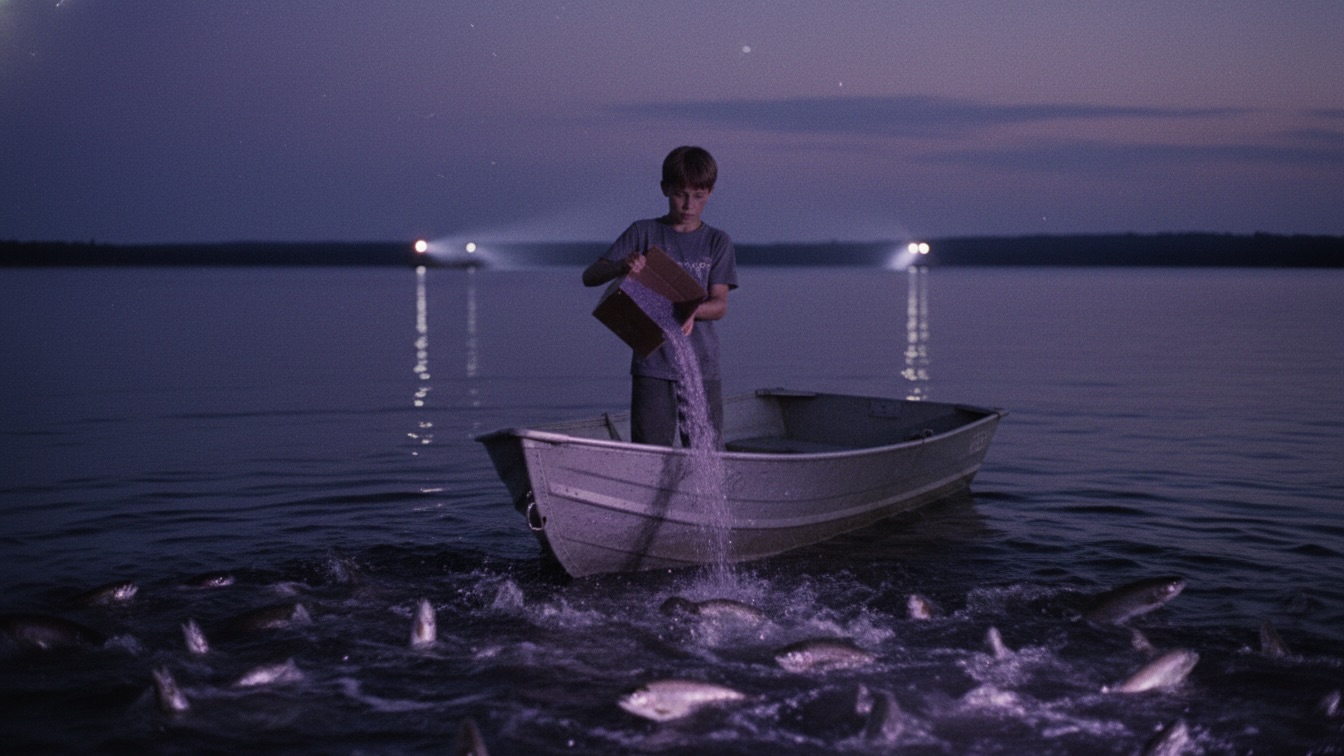
I walked outside to the edge of the dock. The water was flat and blue, but it wasn't a happy blue. It looked like a sheet of plastic that someone had forgotten to clean. Usually, the lake trout would jump and make splashes that looked like silver coins. Now, they just floated near the top. They were swimming in circles. Round and round and round. They looked like they were looking for something they could never find. I could see their ribs. Their skin was pulled tight over their bones, like they were wearing shirts that were two sizes too small. It made my stomach feel tight just looking at them. They didn't even look like real fish anymore. They looked like ghosts that were trying to remember how to be alive. The silence was the worst part. Usually, there were tourists laughing and the sound of engines. Now, it was just the sun and the circles in the water.
"Pardon me, young master of the docks," a voice said. It was a loud, clear voice, like someone speaking in a play at school. I turned around. A woman was standing there. She had a big bag on her shoulder and a hat that looked like a giant mushroom. Her eyes were very sharp, like the eyes of a hawk looking for a mouse. She looked at the empty cafe and then at me. She didn't look like she was from Kenora. People in Kenora wore old t-shirts with holes in them. She wore a vest with a hundred pockets. She looked like she was ready for an adventure, even though the world was breaking.
"I am Stefani," she said, holding out a hand that was covered in dirt and silver scales. "I have traveled from the distant lands of Thunder Bay to witness these tragic, circling creatures. But first, I must inquire: where is the black gold? Where is the bitter liquid that fuels the human soul?" She looked at the coffee machine through the window. Her face fell. It was like watching a balloon lose all its air. She looked at the empty pot and then back at me. Her shoulders slumped. I realized then that she was just as tired as I was. We were both just people standing in the sun, waiting for something that wasn't coming. The lake was full of starving fish, and the town was full of starving people who just wanted a cup of coffee. It was a strange, sad summer, and it was only just beginning.
We sat on the bench outside the cafe. The wood was peeling, and the green paint came off in little flakes that stuck to my pants. Stefani looked at the water. She didn't look like a scientist right then. She looked like someone who had lost their favorite toy. "The blockade is a most cruel mistress," she said. "To think that a world so vast could be brought to its knees by the absence of a simple bean. My brain is a foggy moor, Eli. I cannot think. I cannot calculate. I can only mourn the loss of my morning ritual."
I looked around to make sure Mayor Trent wasn't watching. The Mayor was always walking around, trying to make everyone feel better by telling lies. He would say things like, "The ships are just behind the clouds!" or "We have plenty of tea!" But everyone knew the tea was just dried grass. I leaned in close to Stefani. I could smell the lake on her—not a fishy smell, but the smell of wet stones and old wood. It was a solid, real smell. "I have a secret," I whispered. I felt like I was telling her where a treasure was buried. "In the back of the marina, in the locker room, I have something. My locker is number forty-two. It has a heavy lock on it."
Stefani’s eyes grew wide. She leaned in, too. "Pray tell, what hidden wonders do you guard in such a fortress?" She was being theatrical again, but I could see her hands shaking just a little bit. She really needed the coffee. I felt a weird flutter in my chest. It wasn't like being sick. It was like a little bird was trapped in there, flapping its wings. I wanted to help her. I wanted to see her smile, even if it was just for a second.
"I have a bag," I said. "It's a small bag. It's hidden behind my extra boots. It's full of espresso beans. Real ones. From before the ships stopped." Stefani gasped. She actually put her hand over her heart. It was the most dramatic thing I had ever seen. "A king's ransom!" she cried out. "You possess the last embers of civilization! Why do you share this secret with me, a mere wanderer of the woods?" I looked at my boots. The laces were frayed. I didn't know why I was telling her. Maybe it was because she looked so lonely. Maybe it was because the fish were swimming in circles and I didn't want to swim in circles, too.
"I don't want to drink it alone," I said. It was the truth. Drinking the last of the coffee alone felt like being the last person on Earth. It felt like dying. But if we drank it together, maybe it would feel like a party. Or a secret club. "If you stay and talk to me, I'll share it. We can use the small stove in the back. The Mayor won't see the smoke."
Stefani stood up. She reached out and patted my shoulder. Her hand was warm. "I accept your most gracious invitation, Eli of the Docks. Let us retreat to your sanctuary and conjure the dark spirits of the bean. My company is a small price to pay for such a magnificent gift." We walked toward the locker room. The sun was still hot, but the gray wool in my head felt a little bit lighter. We were like two spies on a mission. The lockers were tall and gray, and they smelled like old sweat and rust. Locker forty-two was at the very end. I turned the dial on the lock. Click. Click. Click. The sound was so loud in the quiet room. I pulled the door open. There, behind my muddy boots, was the silver bag. I picked it up. It was heavy. It felt like holding a bag of gold. I handed it to Stefani. She held it to her nose and closed her eyes. She looked like she was in a dream. "The scent of a world that was," she whispered. "It is a tragedy and a triumph all at once."
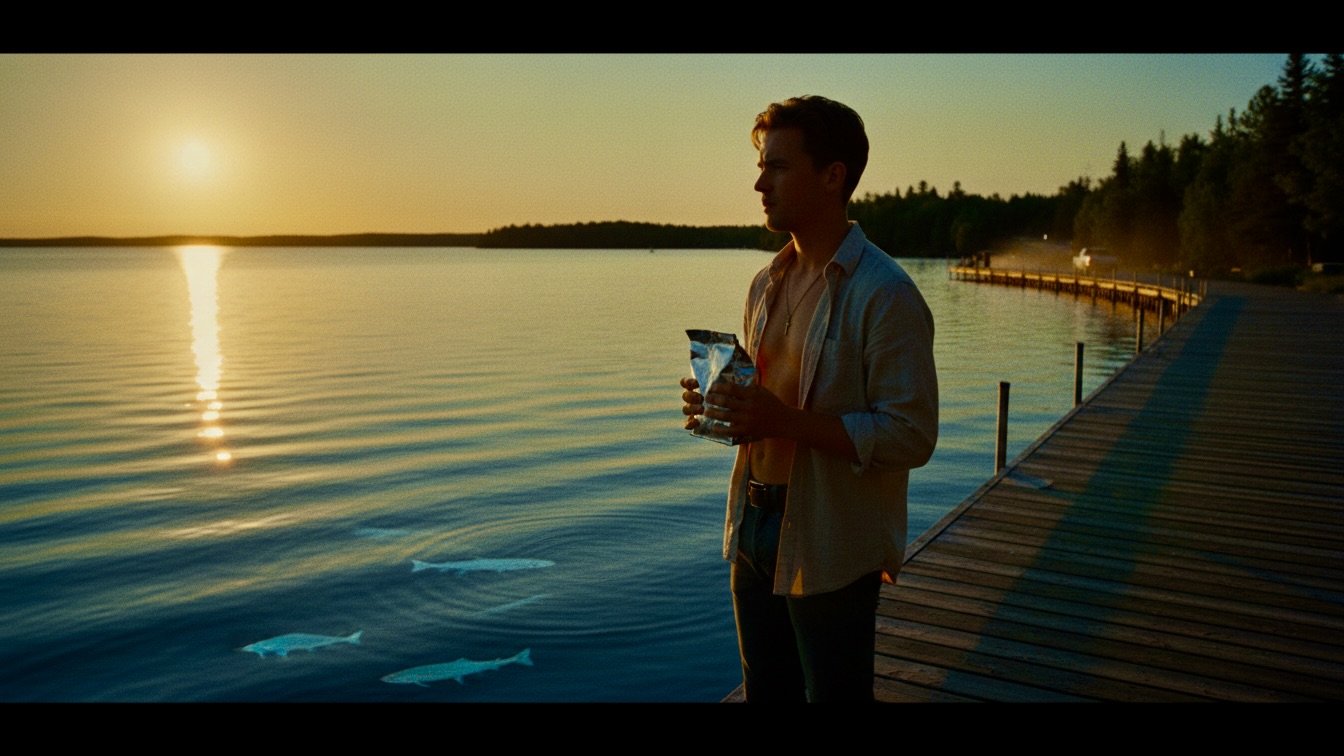
The moon was a thin, white fingernail in the sky. We were sitting on the rocks at the edge of the water. The rocks were still warm from the day, holding onto the heat like a secret. We had the small stove between us. It was a tiny blue flame that hissed in the dark. The smell of the coffee was starting to rise up. it didn't smell like the lake or the dead fish. It smelled like somewhere else. It smelled like a big city with tall buildings and people in suits. It smelled like a morning that wasn't sad. I watched the water. The 'zombie trout' were still there. In the moonlight, they looked like silver ribbons twisting in the dark. They didn't make any noise. They just moved in their slow, hungry circles.
"Why won't they eat?" I asked. I watched a big trout swim right past a bug on the surface. The fish didn't even look at it. It just kept going, its mouth open a little bit. It looked like it was yawning. Stefani was staring at the stove. She looked serious now. The theatrical way she talked was gone for a moment. "It is a metabolic glitch, Eli," she said. Her voice was soft, like she didn't want the fish to hear her. "The deep water grew warm too fast this spring. It was like a fever that never broke. Their bodies think they are working very hard, but their brains have forgotten how to tell them to swallow. They are surrounded by food, yet they perish from emptiness. It is a cruel joke of nature."
I didn't like that. I didn't like the idea of being hungry and forgetting how to eat. It felt like the coffee. We were surrounded by water and trees and sun, but the thing we wanted was gone. "Can you fix them?" I asked. I wanted her to say yes. I wanted her to have a magic potion in one of her hundred pockets. She shook her head. The mushroom hat tilted to the side. "Alas, the powers that be have decided that my scales and my water-tests are of little value. My gold—my research grant—is being stolen away. They wish to spend it on 'digital enforcement.' They want to make sure the children stay off the machines, rather than ensuring the fish stay in the lake. My mission is a ghost ship, sailing toward a shore that no longer exists."
She looked so sad that I wanted to reach out and hold her hand, but I was too shy. Instead, I picked up the small pot. The coffee was ready. It was black and thick, like oil. I poured it into two plastic cups. We didn't have any cream or sugar. We just had the blackness. "To the end of the world," Stefani said, raising her cup. Her voice was back to being grand and theatrical, but her eyes were wet. "And to the young man who keeps the beans."
We drank. It was bitter. It was so bitter it made my tongue curl up, but it was also the best thing I had ever tasted. It felt like a spark of fire going down my throat. It made my heart beat faster. Thump-thump. Thump-thump. For a minute, the gray wool in my head was gone. I could see everything clearly. I could see the tiny lines on Stefani's face. I could see the way the moonlight hit the ripples in the water. We sat there for a long time, just drinking and watching the fish. It was a wake. That's what my grandma called it when someone died and everyone sat around and talked about them. We were having a wake for the coffee and the fish and the world that used to be.
"Come," I said, standing up. "I'll show you something better. I'll take you out in the boat. The deep water is different at night." Stefani looked surprised. "A midnight voyage? How very romantic and daring of you, Eli! Lead the way, my captain." We walked to the small aluminum boat. It was old and the motor was cranky, but it still worked. I helped her in. The boat rocked, and for a second, she had to grab my arm to stay steady. Her skin felt like silk. I pushed us off the dock. The oars made a quiet splash in the water. I didn't start the motor. I didn't want to break the silence. We floated out into the middle of the lake. The water was so deep here that it looked like a black hole. But then, I saw them. Under the boat, there were thousands of them. A massive, silent migration. They weren't swimming in circles here. They were moving in a long, straight line, like a parade of ghosts. They were moving toward the cold, dark center of the lake. They were beautiful and terrible at the same time. We didn't say a word. We just watched the silver shapes move beneath us, a whole world of hungry things looking for a place to rest.
The next morning, the sun was back, and it was meaner than ever. It felt like it was trying to bake the whole town into a cracker. Mayor Trent was standing in the middle of the square, shouting through a megaphone. He looked very proud. Behind him was a big truck with a sign that said 'PEACE INITIATIVE.' "Citizens!" he roared. "The shipping crisis is solved! Our friends in the south have sent us a substitute! We shall have tea for all!" Everyone gathered around. People were cheering. They looked so happy. They thought the waiting was over. I stood with Stefani at the edge of the crowd. She was holding her empty cup from the night before, her fingers tracing the rim.
They opened the back of the truck. There were hundreds of small, brown boxes. The Mayor grabbed one and ripped it open. He reached in and pulled out... a handful of sand. It was decorative sand. The kind you put in a fish tank to make it look pretty. It was brown, just like coffee, but it was just rocks. A logistical mix-up, the driver said. The tea had gone to a construction site in Toronto, and we got the sand. The cheering stopped. It didn't just stop; it died. The silence that followed was heavier than the heat. People just looked at the sand on the ground. It was a joke that nobody found funny.
Stefani sighed. It was a long, tired sound. "My orders have arrived, Eli," she said. Her voice was flat now. No more theater. "The government has decided that the 'zombie fish' are not a priority. They say nature will take its course. They want me back in the city to help with the digital ban. I am to leave at noon." My heart felt like it had been stepped on. I didn't want her to go. She was the only person who knew about the beans. She was the only person who saw the ghosts under the boat. "But the fish," I said. "They're still starving."
"We are all starving, Eli," she said. She looked at me, and for a second, I thought she might kiss me. But she didn't. She just reached out and touched my cheek. Her hand felt dry and hot. "You have been a light in a very dark place. Keep your locker locked. Keep your secrets close. The world is getting very small, and we must hold onto the things that make us feel like humans."
I watched her walk to her truck. It was a big, white truck with a government seal on the door. She put her mushroom hat in the back and climbed into the driver's seat. She didn't look back. The engine started, and it sounded like a growl. She drove away, down the Trans-Canada highway, until the truck was just a tiny white dot in the distance. The dust from the road hung in the air for a long time, turning the sunlight into a hazy, orange curtain.
I went back to the cafe. It was empty and quiet. I found the silver bag of coffee beans on the counter. There were only a few left at the bottom. I picked up the bag and held it to my face. I breathed in as hard as I could. It still smelled like her. It smelled like the night on the rocks and the bitter black liquid and the silver fish moving like ghosts. It was the smell of a world that was gone. I looked out at the lake. The trout were still there, swimming in their circles. Round and round and round. I sat on the floor of the empty cafe and closed my eyes. I held the bag tight against my chest. It was just a piece of silver plastic now, but it was all I had left of the summer. The sun continued to beat down on the roof, and the town stayed silent, waiting for a ship that would never come.
“I reached into the bag, but my fingers found only the smooth, cold bottom, and the realization hit me that I was finally, truly alone in the silence.”