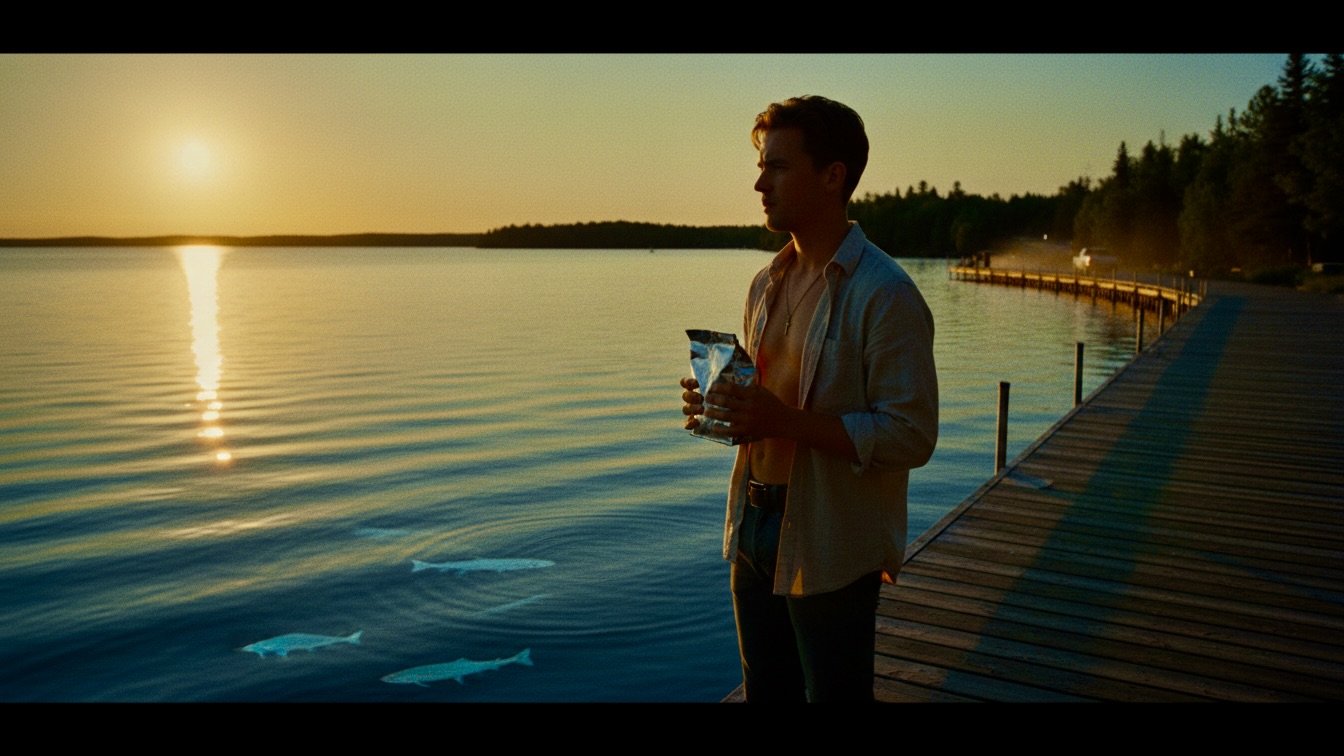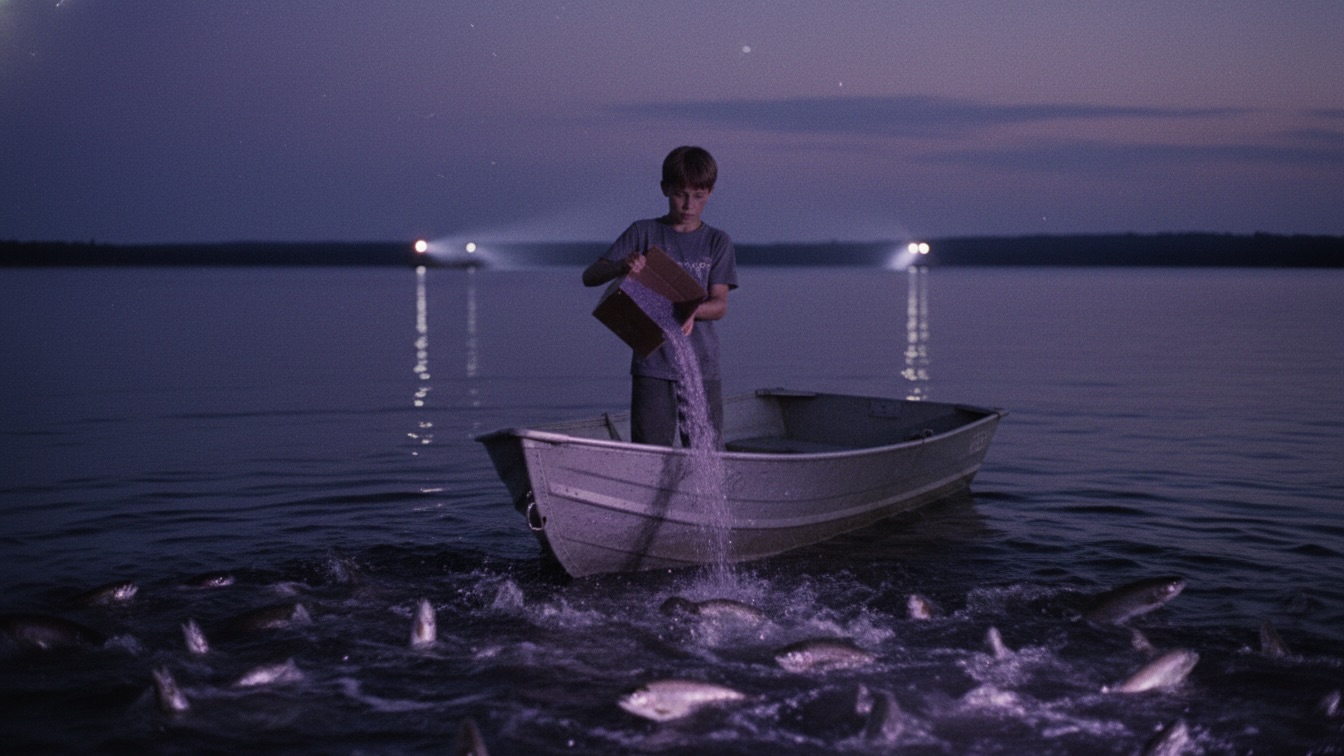
I dropped the bag of sand into the water and the fish stopped their circles for the first time.
The cafe felt like a hollow tooth. It was a giant, empty space where something important used to be. I sat on the stool and kicked my heels against the metal base. Clang. Clang. Clang. The sound went up to the ceiling and bounced back down, but it didn't find anyone to talk to. Stefani was gone. The white truck was a ghost memory on the highway. I looked at the coffee machine. It was still a silver mountain, but now it was a dead one. The little lights that used to blink green and red were dark. It looked like it was pouting. I touched the counter. It was dusty. Not the kind of dust that comes from being dirty, but the kind that comes from being forgotten. The sun came through the big front window in a long, yellow rectangle. It showed every little scratch on the wood. It showed where the coffee mugs had left rings that would never go away. I put my hand in the sunlight. My skin looked orange. I could see the tiny hairs on my arm standing up. It was so hot that the air felt like it was sitting on me, pushing me down into the stool.
Outside, the world was too bright. It was the kind of bright that makes you squint until your face hurts. The trees were a green so deep it looked almost black. They didn't move. There was no wind. The lake was a piece of glass that someone had polished too hard. I could see the reflection of the clouds, but they weren't moving either. Everything was stuck. It was like the whole world had held its breath when Stefani's truck disappeared and forgot how to let it out. I looked at the floor. There were some brown grains near the door. It was the sand. The 'tea' that wasn't tea. The Mayor had left a mess when he ripped the box open. I knelt down and touched it. It wasn't soft like the sand at the beach. It was sharp. It felt like tiny pieces of broken stars. It was a strange, burnt-sugar color, but when the light hit it just right, it shimmered with a weird, oily purple.
I picked up a handful. It was heavy for its size. It didn't slip through my fingers like regular sand. It clumped together, almost like it was trying to hold hands. I wondered if the fish would like it. The fish liked anything that fell into the water. Usually, they would snap at a cigarette butt or a piece of plastic. But these fish, the zombie trout, they didn't snap at anything. They just swam. Round and round. A never-ending circle of hungry ghosts. I thought about the silver bag of beans in my locker. It was almost empty. The secret was getting smaller every day. I felt a lump in my throat that wouldn't go away, even when I swallowed. It felt like a marble was stuck there. It was the feeling of being the only one who knew the truth about the beans and the ghosts under the boat. Stefani knew, but she was in the city now, probably talking to people in suits who didn't care about fish.
Mayor Trent walked past the window. He was wearing his big sash, the one with the gold fringe. He looked like he was marching to a song that only he could hear. He stopped and looked at the sand on the sidewalk. He made a face like he had just bitten into a lemon. He saw me through the glass and waved. It wasn't a nice wave. It was the kind of wave you give to a fly you're about to swat. He opened the door, and the heat from outside rushed in. It felt like a hairdryer was being pointed at my face. The bell above the door gave a tiny, weak jingle. It sounded tired. The Mayor didn't look tired. He looked like he was made of plastic and loud noises. He marched over to the counter and slapped his hand down. The dust jumped.
"Young Eli!" he shouted. His voice was too big for the empty room. "Why do you linger in this mausoleum of caffeine? The day is vibrant! The sun is a golden orb of opportunity! We must celebrate our new shipment!"
I looked at the sand in my hand. "It's just rocks, Mayor. The man said it was a mix-up. We don't have any tea. We just have brown rocks."
The Mayor straightened his sash. He looked at the ceiling like he was talking to a crowd of thousands. "A mere logistical hiccup, my boy! A temporary diversion of resources! We must maintain the facade of progress. The people require hope, and if hope comes in the form of decorative mineral aggregate, then we shall embrace the grit!"
"The grit doesn't taste like anything," I said. I felt bold because I was sad. "You can't drink rocks. The people are going to be mad when they try to boil this."
He leaned over the counter. I could see the little beads of sweat on his forehead. They looked like tiny clear marbles. "They will not boil it, Eli. They will display it! We shall have a competition! The most artistic arrangement of 'Southern Tea Sand' shall win a prize! We are pivoting, you see? We are no longer a town of drinkers. We are a town of decorators!"
He laughed, but his eyes didn't move. They stayed flat and hard, like two blue buttons. He didn't believe a word he was saying. He was just filling the silence with noise so he wouldn't have to hear the world breaking. He turned around and marched back out the door. He didn't even close it all the way. I watched him go. He was a small man in a big sash, walking through a town that was slowly turning into a statue. I looked back at the sand in my hand. It was vibrating. Just a little bit. It was a tiny hum that I could feel in my bones. It wasn't a sound. It was a feeling. Like when you stand too close to a big engine. I decided then that I wasn't going to stay in the cafe. I was going to go to the water. I was going to see what the rocks did to the ghosts.
The walk to the dock felt longer than usual. The sun was a physical weight on my shoulders, like I was carrying a backpack full of lead. My shadow was a short, dark puddle at my feet. The pavement was so hot that I could feel the heat through the soles of my sneakers. It felt like the ground was trying to cook me. I carried a small bucket of the brown grit. It clinked against my leg. Clink. Clink. Clink. The sound was sharp and metallic. I passed the old bait shop. The windows were boarded up with gray plywood. Someone had spray-painted a big red 'X' on the door. It looked like a scar. There were no tourists. There were no cars. Just the heat and the sound of my own breathing. It was a heavy, wet sound. Every breath felt like I was trying to inhale a warm sponge.
I reached the edge of the dock. The wood was silver and cracked from the sun. I could see the splinters standing up like tiny spears. I sat down on the edge and let my legs dangle over the water. The lake didn't look like water today. It looked like thick blue syrup. It didn't splash against the pilings. It just kind of nudged them. I looked down. The trout were there. They were always there now. They were swimming in their tight, perfect circles. They looked like they were part of a machine that had been left on by mistake. Their eyes were cloudy, like someone had rubbed them with soap. They didn't look at me. They didn't look at anything. They just followed the tail of the fish in front of them. Round and round. It made my head spin just watching them. It was a slow, dizzy dance that never ended.
"I brought you something," I whispered. My voice sounded small against the vastness of the lake. "It's not coffee. It's not even food. But it's all I have."
I reached into the bucket and pulled out a handful of the brown grit. The sun caught the purple shimmer. It looked like a handful of crushed jewels. I held it out over the water. I hesitated. What if it hurt them? What if the Mayor was right and it was just decorative sand? But then I thought about the way the fish looked. They were already hurting. They were starving in a lake full of bugs. They were ghosts. I opened my hand. The sand fell in a long, glittering stream. It hit the water with a sound like a thousand tiny bells. It didn't sink right away. It floated on the surface for a second, swirling in the blue syrup. It looked like a galaxy made of dust.
Then, something happened. One of the trout stopped. It didn't just slow down. It stopped dead in the water. The fish behind it bumped into its tail. Then that fish stopped. One by one, the circle broke. The machine fell apart. The trout drifted, their fins twitching. I held my breath. The silence was so loud it made my ears ring. The sand began to sink. It moved in slow, swirling clouds, like smoke underwater. As the grains touched the fish, they reacted. It wasn't a violent reaction. It was like they were waking up from a very long nap. Their gills, which had been moving slowly, suddenly flared. They turned a bright, healthy red. The cloudiness in their eyes began to clear, like a fog lifting from a valley. I could see their pupils again. They were black and sharp.
One trout, a big one with a notched fin, turned its head. It looked up at me. I felt a shock go through my body. It was like a spark of electricity had jumped from the water into my chest. For the first time in weeks, a fish was looking at me. It wasn't a ghost anymore. It was a living thing. It flicked its tail, a powerful, sudden movement that sent a ripple across the surface. Then, it did something even more amazing. It opened its mouth and snapped at a water strider that was skating nearby. The bug disappeared in a tiny splash. The fish swallowed. It had remembered how to eat. I felt a surge of joy so strong it made me want to cry. I reached back into the bucket and threw another handful. And another. I was laughing now, a dry, dusty sound that filled the air. The water was alive. The trout were darting back and forth, their silver bodies flashing in the sunlight. They were no longer swimming in circles. They were hunting.
But as I watched, I noticed something else. The sand wasn't just sinking. It was changing the water. Where the grit touched the lake, the blue syrup turned clear. It was a cold, crystalline clear that looked like ice. I could see all the way to the bottom. I could see the old tires and the sunken branches and the white stones. The clarity was spreading. It was like a drop of ink in a glass of milk, but in reverse. The brown grit was cleaning the lake. It was eating the heat and the stagnation. I looked at my hands. There were a few grains of sand left in my palm. They were glowing. It was a soft, violet light that was hard to see in the bright sun, but I knew it was there. I could feel the hum again, stronger now. It felt like a heartbeat.
"What have you found, Eli?"
The voice was sharp and cold. I jumped, and the bucket tipped over. The rest of the sand spilled onto the dock, some of it falling through the cracks into the water. I turned around. Mayor Trent was standing there. He wasn't wearing his sash anymore. He was wearing a dark suit that looked too heavy for the summer. He was holding a small black device in his hand. He wasn't looking at me. He was looking at the water. He was looking at the clear patch where the fish were darting around. His face wasn't full of fake hope anymore. It was full of something else. It was full of greed. It was the look a hawk gives a mouse right before it dives. He looked at the spilled sand on the dock and then at me. His eyes were like cold stones.
"I asked you a question, boy," he said. His voice was formal and theatrical, but there was a sharp edge to it, like a razor blade hidden in a velvet glove. "What is the nature of this interaction? Why do the creatures respond to the mineral aggregate in such a fashion?"
I scrambled to my feet. I tried to hide the bucket behind my legs. "I don't know, Mayor. I just threw some in. I thought they might be hungry."
He stepped closer. He was so close I could see the tiny lines of red in the whites of his eyes. "Do not play the fool with me. I have spent decades navigating the murky waters of local governance. I know when a miracle is occurring. This is not decorative sand. This is something far more potent. It is a catalyst. A restoration agent. And it was sent to us by mistake."
He reached down and picked up a pinch of the sand from the dock. He held it up to the light. The violet shimmer was unmistakable now. He looked at it with a kind of hunger that made my stomach turn. It wasn't the hunger for food or coffee. It was the hunger for power. He looked back at the lake, where the clear patch was slowly being swallowed by the surrounding blue syrup. The effect of the sand was wearing off. The fish were starting to slow down. The big trout with the notched fin drifted back into a slow, lazy curve. The circle was trying to reform.
"This grit is not for the fish," the Mayor whispered. He wasn't talking to me anymore. He was talking to the sand. "It is for the town. It is for the future. Imagine, Eli! A lake as clear as glass! A town that is the envy of the entire province! We shall be the center of the world again. We shall have everything we lost, and more."
"But the fish need it," I said. I felt small and powerless. "They're waking up. If we give them more, they won't die."
The Mayor looked at me, and for a second, I saw a flash of something that might have been pity. But it was gone in an instant. "The fish are a tragedy, Eli. A lamentable consequence of a changing climate. But a town? A town is an institution. We must prioritize the collective over the individual... even if that individual has scales. You will tell me where the rest of the boxes are. Now."
I looked at the water. The big trout was almost back in its circle. I looked at the Mayor. He was a giant made of cold logic and expensive fabric. I felt the silver bag of beans in my pocket. It was a small weight, but it felt like a mountain. I knew then that I couldn't tell him. I couldn't let him turn the miracle into a decoration. I didn't say a word. I just turned and ran. I ran as fast as my legs would carry me, away from the dock and the Mayor and the clear water that was turning back into syrup. I ran toward the cafe, toward the only place I had left to hide.
The cafe was a dark cave after the blinding sun. I slammed the door and locked it. The bell gave a frantic, jagged jingle. I leaned against the wood, my chest heaving. The air in here was still, but it felt safer. I could hear the blood thumping in my ears. Thump-thump. Thump-thump. It sounded like the motor of my boat. I looked around. The shadows were long and skinny. They looked like fingers reaching out from the corners. I went to the back, to the small room where the extra supplies were kept. There were stacks of paper napkins and boxes of plastic spoons. And there, in the corner, were the three brown boxes the Mayor had left behind. They were plain and boring, with no labels. Just 'SOUTHERN TEA' stamped on the side in black ink.
I knelt down and opened one. The purple shimmer hit me immediately. It was like looking into a deep, dark hole full of stars. The hum was louder here. It was a steady vibration that made my teeth ache. I reached in and grabbed a handful. It felt cold. Not like ice, but like the air inside a basement. It was a heavy, solid cold. I realized that the Mayor wouldn't stop. He would come here. He would take the boxes and use them to make the town look pretty while the fish died. He would turn the miracle into a tourist attraction. I couldn't let him do that. But I was just a kid. I didn't have a big sash or a government truck. I just had a bucket and a secret.
I found an old glass jar on a shelf. It used to hold pickles, but now it was empty and smelled like nothing. I filled it with the sand. I stuffed as much as I could into the jar, tamping it down with a plastic spoon. Then I put the lid on tight. I hid the jar inside my extra boot in my locker. It felt like I was hiding a piece of the moon. I looked at the three boxes. I couldn't hide them all. They were too big. I had to do something with them. I had to get them to the lake, but not where the Mayor could see. I had to take them to the deep water. The place where the ghosts went at night.
I heard a car pull up outside. The engine was loud and smooth. It wasn't the Mayor's car. It was something bigger. I peered through the front window. A black SUV was parked at the curb. Two men in grey suits got out. They didn't look like people from around here. They looked like the people Stefani talked about. The ones who cared about digital bans and enforcement. They looked at the cafe and then at each other. They didn't move like regular people. They moved like they were being controlled by wires. They walked to the door and tried the handle. It didn't budge. One of them knocked. It was a loud, rhythmic sound. Knock. Knock. Knock.
"Open the door, Eli," a voice said. It wasn't the Mayor. It was a woman's voice. It was flat and cold, like a piece of metal. "We know you are inside. We are here for the diverted shipment. It is government property."
I froze. The government? Why did they want the sand? If it was just decorative rocks, why were they sending people in suits? I realized then that the 'mix-up' wasn't a mix-up at all. It was a mistake that someone was trying to fix. The sand wasn't meant for a construction site in Toronto. It was meant for something else. Something big. I looked at the boxes. I couldn't let them have it either. If the Mayor wanted to make the town pretty, the government probably wanted to turn it into a weapon or a fuel. They didn't care about the fish. They didn't care about the lake. They only cared about the 'grit.'
I ran to the back door. It led to the alleyway where the trash cans were kept. I pushed it open and slipped out. The heat hit me like a physical blow, but I didn't stop. I grabbed the first box. It was heavy, and the cardboard was rough against my arms. I lugged it to the end of the alley. My boat was tied up at the small private slip behind the cafe. It was a secret spot that only I used. I tumbled into the boat, the box landing with a heavy thud on the aluminum floor. I went back for the second box. Then the third. My arms were shaking. My breath was coming in short, sharp gasps. I could hear the people in suits talking at the front of the cafe. They were going to break the door down soon.
I untied the ropes. The boat drifted away from the dock. I didn't start the motor. I didn't want them to hear me. I picked up the oars. They felt like they were made of stone. I pushed against the water. The boat moved slowly, cutting through the blue syrup. I headed toward the center of the lake, toward the place where the water turned black. The sun was starting to go down, and the sky was turning a bruised purple. The light was fading, and the world was getting quiet again. I looked back at the town. It looked small and fragile, like a toy village that could be crushed by a single hand.
I reached the deep water. The lake was a vast, empty mirror. I could see the reflection of the first stars. They looked like the grains of sand in the boxes. I stopped rowing and let the boat drift. I looked down into the depths. I couldn't see the fish anymore. They were too far down. But I could feel them. I could feel the thousands of ghosts moving in their silent parade. They were waiting. I stood up in the boat. It rocked beneath me, but I didn't care. I grabbed the first box and ripped it open. The purple light spilled out, illuminating the boat in a ghostly glow. I began to pour.
It was like pouring liquid starlight into the dark. The sand hit the water and exploded into a million tiny sparks. It didn't just sink; it spread. It moved like a living thing, reaching out with long, shimmering fingers. I opened the second box. Then the third. I poured and poured until the entire surface of the lake around the boat was a swirling galaxy of violet and brown. The hum was so loud now that I could feel it in my teeth. It was a song. A deep, vibrating song that spoke of cold water and clean air and a world that wasn't broken. I watched as the sand began to sink. It moved in a massive, glowing curtain, descending into the blackness.
Then, the water began to churn. It wasn't a storm. It was a migration. From the depths, the silver shapes began to rise. Thousands of them. Tens of thousands. The zombie trout were coming to the light. They broke the surface, their bodies flashing in the twilight. They weren't swimming in circles. They were jumping. They were splashing. They were alive. The lake was no longer a piece of glass. It was a boiling pot of silver and violet. I stood in the middle of it, the oars held tight in my hands. I felt like a king. I felt like a god. I had given the ghosts their lives back.
But as the last of the sand disappeared into the depths, I saw something that made my heart stop. A fleet of lights was moving across the water. They were coming from the town. Bright, white searchlights that cut through the darkness like knives. The Mayor and the people in suits were coming. They had seen the light. They had heard the song. And they were coming to take it back. I grabbed the motor's pull-cord. I had to go. I had to get away. But where could I go? The lake was big, but the world was getting very small. I pulled the cord. The motor roared to life, a loud, angry sound that shattered the peace. I turned the boat toward the far shore, toward the dark woods where the roads didn't go. I didn't look back. I just drove, the silver fish leaping in my wake like a thousand tiny stars.
The motor's growl was the only thing I could hear. It was a rhythmic, mechanical heartbeat that kept me moving. The wind was hot on my face, but it felt good. It felt real. Behind me, the searchlights were getting closer. They were like the eyes of a giant monster, searching for me in the dark. I steered the boat into a small cove, a place where the trees hung low over the water. I killed the engine and let the boat glide into the reeds. The silence that followed was heavy. It was the fading light of a world that was changing. I sat there for a long time, my hand resting on the glass jar in my pocket. It was still cold. It was still humming.
I looked out at the lake. The violet glow was gone, but the water felt different. It didn't look like syrup anymore. Even in the dark, I could tell it was clearer. I could hear the fish jumping in the distance. It was a happy sound. A sound of life. I had done it. I had saved them. But I knew I couldn't stay. The Mayor and the grey suits would find me. They would take the jar. They would ask me where the rest of the sand went. And then they would turn the lake into something it wasn't meant to be. I had to find Stefani. She was the only one who would understand. She was the only one who could help me figure out what the grit really was.
I stepped out of the boat and into the shallow water. It felt cool and crisp against my ankles. I pulled the boat up onto the muddy shore and covered it with branches. It looked like a pile of drift wood. I shouldered my small bag. Inside was the silver bag of coffee beans, my extra socks, and the glass jar of sand. It was everything I owned. It wasn't much, but it felt heavy. I looked up at the stars. They were bright and clear, like the grains of grit. I didn't know which way the highway was, but I knew the direction Stefani had gone. She had gone south. Toward the city. Toward the place where the big boats were stuck.
I began to walk. The woods were thick and dark, but I wasn't afraid. I felt like the fish. I had woken up. The gray wool in my head was gone, replaced by a sharp, cold clarity. I moved through the trees like a ghost, my footsteps silent on the damp earth. I could see things I hadn't noticed before. The way the moonlight hit the moss. The way the owls watched me from the high branches. The world was giant, and I was small, but I wasn't lost. I was moving. I was heading toward a shore that did exist, even if I hadn't seen it yet.
Hours passed. The sky began to turn a pale, dusty grey. The first light of morning was coming. I reached the edge of the woods and saw the highway. It was a long, black ribbon that stretched out into the distance. It looked like the path the fish took in the deep water. I sat on a rock and waited. I pulled the silver bag of beans out of my bag. There were only three left. Three little brown seeds of a world that was gone. I put one in my mouth and bit down. It was bitter. It was so bitter it made my eyes water. But it was also strong. It made my heart beat faster. Thump-thump. Thump-thump. I felt the spark of fire go down my throat.
I looked at the jar of sand. The purple light was faint in the morning sun, but it was there. It was a promise. It was a piece of the future. I didn't know what would happen when I got to the city. I didn't know if I would find Stefani. I didn't know if the government would catch me. But I knew one thing. I wasn't going to swim in circles anymore. I was going to move in a straight line. I was going to find the source of the grit. I was going to find out why the world was breaking and how to fix it.
A truck appeared in the distance. It was a big, white truck, just like Stefani's. My heart leaped in my chest. I stood up and waved my arms. The truck slowed down. It hissed as it came to a stop. The driver leaned out the window. He was an old man with a face like a wrinkled map. He looked at me, then at my bag, then at the empty highway behind me. He didn't ask any questions. He just opened the door.
"Where you headed, kid?" he asked. His voice was gravelly and kind.
"South," I said. "I'm going to the city."
He nodded. "Get in. It's a long drive, and the sun's going to be a mean one today."
I climbed into the cab. It smelled like old vinyl and cold air. It was a good smell. A real smell. I settled into the seat and held my bag tight against my chest. The truck began to move. I looked out the window as we drove past the sign that said 'WELCOME TO KENORA.' It was peeling and faded, a relic of a time that was ending. I looked back at the lake one last time. It was a bright, shimmering blue. The fish were jumping. The water was clear. I closed my eyes and listened to the hum of the jar. It sounded like a song. A song about a morning that wasn't sad. A song about a world that was just beginning to wake up. And as the truck sped down the highway, I realized that I wasn't alone. I had the beans, I had the grit, and I had the memory of the silver fish moving like ghosts in the dark. I was ready for whatever came next.
“The truck's gears ground loudly as we climbed the first hill, and I realized I had never told anyone where I hid the jar.”