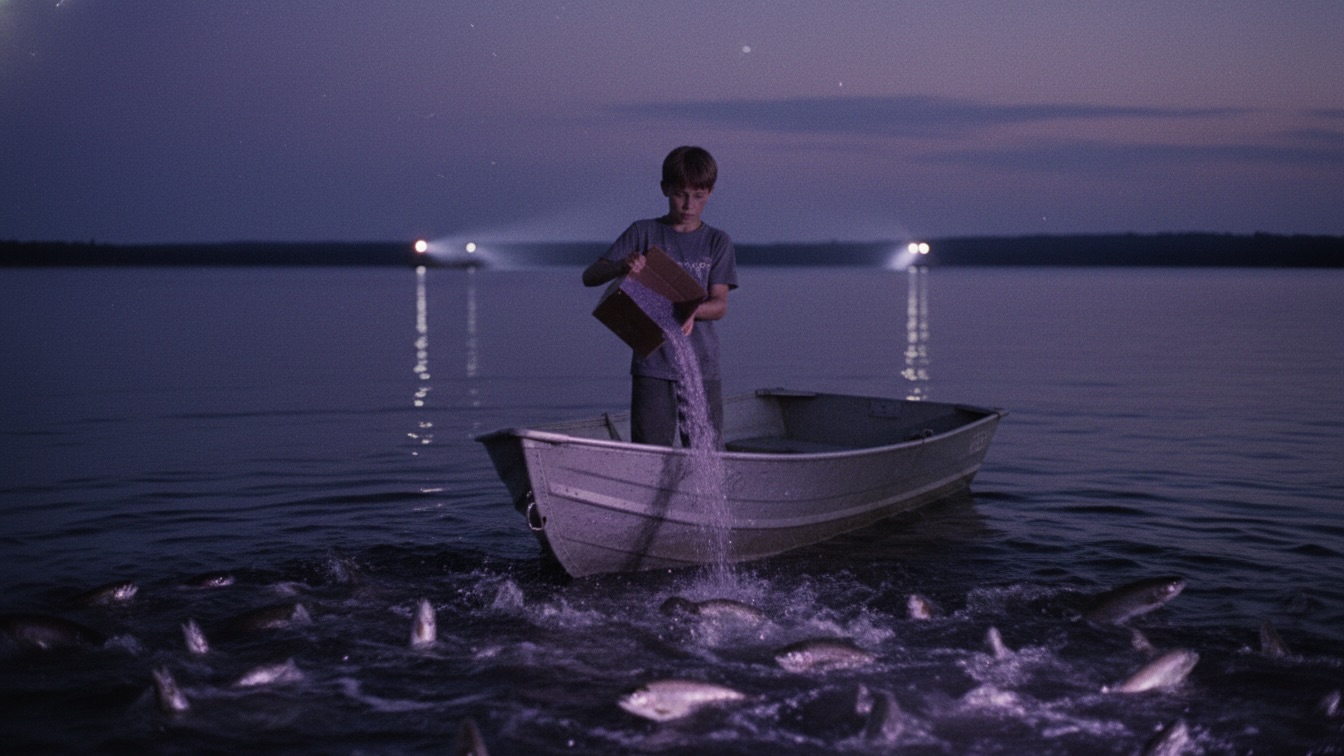
The story begins in the oppressive, stagnant atmosphere of a dying cafe where Eli mourns the departure of his friend, Stefani. He discovers that the "Southern Tea Sand" left behind by the Mayor is not mere decorative grit but a potent, shimmering substance that hums with an otherworldly energy. Upon testing the grit in the lake, Eli witnesses a miraculous transformation as the lethargic "zombie trout" regain their vitality and the murky water turns crystalline.
This discovery brings him into direct conflict with Mayor Trent, who views the substance as a tool for political optics and personal power rather than ecological restoration. As government agents arrive to reclaim the "misdirected" shipment, Eli realizes the grit is a high-stakes catalyst that neither the local nor federal authorities can be trusted with. He chooses to prioritize the life of the lake over human greed, lugging the heavy boxes to the deep water and releasing the grit in a grand, sacrificial gesture.
The chapter concludes with Eli’s narrow escape as he flees the town of Kenora, heading south toward the city in search of Stefani. He carries with him a final jar of the grit and the last few coffee beans, symbols of a world that is either ending or being reborn. His journey marks a definitive break from the stagnation of his past, as he hitches a ride with a stranger, determined to uncover the truth behind the breaking world.
A primary theme of the narrative is the tension between organic restoration and artificial preservation. The Mayor represents a desperate attempt to maintain a "facade of progress," preferring to use the grit as a decorative element to mask the town's decay rather than using it to heal the environment. Eli, conversely, recognizes the intrinsic value of the living world, understanding that the fish are not merely "tragedies" but vital components of a functioning reality. This conflict highlights a psychological divide between those who seek to control nature for status and those who seek to commune with it for survival.
The concept of stagnation and "holding one's breath" serves as a powerful metaphor for the town's psychological state. The world is described as stuck, with the lake resembling syrup and the fish swimming in endless, mindless circles. This reflects a collective trauma where the inhabitants have lost their sense of purpose and direction. The grit acts as a literal and figurative catalyst, breaking the "machine" of the trout’s circular swimming and forcing the world to exhale, even if that exhale leads to a chaotic and uncertain future.
Another significant theme is the burden of secret knowledge and the isolation it creates. Eli carries the weight of the coffee beans and the truth about the grit like physical objects, describing a "marble" stuck in his throat. This reflects the psychological isolation of the whistleblower or the visionary who perceives a reality others are either too greedy or too fearful to acknowledge. His decision to flee is not just an escape from the law, but a movement toward a community—represented by Stefani—where his knowledge might finally be shared and validated.
Eli is a character defined by sensory sensitivity and a profound sense of loss. He experiences his environment with an almost painful intensity, feeling the heat as a physical weight and the silence as a hollow space. This heightened perception suggests a high degree of empathy, which explains why he is the only one to notice the true nature of the trout’s suffering. He views the fish not as resources, but as "hungry ghosts," reflecting his own feelings of being haunted by the departure of Stefani and the slow death of his home.
His psychological journey in this chapter is one of reclamation and agency. Initially, he is passive, kicking his heels against a stool in a "hollow tooth" of a cafe, but the discovery of the grit provides him with a sense of mission. By choosing to dump the grit into the lake, he transitions from a victim of circumstances to a steward of the environment. He rejects the "gray wool" of his previous stagnation, opting for a "sharp, cold clarity" that allows him to navigate the woods and the highway with newfound purpose.
Mayor Trent serves as a psychological foil to Eli, embodying a persona of performative authority that masks a deep-seated insecurity. He is described as being made of "plastic and loud noises," suggesting that his identity is entirely constructed from his social role. His insistence on wearing a gold-fringed sash in a dying town indicates a delusional need to maintain the "facade of progress" at all costs. He is a man who fears the silence of the breaking world and fills it with "logistical hiccups" and "decorative mineral aggregates."
His reaction to the grit reveals a predatory nature driven by a "hunger for power" rather than a desire for communal healing. He views the miracle of the fish’s restoration through the lens of greed, seeing it as a way to make the town the "envy of the entire province." His dismissal of the fish as a "lamentable consequence" shows a profound lack of empathy and a commitment to institutional survival over biological life. Trent is a man who has become a "statue" of his own ego, unable to move or change even as the world around him begins to vibrate with new energy.
The narrative voice is heavily grounded in sensory metaphor, creating an atmosphere that feels both grounded and surreal. The comparison of the cafe to a "hollow tooth" and the lake to "blue syrup" establishes a sense of rot and stagnation that the reader can feel physically. These descriptions serve to heighten the impact of the "grit," which introduces a new sensory palette of violet light and metallic humming. The contrast between the "dust of being forgotten" and the "liquid starlight" of the sand marks the shift from a dying world to a burgeoning mystery.
Pacing in the chapter mirrors Eli’s internal state, moving from the slow, rhythmic "clang" of his heels to the frantic, breathless escape in the boat. The author uses short, punchy sentences during the moments of action to convey a sense of urgency and high stakes. For example, the description of the fish waking up is broken into small, observational fragments that mirror Eli’s own stunned realization. This shift in tempo effectively draws the reader from a state of mournful contemplation into a high-stakes ecological thriller.
The use of color is particularly significant in establishing the tone and the supernatural elements of the story. The "yellow rectangle" of the sun and the "brown grains" of the sand initially suggest a mundane, parched environment. However, as the "oily purple" and "violet light" emerge, the color palette shifts toward the ethereal, signaling the presence of a power that transcends the local politics of Kenora. This visual progression reinforces the idea that the world is moving away from its old, faded reality and into a vibrant, albeit dangerous, new era.


