The truck interior was a museum of missing things, where the silence spoke louder than the roaring engine outside.
The truck cab was a metal box that didn't know how to be a home. It was filled with things that weren't there. There was a square of darker gray on the dashboard where a photo used to be taped. There was a round ring in the dust of the console where a coffee mug had sat for a thousand miles. Now, those spaces were just holes. I sat in the passenger seat and felt the ghost of whatever used to fill them. The sun was a white hammer hitting the windshield. It didn't make the cab bright; it made it sharp.
Every edge of the plastic dashboard looked like it could cut. The seats were covered in a fabric that felt like dried lizard skin. It scratched at the back of my legs. I held my bag tight. The jar inside was cold. It was the only cold thing in the world. Outside, the highway was a black river of melted tar. The heat made the air above the road wiggle. It looked like the world was trying to turn into water, but it was failing. The trees on the side of the road weren't green anymore. They were the color of old pennies. They didn't have leaves so much as they had sharp, brittle fingers that poked at the sky.
Silas, the driver, didn't look at the road the way most people do. He looked at it like he was reading a book that was written in a language only he knew. He was old, but his hands were like the roots of a tree—knotted and strong and stuck to the steering wheel. He wore a hat that had lost its shape. It looked like a tired bird resting on his head. He didn't speak for a long time. The only sound was the deep, growling rumble of the engine. It was a sound you didn't just hear; you felt it in your stomach. It felt like the truck was eating the road. I looked at the glovebox. The handle was missing. There was just a jagged hole where you were supposed to pull. It reminded me of the cafe. It reminded me of the way the Mayor looked when he saw the clear water. A hole where a person’s heart should be. I reached into my bag and touched the glass of the jar. The hum was there. It was a tiny, electric bee buzzing against my fingertips.
"You possess the posture of a fugitive, young Eli," Silas said. His voice was like two stones rubbing together. It was formal, like he was delivering a speech to a king. "Do you find the upholstery of this chariot to be insufficient for your comfort? Or is it the weight of your cargo that prevents your spine from aligning with the divine geometry of the seat?"
I blinked at him. I didn't know what geometry was, but I knew the seat was lumpy. "I'm just holding my bag," I said. "It's important. I can't let it fall."
Silas steered the truck around a long curve. The metal of the cab groaned. "Importance is a relative specter, boy. A man once told me his collection of thimbles was the anchor of his soul. Then he lost them in a flood and found he could float quite well without them. Tell me, does your bag contain anchors or wings?"
"It contains sand," I said. I felt the secret get heavy in my mouth. "But it's not regular sand. It makes the fish wake up. It makes the lake turn into glass. The Mayor wants it. The people in the suits want it too."
Silas let out a sound that might have been a laugh, but it sounded more like a cough. "The Grey Suits. They are the architects of the mundane. They crave the extraordinary only so they may dismantle it and file the pieces in a cabinet of dust. If your sand is indeed a miracle, you are carrying a lightning bolt in a cardboard box. A most precarious endeavor."
I looked out the window. A sign flashed past. It said '300 KM TO THE CITY.' The city was a place I had only seen in pictures. It looked like a forest made of glass and steel. I wondered if the fish there were ghosts too. I wondered if Stefani was standing on a sidewalk somewhere, looking for a white truck that wasn't coming. The light was starting to fade, turning the orange of a bruised peach. The shadows of the telephone poles stretched across the road like long, skinny fingers. They seemed to be trying to trip the truck. I felt a sudden, sharp pang in my chest. It wasn't a pain, exactly. It was the feeling of being far away from the only place I knew, even if that place was broken. I missed the sound of the lake hitting the dock. I missed the way the silver mountain of the coffee machine looked in the morning. Here, there was only the engine and the heat and the missing things.
"Will the city be hot?" I asked. My voice sounded small in the big cab.
"The city is a furnace that never sleeps," Silas replied. He adjusted his hat. "It is a collection of stone and glass designed to trap the sun's arrogance. You shall find no respite there, unless you seek the Concrete Shore. That is where the water meets the ambition of man. It is a place of great friction."
I didn't like the sound of friction. It sounded like something that would rub my skin raw. I looked at the jar again. The violet light was getting stronger as the sun went down. It was a soft, pulsing glow that lit up the bottom of my bag. It looked like a heart beating. I wondered if the grit was lonely. I wondered if it wanted to be back in the boxes, or if it liked being in a pickle jar in a truck. I thought about the big trout with the notched fin. Was it still hunting? Or had the clear water turned back into blue syrup the moment I left? The world felt like it was made of sand that was slipping through my fingers. No matter how hard I squeezed, I couldn't hold onto it all.
Silas reached out and flipped a switch on the dashboard. The headlights cut through the gathering dark. They were two yellow eyes searching for a way out. "We shall arrive under the cover of the moon's indifference," he said. "Do not fear the Grey Suits, Eli. They are slow. They move with the weight of their own bureaucracy. But do fear the Mayor. A man with a sash and a dream is a dangerous beast indeed."
I nodded, though I wasn't sure if he could see me. I felt the truck hit a bump, and the jar clinked against the coffee beans. It was a sharp, clear sound. Like a bell ringing in a graveyard. I closed my eyes and tried to imagine the city. I imagined it as a giant lake, but instead of water, it was full of people swimming in circles. I hoped I could find the way to the Concrete Shore. I hoped I could find Stefani before the light went out for good.
The clock on the dashboard was broken. The little red needle just twitched back and forth, never moving past the number six. It was a nervous sound. Tick. Tick. Tick. It felt like the truck was anxious to get where it was going, even if Silas wasn't. The fading light had turned the interior of the cab into a cavern of deep blues and sharp blacks. I could no longer see the dust on the console, only the shapes of things. The missing handle on the glovebox looked like a dark mouth waiting to snap shut. I shifted my weight on the lizard-skin seat. My legs were sticky. The heat hadn't left; it had just become heavy. It felt like a wet towel draped over my head. Silas was a silhouette against the road. His profile was sharp, like a bird of prey carved out of wood.
"Pray tell, young wanderer," Silas began, his voice cutting through the mechanical hum. "What manner of destination do you envision at the end of this asphalt ribbon? Do you seek a sanctuary, or a stage for your particular brand of revolution?"
I thought about the word revolution. It sounded like the circles the fish made. "I just want to find Stefani," I said. "She's the only one who knows about the beans. She's the only one who didn't look at the sand like it was just rocks."
Silas turned the wheel slightly, the truck swaying like a ship on a gentle sea. "Ah, the quest for the kindred spirit. A classic narrative arc. Yet, you must consider the possibility that the city has altered her composition. The urban sprawl has a way of grinding the silver from a person’s soul and replacing it with leaden pragmatism. Will you recognize her if she no longer speaks the language of the lake?"
"She'll remember me," I said. I felt a surge of heat in my face that wasn't from the summer. It was a sharp, stinging certainty. "We found the ghosts together. You don't forget something like that. It’s like having a secret that only two people can breathe."
Silas nodded, his hat bobbing. "A shared inhalation. A poetic sentiment. However, the Grey Suits possess a different sort of breath. They breathe the air of ledgers and law. They have been following this truck since the last toll booth. Did you notice the black SUV with the singular headlight? It possesses a most persistent gaze."
I spun around in my seat, my heart slamming against my ribs like a trapped bird. Through the small, rectangular back window, I could see it. Far behind us, a single eye of white light was bobbing in the dark. It didn't move closer, and it didn't fall back. It just watched. It was a cold, mechanical eye. I felt the jar in my bag vibrate. The hum was getting louder. It wasn't just a feeling anymore; I could hear it. It was a low, vibrating drone that harmonized with the truck's engine. It sounded like the world was singing a song under its breath.
"Are they going to stop us?" I whispered. My throat felt like it was full of dry crackers.
"They are observers of the cosmic dance, Eli," Silas said, his tone remains theatrical and calm. "They shall wait for the moment of maximum vulnerability. The city limits provide a most excellent theater for such an intervention. We must navigate the outskirts with the stealth of a shadow in a coal mine."
I looked at the dashboard. The needle was still twitching at the six. I felt like the needle. I was moving, but I wasn't going anywhere. I was stuck in the middle of the night, between a town that was dying and a city that was a furnace. I reached into my pocket and pulled out one of the three remaining coffee beans. It was small and hard and dark. I held it up to the light of the dashboard. It didn't glow like the grit, but it felt solid. It felt like a piece of the earth that hadn't been turned into sand yet. I put it back. I couldn't eat it yet. I had to save it for when the world got even darker.
"The Mayor said the sand was for decoration," I said, trying to distract myself from the single eye behind us. "He said we were going to have a competition for the most artistic arrangement. He was lying, wasn't he?"
Silas let out a dry, rattling sound. "The Mayor is a weaver of illusions, boy. He understands that the populace requires a colorful shroud to cover the corpse of their expectations. To him, your sand is a paint. To the Grey Suits, it is a fuel. To you, it is a miracle. The tragedy of the world is that everyone sees the same object but perceives a different reality. Friction is the inevitable result of such dissonance."
I didn't want to be friction. I wanted to be the clear water. I wanted the fish to jump and the lake to be cold. I looked out at the passing landscape. There were no more trees. Now, there were giant metal towers with wires stretching between them. They looked like massive spiders waiting for the truck to get caught in their web. The sky was no longer purple; it was a muddy, glowing orange. The city was close. I could feel its heat pushing against the windshield. It was a different kind of heat than the sun. It was the heat of a million lightbulbs and a million car engines and a million people all breathing at once. It felt crowded, even though we were still in the middle of nowhere.
"Prepare yourself, young Eli," Silas said, his hands tightening on the wheel. "The Concrete Shore approaches. We shall soon see if your jar holds the power to still the waters of the urban abyss, or if it is merely a beautiful bauble in a world of grey."
I gripped my bag. The single eye behind us seemed to grow brighter. The tick of the broken clock was getting faster. The world was shrinking down to the size of the truck cab, and the only thing that mattered was the cold glass against my side. I wasn't a kid anymore. I was a carrier of the light. And the light was very, very heavy.
The highway began to split into a dozen different paths, like a giant snake with too many tails. The asphalt was no longer smooth; it was patched with silver metal plates that went 'ba-dump, ba-dump' under the tires. Each jolt sent a shiver through the truck and through my teeth. The light from the city was so bright now that I could see the individual hairs on Silas’s arms. They were white and wiry, like tiny lightning bolts. The cab felt smaller than ever, squeezed by the towering concrete walls that had replaced the spider-web towers. There were signs everywhere, glowing in neon pink and electric blue. They were shouting words I didn't have time to read. 'BUY,' 'GO,' 'EAT,' 'NOW.' It was a loud world, even with the windows rolled up.
"Behold the architecture of distraction," Silas proclaimed, waving a gnarled hand at the shimmering skyline. "Each light represents a desire, and each desire is a brick in the wall of the soul. We are navigating a labyrinth of our own making, Eli. Do not let the neon blind you to the path of the true grit."
I looked down at my bag. The violet glow was leaking through the canvas. It was so bright it made the lizard-skin seat look purple. The hum had become a physical weight, a vibration that made the soles of my feet itch. I felt like the jar was trying to tell me something, but it was speaking in a language of shakes and shimmers. The single eye behind us was still there, but now it was joined by others. A whole fleet of black SUVs was merging into the lane behind us. They moved in perfect synchronization, like a school of metal sharks. They didn't have turn signals. They didn't have faces. They just had the cold, flat reflection of the city on their windshields.
"The Grey Suits are multiplying," I said, my voice trembling. "They’re right behind us, Silas. There are five of them now. Maybe six."
Silas didn't look back. "The numerical superiority of the adversary is a common trope in the drama of existence. It serves only to heighten the eventual triumph, or to provide a more spectacular backdrop for the fall. We shall not be deterred by the multiplication of shadows. Observe the overpass ahead. It is the gate to the industrial district, where the Concrete Shore begins its descent into the harbor."
As we drove under the massive concrete bridge, the sound changed. The roar of the engine was joined by a high-pitched whistling, the wind whipping through the narrow gaps between the buildings. It sounded like a thousand flutes played by ghosts. The smell of the air changed too—wait, no, it didn't smell like anything. It was just flat. Empty. Like the air in a brand-new plastic bag. I realized I was holding my breath. I let it out in a long, shaky sigh. My chest felt tight, as if the city were a giant hand squeezing the air out of my lungs.
Suddenly, the truck swerved. Silas yanked the wheel to the left, and I was slammed against the door. The jar in my bag let out a sharp 'clack.' I looked out the window. One of the black SUVs had pulled up alongside us. The window was tinted so dark it looked like a hole in the world. But as the truck corrected its course, the SUV’s window slid down just an inch. I saw a pair of silver-rimmed glasses and a mouth that was a straight, thin line. It wasn't a human mouth. It was a seam in a piece of grey leather.
"They’re trying to push us off the road!" I yelled. "Silas, they're hitting us!"
"A crude tactic for such sophisticated agents!" Silas shouted back. His theatricality was gone, replaced by a fierce, wild energy. He shifted the gears with a violent grace, the truck’s engine screaming in protest. "They seek to disrupt the vessel of the miracle! But this chariot was forged in the fires of a thousand long-haul nights! It shall not yield to the pressure of the mundane!"
He slammed his foot on the brake for a split second, then floored it. The truck let out a cloud of black smoke that engulfed the SUV. I saw the silver glasses disappear into the soot. We surged forward, the truck shaking so hard I thought the bolts would fly out of the floor. We were entering a world of rusted warehouses and giant piles of scrap metal. The neon lights were gone, replaced by flickering yellow streetlamps that cast long, jagged shadows. This was the edge of the city. The place where things were broken and forgotten. It felt more like home than the bright part did.
"The harbor is near!" Silas cried. "I can feel the stagnation of the water! It is a mirror of the city’s heart, Eli! A dark, oily expanse that has forgotten the taste of the sky! Your grit must find its mark before the Grey Suits close the circle!"
I reached into my bag and pulled out the jar. It was vibrating so hard it was difficult to hold. The violet light was blinding now, filling the entire cab with a ghostly radiance. I looked at the pickle jar lid. It was just a piece of cheap metal, but it was holding back something that felt like a storm. I looked at Silas. His face was lit by the purple glow, making him look like an ancient wizard from a book. He wasn't Silas the driver anymore. He was Silas the guardian.
"Where do I put it?" I asked. "Where does the grit go?"
"The Concrete Shore!" he yelled over the roar of the wind and the engine. "There is a pier that reaches out like a desperate finger into the black. You must go to the very tip! You must give the city back its reflection!"
Behind us, the black SUVs were emerging from the smoke. They were faster than the truck. They were gaining on us, their headlights cutting through the dark like searchlights in a prison yard. I saw the pier ahead. It was a long, gray stretch of wood and stone that disappeared into a wall of fog. Beyond the fog, I could hear the low, rhythmic thumping of the harbor. It didn't sound like the lake. It sounded like a giant, slow-beating drum. It was the sound of the Concrete Shore. And I was the only one who could make it stop.
The truck skidded to a halt at the base of the pier, the tires screaming against the salt-crusted concrete. The smell—no, the sensation—of the harbor was a cold, wet pressure against my skin. It wasn't refreshing like the lake. It was heavy, like a damp wool coat. Silas didn't turn off the engine. It stayed running, a low, growling beast that seemed to be warning the shadows to stay back. He turned to me, his eyes bright in the purple glow of the jar. He reached out and touched my shoulder with a hand that felt like warm leather.
"The stage is set, Eli," he said. His voice was no longer theatrical. It was quiet and sharp, like a needle. "The actors are in place. The audience of the night is waiting. You must run. Do not look back at the truck. Do not look back at the Grey Suits. Look only at the water. It is the only truth that remains."
I didn't wait. I grabbed the jar and scrambled out of the cab. The moment my feet hit the ground, I felt the heat of the city again, but it was being fought back by the cold breath of the harbor. I ran. The pier was made of massive wooden planks that were slippery with green slime. Every step was a gamble. I could hear the black SUVs screeching to a stop behind me. I heard the doors slam. Thud. Thud. Thud. It sounded like the world was being hammered shut. I didn't look. I just kept my eyes on the fog at the end of the pier.
"Stop the boy!" a voice shouted. It was a woman's voice, flat and cold, like a sheet of ice. "He is in possession of unrefined temporal aggregate! Secure the jar!"
I didn't know what temporal aggregate was, but I knew they wanted my grit. I squeezed the jar tighter. The hum was so loud now it was a physical pain in my ears. It felt like my head was full of bees. I reached the middle of the pier. The fog was thick here, tasting of salt and old iron. I could see the shapes of giant cranes in the distance, looking like prehistoric monsters frozen in time. The water below was a black, oily soup. It didn't move. It didn't splash. It just sat there, suffocating under the weight of the city.
I reached the end of the pier. There was nothing left but a rusted iron railing and the vast, dark emptiness of the harbor. I stopped and turned around. The Grey Suits were coming out of the fog. There were four of them. They moved with a terrifying, rhythmic precision. They didn't run; they marched. Their suits were the color of the concrete, and their faces were blank, like unpainted dolls. The woman in front had silver hair that looked like it was made of wire. She held out a hand. It was a long, thin hand with fingers that looked like they were designed for counting money, not for touching water.
"Relinquish the vessel, Eli," she said. Her voice didn't need to be loud to be scary. "It is a dangerous anomaly. It does not belong in the hands of a child. It is a resource that requires management. Logic. Enforcement."
"It's for the fish!" I shouted. My voice sounded tiny against the roar of the city behind them. "It's to make the water clear! You just want to turn it into a fuel! You want to put it in a box!"
She stepped closer. The other suits spread out, forming a semi-circle around me. I was trapped between the grey and the black. "The clarity of the water is a secondary concern," she said. "The stability of the system is paramount. You are a disruption. Give us the jar, and you may return to your truck. Silas is already being processed."
My heart stopped. Silas. They had him. I looked at the jar. The violet light was so intense now it was turning the fog into a glowing cloud. The hum was a scream. I realized then that the grit didn't want to be in the jar anymore. It didn't want to be a miracle in a pickle jar. It wanted to be free. It wanted to find the ghosts. I looked at the woman with the silver hair. I looked at her cold, silver eyes. She didn't see the light. She only saw the jar.
"You're wrong," I said. I felt a strange, cold calm wash over me. It was the feeling of the lake in the morning. "It's not an anomaly. It's the world waking up."
I didn't wait for her to move. I turned to the water and raised the jar high above my head. I didn't unscrew the lid. I didn't have time. I just threw it. I threw it with every bit of strength in my small arms. I watched it sail through the air, a streak of violet lightning cutting through the fog. It seemed to hang there for a second, a piece of the moon falling into the abyss. Then, it hit the surface.
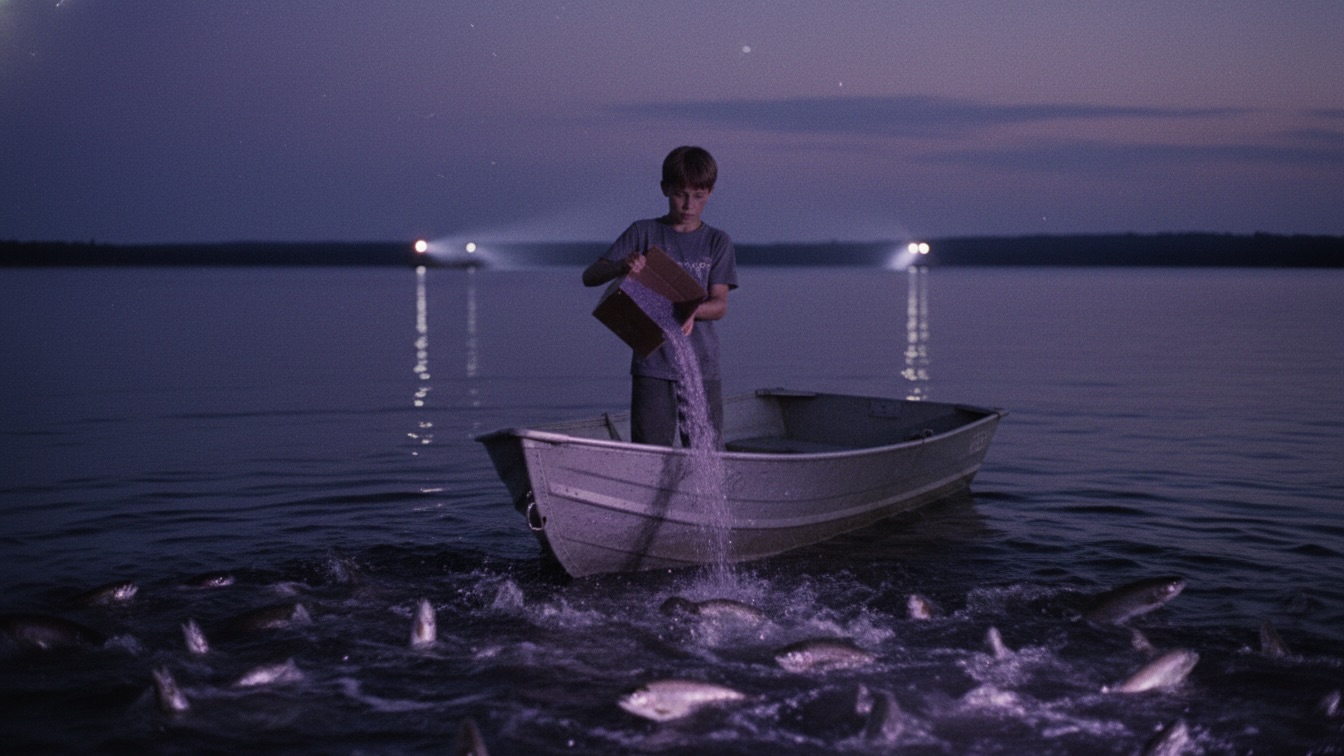
There was no splash. There was an explosion of light. A massive, silent wave of violet energy erupted from the point of impact, rushing outward in a perfect circle. It hit the pilings of the pier, and the wood suddenly looked new and strong. It hit the fog, and the air became crystal clear. It hit the black, oily water, and for a hundred yards in every direction, the harbor turned into a pane of pure, blue glass. I could see the bottom. I could see the sunken ships and the lost anchors and the white stones. And I could see the fish. Not trout, but giant, silver salmon that had been hiding in the dark. They were rising. Thousands of them, their scales shimmering with the violet light. They were jumping, their bodies cutting through the air like silver blades.
The Grey Suits froze. The woman with the silver hair covered her eyes, as if the light were a physical blow. They looked small and fragile against the sudden beauty of the water. The city behind them seemed to dim, its neon lights looking tawdry and fake compared to the radiance of the harbor. The hum was gone, replaced by the sound of a thousand splashes. The sound of life returning to the Concrete Shore.
I stood at the edge of the pier, my hands empty and my heart full. I looked out at the clear water, and for a moment, I thought I saw a white truck parked on a distant bridge. I thought I saw a girl with golden hair standing by the railing, looking down at the silver fish. I didn't know if it was Stefani. I didn't know if Silas was okay. I didn't know what the Grey Suits would do to me now that the jar was gone. But as the first light of a new summer morning began to crawl over the horizon, I knew one thing for sure. The ghosts were gone. The world was awake. And I was finally standing on a shore that was real.
“I reached for the iron railing as the silver-haired woman stepped into the light, her hand outstretched, but my eyes were fixed on the girl standing on the bridge who looked exactly like the memory of home.”