Format: Short Film / Anthology Episode | Est. Length: 10-12 minutes
Imagine "The Espresso Debt" as a haunting installment of The Great Thirst, an anthology series exploring the collapse of modern civilization through the lens of lost mundane luxuries. Each episode focuses on a different community grappling with the "Metabolic Glitch"—a world where global supply chains have snapped and nature has begun to forget its own functions. In this episode, the focus is on the psychological weight of the "last of things," where a cup of coffee is not just a drink, but a funeral rite for a dying era.
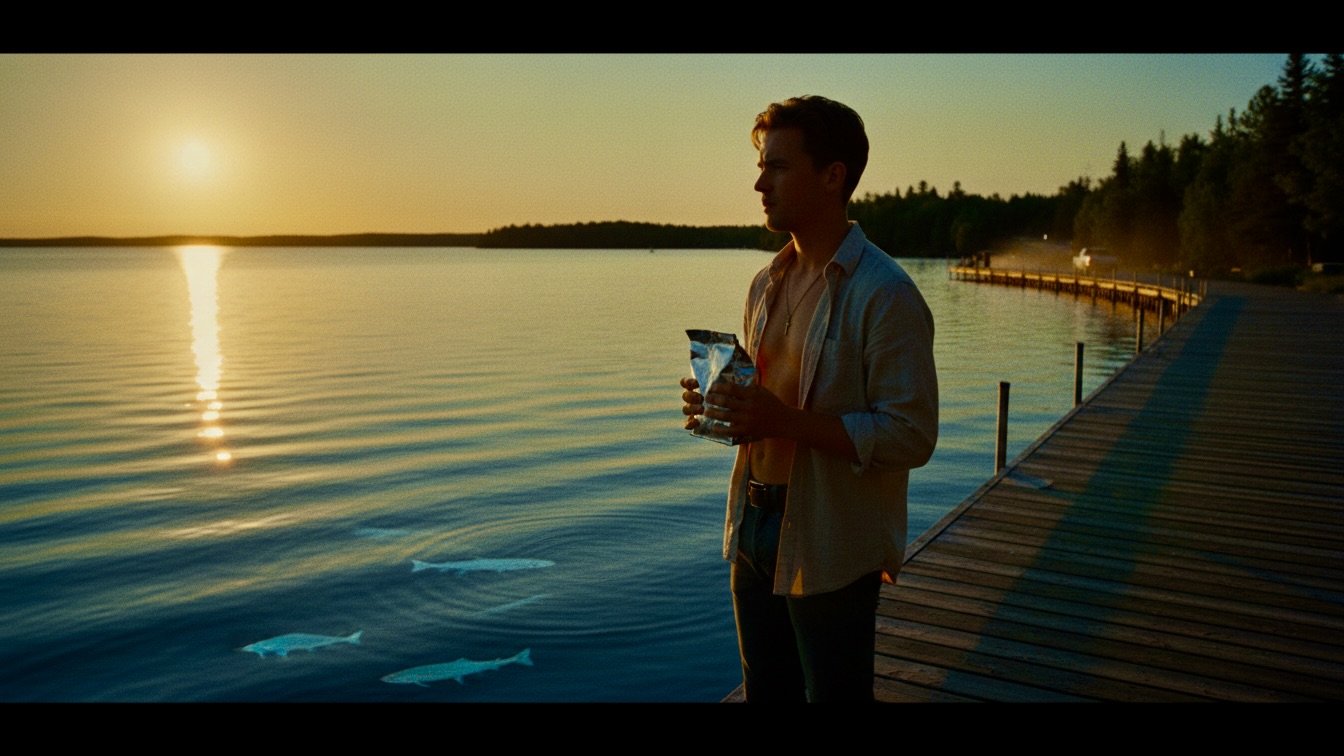
Eli stares into the bottom of a dry, silver coffee pot, his own gaunt reflection staring back from the metal as "zombie trout" swim in endless, starving circles in the stagnant water below the dock. The silence of the marina is broken only by the oppressive heat and the realization that the ships from the Strait of Hormuz are never coming back.
In a sun-scorched marina where the fish have forgotten how to eat, a lonely boy shares his final secret stash of espresso beans with a weary scientist. Their midnight "wake" for the world offers a fleeting spark of humanity before the crushing weight of a resource-stripped reality settles back over the docks.
The primary theme is the "Metabolic Glitch," representing both the biological failure of the trout and the systemic failure of human society. It explores how the loss of small, daily rituals—like a morning coffee—leads to a profound spiritual starvation that mirrors the physical starvation of the environment.
The story also touches on the absurdity of institutional responses to catastrophe. While the natural world and its inhabitants wither, the governing bodies pivot to "digital enforcement" and "decorative substitutes," highlighting a disconnect between those in power and the visceral reality of those left behind in the "dead zones."
For Eli, the stakes are purely existential; the espresso beans are his last tether to a world that made sense, and losing them means surrendering to the "gray wool" of numbness. For Stefani, the stakes are professional and ecological, as her failure to secure funding or find a cure for the fish signals the end of scientific agency in the face of collapse. The town of Kenora faces the ultimate stake of total obsolescence, abandoned by a government that provides sand instead of sustenance.
The external conflict is driven by the global blockade and the environmental "fever" killing the lake, alongside the bureaucratic indifference of Mayor Trent and the distant government. Internally, Eli battles a suffocating loneliness and the fear of "swimming in circles" like the fish, while Stefani struggles with the humiliation of her mission being reduced to a "ghost ship" sailing toward a non-existent shore.
Eli, a young man tending a derelict marina in Kenora, lives in a world muted by the absence of coffee and the presence of "zombie trout"—fish that swim in circles until they starve. The arrival of Stefani, a theatrical but exhausted scientist from Thunder Bay, disrupts his isolation as she searches for the "black gold" that fuels her intellect. Recognizing a kindred spirit in her desperation, Eli reveals a dangerous secret: locker forty-two in the marina contains a hidden bag of real espresso beans, a "king's ransom" in a world of dried grass tea.
The two form a brief, intense bond as they brew the coffee on a hidden stove under the moonlight, treating the bitter liquid as a sacred offering. As they drink, the "gray wool" lifts from Eli’s mind, allowing him to see the haunting beauty of the fish migrating toward the cold depths one last time. However, the morning brings a cruel reality check as the government’s "Peace Initiative" delivers crates of decorative sand instead of tea, and Stefani is reassigned to digital surveillance. She leaves Eli alone at the dock, where he is left to clutch an empty silver bag, watching the sun bake the remains of his hope.
Eli: A quiet, observant youth whose internal world is clouded by the "gray wool" of caffeine withdrawal and isolation. At the start, he is a passive observer of decay, but through his interaction with Stefani, he experiences a brief re-awakening of his senses and agency. By the end, he returns to a state of loneliness, but now carries the heavy, conscious burden of memory.
Stefani: An eccentric researcher who uses theatrical language as a shield against the grim reality of her failing mission. She begins the episode as a desperate seeker of "the bitter liquid," oscillating between grandiosity and exhaustion. By the end, her shield is shattered, leaving her a resigned servant of a government that has abandoned science for control.
Mayor Trent (Supporting): A performative authority figure who manages the town's decline with delusional optimism and megaphone-led lies. He represents the systemic failure to address the reality of the crisis, offering "decorative sand" as a solution to starvation.
* Beat 1: Eli inspects the cold marina cafe and the "zombie trout" swimming in circles, establishing the oppressive heat and the sensory numbness of the coffee-less world. The visual of his stretched reflection in the empty pot sets the tone of a distorted, hollow reality.
* Beat 2: Stefani arrives in her mushroom hat and pocket-laden vest, her grand theatricality clashing with the dusty silence of Kenora. Her collapse upon seeing the empty coffee pot reveals the shared human desperation beneath her eccentric exterior.
* Beat 3: On a peeling green bench, Eli leans in to whisper the secret of locker forty-two, offering Stefani a glimpse of the "treasure" he has guarded. The tension rises as they look out for the Mayor, turning the act of sharing coffee into a subversive, high-stakes conspiracy.
* Beat 4: Inside the rusted locker room, Eli retrieves the silver bag of beans, and the two share a tactile moment of reverence for the scent. This beat serves as the "inciting incident" of their bond, moving from strangers to co-conspirators in a dead world.
* Beat 5: Under a thin moon, they brew the espresso on a small stove, the hiss of the flame and the rising aroma contrasting with the silent, circling fish. Stefani explains the "metabolic glitch" of the trout, mirroring the spiritual glitch of the human characters who have forgotten how to thrive.
* Beat 6: They drink the bitter, black liquid—a "wake" for civilization—which triggers a sensory explosion for Eli, clearing the "gray wool" from his mind. He takes Stefani out on the boat to witness the ghostly migration of the fish, a moment of tragic beauty that serves as the episode's emotional climax.
* Beat 7: Morning brings the "Peace Initiative" truck, where the town’s hope is crushed as the crates are revealed to contain only brown decorative sand. The silence of the crowd after the "logistical mix-up" is announced highlights the finality of their abandonment.
* Beat 8: Stefani departs in her government truck for a new life of "digital enforcement," leaving Eli with a final touch on the cheek. Eli returns to the cafe to smell the empty bag, a solitary figure in a silent town, waiting for ships that will never arrive.
The episode begins with a sense of Stagnation and Numbness, characterized by the heavy heat and the repetitive motion of the fish. As Eli and Stefani connect, the mood shifts to Subversive Hope and Reverence, peaking during the "midnight wake" with a feeling of Tragic Clarity. The final act plunges into Profound Disillusionment and Melancholy, leaving the audience with a lingering sense of "the quiet after the end."
If expanded, the season would follow the "Digital Enforcement" mandate Stefani is sent to join, exploring how the government uses virtual reality and digital "tea" to pacify a starving population. Each episode would track a different commodity—sugar, silk, paper—showing how their disappearance triggers a specific type of societal or biological "glitch." The season-long arc would involve Eli eventually leaving the marina to find Stefani in the city, discovering that the "world that was" has been replaced by a digital hallucination that masks a dying planet.
The visual style is "Sweaty Realism," utilizing high-contrast cinematography with a jaundiced, yellow-orange color grade to emphasize the heat. Close-ups should be tactile and intimate—focusing on the peeling paint, the silver scales on Stefani’s hands, and the oily sheen of the espresso—contrasted with wide, static shots of the flat, "plastic" blue water.
The tone is a blend of Post-Apocalyptic Melancholy and Absurdist Drama, reminiscent of Station Eleven or The Leftovers. The "theatricality" of Stefani provides a thin layer of dark comedy that only serves to make the eventual silence and the "sand reveal" feel more devastating.
The target audience is adult viewers (25-55) who enjoy prestige "cli-fi" (climate fiction) and anthology dramas like Black Mirror or Tales from the Loop. It appeals to viewers who appreciate slow-burn storytelling, rich character psychology, and narratives that find profound meaning in the smallest details of human existence.
The pacing is deliberate and atmospheric, designed to make the 10-12 minute runtime feel like a heavy, summer afternoon. The first half is slow and observational, building the "stagnation," while the "midnight wake" scene should feel rhythmically faster and more vibrant to reflect the caffeine's effect. The final three minutes return to a slow, funeral-like tempo.
The "zombie trout" should be achieved through a mix of practical animatronics and clever camera angles to maintain a grounded, gritty feel; CGI should be avoided to keep the "Metabolic Glitch" feeling like a physical, biological reality. The marina set requires significant "distressing" to look like a place where maintenance stopped months ago, with the green peeling paint being a key recurring visual texture.
The "sand" in the final scene must be visually distinct from coffee—glittery or unnaturally uniform—to emphasize the absurdity of the government's failure. Sound design is critical, specifically the contrast between the "loud, happy roar" of the past coffee machine and the oppressive, buzzing silence of the present-day marina.


