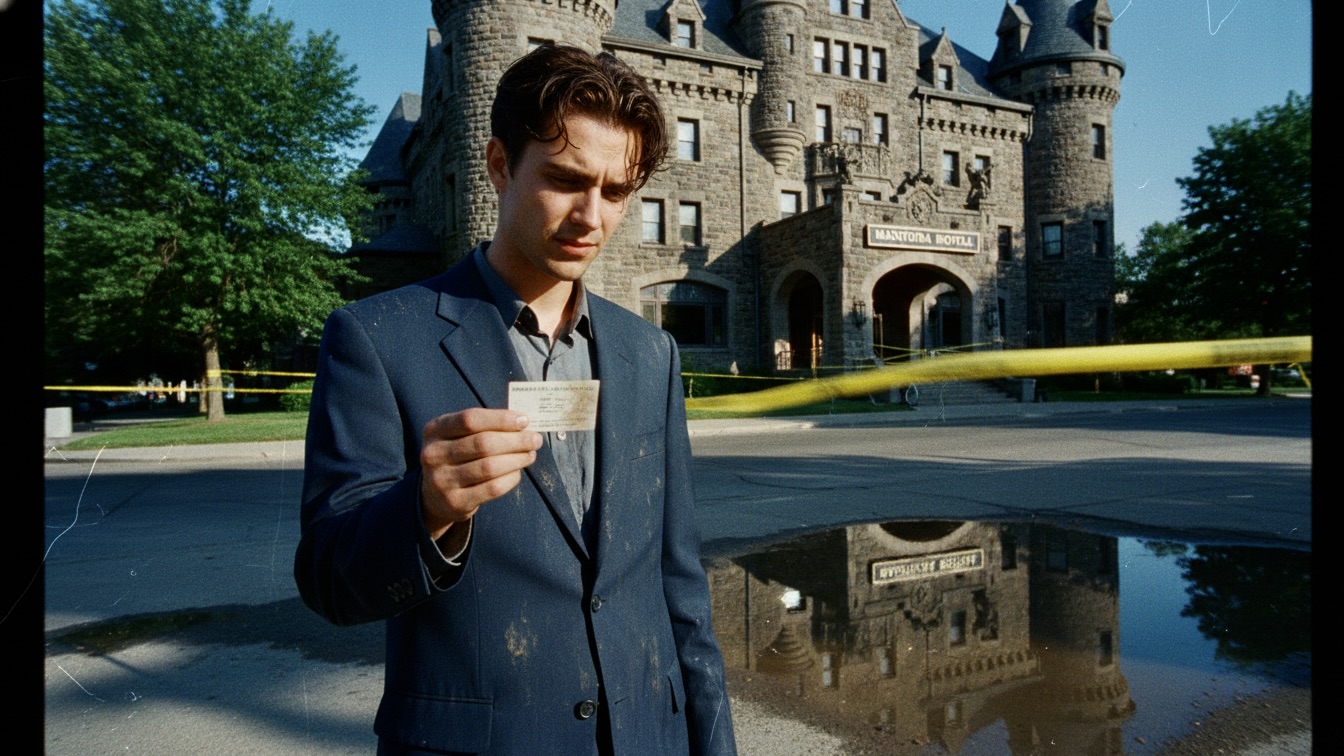
A manufacturing worker loses his job to trade wars and finds himself trapped in a cellar with elite.
The heat in the plant was a physical presence. It did not just sit in the air; it pressed against your skin like a wet, hot wool blanket. The stamping machines were screaming. It was a rhythmic, metallic shriek that vibrated in my teeth and made the marrow of my bones feel like it was rattling around. I wiped the sweat from my forehead with the back of a greasy glove, leaving a smear of dark oil across my skin. The clock on the wall was a relic from the eighties, its plastic casing yellowed and cracked, the second hand ticking with a jerkiness that suggested it was about to give up entirely. It was three in the afternoon on a Tuesday in July, and the Winnipeg sun was hammering the corrugated metal roof until the entire building felt like a slow-cooker. I looked at the line of raw aluminum sheets moving down the conveyor. They were bright, reflecting the harsh overhead fluorescents in a way that made my eyes ache.
I saw Miller coming toward me. Miller was the floor manager, a man who had spent thirty years in this humidity and looked like he was made of beef jerky and resentment. He wasn't wearing his hard hat, which was the first sign that something was wrong. He was holding a stack of envelopes. They were pink. The color was absurdly cheerful against the grey and brown of the shop floor. He stopped in front of my station and signaled for me to hit the emergency stop. I pulled the red plunger. The sudden silence was more jarring than the noise. It left a ringing in my ears that felt like a swarm of angry bees. Miller didn't look at me. He looked at the envelope. He looked at the grease on my boots. He looked at anything except my face.
"Santosh," he said. His voice was gravelly, worn thin by decades of shouting over the stamps. "I am compelled to inform you that your tenure at Broadview Industrial is reaching a most abrupt conclusion. It is a matter of profound geopolitical instability, I am afraid." He handed me the pink envelope. The paper felt cheap and thin. "The orange guy down south has seen fit to impose a new regime of tariffs on raw materials. Our retaliatory measures have, in turn, rendered our domestic operational costs unsustainable. It is a theatrical tragedy of the highest order, but the board has mandated a total cessation of production on this line."
I looked at the envelope. I didn't open it. I knew what was inside. A check for two weeks' pay and a pamphlet on how to update my resume for a world that didn't want me. "So, that is it?" I asked. My voice sounded flat in the sudden quiet of the plant. "After five years, you are just ghosting the entire shift because of a trade war?" Miller finally looked at me, and his eyes were tired. "It is not a personal slight, Santosh. It is the invisible hand of the market, and currently, that hand is clenched into a fist. You are bricked. We are all bricked. I have ten more of these to hand out before I can go home and drink enough rye to forget I ever met you."
I walked out of the plant ten minutes later. The sun outside was even worse than the heat inside. It was a direct, punishing glare that turned the asphalt of the parking lot into a soft, sticky mess. I stood by my rusted-out sedan and watched the other guys coming out. Some were swearing. Some were just staring at the ground. I felt a strange, cold hollowness in my chest. It wasn't anger yet. It was just a realization that the floor had been pulled out from under me, and I was still falling. I reached into my pocket and felt the envelope. It was the only thing I had left of my professional life. I thought about my rent. I thought about the grocery bills. I thought about the CEO of Broadview, a man named Quinn who lived in a house that probably had more bathrooms than my entire apartment building had rooms.
I drove home in a daze. The city was vibrant with summer. People were sitting on patios, drinking cold beers and laughing. They didn't know about the tariffs. They didn't care about the aluminum sheets. They were living in a different Winnipeg than the one I was currently standing in. I went up to my third-floor walk-up. The air was stagnant. I stripped off my work clothes and stood in the shower until the water turned cold. I looked at myself in the cracked mirror over the sink. I looked like a man who had been discarded. I looked like a piece of scrap metal.
I opened my closet. Hanging there, in a plastic bag I had forgotten to take off, was my only suit. It was navy blue, bought for a cousin's wedding three years ago. It was a bit tight in the shoulders and the trousers were a fraction too short, but it was clean. It was the clothes of a person who mattered. I looked at the news on my phone. The Blue River Gala was happening tonight at the Fort Garry Hotel. It was a fundraiser for 'Water Security,' which was just a fancy way of saying the rich people wanted to make sure their basements didn't flood while the North End turned into a lake every spring. CEO Quinn would be there. He would be wearing a suit that cost more than my car. He would be eating shrimp and talking about the 'challenges of the current fiscal year.'
I decided then. I wasn't going to sit in my dark apartment and eat instant noodles while my life dissolved. I was going to go to the Fort Garry. I was going to find Quinn. I was going to look him in the eye and ask him how the shrimp tasted. I put on the suit. I tied my tie with trembling fingers. I looked at my reflection again. I didn't look like a manufacturing worker. I looked like a guest. Or at least, I looked like someone who belonged in a room where decisions were made. The suit felt like armor. It was uncomfortable, restrictive, and entirely necessary. I walked out the door and down the stairs, the heat of the evening air hitting me like a physical blow as I stepped onto the sidewalk.
The Fort Garry Hotel is a castle made of stone and history, sitting at the edge of downtown like a sentry that has seen too much. As I approached, the sidewalks were teeming with the dual realities of the city. On one side, the black SUVs and town cars were idling, their exhausts shimmering in the heat. On the other, a crowd of protesters had gathered behind metal barricades, their voices rising in a discordant chant that the thick stone walls of the hotel seemed to ignore with practiced ease. I saw the signs: DAMS FOR THE PEOPLE, NOT THE POOLS. I saw the faces, flushed with heat and conviction.
I spotted Amara near the front of the line. She was my cousin, a woman whose energy was a constant, buzzing current. She was holding a megaphone in one hand and a sign that depicted a flooded street in the North End in the other. Her hair was pulled back in a messy knot, and her face was slick with sweat. She saw me approaching and her eyes widened. She lowered the megaphone, the feedback squeal cutting through the air like a knife.
"Santosh?" she asked, her voice incredulous. "What in the name of all that is holy are you wearing? You look like you are auditioning for a role as a junior partner in a failing law firm. Why are you here? The protest is for the community, not for people who dress like they own the bank."
I stopped in front of her. The suit felt even tighter now that I was standing next to someone wearing a t-shirt and cargo shorts. "I am bricked, Amara," I said. "Broadview let the entire shift go this afternoon. Tariffs. The orange guy. Retaliation. I am officially a casualty of the trade war."
Amara's expression shifted instantly from mockery to a sharp, burning sympathy. "Oh, Santosh. I am so sorry. Those absolute ghouls. They are in there right now, you know? Quinn is in there. He is probably giving a speech about 'resilience' while the people who built his company are wondering how they are going to pay for their kids' dental work. It is a performance of the most grotesque variety."
"I know," I said. "That is why I am here. I am going inside. I am going to find him."
Amara looked at the hotel entrance, where two security guards in crisp white shirts were checking invitations. "You will never get past the threshold, Santosh. They have a scent for people who don't belong. They can smell the desperation under that cheap polyester. You are essentially attempting to infiltrate a fortress with a butter knife."
"It is wool blend," I corrected her, though I knew she was right. "And I am not going through the front. I remember the layout from that catering gig I did in college. There is a service entrance near the loading dock that they usually leave propped open for the cigarette breaks. If I can get into the kitchens, I can find the ballroom."
Amara gripped my arm. Her hand was hot. "Be careful. These people do not play. To them, a worker in a suit is more of a threat than a hundred protesters with signs. You are a glitch in their matrix. If they catch you, they won't just throw you out; they will make sure you are blacklisted from every temp agency in the province."
"I am already blacklisted by the economy, Amara. There is nothing left for them to take." I pulled away from her and started walking toward the side of the building. The shadows of the hotel were long and dark, providing a brief respite from the sun. I found the loading dock. It was a hive of activity. Crates of expensive water and boxes of high-end spirits were being moved by men who looked just as tired as I had felt four hours ago. None of them looked at me. In a suit, I was invisible to them. I was just another guest who had lost his way.
I stepped through the heavy steel door. The air inside the service corridor was cooler, but it carried the heavy, cloying scent of industrial floor cleaner and roasting meat. I walked with purpose, keeping my head down, my shoes clicking on the linoleum. I passed a line of servers prep-ping trays of hors d'oeuvres. They were moving with a frantic, military precision. I found the service elevator and pressed the button for the mezzanine. The doors slid shut with a soft hiss, and for a moment, I was alone in the mirrored box. I looked at myself. My tie was slightly crooked. I straightened it. I took a deep breath. My heart was thumping against my ribs like a trapped bird.
When the doors opened, I was in a different world. The mezzanine overlooked the grand ballroom. The floor was a sea of shimmering gowns and dark tuxedos. The chandeliers were massive, glittering clusters of crystal that seemed to defy gravity. The air was perfectly chilled, a dry, expensive cold that felt like a rebuke to the humidity outside. I walked down the grand staircase, my hand trailing on the velvet-covered banister. No one stopped me. No one even looked at me. I was a ghost in a navy suit.
I scanned the room. It took me a few minutes, but I found him. Quinn was standing near a large ice sculpture of a sturgeon. He was holding a glass of amber liquid—scotch, no doubt, the kind that cost more than my monthly grocery budget. He was laughing at something a woman in a shimmering gold dress was saying. He looked relaxed. He looked like a man who had never heard the word 'tariff' in his life, or if he had, it was something that happened to other, lesser people.
I started moving toward him. My path was blocked by a server carrying a tray of tiny, delicate tarts. I waited, my pulse accelerating. I was ten feet away when I saw him turn. Our eyes met for a fraction of a second, but there was no recognition. To him, I was just another face in the crowd of donors. I took another step forward. I could hear the murmur of a hundred conversations, a polite, theatrical hum of wealth and self-congratulation. I reached out a hand, my fingers inches from his sleeve, ready to shatter the illusion of his perfect evening.
I was close enough to smell the cedar and smoke on Quinn’s breath. He was mid-sentence, his voice a smooth, practiced baritone. "The logistical complexities of the current trade environment are indeed formidable, Mrs. Taylor, but one must maintain a certain level of strategic optimism." He took a sip of his scotch, the ice clinking delicately against the glass. I cleared my throat, a sound that felt like a gunshot in the refined atmosphere.
"Mr. Quinn," I said. My voice was steadier than I expected. "I believe your strategic optimism might be lacking a certain ground-level perspective. Specifically, the perspective of the two hundred employees you ghosted this afternoon at the Broadview plant."
Quinn froze. The woman in the gold dress, Mrs. Taylor, blinked at me with a look of profound confusion, as if I had just started reciting poetry in a language she didn't realize existed. Quinn turned his head slowly, his eyes narrowing as he processed my presence. He didn't look angry; he looked inconvenienced.
"I beg your pardon?" he asked, his tone dripping with a formal, theatrical disdain. "Do I know you? This is a private function, and I am quite certain your name was not on the manifest of invited dignitaries."
"My name is Santosh," I said. "I was on your payroll until four hours ago. You sent a man named Miller to do your dirty work while you came here to drink twenty-year-old scotch and talk about 'logistical complexities.' I wanted to see if you could say the word 'resilience' to my face while I’m holding my pink slip."
Mrs. Taylor let out a small, sharp gasp. "Is this a protest? Heavens, I thought the security was supposed to be impenetrable this year."
Quinn raised a hand to silence her, his gaze never leaving mine. "Santosh. A dramatic entrance, to be sure. However, you must understand that the cessation of operations was a fiduciary necessity. The tariffs have created a fiscal climate that is simply untenable for a facility of Broadview’s scale. It is a tragedy, yes, but a systemic one, not a personal one."
"It feels pretty personal when I can't pay my rent, sir," I replied. I was about to say more, to really lay into the hypocrisy of the ice sturgeon and the silk ties, when the world changed.
There was a sound. It wasn't a bang, exactly. It was a heavy, metallic pop that seemed to come from beneath our feet. It was followed instantly by a low, gutteral groan of straining machinery. The massive chandeliers flickered, their crystal droplets shivering, and then the lights went out. Not just the chandeliers, but every light in the ballroom. The darkness was absolute for a heartbeat, and then the emergency lights kicked in—a dim, sickly orange glow that cast long, distorted shadows across the room.
Someone screamed. It was a high, thin sound of pure animal terror. "He has a gun!" a man yelled from the far side of the room. "Active shooter! Did you hear that? He’s shooting!"
The panic was instantaneous. It was like a wave breaking over the room. The polite, theatrical hum of the gala was replaced by a chaotic roar of crashing glass and thundering footsteps. People weren't running; they were stampeding. I saw a man in a tuxedo trip and get trampled by two women in evening gowns. Mrs. Taylor let out a shriek and grabbed my arm, her manicured nails digging into my suit jacket.
"We are going to die!" she wailed. "In a hotel ballroom! It is so dreadfully cliché!"
Quinn looked around, his face pale in the orange light. He wasn't a leader anymore; he was just a frightened man in a very expensive suit. A security guard, a large man with a shaved head and a face slick with sweat, burst through the crowd toward us. He was shouting into a radio, his voice cracking with stress.
"Move! Move! We have a breach! Code Silver! Secure the principals!" He grabbed Quinn by the shoulder and shoved him toward a small, inconspicuous door near the catering station. He grabbed me and Mrs. Taylor as well, his strength more than we could resist. "Inside! Now! Go, go, go!"
He threw us through the door into a narrow, stone-walled corridor. I heard the heavy thud of the door closing behind us and the sharp click of an electronic lock engaging. We were in a small, square room lined with wooden racks. The air was cool and smelled of damp earth and old cork.
"Where are we?" Quinn gasped, leaning against a rack of wine bottles. He was breathing hard, his silk tie undone.
"The reinforced wine cellar," I said, looking around. I knew this room. It was built into the original foundation of the hotel, a bunker of limestone and oak. "The guard locked us in. He’s probably following protocol for a lockdown."
"A lockdown?" Mrs. Taylor was shivering, her gold dress catching the faint light from a single, battery-powered emergency bulb on the ceiling. "Is there truly a gunman? I heard a blast. It sounded like a cannon."
"It didn't sound like a gun to me," I said, my ears still ringing. "It sounded like a transformer blowing. The basement is probably flooding from the rain. The river is high this year, and the city’s drainage system is a joke. The water hits the electrical main, and boom. No more party."
Quinn straightened his jacket, though his hands were still shaking. "A mechanical failure? You think this entire display of cowardice is due to a faulty circuit breaker? That is preposterous. The security staff are trained professionals. They wouldn't lock down the CEO of a major corporation for a blown fuse."
"They would if they were scared, sir," I said. "Fear doesn't care about your portfolio. Right now, to that guard, we are just three bodies he needs to keep behind a locked door so he doesn't get fired for negligence."
I sat down on a wooden crate. The silence of the cellar was heavy, broken only by the distant, muffled sound of the chaos in the ballroom above. I looked at the bottles around us. I recognized the labels. Chateau Lafite. Petrus. Vintages that were older than I was.
"Well," I said, looking at Quinn. "Since we are trapped here, would you like to continue our discussion on the fiscal climate? Or should we just wait for the water to start coming through the floorboards?"
The silence in the cellar was becoming heavy, a physical weight that made it hard to breathe. Quinn was pacing the small space, his leather shoes clicking on the damp stone floor. He looked at his watch every thirty seconds. Mrs. Taylor had huddled in a corner, her gold dress draped around her like a discarded wrapper. She was staring at a bottle of 1945 Bordeaux as if it might offer her a way out.
"This is an administrative catastrophe," Quinn muttered. "The optics of this are going to be horrifying. The CEO of Broadview Industrial, cowering in a wine cellar like a common thief. The press will have a field day. They will paint me as a man who fled while his guests were in peril."
"Technically, sir, you were shoved," I said. I was leaning against a rack of Riesling. "And you aren't cowering alone. You have me and Mrs. Taylor to keep you company. Although, I suspect I am the only one here who actually knows how to use a wrench if things get watery."
My phone buzzed in my pocket. I pulled it out. The screen was cracked, but I could still see the message from Amara. The whole block is locked down, Santosh. Cops are everywhere. They are saying there is an active threat, but the word on the street is the power grid just melted. Vibes are horrific. Are you out?
"The vibes are indeed horrific," I whispered to myself. I looked up at Quinn. "My cousin says the police have the hotel surrounded. They still think there is a shooter. It is going to be a while before anyone remembers to check the wine cellar."
Quinn stopped pacing. He looked at me, his expression shifting into something calculating. The fear was still there, but the businessman was re-emerging. "Santosh. Let us be pragmatic. You are clearly a man of... initiative. You found your way in here. You kept your head when the panic started. That is a rare quality in the modern workforce."
"I also have a pink slip in my pocket that says I’m redundant, sir," I reminded him.
"Yes, well, circumstances evolve," Quinn said, his voice taking on that formal, theatrical tone again. "If you were to, shall we say, provide a certain level of discretion regarding my conduct during this incident—specifically the part where I may have appeared less than composed—I believe there might be a role for you. A 'consultant' position. To help bridge the gap between management and the labor force during this transition."
I laughed. The sound echoed off the stone walls. "You want to hire me to keep my mouth shut about you crying in a closet? That is the most authentic thing you’ve said all night. You aren't afraid of a gunman, Quinn. You are afraid of a PR disaster."
Before he could respond, there was a new sound. A low, rushing hiss. We all froze. It was coming from the base of the heavy, reinforced door. A thin line of brown, silty water was beginning to seep through the gap between the door and the floor. It didn't look like much at first, just a wet ribbon, but it was moving fast.
"The river," I said, standing up. "The hotel foundation is old. The street drains are backed up, and the pressure is pushing the water through the old limestone. We are at the lowest point in the building. This cellar is about to become a cistern."
Mrs. Taylor jumped to her feet, her eyes wide. "Water? No, no, no! This dress is dry-clean only! It is silk and hand-stitched sequins! We have to stop it!" She grabbed the bottle of 1945 Bordeaux from the rack. "Here! Use this! Plug the gap!"
I watched, mesmerized by the sheer absurdity of it, as she knelt in the growing puddle and tried to jam the neck of the five-thousand-dollar bottle into the space under the door. The silt-laden water swirled around her expensive shoes, staining the gold fabric of her hem. It was a perfect, cruel mirror of the city’s problems—the wealthy trying to fix a systemic infrastructure failure with a luxury item.
"Mrs. Taylor, that is not how hydraulics work," I said, though I didn't move to stop her. I wanted to see how long she would try.
"It has to work!" she cried, her voice echoing the desperation of a woman who had never been told 'no' by a physical law. "It is a heavy bottle! It is reinforced glass!"
Quinn watched her, his face a mask of disgust and pity. "We are trapped in a tomb with a madwoman and a disgruntled laborer," he whispered. "This is the end of my career. I can see the headlines now."
"Actually, sir," I said, looking at the water, which was now an inch deep and rising, "I think you should be more worried about your lungs than your headlines. If that water hits the electrical conduits in the walls, the air in here is going to get very spicy."
I walked over to the door and hammered on it with my fist. "Hey! We are in here! Cellar four! Open the door!"
There was no answer for a long time. The water reached our ankles. It was cold, carrying the smell of the Red River—mud, rot, and the ancient weight of the prairies. I kept hammering. I used the heel of my palm until it was bruised and raw. Quinn eventually joined me, his frantic pounding a discordant rhythm against mine. Even Mrs. Taylor started screaming, her voice a shrill siren that cut through the gloom.
Finally, we heard it. The heavy clatter of boots in the corridor. The sound of a keycard swiping. The door groaned and then swung outward, the pressure of the water behind us pushing it open with a splash. A group of police officers in tactical gear stood there, their flashlights blinding us.
"Clear!" one of them shouted. "We have three civilians! Get them out!"
They hauled us out of the cellar and through the dark, flooded hallways of the hotel. The ballroom was a wreck—overturned tables, broken glass, and the smell of ozone from the fried electronics. We were led out the front doors, past the barricades where Amara was still standing. She saw me and her jaw dropped. I was soaked to the knees, my suit was ruined, and I was walking next to the CEO of Broadview Industrial.
Quinn stopped at the edge of the police line. He looked at me, his face pale and drawn in the early morning light. The sun was beginning to rise, casting a pale, washed-out glow over the city. He reached into his pocket and pulled out a sodden business card. He scribbled something on the back with a silver pen.
"My personal number," he said, handing it to me. His voice was low, stripped of its theatrical polish. "Call me on Monday. We will discuss that... consultancy. And Santosh? I expect total silence regarding the Bordeaux."
I took the card. It was damp and the ink was smudged, but the numbers were legible. I watched him climb into a black SUV and vanish into the traffic. Amara ran over to me, her face a mix of worry and excitement.
"What happened?" she asked. "Did you talk to him? Did you get your job back?"
I looked at the card, then at the hotel, and then at the muddy water receding into the gutters. The whole city felt like it was held together by nothing more than tradition and luck. "I don't know if I want the job back, Amara," I said. "I realized something down there. The whole system—the gala, the tariffs, the security, the CEOs—it is all just three raccoons in a trench coat, trying to convince us they are a person. They are just as scared and confused as we are, they just have better wine to hide behind."
I turned and started walking toward the bus stop. The suit was heavy with river water, and my shoes squeaked with every step. I felt exhausted, but for the first time in years, I didn't feel bricked. I felt like I was the only one who knew the secret.
“I looked at the smudged ink on the card and realized the only thing more dangerous than a man with power is a man who knows exactly how that power can be faked.”


