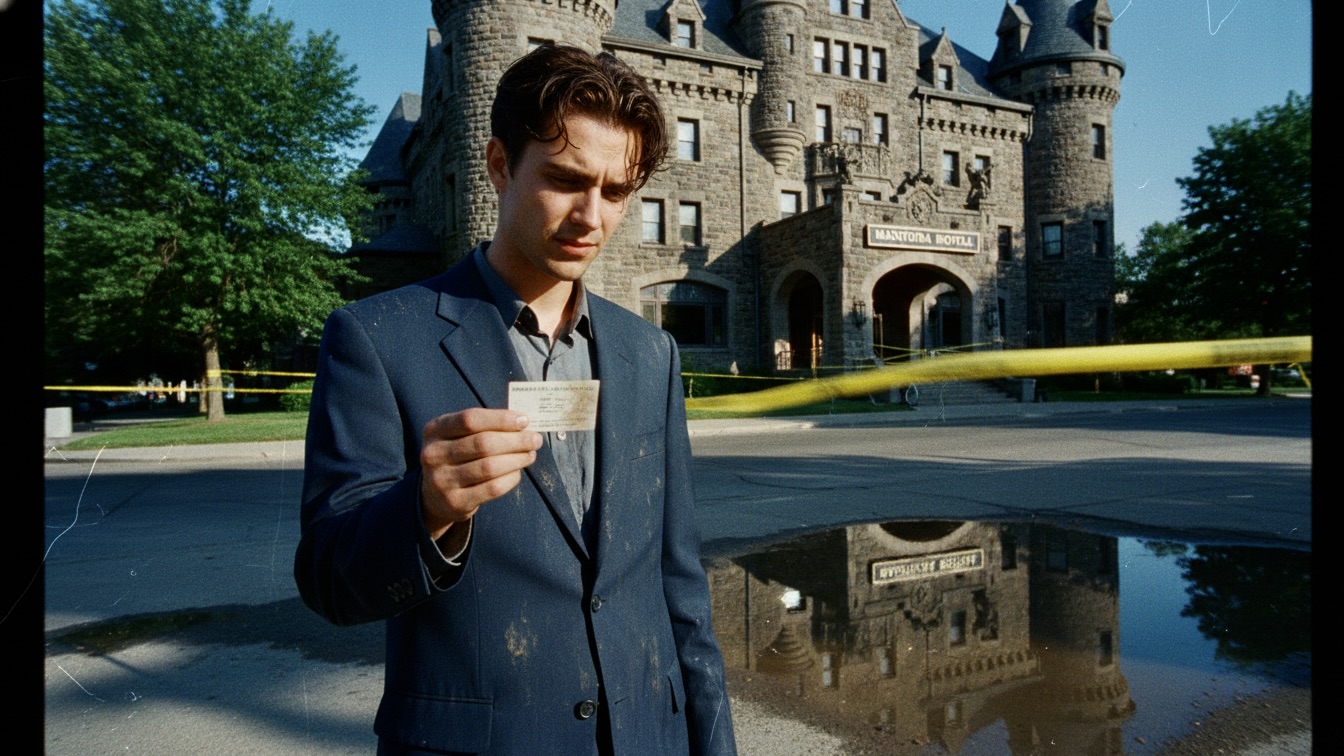
The story begins in the oppressive heat of a Winnipeg manufacturing plant, where the protagonist, Santosh, is abruptly laid off. His floor manager, Miller, delivers the news with a mixture of resentment and exhaustion, blaming the sudden termination on international trade tariffs. Left with nothing but a pink envelope and a sense of profound displacement, Santosh decides to confront the company’s CEO, Quinn, at a high-society gala held at the historic Fort Garry Hotel.
Clad in a navy suit that serves as both a disguise and a psychological shield, Santosh successfully infiltrates the event through a service entrance. He finds Quinn amidst the opulence of the ballroom, but their confrontation is interrupted by a sudden power failure and a perceived security threat. In the ensuing panic, Santosh, Quinn, and a socialite named Mrs. Taylor are locked in a reinforced wine cellar by security staff.
As the cellar begins to flood due to the city’s failing infrastructure and a rising river, the social hierarchy dissolves into absurdity. Mrs. Taylor attempts to plug the flooding door with an expensive bottle of wine, while Quinn’s authoritative persona crumbles into cowardice. After they are rescued by police, Quinn offers Santosh a job to ensure his silence regarding the CEO’s undignified behavior. Santosh leaves the encounter with a ruined suit but a newfound understanding of the inherent fragility and performative nature of the ruling class.
The narrative serves as a poignant exploration of class volatility and the artificiality of social structures. The "suit" acts as a central motif, representing the thin veil between the laboring class and the elite. Santosh notes that once he dons the garment, he becomes invisible to the service staff and acceptable to the donors, suggesting that identity in this world is largely a matter of aesthetic performance rather than intrinsic value.
Systemic fragility is another dominant theme, illustrated by the literal and metaphorical "leaks" in the foundation of the city. The trade war, the failing power grid, and the flooding cellar all point to a world where the systems designed to provide stability are actually precarious. The story suggests that the elite are not masters of these systems but are merely better insulated from their failures until a crisis forces a confrontation with reality.
The metaphor of "three raccoons in a trench coat" encapsulates the story's cynical view of institutional authority. It posits that the people in power are just as terrified and confused as those they govern, relying on "theatrical" language and luxury goods to maintain an illusion of competence. By the end of the story, the "invisible hand of the market" is revealed to be a clumsy and reactionary force rather than a calculated mechanism of progress.
Finally, the story touches on the psychological impact of being "bricked" or discarded by the economy. Santosh’s journey is one of reclaiming agency in a world that treats him as scrap metal. His refusal to be a passive victim of "logistical complexities" leads him to a realization that true power lies in seeing through the facades of those who claim to possess it.
Santosh is a man grappling with a sudden loss of identity and purpose. As a factory worker, he is accustomed to the physical reality of production, which makes the "ghosting" of his entire shift feel like a betrayal of his very existence. His decision to attend the gala is not merely an act of revenge, but a psychological necessity to bridge the gap between his discarded reality and the insulated world of his employer.
Throughout the ordeal, he maintains a grounded perspective that contrasts sharply with the histrionics of his companions. His background in manual labor provides him with a pragmatic understanding of the situation, such as recognizing the sound of a blown transformer over a gunshot. This competence gives him a quiet sense of superiority over Quinn, transforming his initial feelings of being "scrapped" into a sense of observant empowerment.
By the end of the narrative, Santosh undergoes a shift from desperation to a state of enlightened detachment. He no longer views his unemployment as a personal failure but as a symptom of a crumbling, farcical system. His refusal to immediately accept Quinn’s "consultancy" offer shows that he has gained something more valuable than a paycheck: the ability to see the world without the distorting lens of class-based intimidation.
Quinn is the embodiment of the "theatrical" executive, a man whose power is built on polished rhetoric and strategic optimism. He uses language as a defensive barrier, employing terms like "fiduciary necessity" and "logistical complexities" to distance himself from the human cost of his decisions. He is a man who has lived so long within the insulation of wealth that he has mistaken his privilege for personal resilience.
When the lights go out and the cellar floods, Quinn’s carefully constructed persona disintegrates. He is revealed to be a man driven by a profound fear of "optics" rather than a concern for human life or safety. His cowardice in the cellar is a psychological unmasking, showing that his authority is entirely dependent on the stability of the environment he inhabits.
His attempt to bribe Santosh with a job offer at the end of the story is his way of trying to regain control over the narrative. He cannot handle the idea of someone seeing him as a "frightened man," so he attempts to bring Santosh into the fold of the elite through a transaction. This final act confirms his character as one who believes that every human interaction, even a shared near-death experience, can be managed through a contract.
Amara serves as the externalized conscience of the story and a foil to Santosh’s internal journey. She represents the vocal, activist response to systemic injustice, standing behind the barricades with a megaphone. While Santosh chooses to infiltrate the system to see its flaws from the inside, she is content to challenge it from the outside, fueled by a sharp and burning sympathy for her community.
Her interaction with Santosh at the hotel entrance highlights the absurdity of his "armor." She is quick to point out the polyester reality of his suit, reminding him that he cannot simply dress his way into a different social class. However, her support for him also provides the emotional anchor he needs to proceed with his plan.
Mrs. Taylor functions as a satirical representation of the detached upper class. Her psychological response to the crisis is entirely filtered through her material possessions, such as her "dry-clean only" dress and her sequins. She is unable to process the physical danger of the flood, focusing instead on the "cliché" nature of dying in a ballroom.
Her attempt to plug the leak with a five-thousand-dollar bottle of wine is the story's most absurd moment of class commentary. It represents a desperate, illogical belief that luxury can solve structural problems. She is a woman who has never been told "no" by reality, and her breakdown in the cellar illustrates the total inadequacy of wealth when faced with the raw forces of nature.
The narrative employs a stark contrast in sensory details to emphasize the divide between Santosh’s two worlds. The opening scene is visceral and industrial, filled with the "metallic shriek" of machines and the "wet, hot wool blanket" of the plant’s humidity. This grittiness establishes a sense of physical labor and exhaustion that makes the transition to the "dry, expensive cold" of the Fort Garry Hotel ballroom feel jarring and surreal.
Pacing is used effectively to mirror Santosh’s internal state. The slow, rhythmic description of the factory floor sets a tone of drudgery, which then accelerates into the frantic, chaotic energy of the gala’s evacuation. The confinement of the wine cellar slows the pace down once more, creating a claustrophobic atmosphere that allows for the psychological deconstruction of the characters.
The narrative voice is one of cynical observation, peppered with metaphors that bridge the gap between the mundane and the profound. Descriptions like "beef jerky and resentment" or "three raccoons in a trench coat" provide a darkly humorous edge to a story about economic ruin. This voice allows the reader to experience Santosh’s disillusionment not as a tragedy, but as a necessary awakening.
The use of the "orange light" in the emergency-lit ballroom and the "brown, silty water" in the cellar creates a visual aesthetic of decay. It suggests that underneath the glittering crystal and silk, there is something muddy and broken waiting to surface. The author successfully uses these environmental cues to reinforce the psychological theme that no amount of "theatrical" wealth can fully suppress the underlying instability of the human condition.


