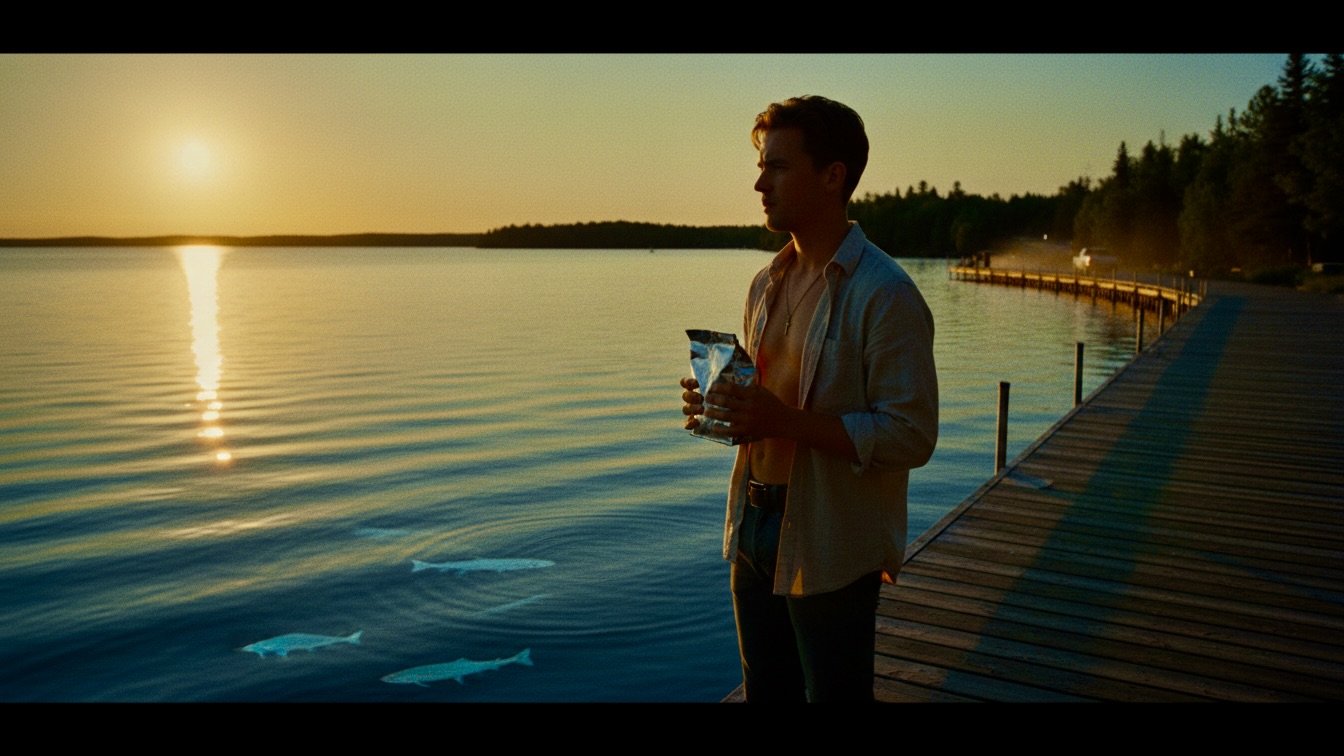
The story unfolds in the sweltering heat of Kenora, where a young man named Eli navigates a world drained of its vitality due to a global coffee shortage. A blockade in the Strait of Hormuz has halted the supply of beans, leaving the town’s inhabitants in a state of lethargic despair. This human crisis is mirrored by an ecological one, as the local lake trout suffer from a metabolic glitch that causes them to swim in aimless circles rather than eat. Amidst this stagnation, a theatrical researcher named Stefani arrives from Thunder Bay to study the fish, only to find herself bonded to Eli through their shared craving for the "black gold" of civilization.
Eli reveals to Stefani that he possesses a secret stash of espresso beans hidden in his marina locker. The two form an immediate, desperate alliance, retreating to the rocks at night to brew the last of the coffee over a small stove. This ritual serves as a "wake" for the world they once knew, providing a brief moment of clarity and connection as they watch the "zombie trout" move beneath the moonlight. However, the momentary reprieve is shattered the following morning when a government shipment of "tea" turns out to be nothing more than decorative sand. Stefani is recalled to the city as her research funding is cut, leaving Eli alone once more to face the heat and the endless, circular patterns of a dying ecosystem.
The narrative explores the profound fragility of modern civilization and the psychological toll of scarcity. Coffee serves as a potent symbol for the "bitter liquid" that fuels the human soul, representing the thin veneer of routine that keeps chaos at bay. When this ritual is removed, the characters experience a literal and metaphorical "gray wool" in their minds, suggesting that human identity is inextricably linked to the small comforts and chemical dependencies of the pre-collapse world. The "Espresso Debt" of the title implies a cost for this reliance, one that is paid in the currency of sanity and hope when the supply lines finally break.
Ecological collapse is a secondary, haunting theme that runs parallel to the human narrative. The "zombie trout" act as a chilling metaphor for the townspeople themselves; both groups are surrounded by the means of survival but have forgotten how to sustain themselves. The warming waters have broken the natural instincts of the fish, just as the blockade has broken the social instincts of the humans. This theme highlights the terrifying reality of a "metabolic glitch" in nature, where the environment continues to exist but the spark of life and purpose has been extinguished by rapid, man-made change.
Finally, the story examines the necessity of human connection in the face of inevitable loss. Eli chooses to share his "king’s ransom" of beans not out of a sense of duty, but because the prospect of consuming the last of the coffee alone feels like a final death. The act of sharing the espresso becomes a sacred ceremony, a way to affirm their humanity against the backdrop of a world that is "getting very small." Even though the connection is fleeting and ends in Stefani’s departure, it provides the only true resistance to the "gray wool" of despair that threatens to consume the protagonist.
Eli is a sensitive and observant protagonist whose internal world is defined by sensory processing and a quiet, desperate longing for meaning. He experiences the world with an almost tactile intensity, describing his caffeine withdrawal as a physical weight of "thick, gray wool" and the sun as a "heavy hand." His decision to hide the espresso beans in locker forty-two demonstrates a survivalist instinct, yet his willingness to reveal this secret to a stranger suggests a deeper need for social validation and companionship. He is a boy on the cusp of a harsh adulthood, forced to witness the slow decay of his home while holding onto the remnants of a more vibrant past.
His motivation is not driven by greed or a desire for power, but by a profound fear of loneliness. He views the act of drinking the last coffee alone as a form of spiritual suicide, choosing instead to use his resource to buy a moment of shared reality with Stefani. Eli’s internal conflict arises from his role as the "master of the docks," a title that sounds grand but carries the burden of watching everything he loves—the fish, the cafe, and the tourists—fade into ghosts. By the end of the story, he is left as a tragic figure of endurance, clutching an empty bag that represents both his greatest treasure and his deepest loss.
Stefani is a complex character who uses theatricality and grand language as a shield against the crushing weight of her professional and personal failures. Her "mushroom hat" and "vest with a hundred pockets" paint the picture of a woman who wants to be prepared for an adventure, yet her slumped shoulders reveal a soul exhausted by the "cruel mistress" of the blockade. She speaks in the cadence of a play to distance herself from the grim reality of the starving fish she cannot save. For her, the coffee is not just a drink but a "dark spirit" that allows her to maintain the persona of a functional, eccentric intellectual.
Beneath her dramatic exterior, she is a woman grappling with the obsolescence of her life’s work. Her research into the trout is deemed less important than "digital enforcement," a shift that mirrors the cold, pragmatic turn of a society in crisis. When she drops her theatrical mask during the midnight boat ride, she reveals a deep empathy and a sharp, scientific clarity that is both beautiful and devastating. Her departure is not an act of abandonment but a surrender to the "orders" of a world that no longer has room for her curiosity or her compassion.
Mayor Trent represents the performative and often deceptive nature of leadership during a catastrophe. He is characterized by his use of a megaphone and his tendency to tell "lies" intended to pacify the populace, such as promising that tea is a viable substitute for their lost rituals. His character serves as a foil to Eli’s quiet honesty; while Eli guards a real treasure in his locker, the Mayor presides over a truck full of useless sand. He embodies the institutional failure to address the root causes of the town's suffering, offering instead hollow slogans and "peace initiatives" that fail to fill the void.
The narrative voice is intimate and grounded in a first-person perspective that emphasizes sensory experience over political or global exposition. The author uses vivid, often grotesque metaphors to describe the environment, such as the water looking like "dirty plastic" and the fish appearing as "ghosts trying to remember how to be alive." This creates a tone of heavy, stagnant melancholy that mirrors the sweltering heat of the Kenora summer. The pacing is deliberate and slow, reflecting the "circling" nature of the fish and the townspeople’s aimless waiting, which makes the brief moments of action—like the opening of the coffee bag—feel incredibly significant.
Sensory details are the primary engine of the story's emotional impact. The contrast between the "cold metal" of the empty coffee machine and the "warm skin" of human touch highlights the theme of life versus mechanical or environmental death. The smell of the espresso is described with a nostalgic reverence, standing in sharp opposition to the "wet stones and old wood" of the dying lake. These details ground the speculative elements of the story in a recognizable reality, making the loss of a simple bean feel as tragic as the loss of an entire ecosystem.
The transition from the "theatrical" day to the "silent" night provides a shift in tone that allows for deeper psychological reflection. During the day, the heat and the Mayor’s megaphone create a sense of frantic, public despair, but the midnight voyage on the boat introduces a more sublime, quiet horror. The image of the silver ribbons of fish moving in a "massive, silent migration" toward the dark center of the lake is a masterful use of visual storytelling. It elevates the narrative from a simple story of a coffee shortage to a haunting meditation on the inevitable pull of the void.


