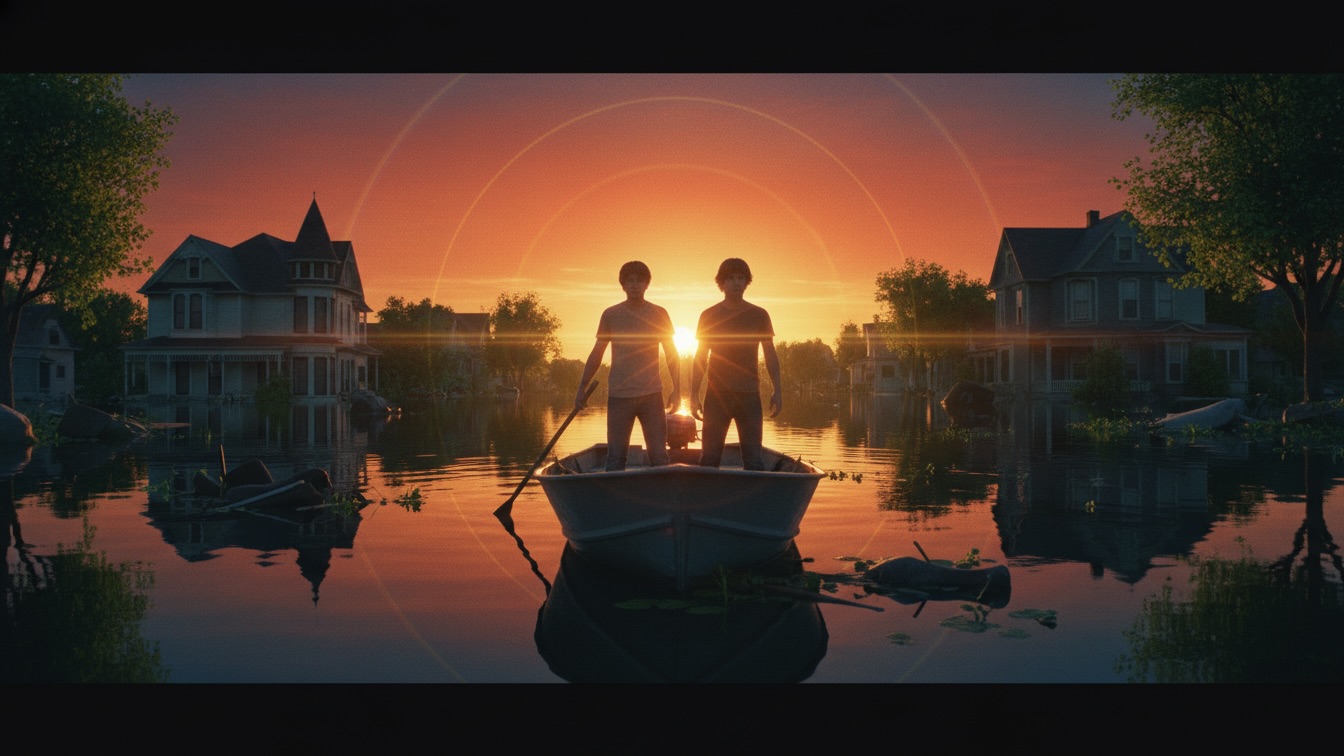
A massive June storm surge sends the Red River into the streets, forcing two brothers to dive for survival.
The tablet screen flickered, a jagged red line cutting through the digital map of Winnipeg like a fresh wound. I wiped a smear of condensation from the glass with my thumb. The Red River wasn't just rising. It was rewriting the city’s layout in real time. It was June 2026, and the heat was a heavy, wet blanket that made the air feel like it was already made of water. The storm surge had hit two hours ago, and the Floodway—the massive ditch designed to save us—had failed. A structural collapse at the gates meant the water was bypassing the spillway and barreling straight into the South End.
"Sam, look at the screen, not your shoes," Mayor Gunn snapped. He was standing by the floor-to-ceiling windows of the emergency ops center, his reflection ghost-like against the backdrop of the lightning-lit sky. He looked tired, but in a way that felt calculated. "The modeling says St. Vital is a write-off. We need to focus on the downtown core."
I looked up. My neck cracked. I’d been in this room for eighteen hours. "St. Vital isn't a write-off, Mayor. It’s where fifty thousand people live. If we don't reinforce the secondary dikes at the St. Mary’s bridge, the whole district is under ten feet of river within the hour. My data shows the surge isn't peaking yet. We have a four-hour window before the second stories of the houses there become the new shoreline."
Gunn didn't turn around. He just tapped his ring against the glass. "The insurance companies are already calling it a total loss. Natural disaster. Act of God. Whatever you want to call it. The land-use committees are already talking about redevelopment. A clean slate. Do you understand what that means for the city’s budget?"
I understood. I was a city engineer, not a politician, but I knew how the gears turned. A total loss meant the city could invoke eminent domain, buy out the ruins for pennies, and flip the land to the guys who funded Gunn’s last campaign. My stomach felt like it was full of cold lead. My parents’ house was in St. Vital. My brother was in St. Vital.
"The land isn't for sale," I said, my voice sounding flatter than I intended. "There’s a trust. The 1920 deed. You know about it. The whole neighborhood is a protected community land trust. You can’t touch it, even if it’s underwater."
Gunn finally turned. His smile didn't reach his eyes. "Records get lost in floods, Sam. Basements fill with silt. Paper rots. Unless you have that physical deed in your hand by tomorrow morning, the trust is a myth. And right now, that neighborhood is a restricted zone. Nobody goes in. Especially not a junior engineer with a hero complex."
I didn't argue. I just grabbed my tablet and my rain jacket. I could feel the vibration of the city’s sirens through the floor. It was a low-frequency hum that set my teeth on edge. I left the room without saying another word. Gunn wouldn't stop me. He thought the water would do his work for him.
I hit the parking garage, the air thick with the smell of wet asphalt and exhaust. My truck was one of the few left. I fired it up, the engine's roar bouncing off the concrete pillars. My phone buzzed in the cup holder. A text from Pete. Just one word: "Stay."
I knew what it meant. Pete was at the house. He’d been out on bail for three weeks, some petty theft charge that he swore was a misunderstanding, but the court didn't care. He was hiding out in the one place he felt safe—our childhood home on Kingston Row. He was stubborn. He was angry. And he was currently sitting in the path of a wall of water that didn't care about his legal troubles.
I drove south, the streets getting quieter as I moved toward the evacuation zone. The sky was a bruised purple, the clouds churning like they were in a blender. I passed a line of police cruisers blocking the main artery into St. Vital. I didn't slow down. I took a side street through an industrial park, my tires splashing through deep puddles that were already beginning to merge into a single, shallow lake.
I reached the edge of the residential zone and stopped. The road ended in a shimmering expanse of dark, moving water. A stop sign poked out of the surface like a red lollipop. I hopped out of the truck, the humidity hitting me like a physical blow. I had a small aluminum motorboat in the back of the truck, something I’d prepped when the forecasts first went south. I dragged it out, the metal scraping against the tailgate with a sound like a scream.
I launched the boat into what used to be a suburban street. The water was cold, a shock against my ankles as I pushed off. I yanked the pull-cord on the small outboard motor. It coughed, spat a cloud of blue smoke, and then hummed into life. I steered into the current, dodging a floating blue recycling bin and a sodden mattress. The silence was the worst part. No dogs barking. No lawnmowers. Just the steady, rhythmic slosh of the river reclaiming the land.
I saw the house from two blocks away. It was an old Victorian, white with green trim that was peeling in long, curly strips. The water was already halfway up the front porch. A figure was sitting on the roof of the porch, legs dangling over the edge, casually smoking a cigarette. Pete.
He didn't move as I pulled the boat alongside the porch. He just looked down at me, his face a mask of bored indifference. He looked older than twenty-four. There were shadows under his eyes that hadn't been there before the arrest. "You're late," he said, flicking ash into the rising tide. "Mayor didn't give you the afternoon off?"
"Get in the boat, Pete," I said. I didn't have time for the sarcasm. "The surge is coming. The main dike at the bend is going to blow in twenty minutes. This whole place is going to be a washing machine."
Pete stood up, balancing perfectly on the sloping shingles. "I'm not leaving. The legacy is in the basement, Sam. Dad’s safe. The deed. You know Gunn’s people were here yesterday? 'Inspecting' the foundations. They want this place gone."
"I know," I said. I looked at the basement windows. They were already submerged. The pressure from the outside was mounting. "But the basement is already full, Pete. You can’t get in there."
"It’s not full yet," he said, jumping down into the boat. The small craft rocked violently. "The airtight seals on the storm windows are holding. For now. But the pressure is going to crack them. We have to go down now or we lose the neighborhood."
I looked at him. Really looked at him. He wasn't just being difficult. He was terrified. Not of the water, but of losing the only thing we had left. Our father had spent thirty years protecting this trust, making sure the developers didn't turn our backyard into a parking lot. If we let the water take the deed, we were letting the water take him, too.
"Fine," I said, killing the engine. "But if the house starts to groan, we're out. I'm not dying for a piece of paper."
"It's not just paper," Pete muttered, reaching for a crowbar he’d tucked into his belt. "It's the only thing that says we were here."
The boat bumped against the side of the house, the aluminum hull ringing like a muted bell. I tied the rope to a sturdy-looking railing on the second-story balcony. The water was moving faster now, a thick, brown slurry carrying the debris of a thousand lives. A child’s plastic slide drifted past, its bright yellow color looking sickly in the grey light. I could hear the city's warning sirens again, but they sounded distant, like a memory of a world that didn't involve drowning.
"Check the seal on the back door," I said, stepping onto the balcony. The wood felt soft under my boots. The humidity was so high I felt like I was breathing through a damp towel. I checked my watch. We had three hours and twelve minutes left of my four-hour window, but the river didn't care about my calculations. The current was scouring the foundation, pulling the earth out from under the house.
Pete followed me, his movements quick and nervous. He was always the faster one, the one who could climb a fence before I’d even found a foothold. Now, that energy felt like a trapped bird. "The back door is blown," he said, pointing. I looked over the railing. The kitchen was already a swamp. I could see the top of our mother’s old oak table floating near the ceiling. "We have to use the internal stairs. If the basement windows hold, there's still an air pocket down there."
"An air pocket under ten feet of hydraulic pressure?" I shook my head. "Pete, the physics don't work. The moment we open that basement door, the pressure differential will kill us both. It'll be like opening a hatch on a submarine."
"Then we don't open the door," Pete said. He was already moving inside, stepping through the master bedroom window. The house smelled of damp plaster and old dust. It was the smell of a thing that had stopped being a home and started being a tomb. "There’s a laundry chute in the hallway. It drops straight into the utility room. If the safe is where Dad said, it's right behind the furnace."
I followed him into the hallway. The floorboards creaked in a way that made my skin crawl. Every sound was magnified in the silence of the flooded house. I could hear the water rushing through the ground floor below us, a low, guttural roar that sounded like a living thing. The house was vibrating. Not much, just a slight tremor that I felt in the soles of my feet. It was the sound of the structure losing its grip on the world.
"You're a suit now, Sam," Pete said, not looking back. He was prying the cover off the laundry chute with his crowbar. "You think in numbers. You think in 'total loss' and 'mitigation.' But some things aren't about the math. You left. You went to the University of Toronto. You got the degree. I stayed here and watched Dad try to keep this place together while his lungs gave out. This deed? It was the last thing he talked about. Not us. Not the money. The land."
I leaned against the wall, watching him work. The subtext was thick enough to choke on. He blamed me for moving on. I blamed him for staying still. We were two halves of a broken machine, trying to fix a problem neither of us fully understood. "I didn't leave to spite you, Pete. I left because there was nothing for me here. And look at it now. It's literally disappearing."
"Because you let it," he spat, the metal cover finally popping off with a loud snap. "You work for the city. You knew the Floodway was failing. You saw the reports. Did you tell anyone? Did you call me?"
"I tried," I said, my voice rising. "I told Gunn six months ago the gates were compromised. He buried the report. What was I supposed to do? Blow the whistle and get fired? Then I’d have no access to the data at all."
Pete looked at the dark hole of the laundry chute. It was a narrow, vertical tunnel that vanished into the darkness of the lower levels. "Access to data didn't save the neighborhood, Sam. It just gave you a front-row seat to the funeral."
He was right, and that made me angrier. I stepped toward the chute. "I'm going first. I have the waterproof flashlight."
"No," Pete said, blocking me. "I know the basement better. I spent half my childhood hiding down there when you and Dad were fighting. I can find the safe in the dark. You stay here. If the house starts to shift, you pull the rope."
He’d already looped a length of nylon cord around his waist and tied the other end to the heavy bedframe in the master bedroom. It was a crude system, but it was all we had. He looked at me then, and for a second, the irony and the anger dropped away. He looked like the kid who used to be afraid of the dark, looking to his big brother to tell him it was okay. I couldn't tell him that.
"Pete," I said, my voice softening. "If that window breaks while you're down there, there's no pulling you out. The current will pin you against the ceiling. You'll have three seconds."
"Then I guess I better be fast," he said. He didn't wait for a reply. He slipped into the chute, his boots scraping against the metal sides as he lowered himself down. I leaned over the edge, shining my light into the hole. I could see him descending, a small, dark shape moving into the belly of the beast.
The tremor in the floorboards increased. I looked out the window. A massive oak tree, roots and all, was drifting down the street. It hit a neighboring house with a sickening crunch, the porch collapsing instantly. The water was winning. I looked back down the chute. "Pete! Talk to me!"
"I'm at the bottom!" His voice was muffled, echoing up the metal tube. "The floor is dry! The windows are holding! But I can see the water pressing against the glass. It’s... it’s bending, Sam. The glass is actually bowing inward."
My heart hammered against my ribs. "Find the safe, Pete! Now! Get the deed and get out of there!"
I stood there, holding the rope, feeling the vibration of the house get worse. I could hear the water outside screaming as it tore around the corners of the building. It was a high-pitched, whistling sound, the sound of a fluid under immense pressure. I looked at the bedframe. The heavy wood was groaning. The house was tilting. Just a fraction of a degree, but I felt it. The foundation was being scoured away on the river side. The whole Victorian was starting to lean into the current.
The sound was like a gunshot. A sharp, cracking report that echoed through the hollow bones of the house. I knew what it was before I even heard the rush of water. One of the basement windows had given up. The river was inside.
"Pete!" I screamed into the chute. No answer. Only the sound of a thousand gallons of water crashing into a confined space. It sounded like a jet engine. I didn't think. I grabbed the rope and threw myself into the laundry chute. The metal sides burned my palms as I slid down, gravity taking hold. I hit the bottom hard, my boots splashing into freezing, waist-deep water that was rising by the second.
The basement was a chaos of floating boxes, old furniture, and the smell of ancient mud. My flashlight beam cut through the murk, reflecting off the swirling surface. The water was coming in through the far window, a solid pillar of brown river that was obliterating everything in its path. The pressure was so intense it was stripping the paint off the walls.
"Pete! Where are you?" I scanned the room. The water was at my chest now. The cold was a physical weight, crushing the air out of my lungs. I saw a hand break the surface near the furnace, followed by a frantic, gasping face. Pete.
He was struggling, his arms flailing. He wasn't swimming; he was pinned. I lunged through the water, my movements slow and heavy like I was moving through molasses. I reached him just as his head went under again. I grabbed his collar and pulled, but he didn't budge. He was stuck on something.
I shoved my light under the water. My heart stopped. He’d gotten tangled in the old nylon fishing nets our dad used to keep hanging from the ceiling joists. The water had knocked them down, and now they were a deadly web, wrapping around Pete’s legs and torso as the current pulled him toward the back of the room.
"Hold on!" I yelled, though I knew he couldn't hear me. I dived under. The water was pitch black, filled with grit that stung my eyes. I felt for the netting, my fingers numb and clumsy. The mesh was thick, the kind used for heavy river casting. I pulled at it, but the more I pulled, the tighter it got around him. Pete was kicking, his movements becoming more desperate. I could feel his heartbeat through the water, a rapid, fluttering thing.
I reached for my belt and pulled out my multitool. I fumbled with the blade, nearly dropping it into the dark. I found the first strand of nylon and sawed at it. It snapped. I moved to the next. The current was trying to push me away, trying to bury us both in the corner of the basement. I jammed my feet against the furnace to anchor myself and kept cutting.
I felt Pete go limp. The panic left him, replaced by a terrifying stillness. I hacked at the last of the net, the blade slipping and catching my own thumb. I didn't feel the pain. The net finally gave way, and I grabbed Pete under the arms, kicking off the furnace with everything I had. We broke the surface together, both of us gasping for air that was mostly spray and mist.
I hauled him toward the laundry chute. The water was inches from the ceiling now. There was no air left. I shoved Pete’s head into the opening of the chute and pushed him upward. "Climb!" I choked out. He coughed, a wet, hacking sound, and grabbed the edges of the metal. I pushed his feet, acting as a human ladder until he could find a grip on the rope I’d left dangling.
I followed him, the water licking at my heels as I scrambled up the chute. I felt like a rat in a drainpipe. When I finally tumbled out onto the second-floor hallway, I collapsed onto the floor, my lungs burning. Pete was lying next to me, shivering violently, his skin the color of a fish’s belly.
We lay there for a long minute, the only sound the roar of the water below and our own ragged breathing. The house gave another terrifying lurch. This time, it didn't stop. The floor stayed tilted at a five-degree angle. The joists beneath us were snapping, a rhythmic popping sound like firecrackers.
"You... you came down," Pete whispered, his voice shaking. He turned his head to look at me. The bravado was gone. The irony was gone. He just looked like my brother. "I thought you’d stay up here. Stay safe."
"I’m an engineer, Pete," I said, wiping mud from my eyes. "I know when a structure is about to fail. I wasn't going to let you be part of the debris field."
He reached into his jacket and pulled out a small, metal box. It was dented and covered in slime, but it was intact. The waterproof safe. "I got it. Before the net took me. I had it in my hand when the window blew."
I looked at the box. It was so small. Such a tiny thing to risk everything for. "Is it in there? The deed?"
"Dad said it was. He said as long as this box existed, the neighborhood belonged to the people who built it. Not the city. Not the banks."
I sat up, the floor slick under me. The water was starting to seep through the floorboards of the second story. The first floor was gone. The house was essentially a boat now, held in place only by a few straining pilings and the weight of its own history. "We have to get to the roof. The boat is tied to the balcony, but the balcony is about to be underwater."
I helped him up. He was weak, his legs shaking, but he held that metal box like it was a holy relic. We made our way to the attic stairs, the house groaning with every step. The air in the attic was sweltering, the heat of the summer sun trapped under the shingles. I kicked out the small dormer window and crawled out onto the roof.
The world was gone. That was the only way to describe it. As far as I could see, Winnipeg had been replaced by a vast, churning sea. The tops of trees and the peaks of roofs were the only landmarks left. The sun was beginning to set, the sky a violent explosion of orange and pink that reflected off the brown water, making the whole world look like it was on fire.
"Look at that," Pete said, crawling out beside me. He sat on the peak of the roof, the metal box in his lap. "It’s beautiful. In a 'we’re totally screwed' kind of way."
"We're not screwed," I said, looking at the boat. It was still there, bobbing at the end of its rope, though the balcony it was tied to was now submerged. I’d have to dive for the line. "We have the box. We have the boat. We just have to survive the night."
"The night is going to be long," Pete said. He looked out over the drowned suburbs. "But at least we know where we stand. Or where we’re floating."
The sun dipped lower, casting long, bloody shadows across the water. The heat didn't break; it just became more suffocating, the humidity rising from the flood like steam from a pot. I watched a car—a white Tesla, probably—drift slowly past our roof. It was upside down, its wheels spinning aimlessly in the current. It looked like a dead beetle.
"I need to get the boat," I said. I stood up, balancing on the wet shingles. The house felt more stable now that it had settled into the silt, but that wouldn't last. Once the current shifted or the next surge hit, we were going for a ride. "If that rope snaps, we're stranded on a sinking island."
"Wait," Pete said. He was looking at the metal box. He fumbled with the latch, his fingers still white and trembling. It was a combination lock, one of those old-school mechanical ones. He dialed the numbers with a focus I hadn't seen from him in years. Click. The lid popped open.
Inside, wrapped in several layers of heavy plastic, was a stack of papers. On top was the deed. It was yellowed, the edges brittle, but the ink was clear. St. Vital Land Trust, 1920. I saw our great-grandfather’s signature at the bottom. It was a bold, looping script that looked like it belonged to a different species of human. A human who believed in permanence.
"It’s real," I whispered. I felt a lump in my throat that I couldn't swallow. All the technical reports, all the city council meetings, all the 'mitigation strategies'—none of it felt as heavy as that piece of paper. It was a promise. A promise that this dirt, this specific patch of the earth, wasn't just a commodity to be traded.
"Gunn is going to hate this," Pete said, a small, genuine smile breaking through his exhaustion. "He’s going to try to say it’s invalid. He’s going to say the trust was dissolved. He’s going to lie."
"Let him try," I said. I looked at the boat. "I’m an engineer. I know how to build a case as well as I know how to build a bridge. We take this to the relief camp. We show the community. We make sure every news outlet in the province sees it before the water even recedes."
I took a breath and dived. The water was warmer on the surface, but a foot down it was like ice. I swam toward the submerged balcony, my hands searching for the nylon rope. I found it, the tension hummed against my palm. I pulled myself down, my lungs screaming, until I reached the knot. I sliced it with my tool and kicked back to the surface, the boat following me like a loyal dog.
I hauled myself back onto the roof, the aluminum hull of the boat scraping against the shingles. "Get in," I told Pete. "We need to move while there’s still light. Navigating this at night is suicide."
We climbed into the boat, the small craft feeling precarious in the vastness of the flood. I started the motor. It took three pulls this time, the engine sputtering before it caught. I steered us away from the house. I didn't look back. I didn't want to see the place where we grew up finally vanish under the brown line of the river.
We moved through the streets, or what used to be streets. I navigated by the tops of the power lines. The silence was heavy, broken only by the hum of our motor and the occasional crash of a collapsing structure somewhere in the distance. We saw other people on roofs—shadowy figures silhouetted against the orange sky. Some waved. Some just sat there, staring at the water. We couldn't take them all. The boat was too small. All I could do was shout that help was coming, that the relief boats were on their way from the north.
It took an hour to reach the high ground of the St. Vital mall parking lot. The mall had been turned into a massive relief camp. Tents were everywhere, and the bright floodlights of the emergency crews cut through the twilight. There were hundreds of people, wrapped in grey blankets, sitting on the asphalt. The air smelled of diesel exhaust and wet dogs.
As we pulled the boat onto the dry pavement, I saw a familiar figure standing near a cluster of black SUVs. Mayor Gunn. He was giving an interview to a camera crew, his face illuminated by the harsh white light of a portable rig. He looked somber. He looked presidential. He was talking about 'resilience' and 'the difficult path ahead.'
"Watch this," I muttered to Pete. I grabbed the waterproof safe and stepped out of the boat. My boots were full of water, every step making a squelching sound that felt like an accusation. Pete followed me, his jaw set, the deed held tightly in his hand.
We pushed through the crowd. People parted as they saw us—two mud-covered, shivering ghosts coming out of the dark. We reached the perimeter of the media circle just as Gunn was finishing his sentence. "...and while the loss of St. Vital is a tragedy, we must look to the future. A new Winnipeg, built on modern foundations—"
"The foundations are just fine, Mayor," I said, my voice cutting through the hum of the generators.
Gunn froze. The camera turned toward me. I saw the flash of recognition in his eyes, followed by a flicker of genuine fear. He looked at me, then at Pete, then at the yellowed paper in Pete’s hand.
"Sam," Gunn said, his voice dropping an octave. "You should be at the hospital. You look... unwell."
"I’ve never felt better," I said. I stepped into the light, the water dripping from my hair onto the dry pavement. "This is my brother, Pete. And this is the 1920 land trust deed for the South End. It turns out the records didn't rot. The legacy is still here."
Pete stepped forward and held the paper up for the camera. "The neighborhood isn't for sale, Mayor. Not now. Not ever. We’re going to rebuild. And we’re going to do it on our terms."
The crowd behind us, the people who had lost everything today, started to murmur. The murmur grew into a roar. It wasn't a cheer; it was a sound of defiance. It was the sound of fifty thousand people realizing they still had a place to go home to.
Gunn looked at the camera, then back at us. He knew he was done. The narrative had shifted. The 'natural disaster' wasn't a clean slate anymore. It was a fight.
I looked at Pete. He was still shivering, his clothes ruined, his future still uncertain with the legal charges hanging over him. But for the first time in ten years, he wasn't looking away. He was standing tall. He looked at me and nodded, a small, weary movement that said more than any of our arguments ever had.
We walked away from the lights, toward the coffee station and the warmth of the tents. The sun was gone now, and the stars were beginning to poke through the thinning clouds. The world was harsh, and cold, and mostly underwater. But as I felt the solid weight of the pavement under my feet and the heat of my brother’s shoulder against mine, I knew we were going to be okay.
We had the paper. We had the land. And for the first time, we had each other.
“I looked at the water receding from the parking lot and realized the real fight for the city was only just beginning.”


