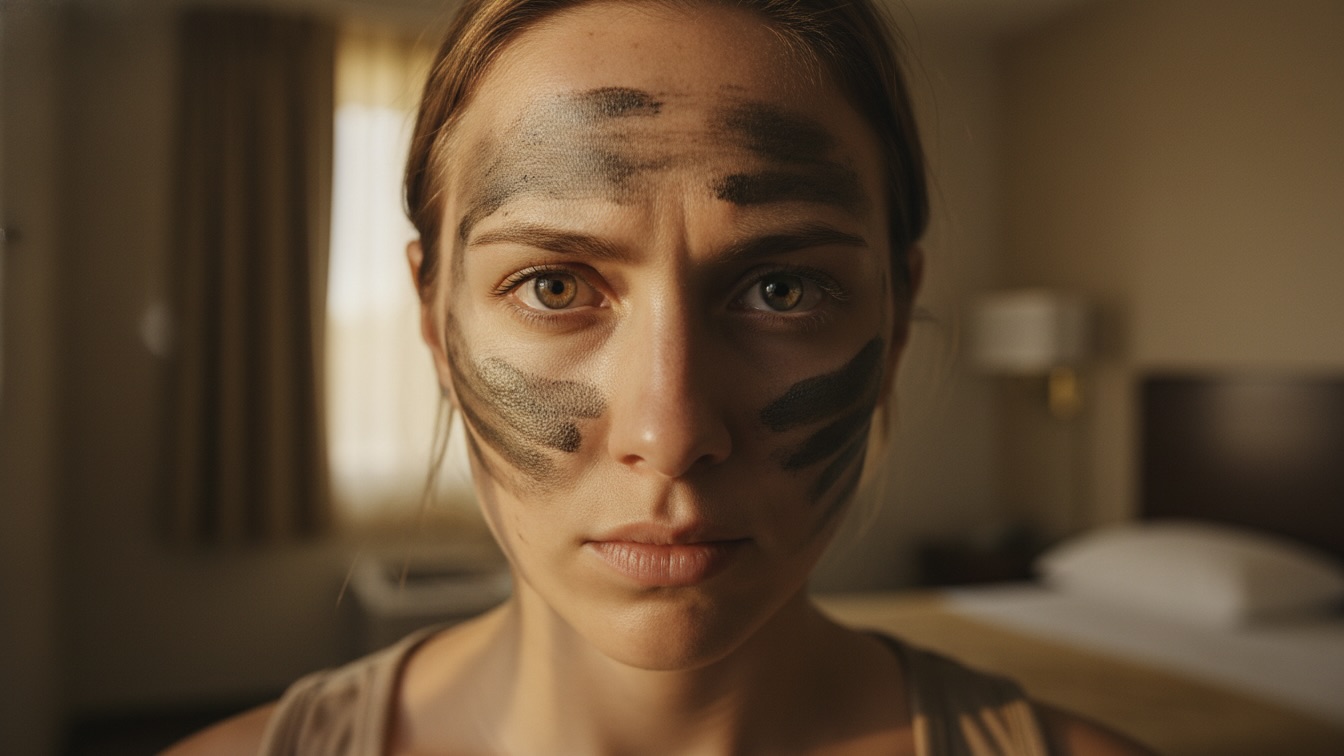
A massive summer storm breaks over the burn scar, forcing Janet and Lionel to fight for their land.
The air was too thick to breathe. It felt like a wet blanket pressed against my face. The sky wasn't blue anymore. It was the color of a bruised plum, dark and swollen. I checked my phone. No bars. Just the little spinning icon of death. The heat didn't move. It just sat on the clearing, baking the ash into a fine, grey crust. I looked at the lake. The water was flat. It looked like glass. It looked fake. Lionel was at the edge of the property, dragging a length of charred cedar. He looked like a stick figure against that purple sky. His shirt was soaked. It stuck to his spine, showing every vertebrae. He looked thin. Too thin.
"Lionel!" I yelled. My voice sounded small. It didn't travel. It just died in the humidity.
He didn't turn around. He just kept pulling. He was building something near the slope. I walked toward him. My boots sank into the soot. Every step kicked up a little cloud that tasted like a campfire. I hated that taste. It was the taste of everything we lost. I caught up to him. He was breathing hard. His chest was heaving. He dropped the log. It hit the ground with a hollow thud.
"What are you doing?" I asked. "It’s a hundred degrees out here."
"Look at the clouds, Jan," he said. He didn't look at me. He looked up. "You see that? That’s not a shower. That’s a dump. If that hits before we get the barriers up, the seeds are gone. The topsoil is gone. Everything we planted goes right into the lake."
I looked at the slope. The ash was loose. It was basically powder. If it rained hard, it would turn into grease. It would slide. I looked at the little spots where we’d tucked the pine seeds. They were vulnerable. They were just sitting there, waiting to be washed away.
"We need more wood," he said. "And rocks. Anything to slow the flow. We have maybe twenty minutes."
"I’ll get the shovel," I said.
I ran back to the shed. The heat inside was worse. It was a kiln. I grabbed the trowel and a heavy iron spade. I found some old burlap sacks in the corner. They smelled like rot and mice. I didn't care. I grabbed them. My hands were shaking. It was the pressure. The air felt heavy, like it was physically pushing down on us. I ran back out. The first drop hit my forehead. It was big. It was warm. It left a dark circle on my shirt the size of a quarter.
Lionel was already digging a trench. He was moving fast. He was desperate. He was fighting for a handful of seeds that might not even grow. It felt insane. It felt like we were trying to stop a bullet with a paper plate. But I started digging anyway. I threw the dirt—mostly ash and charred roots—into the burlap sacks. We needed weight. We needed a wall.
"Fill them up!" Lionel barked. He was sweating so much it was dripping off his chin.
I filled the sacks. The dust got in my nose. I coughed. It was a dry, racking cough. I felt the wind pick up. It wasn't a cool breeze. It was a hot blast, like an oven door opening. The lake started to ripple. The glass was breaking. The trees—the black skeletons of the pines—started to moan. That was the only way to describe it. The wind through the dead branches sounded like a choir of ghosts.
"Over here!" Lionel shouted. He was pointing at the steepest part of the ridge.
I dragged the sacks. They were heavy. They felt like lead. My muscles burned. I hadn't done real work like this in years. My city life was all screens and ergonomic chairs. This was real. This was the earth trying to reclaim itself. I dropped a sack near his feet. He grabbed it and jammed it into the trench.
"More!" he yelled.
I went back for another. The sky was turning black now. The purple was gone. It was just an absence of light. Another drop hit. Then another. They sounded like pebbles hitting a tin roof. The sound was deafening. The silence of the morning was a memory. Now, there was only the roar of the coming water. I looked at my hands. They were black. The ash had turned to paste. It looked like I was wearing gloves made of ink.
I saw a flash. It wasn't a bolt. It was just a sudden brightening of the world, a strobe light behind the clouds. Then the thunder hit. It wasn't a rumble. It was a crack. It felt like someone had slammed a door in my brain. I felt it in my teeth.
"Janet, get down!" Lionel screamed.
I didn't get down. I kept digging. I was obsessed now. I saw one of the blueberry bushes. A small one. It was right in the path of the runoff. I started piling stones around it. I was protecting a weed. Lionel was right. It was poetry. It was stupid. But it was all I had. I felt the first real wave of rain hit. It wasn't drops anymore. It was a wall. It was a solid mass of water that knocked the breath out of me.
I couldn't see. The world turned grey. I could only see a few feet in front of me. I saw Lionel’s boots. I saw him wrestling with a log. He was trying to wedge it against a stump. The water was already starting to move. It wasn't clear. It was black. It was carrying the ash. It looked like a river of oil.
"It's not holding!" he yelled. His voice was almost lost in the sound of the rain.
He was right. The trench was filling up. The burlap sacks were sinking into the mud. The earth was liquefying. We were standing on a landslide. I felt the ground shift under my feet. It was a slow, sickening slide. I grabbed a branch. It snapped. I fell. I hit the mud hard. It was warm. It was slimy. I scrambled to get up, but my hands couldn't find purchase.
"Lionel!"
I saw him reach for me. He was sliding too. He went down on one knee. We were both being washed toward the lake. The ridge was failing. The whole property was trying to jump into the water. I saw the blueberry bush get uprooted. It just spun away in the black flow. It felt like a personal insult.
Then, I felt something hard. My foot hit something that didn't move. It wasn't a rock. It was too flat. Too straight. I kicked at the mud, trying to find a footing. I felt a corner. A sharp, concrete edge.
"Li! Over here!" I screamed.
I grabbed the edge. It was solid. It was anchored. Lionel crawled toward me, his face a mask of grey sludge. He grabbed the ledge too. We hung on as the water rushed past us. It felt like we were clinging to the side of a ship in a storm. The rain didn't stop. It got harder. It was a deluge. It felt like the sky was trying to drown the fire once and for all, even if it took us with it.
The pressure of the water was immense. It pushed against my chest, trying to peel my fingers back from the concrete ledge. Lionel was right beside me, his knuckles white, his jaw set in a grimace that looked like a snarl. We were anchored to this one solid thing in a world that had turned to liquid. The sound was a continuous roar, a jagged white noise that drowned out everything else. I looked up and saw the black skeletons of the trees swaying violently. One of them, a tall Jack pine that had been leaning since the fire, finally gave up. It didn't fall fast. It tilted slowly, then its roots groaned and tore out of the softened earth. It crashed into the mud ten feet away and was immediately swept toward the lake like a piece of driftwood.
"Keep holding!" Lionel shouted. I could barely hear him. His voice was a rasp.
I closed my eyes. The rain felt like needles against my eyelids. I focused on the cold hardness of the concrete. What was it? There shouldn't have been concrete here. This was the edge of the old garden, where the peonies used to be. The house was fifty yards away. The shed was even further. This was supposed to be just soil and roots. I shifted my weight, trying to get a better grip. My foot found another edge. It was a square. A large, flat square buried under the ash.
As the water continued to sheet over us, it acted like a pressure washer. The thick layer of soot and mud was being stripped away. I watched as more of the structure emerged. It wasn't just a block. It was a hatch. A heavy, iron-reinforced concrete door set flush into the ground. It was old. The edges were chipped, and there was a rusted iron ring recessed into the center.
"Li, look!" I pointed down.
He saw it. His eyes widened. He wiped mud from his brow with his shoulder. He looked confused, then focused. The water was still rushing over the hatch, but the worst of the initial surge seemed to be passing. The black river was turning into a series of smaller, muddy streams. The immediate danger of being swept into the lake was fading, but the rain was still relentless.
"What is that?" I yelled.
"I don't know!" he shouted back. "I've lived here my whole life. I never saw this!"
"Grandma never mentioned it?"
He shook his head. He looked spooked. Lionel didn't get spooked by nature, but he got spooked by things that didn't make sense. We stayed there for another ten minutes, huddled over the hatch, until the rain finally slowed to a steady, heavy drizzle. The roar subsided to a rhythmic splashing. The air was cooler now, but it was still heavy with the scent of wet ash and ozone.
I stood up slowly. My legs were shaking. My jeans were heavy with mud, sagging around my hips. I looked around at the damage. The ridge was a mess. Huge gouges had been carved into the earth. The silt fences we'd built were mostly destroyed, buried under mounds of debris. The seeds... I didn't even want to think about the seeds. They were probably halfway to Kenora by now.
Lionel stood up too. He looked at the hatch. He kicked at the mud covering the iron ring. "This shouldn't be here."
"Maybe it's an old septic tank?" I suggested. I didn't believe it. It was too solid. Too deliberate.
"No. Septic is on the north side. Always has been. This is something else."
He reached down and grabbed the iron ring. He pulled. Nothing happened. He adjusted his stance, planting his boots firmly on the concrete, and pulled again. His muscles strained. I could see the effort in the cords of his neck. With a sickening, grinding sound of metal on stone, the hatch moved. Just a fraction of an inch.
"Help me," he said.
I grabbed the other side of the ring. We pulled together. It was heavy—at least a hundred pounds of concrete and iron. It fought us, held down by years of dirt and the suction of the wet earth. But then, with a wet shloop sound, it gave way. We hauled it back, letting it thud onto the mud.
Below us was a dark square hole. A set of rusted metal rungs led down into the blackness. A puff of air hit me. It didn't smell like the rain or the fire. It smelled like old paper, dry dust, and something metallic. It was the smell of a place that had been closed for a long time.
"A cellar," I whispered.
"A storm cellar?" Lionel asked. "In the middle of the yard? Why would you put a storm cellar fifty yards from the house?"
"Maybe it's not for storms," I said.
I pulled my phone out of my pocket. The screen was wet, but it was still working. I turned on the flashlight. The beam cut through the darkness of the hole. The rungs went down about eight feet. At the bottom, I could see a concrete floor. There were boxes. Wooden crates stacked against the walls.
"I'm going down," Lionel said.
"Li, wait. It could be unstable. The rain..."
"The rain didn't touch this," he said, pointing at the dry rungs a few feet down. "It’s sealed tight. If it was going to collapse, it would have done it when the house burned."
He didn't wait for my approval. He swung his legs into the hole and started to climb down. The metal rungs groaned under his weight, but they held. I watched his head disappear into the shadows.
"Is it okay?" I called down.
"Yeah," his voice echoed. It sounded hollow. "It's dry. It's totally dry, Jan. Get down here."
I followed him. The rungs were cold and bit into my palms. I climbed down slowly, my heart hammering against my ribs. When my boots hit the floor, I looked around. It was a small room, maybe ten by ten. The walls were poured concrete. It was remarkably clean compared to the chaos above.
Lionel was standing in the center of the room, looking at a wooden table. On the table was a lantern—an old kerosene one—and a stack of leather-bound books. Against the far wall were the crates I'd seen from above. They were marked with faded stencils. Property of J.D. Miller.
"That was Great-Grandpa," Lionel said. His voice was quiet now. He sounded like he was in a church. "He's the one who bought the original lot. Before the war."
I walked over to the crates. I wiped a layer of dust off the top of one. It was heavy. I pried the lid up with the edge of the shovel I'd brought down. Inside weren't tools or seeds. They were jars. Hundreds of them. But they weren't full of jam.
They were full of ore.
Small, greyish rocks with streaks of silver and white. They were labeled with dates and coordinates.
"Lionel," I said, my voice trembling. "Look at this."
He came over and picked up a jar. He held it up to my phone's light. "Lithium?"
"I think so. Look at the labels. He wasn't farming, Li. He was prospecting. He was looking for exactly what that mining company wants now."
Lionel looked at the crates, then at the books on the table. He picked one up. It was a ledger. He flipped it open. The pages were yellow and brittle, covered in a tight, disciplined script.
"He found it," Lionel whispered. "He found the main vein. Right under the ridge. Right where we were planting those seeds."
I looked at the walls of the cellar. It wasn't just a shelter. It was a vault. A secret our family had been sitting on for eighty years. And now, the fire had literally stripped the earth bare, revealing the very thing Great-Grandpa had hidden.
"Why didn't he sell?" I asked. "If he found it, why did he stay a subsistence farmer? Why did Grandma live in a house with a leaky roof and an outhouse until 1970?"
Lionel was reading the ledger. He didn't answer for a long time. The only sound was the dripping of water from our clothes onto the concrete floor.
"Because of the lake," Lionel finally said. He turned the book toward me. "Read the last entry."
I took the book. The handwriting was shakier here, dated October 1948.
The yield is massive. Enough to change everything. But the cost to the water is absolute. To take the stone is to kill the lake. I will not be the man who poisons the well. Let it stay in the dark. Let the trees grow over it. If they find it, they will destroy it all. I am burying the maps. God forgive me if I'm wrong.
I looked up at Lionel. We were standing on a fortune. A fortune that the mining company already knew was there—or at least suspected. And we had been fighting to keep the land because of 'poetry' and 'memories.'
"They knew," I said. "The mining company. They weren't guessing. They’ve seen the old geological surveys. They probably have the other half of these maps."
"But they don't have the site access," Lionel said. "Not unless we sign."
He looked at the jars of ore. His face was unreadable. I knew what he was thinking. This was the 'out' he wanted. This was the Thunder Bay house. This was the end of the struggle. All he had to do was say yes, and he'd never have to dig another trench in his life.
"Li?" I asked softly.
He looked at me, then back at the ledger. The storm was still going on above us, a muffled thumping against the concrete hatch. We were caught between the past and the future, in a hole in the ground, while the world washed away.
We sat on the floor of the cellar for an hour, maybe longer. The rain eventually stopped. The silence that followed was heavy. It was the kind of silence that only exists after a massive release of energy. Lionel hadn't moved. He was still staring at the ledger, his fingers tracing the old ink. I was leaning against the crates, the cold glass of the ore jars pressing into my back.
"We could be rich, Jan," he said. He didn't sound happy. He sounded tired. "Like, actually rich. Not 'new truck' rich. 'Never work again' rich."
"I know."
"Everything we lost in the fire. It's nothing compared to this. We could buy a hundred houses. We could buy a whole town."
"I know," I said again. I looked at the ceiling. A single drop of water was hanging from the hatch frame. It caught the light from my phone and looked like a diamond before it fell and shattered on the floor. "But the lake. You heard what he wrote. 'The cost to the water is absolute.'"
Lionel stood up and walked to the wall. He kicked it. "The lake is already dying! Look at the shoreline. It's charcoal. The fish are gone. The bear we saw? He's starving. Nature is done with this place, Janet. Why shouldn't we be?"
"Nature isn't done. The blueberries are growing. The seeds... well, maybe the seeds are gone, but the roots are still there."
"Roots don't pay the bills!" he snapped. He turned to me, his eyes bright with a sudden, sharp anger. "You come up here for a few weeks, play at being a pioneer, then go back to your apartment with your high-speed internet and your delivery food. I'm the one who stays. I'm the one who watches the trees rot. I'm the one who has to decide if I’m going to spend the rest of my life as a glorified janitor for a graveyard."
I felt the sting of it. He wasn't wrong. I was an outsider now. I had a life that didn't depend on this soil. He didn't.
"If you sell," I said, keeping my voice steady, "you're not just selling a lot. You're selling the water. You're selling the ridge. You're selling the reason we come here."
"The reason we come here is gone! It burned down!"
He grabbed one of the jars and threw it. It didn't break—the glass was thick—but it hit the far wall with a terrifying crack. The sound echoed in the small space, vibrating in my chest. He stood there, chest heaving, looking at the jar on the floor.
I didn't say anything. I let the echo die.
After a minute, his shoulders slumped. He looked at his hands. They were still stained with the ash and the mud. He looked at the ledger on the table.
"He stayed," Lionel whispered. "He stayed and he kept it secret. He must have been so lonely with that knowledge."
"He wasn't lonely," I said. "He had the family. He had the lake. He had the garden. He chose those things over the money. He chose us, Li. Before we were even born, he chose the place over the profit."
Lionel sat back down on the bench. He looked small. "I don't know if I'm that strong, Jan. I'm really tired."
"You don't have to be strong right now. You just have to be here."
I stood up and walked over to him. I put my hand on his shoulder. His shirt was still damp, but he'd stopped shivering. We stayed like that for a long time. The air in the cellar was getting stale. We needed to go back up, back into the light, even if the light was just the grey aftermath of a storm.
"Let's take the ledger," I said. "And the maps. We need to see exactly what we're sitting on. Not for them. For us."
He nodded. He gathered the books and the maps, wrapping them in his dryest undershirt. I picked up the kerosene lantern. It was empty, but it felt like something that should be in our kitchen, not a hole in the ground.
We climbed out. The world above was transformed. The sun was trying to peek through the clouds, casting a strange, pale yellow light over the ruins. The air was fresh and cool, the scent of wet pine and damp earth finally replacing the smell of smoke.
I looked at the ridge. It was scarred. The black water had carved deep channels through the ash. But at the bottom of the slope, where the mud had settled, I saw something.
I walked down the hill, my boots squelching. Lionel followed me. At the edge of the property, where we'd built the first silt fence, a mound of debris had collected. And sticking out of the mud was a flash of green.
It wasn't a blueberry bush.
It was a seedling. A Jack pine. Barely three inches tall. It had been washed down the hill, but its roots had caught on the burlap sack. It was standing upright, its needles dripping with rainwater.
"Look," I said.
Lionel knelt down beside it. He touched the needles with one finger. "It's one of ours?"
"No. It's too big. This is a survivor, Li. It was here the whole time, under the ash. The rain didn't kill it. It just uncovered it."
He looked at the seedling, then back at the ridge, then toward the lake. The water was muddy near the shore, but further out, it was still that deep, impossible blue.
"The mining company is going to keep calling," he said.
"Let them. We have the maps now. We know where the line is. We can fight them with more than just feelings. We can fight them with their own data."
Lionel stood up. He looked at the seedling, then at the cellar hatch. He walked back to the hatch and pulled the heavy lid shut. The sound of it closing was final. A heavy, concrete thud. He kicked mud over the edges, smoothing it out with his boot until it was almost invisible again.
"We don't tell anyone," he said. "Not yet."
"Not yet," I agreed.
We walked back toward the truck. The property was a disaster area, but for the first time since I'd arrived, it didn't feel like a graveyard. It felt like a construction site. The foundation was still there. The water was still there. And the secrets... the secrets were ours to keep.
As we reached the truck, another car pulled up the drive. It was a dusty SUV. Not a mining company truck. It was Mrs. Mistis. She rolled down the window, her face pale.
"You two okay?" she called out. "That was a hell of a blow. I thought for sure the whole ridge would slide."
"We're okay, Mrs. Mistis," I said, leaning on the truck door. "We lost some soil, but we found our footing."
She looked at the mess, then at Lionel. "You look like you've been down a mine shaft, Lionel."
He wiped a smear of mud from his cheek and smiled. It was a real smile. "Just gardening, Mrs. Mistis. It's a dirty business."
She laughed, a short, dry sound. "Well, come by the motel later. I've got some sandwiches. And I think someone found a crate of beer that didn't skunk."
"We'll be there," I said.
She nodded and backed the SUV out. We watched her go. The sun was lower now, hitting the lake at an angle that made the water sparkle like it was full of diamonds. It was beautiful. It was a lie, because the water was full of silt and the trees were dead, but it was a beautiful lie.
Lionel opened the truck door and tossed the bundle of maps onto the seat. "You still want to plant those seeds?"
"Every single one," I said.
"Good. Because the mud is soft now. It'll be easy digging tomorrow."
I looked at the ridge one last time. The shadows were lengthening, reaching out across the ash like long, dark fingers. The cellar was hidden again. The seedling was growing. The lake was waiting. We weren't just survivors anymore. We were something else. We were the guardians of a secret, and the owners of a future we hadn't even imagined an hour ago.
I got into the truck. The interior smelled like old coffee and Lionel's cigarettes. It was a good smell. It was a human smell. I looked at my phone. Two percent battery. I didn't care. I turned it off. I didn't need the digital world. I had the mud under my fingernails and the weight of the past in the seat beside me.
"Let's go," Lionel said, turning the key. The engine roared to life, a steady, reliable growl.
We drove down the driveway, leaving the ruins behind for the night. The light was fading, but the world felt clearer than it ever had. We had work to do. So much work. But for the first time, I knew exactly why I was doing it. We weren't just rebuilding a house. We were protecting the soul of the land, one seed—and one secret—at most.
The night at the motel was loud. Too loud for people who had just been through a war with the sky. Mrs. Mistis had set up a folding table in the parking lot, and the survivors of Eagle Lake were huddled around it like it was a campfire. There was a weird energy in the air—half relief, half exhaustion. People were drinking cheap beer out of cans and eating ham sandwiches that tasted like the plastic they were wrapped in. I sat on the tailgate of Lionel’s truck, watching them. I felt like a ghost. I had the maps in my head. I had the ledger’s words ringing in my ears. I looked at these people, my neighbors, and wondered what they would do if they knew what was under their feet.
"You're quiet," Lionel said. He handed me a lukewarm can of Coors.
"Just thinking."
"Stop it. It's dangerous."
He leaned against the truck next to me. He’d showered in the motel's communal stall, but he still had a smudge of soot behind his ear. He looked younger in the moonlight. The hardness in his eyes had softened, replaced by a strange, focused intensity. He wasn't looking at the crowd. He was looking at the dark outline of the trees against the stars.
"I looked at the coordinates on the first map," he whispered, his voice low enough that even I could barely hear him. "The vein... it doesn't just stay on our lot. It runs north. Under the Mistiss' place. Under the church. It’s the whole ridge, Jan. It’s the entire town."
I felt a chill that had nothing to do with the night air. "So if we sell, they all lose. But if we don't sell..."
"If we don't sell, the mining company eventually goes to the government. They claim mineral rights. They try to force us out anyway. But with those papers? With the environmental notes Great-Grandpa took? We can prove the damage. We can prove he knew it was a disaster before the technology even existed to fix it."
"Do you think it'll work?" I asked.
"I think it's a better shot than a garden hose," he said.
I took a sip of the beer. It was bitter. I looked over at Mrs. Mistis. She was laughing at something a man in a flannel shirt was saying. Her house was gone. Her husband was gone. Her life was a suitcase in room 212. And yet, she was here. She was still a part of the lake.
"Why didn't she know?" I wondered out loud. "How could a whole town not know?"
"Because they wanted to be farmers," Lionel said. "They wanted the trees and the water. Nobody wanted to be a miner. Not then. They came here to escape the smoke of the cities, not to bring it with them. Great-Grandpa wasn't just hiding a fortune. He was hiding a curse."
I thought about the jars of ore. They were beautiful, in a cold, sterile way. But they were heavy. They felt like lead in my memory. I thought about the seedlings we’d found. They were light. They were fragile. They were exactly what this place needed.
"I'm going to Thunder Bay tomorrow," I said suddenly.
Lionel looked at me. "Why?"
"I'm going to the university. The geology department. I have an old friend there. Someone who can look at these maps without telling the world. We need to know exactly how much damage the mining would do. We need the science to back up the poetry."
Lionel nodded slowly. "Take the truck. My car is junk anyway."
"What are you going to do?"
"I'm going back to the lot," he said. "I’m going to start clearing the debris from the cellar. Not just the mud. The whole thing. I want to see if there's anything else down there. Tools. More notes. Anything we can use."
"Be careful, Li. The ground is still soft."
"I know the ground, Jan. Better than anyone."
We sat in silence for a while, listening to the murmurs of the crowd. A woman started crying a few cars down, a low, rhythmic sobbing that no one acknowledged. It was a common sound here. Grief was the background noise of the summer.
"You think the seeds survived?" I asked.
"Some of them," he said. "The ones we tucked deep. And the ones that washed down? Maybe they'll find a new place to grow. That's the thing about this kind of land. It’s stubborn. You can burn it, you can drown it, but it just keeps trying."
I looked at my hands. The stains were finally starting to fade, but my skin felt different. Rougher. Older. I felt like I finally belonged to the lake, not as a visitor, but as a part of the cycle. I wasn't the city girl anymore. I was the girl with the iron spade and the secret vault.
"I'm glad you came back, Jan," Lionel said. He didn't look at me when he said it. He kept his eyes on the stars.
"I didn't have a choice," I said. "The berries called me."
He laughed, a short, genuine sound. "Yeah. The berries. They’re the real bosses around here."
I finished my beer and stood up. I was exhausted, the kind of deep, bone-weary tired that makes your brain feel like it’s floating. I needed to sleep, but I knew I wouldn't. My mind was already racing, planning the trip, the meetings, the defense of our ridge.
I walked to the door of my motel room. It was a small, cramped space that smelled like lemon cleaner and old carpet. I looked back at Lionel. He was still sitting on the tailgate, a solitary figure in the moonlight. He looked like a king on a throne of rusted metal.
"Goodnight, Li."
"'Night, Jan. See you in the morning."
I went inside and closed the door. I didn't turn on the light. I just sat on the edge of the bed and looked out the window. The moon was high now, silvering the world. Somewhere out there, under the ash and the mud, the lithium was waiting. And above it, the seeds were sleeping.
I reached into my pocket and pulled out the small piece of ore I’d tucked away. It was heavy for its size. I held it in my palm, feeling its cold weight. It was a piece of the earth, a piece of the past, and a piece of a future we were going to fight for. I put it on the nightstand and lay down.
Outside, the wind picked up again, a soft sigh through the trees that had survived. It didn't sound like ghosts anymore. It just sounded like the wind. I closed my eyes and breathed in the scent of the summer—hot, dry, and full of the promise of things yet to break the surface.
I thought about the house we would build. It wouldn't be the same. It would be smaller, maybe. Stronger. It would have a garden that could withstand a flood and a cellar that held more than just shadows. We would stay. We would plant. We would wait.
In the darkness, I could almost feel the roots moving. I could almost hear the seeds cracking open, reaching for the light that would eventually come. The summer wasn't over. Not even close. But for the first time, I wasn't afraid of the heat. I wasn't afraid of the fire. I was ready for whatever came next.
I fell asleep with the taste of blueberries on my tongue and the weight of the mountain in my heart. The world was broken, but the ground was still there. And for now, that was enough.
“I reached into my pocket and felt the cold, heavy stone, knowing the real storm was only just beginning.”


