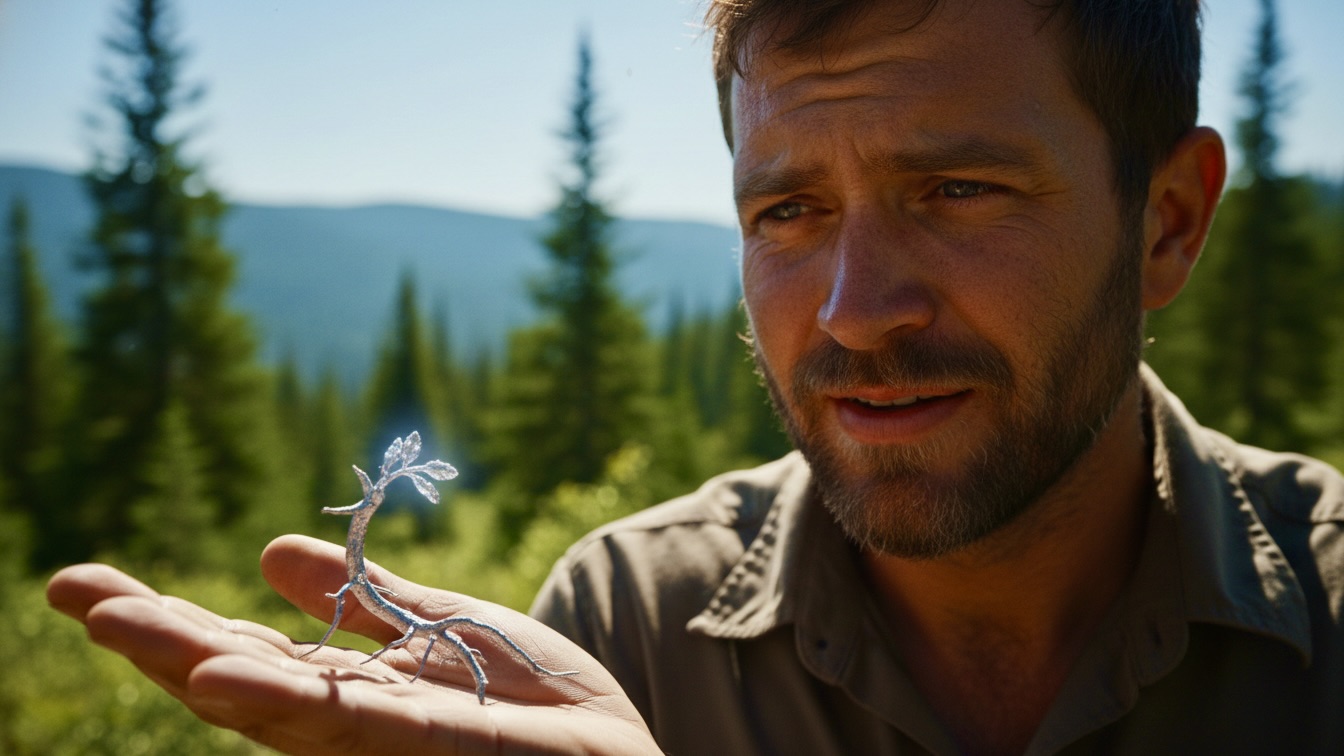
A ranger discovers a natural dead zone where surveillance fails and families hide from the city's digital safety.
The heat in the Alberta Rockies didn't shimmer; it hammered. Ben wiped sweat from his forehead with the back of a glove that had seen better decades. He was standing at the base of Beacon 42, a sleek, silver needle planted by the Ministry of Digital Safety three months ago. It looked like a giant's toothpick, meant to keep the 'friction' out of the wilderness. But something was wrong with this one. It wasn't humming. Usually, these things put out a low-frequency buzz that made Ben’s teeth ache and his dog, Barkly, refuse to leave the truck. Today, it was silent.
Ben stepped closer, his boots crunching on the dry shale. He saw the vines first. They weren't the usual pale green of wild hops or the dusty brown of dead brush. They were dull grey, the color of unpolished lead, and they didn't just climb the beacon—they were crushing it. The metal casing of the tower was crimped like a soda can under the pressure of the growth. He touched one of the tendrils. It didn't feel like plant matter. It felt like cold, braided wire, but it was pulsing. A slow, rhythmic throb. It was alive, and it was pissed off.
"What the hell are you?" Ben muttered. He pulled his multitool and tried to nick the surface. The blade sparked. It didn't cut. It just slid off the metallic skin of the vine. This wasn't a mutation; it was a response. The mountain was building its own firewall. The silence here was heavy, physical. For the first time in a year, Ben didn't feel like his brain was being scanned by a remote server in Ottawa. The constant itch behind his eyes—the one that came from being 'safe'—was gone. It was just him, the rock, and this weird, heavy-metal fungus.
His radio crackled. It was a legacy analog unit, the kind the Ministry hated because they couldn't encrypt it as easily. "Ben, you there?" It was Sarah at the base station, ten miles down the pass. Her voice was thin, filtered through layers of static. "We’ve got a localized blackout on the grid. Beacon 42 and 43 just dropped off the map. You seeing anything?"
Ben looked at the crumpled tower. "Yeah, Sarah. I’m seeing a technical difficulty. Looks like the local flora has a bug in the system. Or a feature. Depending on who you ask."
"The Ministry isn't going to like that, bruh," Sarah said. She was twenty-two and treated the encroaching surveillance state with a mix of irony and profound exhaustion. "They already flagged the valley for 'abnormal signal absorption.' If the towers are actually breaking, they'll send a recovery team. Probably with flamethrowers."
"Let them come," Ben said, looking at the grey vines. "They'll need better gear than they've got. These things are literal iron. I’m heading back to the truck. It’s too quiet out here. It’s making me feel like a person again."
"Careful," Sarah warned. "Being a person is a high-friction activity these days. Catch you later."
Ben turned back toward the trailhead, but he stopped when he saw a plume of dust rising from the access road. It wasn't a Ministry SUV. It was an old, beat-up minivan, the kind that shouldn't be able to make it past the first three switchbacks. It was dragging its muffler, and the engine sounded like a bag of rocks in a blender. It skidded to a halt twenty feet from his truck. The side door slid open with a screech of unlubricated metal.
A man climbed out, looking like he hadn't slept since the Great Server Migration of '24. He was followed by a woman and two kids who looked far too quiet for their age. They weren't looking at the scenery. They were looking at their phones, then at the sky, then at Ben. They looked hunted. The man held up a hand, his palm shaking. "Is this the place?" he asked. His voice was raspy, dry.
"That depends," Ben said, leaning against his fender. "What place are you looking for? This is a provincial park. Mostly just rocks and bears."
"The dead zone," the woman said, stepping out. She had a streak of grey in her hair that looked like it had appeared overnight. "We heard there was a place where the GPS stops working. Where the friction score doesn't follow you. Please. They disabled our car in Canmore. We had to hotwire the manual override just to get this far."
Ben looked at the kids. They were holding tablets that were stuck on a spinning 'Searching for Signal' icon. They looked terrified, like the devices were life support and the plug had been pulled. He looked back at the ruined beacon. The metallic vines were still pulsing. The mountain was breathing, and it was offering a seat at the table.
"You're the Keisslers?" Ben asked. He'd seen a flash-memo on his terminal this morning about a family from Calgary 'deviating from their assigned safety corridor.'
"We just wanted to go camping," the man, Keissler, said. "Then the alerts started. My wife's score dropped because she bought the wrong brand of flour. Then mine dropped because I didn't 'verify' a political post. Then they cut our credit. We’re not criminals. We’re just... tired."
Ben sighed. He knew the look. It was the look of a civilization that had traded its soul for a seamless user experience. "Look, the Ministry is going to be here soon. They don't like it when their toothpicks get stepped on. You can't stay on the road."
"Where do we go?" the woman asked.
Ben pointed toward the high ridge, where a dark slit in the limestone marked the entrance to the old Silver Basin mine. "There’s a cave. It’s deep, and it’s full of these grey roots. Nothing gets in there. Not 6G, not satellite pings, not even the Ministry’s bad vibes. If you can get the van up that goat path, you might have a chance."
"Thank you," Keissler said. He looked at Ben’s badge. "Aren't you going to report us?"
Ben looked at the metallic vine on the beacon. It seemed to have grown an inch since he arrived, slowly tightening its grip on the silver throat of the state. "I’m a ranger, Keissler. My job is to protect the park. And right now, the park seems to want you here more than it wants that tower. Go. Before the drones catch the scent."
The van groaned as it lurched up the incline, spitting gravel like a wounded animal. Ben followed on foot, his heart hammering against his ribs in a rhythm that felt dangerously like hope. He hadn't felt hope in a long time. In 2026, hope was usually just a marketing term for a new subscription tier. But watching that family disappear into the shadow of the mountain felt real. It felt heavy. The air up here was different. It didn't have the metallic tang of the city. It smelled of sun-baked pine needles and the cold, sharp scent of ancient stone.
Inside the mine entrance, the temperature dropped twenty degrees. The Keisslers huddled together, their breath visible in the dim light. The cavern was massive, a cathedral of rock and silence. But it wasn't empty. The Iron Roots were everywhere here. They hung from the ceiling like frozen lightning, thick and grey and humming with a frequency so low it was more of a feeling than a sound. It was the sound of the earth's own nervous system.
"The phones," the daughter whispered. She was staring at her screen. "It's gone. Everything's gone."
"It's okay, Maya," her mother said, though she looked just as unsettled. "We don't need them right now."
"But how do we know what's happening?" the boy asked. "How do we know if we're safe?"
Ben stepped into the cave, his flashlight beam cutting through the gloom. "You're safe because they can't see you. That's the only kind of safety that matters anymore. These roots... they're a fungal network. I’ve been studying them. They react to electronic stress. The more the Ministry pumps the valley full of signals, the faster these things grow to eat them. It’s a biological immune response."
Keissler touched a root. It felt like cold silk. "It’s like the mountain is wearing noise-canceling headphones."
"Exactly," Ben said. "But you can't stay in the van. You need to set up camp deeper in. There’s an underground spring about fifty yards back. The water is clean. Cold as hell, but clean. I’ll bring you some supplies tonight. Dry wood, some blankets. You need to keep the fire low. Smoke is the only thing the drones can still track."
"Why are you helping us?" the woman asked. She was looking at Ben with a skepticism that was hard-coded into her generation. "You’re government. You’ve got the pension, the health plan. You're throwing that away for people you don't even know."
Ben looked at his hands. They were stained with the grey dust of the roots. "I took an oath to protect the land. The Ministry thinks the land is a resource. A backdrop for their 'Safety' infrastructure. But the land is an actor. It’s doing something here, and I want to be on the winning side. Besides, I’m tired of the noise, too. My brain feels like a browser with fifty tabs open, and forty of them are frozen. This cave? This is the 'Close All' button."
He left them there, a small pocket of humanity tucked into the stone. As he walked back down to his truck, he noticed the silence again. It wasn't the absence of sound; it was the presence of peace. He could hear the wind moving through the high grass. He could hear a hawk screaming somewhere in the distance. These were sounds that didn't require a data plan.
When he reached the trailhead, a black SUV was waiting. It didn't have license plates, just a Ministry seal on the door. A man in a suit that cost more than Ben’s truck was standing by the ruins of Beacon 42. He was holding a handheld scanner that was emitting a frustrated series of beeps.
"Ranger Ben?" the man asked. He didn't look up. "I’m Inspector Brunton. Resource Recovery. We have a problem."
"Just one?" Ben asked, leaning against his truck. "I thought the Ministry had everything under control. Seamless safety, right?"
Brunton looked up. His eyes were cold, the eyes of a man who saw the world in spreadsheets. "Don't be cute. We’ve lost three beacons in this sector. The signal absorption is at ninety-eight percent. It’s a literal black hole. And we’ve got a family of friction-deviants pinger-locked to this coordinate before their car went dark. You see a minivan?"
"A minivan? Up here?" Ben laughed. It was a dry, hollow sound. "Bruh, a mountain goat would struggle on these roads. If they tried to come up here in a van, they’re probably at the bottom of a ravine five miles back. I haven't seen anything but rocks and this weird weed."
Brunton walked over to the beacon and kicked one of the grey vines. "This 'weed' is a Class A environmental hazard. It’s interfering with federal infrastructure. We’re bringing in a team tomorrow to clear the valley. Chemical defoliants. High-intensity scanners. We’re going to map every inch of this rock until we find the interference."
"You’re going to spray the pass?" Ben’s voice went flat. "During a summer drought? You’ll start a fire that’ll burn half the province."
"Safety is our primary mandate, Ranger," Brunton said, checking his watch. "If the forest has to burn to ensure the network is secure, then it burns. We can always replant with approved, low-friction timber. You have twelve hours to clear your gear out of the station. You're being reassigned to the city. Surveillance monitoring. Since you like people so much."
"I’m not leaving," Ben said.
Brunton smiled. It was a thin, predatory expression. "It wasn't a request. Your social score just took a fifty-point hit for 'uncooperative behavior.' You’re one more 'no' away from losing your access to the grid entirely. Think about that before you decide to play hero for a bunch of trees."
Brunton climbed back into his SUV and sped off, leaving a cloud of acrid exhaust in his wake. Ben watched him go, then looked at the Iron Roots. They were pulsing faster now. They knew. The mountain was waking up, and it wasn't going to go down without a fight.
The night was a heavy blanket of velvet and silver. Ben moved through the brush like a ghost, his pack loaded with canned beans, wool blankets, and a heavy-duty axe he’d sharpened by hand. He didn't use a flashlight. He didn't need one. The Iron Roots gave off a faint, bioluminescent glow, a soft grey light that guided him toward the mine. It was like the mountain was holding a candle for him.
He found the Keisslers huddled around a small, smokeless fire deep in the cavern. The father, Mark, was trying to explain to his kids how to play a game with shadows on the wall. They looked less like refugees and more like pioneers now. The fear was still there, but it was being replaced by a strange, sharp-edged alertness.
"They're coming tomorrow," Ben said, dropping the pack. "The Ministry. They're going to use chemicals. They want to kill the roots."
Mark stood up, his face hardening. "Then we have to leave. We'll head over the pass."
"You won't make it," Ben said. "The pass is monitored by high-altitude drones. The moment you step out from under the canopy, they’ll have a lock on your heat signature. You’ll be back in a 'Safety Center' by dinner."
"So what do we do?" the wife asked. "We can't just sit here and wait to be gassed."
Ben looked at the roots. They were everywhere now, thicker than they’d been even six hours ago. They were weaving themselves into a dense mat across the ceiling of the cave. "The mountain is on our side. I can feel it. These roots... they don't just eat signals. They create them. They’re a biological jammer. If we can get you deeper into the pass, through the old goat trails, the drones won't be able to see you. The magnetic interference is too high."
"But the trails are blocked," Mark said. "I saw the rockfalls on the way up."
"The trails aren't blocked for people who know how to listen," Ben said. "I’m going to lead you out tonight. We’re going to the Hidden Valley. It’s an old glacial basin that isn't even on the new maps. The Ministry thinks it’s a solid ridge because the signal bounce is so bad there. They’ve never been able to get a drone over it without the sensors frying."
"Is it safe?" Maya asked, clutching a tattered teddy bear.
"It's wild," Ben said, kneeling down to her level. "There’s no Wi-Fi. No tablets. No one telling you how to feel or what to buy. There’s just the wind and the trees and the stars. Is that safe? Maybe not. But it’s free. And right now, free is the best kind of safe there is."
They moved out an hour later. It was a slow, grueling climb. Ben led them through narrow crevices and over jagged outcrops that didn't look like paths at all. But every time they reached a dead end, a section of the Iron Roots would seem to part, or a hidden ledge would reveal itself in the moonlight. The mountain was opening its doors for them.
As they reached the summit of the first ridge, the sound of rotors cut through the night. A Ministry heavy-lift drone, the size of a small car, was hovering over Beacon 42. It was shining a high-intensity spotlight down onto the ruins, the beam a harsh, artificial white that looked like a scar on the darkness.
"Down!" Ben hissed.
They crouched behind a line of grey-barked trees. The drone swung its light toward them, the beam sweeping across the rocks. Ben held his breath. He could feel the vibration of the drone in his teeth. But the light didn't stop. It passed right over them, as if they were part of the stone itself. The Iron Roots around them were pulsing with a fierce, silver energy, throwing off enough magnetic interference to mask their body heat.
"We’re invisible," Mark whispered, his voice full of awe.
"No," Ben said. "We’re just part of the mountain now."
They pushed on, descending into the Hidden Valley just as the first hint of dawn began to bleed over the horizon. The valley was beautiful. It was a lush, green bowl protected by towering peaks of grey limestone. There were no towers here. No wires. No signals. The air was so clear it felt like a physical weight being lifted from Ben’s lungs. He took a deep breath, and for the first time in years, he didn't taste ozone.
But the peace didn't last. A voice boomed from the ridge above them, amplified by a megaphone. "Ranger Ben! Stand down!"
Ben turned. Brunton was standing on a ledge fifty feet above them, flanked by two men in tactical gear. They were holding high-intensity scanners that looked like oversized rifles. Brunton looked down at them with a mixture of pity and rage.
"You really thought you could hide?" Brunton shouted. "We tracked the heat signature of your truck. We know you’re here, Ben. Hand over the dissidents. If you do it now, I might be able to save your pension. You’ve got twenty years in. Don't throw it away for a bunch of people who couldn't even keep their social scores above a forty."
Ben looked at the Keisslers. They were huddled together, looking up at the agents with a quiet, dignified defiance. Then he looked at Brunton. He looked at the expensive suit, the high-tech gear, the cold, empty eyes of a man who had forgotten what it felt like to be human.
Ben started to laugh. It wasn't a manic laugh; it was a genuine, joyful sound that echoed off the valley walls.
"What’s so funny?" Brunton demanded.
"You," Ben said, wiping his eyes. "You’re talking about my pension? Bruh, look around you. You’re standing on a mountain that’s literally eating your technology. You’re trying to threaten a man with a paycheck when the world is ending. You can't fire me. I don't work for you anymore. I work for the trees now."
"Kill the vines!" Brunton ordered his men. "Clear the ridge!"
The agents raised their scanners, but before they could trigger them, the ground began to shake. It wasn't a sharp jolt, but a deep, rhythmic thrumming that came from the very core of the earth. The Iron Roots at the base of the ridge began to glow with a blinding, silver light. They weren't just absorbing signals anymore; they were projecting them. A massive wave of electromagnetic energy surged up the ridge, hitting the agents like a physical blow.
Their scanners exploded in a shower of sparks. The megaphone shrieked and died. Brunton’s SUV, parked further back, began to smoke as its electrical system fried. The agents stumbled back, clutching their heads as the 'noise' of the mountain filled their ears.
Then, with a sound like a thousand panes of glass breaking at once, the ridge itself began to move. A massive slab of limestone, held in place for centuries, slid forward. It wasn't a chaotic collapse; it was a precise, controlled rockslide. It poured down the slope, burying the access road under twenty feet of rubble. It didn't hit the agents—they were safe on their ledge—but it cut them off. The only road into the valley was gone. The only way out was through the trails that only Ben knew.
Brunton stared down at the destruction, his face pale. He looked at his dead scanner, then at Ben. For the first time, he looked afraid.
"You’re trapped," Brunton whispered.
"No," Ben said, looking at the Hidden Valley behind him. "We’re finally home."
The weeks that followed were a blur of manual labor and quiet discovery. The Hidden Valley became a sanctuary. The Keisslers were the first, but they weren't the last. Others found their way—people who had seen the 'dead zone' on old maps, people who had heard the rumors of a place where the pings stopped. They came with nothing but what they could carry, fleeing a world that had become a gilded cage.
They built a society out of what the mountain gave them. They used the Iron Roots to reinforce their shelters, finding that the metallic vines were as strong as steel but as flexible as rope. They learned to farm the high-altitude soil, rediscovering the slow, patient rhythm of the seasons. There were no tablets, no social scores, no 'friction' reports. Speech was free because there was no one listening but the birds and the wind.
Ben watched the children play in the creek. They weren't looking for signal bars anymore. They were looking for shiny stones and strange insects. They were rediscovering the 'wildness' that the modern world had tried to legislate away. Their skin was tanned by the sun, their hands were calloused, and their eyes were bright with an intelligence that didn't come from an algorithm.
One evening, Ben sat on a high ridge overlooking the entrance to the pass. The rockslide had held. The Ministry had tried to clear it once, but the mountain had responded with another slide, even bigger than the first. Eventually, they had given up. The valley was marked as a 'High-Hazard Ecological Zone' on the official maps—a place to be avoided, a glitch in the system.
Sarah was there, too. She had hiked in a week after the road closed, carrying a bag of heirloom seeds and a defiant grin. She had traded her irony for a shovel, and she looked younger than she ever had in the city.
"Think they'll ever come back?" she asked, looking toward the distant, hazy line of the horizon where the lights of the city still glowed like a dying ember.
"Maybe," Ben said. "But they won't find us. The mountain is growing faster than they can map it. The Iron Roots are spreading. I saw a patch of them ten miles down the other side of the ridge today. They’re following the power lines. They’re heading for the grid."
"A literal firewall," Sarah said, smiling. "I love that for us."
Ben reached into his pocket and pulled out a small, heavy object. It was a seed—or at least, the fungal equivalent. It was a tight, silver coil of Iron Root, pulsing with a faint, internal warmth. It felt like a heartbeat.
"What are you going to do with that?" Sarah asked.
Ben looked at the edge of the pass, where the wild mountain met the managed world. "I’m going to plant it. Just in case the city tries to creep back in. This isn't just a wall, Sarah. It’s a seed. A new way of being. We’re not just hiding from the world; we’re waiting for it to catch up."
He knelt down and dug a small hole in the dry, rocky soil. He placed the silver coil inside and covered it with earth. As he pressed the dirt down, he felt a sharp, clear sensation of oxygen—the physical sense of a burden being lifted. The claustrophobia of the digital age was gone. The clarity of the wild had taken its place.
He stood up and looked out over the valley. The sun was setting, casting long, golden shadows across the green basin. In the distance, he could hear the sound of a flute—someone had carved one from a piece of cedar. It was a simple, haunting melody that didn't need to be recorded or shared to have meaning. It was enough that it existed in the moment.
Ben knew the struggle wasn't over. The Ministry would eventually find a new way to threaten them. The world outside would continue to tighten its grip on the people who remained. But for now, in this valley, the signal was dead, and the humans were alive.
He turned and started the long walk back down to the camp. He had a lot to do. There were houses to build, stories to tell, and a future to invent from scratch. He wasn't a ranger anymore. He was a pioneer. And as the first stars began to pierce the darkening sky, he realized he had never felt more at home.
The mountain breathed behind him, a vast, silent ally in the long war for the soul of the world. The Iron Roots were growing, weaving a net of silence that would eventually cover the earth, one dead zone at a time.
“As the silver vine began to pulse beneath the soil, Ben saw a faint, answering glow on the far ridge, miles away, where no one should have been.”


