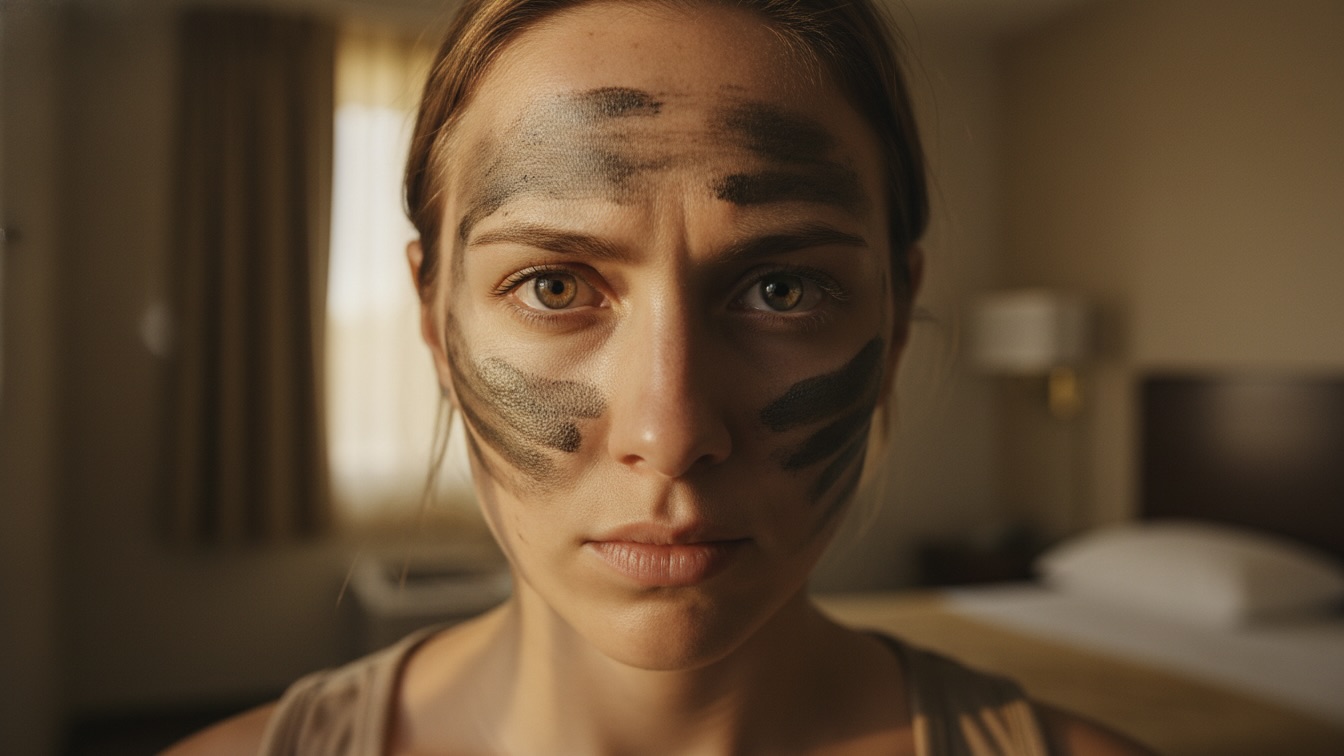
Janet returns to her family's charred lakeside home, finding only wild blueberries thriving in the ash and ruins.
The ground was a graveyard of things that used to be important. I stepped out of the car, and the soles of my sneakers hit the fine, grey powder that used to be the front porch. It didn't crunch. It just gave way. Everything was quiet in a way that felt wrong for July. Usually, the bugs at Eagle Lake are loud enough to vibrate in your teeth.
Now, there was nothing. Just the wind through the blackened skeletons of the Jack pines. They looked like giant, charred needles stuck into the earth by a frustrated god. I didn't want to be here, but the property tax bill didn't care about my trauma. Neither did the insurance adjuster. I walked toward what was left of the kitchen. The fridge was a slumped, melted heap of white enamel and plastic. It looked like a marshmallow someone had left too long in the fire.
I looked down at my feet. In the middle of all that grey and black, there was a shock of neon green. Low-bush wild blueberries. They were everywhere. It was like the fire had been an invitation. The plants were barely six inches high, but they were loaded. Deep, dusty purple spheres huddled under the leaves. I reached down and picked one. It was warm from the sun. When I popped it into my mouth, the sweetness was sharp, followed by that hit of acidic earth. It tasted like the lake used to feel before the sky turned orange and the sirens started. I knelt in the soot, my jeans turning a dark, charcoal grey. I didn't have a bucket. I just started picking and eating. My fingers were already stained. It looked like I’d been caught red-handed, or purple-handed, in a crime I didn’t commit.
Then I heard the rumble. It wasn't thunder. It was the low, rattling growl of a diesel engine. A white Ford F-150 pulled up the drive, kicking up a cloud of ash that hung in the air like a ghost. I didn't have to look at the plates to know who it was. Lionel. He didn't get out right away. He just sat there with the engine running, probably staring at me through the windshield, judging the fact that I was wearing a clean t-shirt and city shoes. He finally killed the engine. The silence that followed was heavier than the noise. He opened the door, and his boots hit the ground with a solid thud. He looked older. His face was lined with soot that seemed to have been tattooed into his pores. He was wearing his work greens, the ones the Ministry of Natural Resources guys wear. He looked like he belonged here. I looked like a tourist in my own life.
"You're late," he said. He didn't say hello. He didn't ask how the drive from Toronto was. He just pointed at the heap of rubble that used to be our childhood. "Adjuster was here three hours ago. He's not coming back."
"Traffic was bad," I said. It was a lie. I'd sat at a gas station in Dryden for forty minutes just staring at the pump, trying to convince myself to keep driving.
"Always is," he muttered. He walked over to me, looking at the berries in my hand. "You're eating those?"
"They're good. Better than usual."
"Yeah, well. Ash is basically fertilizer. Nitrogen, potassium. The soil's acidic now. It's exactly what they want. They're the only things happy about this."
He kicked at a piece of charred timber. It broke apart into a thousand black flakes. He looked at the lake. The water was still blue, but the shoreline was a ring of charcoal. It looked like a drawing someone had forgotten to color in. I stood up, wiping my hands on my thighs. It only made the stain worse.
"Lionel, I'm sorry I wasn't here," I said. The words felt thin.
"You were where you were," he said. "I was the one holding the hose. Not that it mattered. The wind shifted. It was over in ten minutes. You ever seen a house breathe? It sucks the air in right before the windows blow out. It's a sound you don't forget."
I looked away. I didn't want the visual. I had the news footage, the shaky cell phone videos people had posted to X. That was enough. I didn't need the internal director's cut.
"Grandma's place?" I asked.
"Gone. Everything from here to the boat launch. Total loss. Most people aren't coming back, Jan. There's nothing to come back to."
I looked at the blueberries again. They were dense. A carpet of them. "We're back."
"I'm here because I work here," he said. "You're here because you have to sign papers. Don't confuse the two."
He walked toward the old garden shed. It was the only structure still standing, though the roof had sagged and the wood was scorched. He pulled the door open. It shrieked on its hinges. He reached inside and pulled out a stack of papers clipped to a board.
"We need to talk about the offer," he said.
"The insurance?"
"No," he said, his voice flat. "The mining company. Northern Lithium. They've been calling everyone. They want the whole ridge. They want the lake access."
"They want to dig a hole where the kitchen was?"
"They want to dig a hole where the whole town was. It's a good out, Janet. It's the only out."
I looked at the patch of green at my feet. The berries were thriving. They were the only thing that hadn't given up. I felt a sudden, sharp spike of anger. It wasn't rational. It was just there, hot and metallic in my throat.
"I'm not selling to a mine, Lionel."
"Then what are you doing? You going to live in a tent? Build a cabin out of soot? Look around. It's dead."
"It's not dead," I said, pointing at the berries. "It's just different."
He laughed, a short, dry sound that had no humor in it. "Typical city-girl poetry. You see a plant, you think it's a sign. I see a plant, I see a weed that likes fire. Get real."
Lionel walked back to his truck and leaned against the hood. He pulled a cigarette from his pocket but didn't light it. He just rolled it between his fingers, a nervous habit he'd picked up since the fire. The sun was high now, beating down on the exposed land. Without the tree cover, the heat was direct and punishing. It felt like the ground was still radiating the heat from a month ago. I followed him, my shoes sinking into the soft earth. Every step I took felt like a betrayal of the memory of this place.
"They're offering three times the pre-fire valuation," Lionel said. "In cash. No inspections, no cleanup costs. We just walk away. I can get a place in Thunder Bay. A real house. Somewhere with a paved road and a grocery store that doesn't sell expired milk."
"And what about the garden?" I asked. "What about Grandma's peonies? What about the community?"
"The community is in a motel in Kenora, Jan. They're living out of suitcases. Nobody's thinking about peonies. They're thinking about how to pay for a funeral or a new car because theirs melted in the driveway."
He looked at me then, really looked at me. His eyes were bloodshot. I realized he hadn't been sleeping. He'd been out here every day, probably, patrolling the ruins, looking for hotspots, or maybe just guarding the ghosts.
"I want to rebuild the garden," I said.
Lionel finally lit the cigarette. The smoke was acrid, mixing with the lingering scent of burnt pine. "With what? The well is contaminated. The soil is full of heavy metals from the old pressure-treated wood that burned. You can't just plant a tomato and hope for the best."
"The blueberries are fine," I argued. "They're better than fine. They're thriving because of the ash. It's science, Lionel. The fire-born nature of the crop. The heat cracks the seeds, the ash provides the nutrients. It's a cycle."
"It's a graveyard, Janet. Stop trying to make it a metaphor. It's just biology. Nature doesn't care about your feelings. It just takes what's left."
He reached into the bed of his truck and tossed me a pair of work gloves. They were stiff with dried mud and smelled like old leather. "If you're so intent on being a farmer, start picking. I told the old folks at the shelter I'd bring some back. It's the only thing they've asked for."
I pulled the gloves on. They were too big, but they felt like armor. We walked back to the patch in silence. We worked in parallel, about ten feet apart. The only sound was the plink-plink-plink of berries hitting the bottom of the plastic pails Lionel had brought. It was tedious work. You had to get low, almost on your stomach, to get the good ones. The sun baked the back of my neck. I could feel a sunburn starting, a slow crawl of heat across my shoulders.
After an hour, my back was screaming. I stood up to stretch and saw something glinting near the base of a charred stump. I walked over and kicked at the debris. It was a metal handle. I reached down and pulled. It was a picking tin. It was warped, the bottom half-melted into a strange, silver puddle, but I recognized the floral pattern on the side. It was Grandma June's. She'd used it every summer for fifty years.
"Lionel," I called out.
He didn't look up. "What?"
"Look."
I held up the tin. He stopped picking and stared at it. His expression didn't change, but he stopped moving. He stayed frozen for a long second, then he went back to the berries.
"Trash," he said.
"It's not trash. It's hers."
"She's gone, Jan. The house is gone. The tin is a piece of scrap metal. Throw it back in the pile."
"I'm keeping it."
"Fine. Keep your garbage. Keep your memories. But memories don't pay the taxes on this lot. The mine does."
He stood up, his bucket half-full. He looked exhausted. The resentment between us was a physical weight, like we were both carrying stones in our pockets. He hated that I left. I hated that he stayed and let it break him. We were both right, and we were both wrong, and the blueberries didn't care either way. They just kept growing, pushing through the soot, indifferent to the mess we'd made of things.
"I'm going to the shed," I said. "I want to see what else is left."
"Nothing's left," he said, but he didn't stop me. He just went back to work, a solitary figure in a black landscape, picking fruit from the ashes of his life.
The shed was a oven. The heat inside was trapped, thick with the smell of scorched cedar and old motor oil. I poked through the remains of our father’s workbench. A rusted saw, a jar of nails that had fused together into a single, jagged lump. I found a trowel, the wooden handle charred but the steel still solid. I tucked it into my back pocket. I didn't know why. I just wanted something that had survived.
When I came back out, the light had shifted. The sun was lower, casting long, distorted shadows across the clearing. Lionel was gone from the patch. I looked toward the truck, but he wasn't there either.
"Lionel?" I called.
No answer. Just the wind.
I walked toward the edge of the property, where the trees started. Or where they used to start. Now it was just a forest of toothpicks. I heard a rustle. A heavy, rhythmic sound. Not a person. A person tries to be quiet. This was something that didn't care if it was heard.
I froze. About thirty yards away, near a large cluster of blueberry bushes, was a black bear. It was huge, its fur dusty with ash, making it look greyish and ghost-like. It was sitting on its haunches, raking its claws through the bushes and shoving whole branches into its mouth. It was focused. It was hungry.
My heart hammered against my ribs like a trapped bird. I knew what to do. Don't run. Make yourself big. But my legs felt like they were made of water. I backed away slowly, my eyes locked on the bear. It hadn't seen me yet.
"Janet."
Lionel's voice was a whisper, right behind me. I jumped, nearly screaming. He caught my shoulder, his grip like a vise.
"Don't," he hissed. "Just back up. Slow."
We moved together, a synchronized retreat toward the truck. The bear paused. It lifted its head, its nose twitching. It looked right at us. Its eyes were small and dark, devoid of malice but full of a heavy, ancient intelligence. It didn't growl. It just watched us. We were two more things in its territory, just as out of place as the melted fridge.
We reached the truck and Lionel opened the driver's side door, nudging me inside. He climbed in after me, pulling the door shut with a muffled click. We sat there, breathing hard. The air in the cab was stale and hot.
"He's just eating," Lionel said, his voice coming back to normal. "They're starving. The fire killed the grubs, the berries are all they have."
We watched the bear for a long time. It went back to its meal, indifferent to our presence. There was something humbling about it. The world had ended for us, but for the bear, it was just a harder summer than usual. It was still finding a way to eat.
"I stayed because I thought I could stop it," Lionel said suddenly. He wasn't looking at me. He was watching the bear. "When the fire jumped the creek, I was standing on the roof with a garden hose. Like I was going to do something. The heat... it was so loud. Like a jet engine. I stayed until the shingles started to curl. Then I jumped. I ran to the lake and stood in the water up to my neck. I watched the house go. I watched Grandma's house go. I just stood there and breathed through a wet rag and watched everything we ever had turn into smoke."
I reached out and touched his arm. His muscles were tight, vibrating with a fine tremor.
"You couldn't have stopped it, Li. Nobody could."
"I should have saved the photos," he said. "I had time to grab the box from the hallway. I just... I froze. I thought if I grabbed the photos, I was admitting it was going to burn. So I didn't. And now they're gone."
"I have some," I said. "On my phone. On the cloud. They're not the originals, but I have them."
He turned to look at me. The hardness in his face had cracked. He looked like the boy I used to follow around the woods, the one who taught me how to bait a hook.
"It’s not the same," he said, but his voice was softer.
"I know. But it's something."
We sat in the truck as the sun began to dip below the horizon. The sky turned a bruised purple, matching the stains on our hands. The bear eventually finished its meal and wandered off into the blackened trees, a shadow disappearing into shadows.
"What if we didn't sell?" I asked.
Lionel sighed. "Jan, don't."
"No, listen. What if we did the Harvest Day? Like Grandma used to. For the families. Everyone's in those motels. They're miserable. We bring them here. We pick the berries. We make the jam. We remind them that the ground is still here. Even if the houses aren't."
Lionel looked at the dashboard. "They won't come. It's too depressing."
"They'll come for the berries. You said it yourself. It's the only thing they've asked for."
He was quiet for a long time. I could see the gears turning. He was calculating the cost, the effort, the potential for failure. He was a man who dealt in certainties, and I was offering him a gamble.
"We'd need a generator," he said finally. "And tables. Most of ours are ash."
"I can get the tables. I'll rent a U-Haul. I'll bring supplies from the city."
"And the mine?"
"Tell them to wait. Tell them we're conducting a... biological assessment of the crop."
Lionel let out a small, genuine puff of air that might have been a laugh. "Biological assessment. You really are a city girl."
"But it's working, isn't it?"
He looked out at the ruins. "We'll see. Don't get your hopes up. This place is still a mess."
"It's a start," I said.
Two weeks later, the driveway was full. Not with trucks from a mining company, but with the beat-up sedans and rusted SUVs of the Eagle Lake survivors. They came in shifts. People I hadn't seen since high school. People who looked like they'd aged ten years in a month. They stepped out of their cars and stared at the ruins of our house with the same hollow-eyed expression I'd had.
But then they saw the tables.
I’d set them up near the shore, away from the worst of the debris. I had big plastic tubs of water for washing hands, and rows of empty jars I’d bought at a big-box store. Lionel had brought a generator and a couple of propane burners. He was standing by the truck, looking uncomfortable but helping people out of their cars. He’d even put on a clean shirt.
"Janet?"
It was Mrs. Gable. She used to live three houses down. She was holding a small plastic bucket, her knuckles white. "Is it true? About the berries?"
"There's more than I've ever seen, Mrs. Gable," I said, handing her a pair of gloves. "Help yourself. The ridge is covered."
By noon, the atmosphere had shifted. The silence of the ruins was replaced by the low hum of conversation. It wasn't happy, exactly, but it was human. People were talking about where they were staying, about the insurance companies, about the heat. But they were also talking about the fruit.
"Look at the size of this one," someone shouted.
"Better than the '98 crop," another replied.
I watched as kids ran through the ash, their faces quickly becoming smeared with purple juice. They didn't care about the lost houses. They just cared about the sugar. Their laughter was the first sign of life the property had heard in weeks.
I was at the burner, stirring a massive pot of berries and sugar. The smell was incredible—sweet, tart, and deep. It filled the air, masking the scent of the burn. Lionel walked over, wiping sweat from his forehead.
"You were right," he said. He sounded surprised.
"Don't sound so shocked."
"I'm just saying. People needed a reason to stand on their own land again. Even if it's just to pick weeds."
"They're not weeds, Li."
"Whatever. They're growing. That's more than I can say for anything else around here."
He looked at the crowd. There were about fifty people scattered across the lot. They looked like a strange sort of army, all bent over the earth, reclaiming it one berry at a time.
"The mining guys called again this morning," Lionel said.
My heart sank. "And?"
"I told them we weren't interested. I told them the land was currently in use."
I looked at him, and he actually smiled. It was a small thing, but it felt like a victory.
As the sun began to set, the crowd started to thin out. People left with jars of warm jam and buckets of fresh berries. They thanked us with a heaviness in their voices, but their eyes were brighter. Mrs. Gable hugged me before she left. She didn't say anything, but she didn't have to.
When the last car pulled away, Lionel and I were left in the quiet again. The generator was off. The only sound was the lapping of the lake against the shore. We stood by the ruins of the shed.
"I found something else," I said.
I reached into my bag and pulled out a packet of seeds. They were Jack pine seeds. I’d ordered them from a forestry supply house.
"You want to plant trees?" Lionel asked. "It'll take forty years before they're anything."
"I don't care. I want to start."
I took the trowel I’d found and knelt in the ash near the property line. The soil was warm. I dug a small hole, maybe two inches deep. I placed a seed inside and covered it with the grey powder.
Lionel watched me for a moment, then he knelt down beside me. He didn't use a tool. He just used his fingers, digging into the earth with the practiced ease of someone who knew the land. He reached into the packet and took a seed.
"Here," he said, planting it a few feet from mine. "If we're going to do this, we do it right. Straight lines. Proper spacing."
We worked our way along the edge of the clearing. We didn't talk. We just dug and planted. The ash got under my fingernails and into the creases of my skin. It felt right. It felt like we were burying the grief, or maybe just giving it something to do.
When we finished the packet, we stood up and looked at the line of disturbed earth. You couldn't even tell anything was there. It just looked like more ash. But I knew. Under the surface, the seeds were waiting. They were sitting in the exact nutrients they needed, born of the very thing that had destroyed their parents.
"It’s going to be a long summer," Lionel said, looking at the horizon.
"Yeah," I said. "It is."
He put his hand on my shoulder. It was heavy and warm. We stood there in the fading light, two people in a broken world, waiting for something to break the surface. The blueberries were still there, dark and silent in the shadows, a purple carpet over the bones of our home. We turned and walked toward the truck, leaving the seeds in the dark, where the real work happens.
“I looked at the blackened earth and wondered if the seeds would ever find their way to the light.”