The humidity is a physical weight, pressing the city into the dirt while we try to save the trees.
The sun is a blunt instrument. It beats on the back of my neck until I can feel my pulse in my ears. We are standing in the middle of three acres of dying oak and invasive ivy, a small patch of green the city forgot to pave over. My boots are caked in dry, grey mud. Every time I move, the dust kicks up and sticks to my shins. It is ninety-eight degrees. The air is so thick it feels like I am breathing through a wet towel. Stef is ten feet away, hacking at a clump of buckthorn with a machete that has seen better decades. He doesn’t look tired. He never looks tired. It is annoying.
Everything is too quiet. Usually, you can hear the 405 from here. It is a constant low-frequency hum that reminds you that you are still in the city. Today, nothing. No cars. No sirens. Even the cicadas have stopped their screaming. It is that kind of silence that makes you think something is about to break. I wipe sweat from my forehead with the back of my glove. The leather is salt-stained and stiff. I look at the sky. It isn’t blue. It is a weird, hazy white, like the color of a cataract. The light is shifting. It’s only 2:00 PM, but the shadows are stretching out, turning long and jagged.
"Water," I say. My voice sounds like sandpaper.
Stef doesn’t look up. He just points with the machete toward the cooler sitting under the lean-to. I walk over. The plastic lid is hot to the touch. Inside, the ice has melted into a lukewarm soup. I grab a bottle and press it against my cheek. It doesn't help. I unscrew the cap and take a long pull. It tastes like plastic and chemicals. I lean against the wooden post of the shelter. The wood is splintering, the paint peeling off in long, curled strips like dead skin. This place is falling apart. We are trying to run a non-profit on vibes and a few hundred bucks in a Venmo account, and the heat is winning.
I look back at Stef. He is wearing a grey tank top that is now almost black with sweat. He has this way of moving that is efficient. No wasted energy. He swings, the branch falls, he moves. He’s been volunteering with us for three months. I still don’t know his last name. I don't know where he lives. He just showed up one day in April and started pulling weeds. He’s the only one who stayed through the June heat spike. Everyone else bailed to find air conditioning. I get it. I’d bail too if this wasn't my entire life.
"You good?" he asks. He finally stops. He wipes his blade on his cargo pants. He doesn't look at me. He looks at the trees.
"I'm fine," I say. "Just the sun."
"The light is weird," he says. He’s right. It is. The shadows under the oaks aren't just dark. They look solid. Like you could trip over them. I blink, trying to clear my vision. Maybe I'm just dehydrated. Maybe my brain is starting to cook. I look at my phone. The screen is cracked in the upper right corner. No service. That’s new. Usually, I get at least one bar out here. I hold it up, searching for a signal. Nothing. Just the black glass reflecting the hazy sky.
I shove the phone back into my pocket. "Service is out."
Stef nods. He walks over to the cooler, his boots crunching on the dry leaves. He takes a bottle, drinks half of it in one go, and then pours the rest over his head. The water runs down his neck and disappears into the collar of his shirt. He sighs. It’s the first human sound he’s made in an hour. He looks at me then. His eyes are dark, almost the same color as the shadows under the trees. There is a tension in his jaw that wasn't there this morning.
"We should finish the north side before it gets worse," he says.
"Before what gets worse?" I ask.
He doesn't answer. He just picks up his machete and heads back into the brush. I watch him go. The way the light hits him makes him look translucent around the edges. It’s an optical illusion. It has to be. I grab my loppers and follow him. The dirt feels hot through the soles of my boots. We are the only two people for miles, or at least it feels that way. The silence is getting heavier. It feels like a physical weight on my shoulders. I keep waiting for a bird to chirp or a plane to fly over. Anything to prove the world is still turning. But there is just us, the heat, and the shifting shadows of the dying trees.
I call it the check-in. It’s the only thing that keeps us from becoming robots. We sit on the edge of the old concrete fountain that hasn't seen water since the nineties. It’s a ritual. Fifteen minutes of being people before we go back to being tools for the land. I sit down and feel the heat of the stone seep through my jeans. It’s a dry, stinging heat. Stef sits three feet away. He doesn't like to be touched. I’ve learned that. He likes his space. He sits with his elbows on his knees, staring at a patch of clover that is turning brown.
"How's the head?" I ask. It’s a low-stakes question. I don't want the deep stuff. Not yet.
"Quiet," he says. "Too quiet."
"That’s not a status report on your spirit, Stef. That’s a weather report."
He looks at me, a small smirk pulling at the corner of his mouth. It’s the closest thing to a smile I ever get. "I'm tired, Riley. Everyone is tired. The city is vibrating. Can't you feel it?"
I put my hand flat against the concrete. I don't feel a vibration. I feel a thrum. A low, rhythmic pulse that seems to be coming from deep underground. It’s not the city. It’s something else. "I feel it. I thought it was just the heat."
"It’s never just the heat," he says. He picks up a pebble and tosses it into the dry basin of the fountain. It makes a sharp, hollow sound. "You ever think about leaving? Just letting the ivy take the whole thing?"
"Every day," I say. I’m being honest. "But then I think about who would come here if I did. Developers. Luxury condos with fake grass on the roof. I can't let that happen."
"You're a martyr," he says. There’s no judgment in his voice. Just a statement of fact.
"And you're still here," I counter. "Why? You don't get paid. You don't even get school credit. You just show up and bleed for a park that doesn't want us here."
He looks away. He watches a hawk circling high above in the hazy white sky. The bird looks like a speck of dust. "I like the silence. Usually. Today it feels different, though. Like the air is holding its breath."
I know what he means. It’s the shadow mass. That physical sense that something is out of place. The light is hitting the trees at the wrong angle. The greens look too sharp, almost neon against the grey dirt. I reach out and touch a leaf on a nearby oak. It feels like plastic. It’s too stiff. It doesn't move when the wind blows—not that there is any wind. The air is dead.
"We’re at two hundred dollars in the bank," I say, changing the subject. I need to ground myself in something real. Something transactional. "If we don't get the grant from the city council by Friday, we can't pay for the new irrigation lines. The whole south quad will be dead by August."
"The council is busy," Stef says. "They’re worried about the blackouts."
"The blackouts haven't hit this district yet."
"They will. Look at the sky, Riley. The grid is screaming. Everyone is running their AC at max. Something has to give."
I look at my hands. My knuckles are red and raw. I spent all morning hauling mulch. My body hurts in a way that feels permanent. I’m twenty-three and I feel fifty. This is the reality of the small organization. No ropes courses. No trust falls. Just two people sitting on a broken fountain, trying to figure out if they’re going to fail today or tomorrow.
"I need you to stay," I say. It’s a moment of forced vulnerability. I hate it. I hate how it sounds. Desperate. "If you leave, I can't do the heavy lifting alone. The ivy is growing faster than I can cut it."
Stef looks at me. Really looks at me. For a second, the irony is gone. The skepticism is gone. He looks scared. "I'm not going anywhere. But I don't think the ivy is the problem."
"Then what is?"
He looks back at the trees. The shadows have moved again. They are pooling together now, creating large, dark stains on the ground that don't match the shapes of the branches above them. It’s like the ground is leaking ink. "Something is changing. The land is tired of us trying to save it."
I want to laugh. I want to make a joke about him being a forest mystic. But the words catch in my throat. The thrumming in the concrete is getting louder. It’s a heartbeat. A slow, heavy heartbeat that matches my own. I stand up, my knees popping. I feel dizzy. The heat is a physical hand pressing down on the top of my head.
"Back to work," I say. I need to move. I need to hit something. "We have thirty yards of vine to clear before the sun goes down."
Stef stands up. He moves slower this time. He picks up his machete. The steel glints in the weird, flat light. "We won't finish."
"We have to try."
"Why?"
"Because if we don't, what was the point of any of this?"
He doesn't have an answer for that. He just follows me back into the green. The trees seem taller now. The canopy is closing in, blocking out what little light is left. We work in silence. The only sound is the rhythmic thwack of his blade and the snip of my loppers. It’s parallel play. We are in the same space, doing the same thing, but we are miles apart. I watch his back. I watch the way his muscles cord when he swings. I want to say something. I want to ask him if he feels the way the air is sticking to his skin. But I don't. I just keep cutting. I keep trying to save a world that is already halfway gone.
By 4:00 PM, the heat has reached a breaking point. We are forced to stop. We retreat to the lean-to, the only place with even a hint of shade. Stef reaches into his backpack and pulls out a mesh bag of oranges. They are small and bright, the only vibrant things in this entire grey landscape. He cracks one open. The scent hits me immediately—sharp, citrusy, and real. It cuts through the smell of dust and dying wood. It’s the most aggressive thing I’ve smelled all day.
He hands me half. I take it. The skin is cool. He must have had them against the ice in the cooler. I peel a segment and pop it into my mouth. The juice is sour and cold. I close my eyes. For a second, I’m not in a dying park in a heatwave. I’m somewhere else. Anywhere else.
"Good?" he asks.
"Best thing I’ve ever tasted," I say. "Where’d you get them?"
"Corner store on 5th. The guy was giving them away. Said the fridge died and he didn't want them to rot."
We sit on the dirt floor of the lean-to. Hierarchy doesn't exist here. I’m the director of this mess and he’s the volunteer, but right now we’re just two animals hiding from the sun. I watch him eat. He’s careful with the peels, stacking them in a neat little pile on a flat stone. He’s a person who leaves no trace. I’m the opposite. I’m a mess of dirt and sweat and loud opinions.
"My dad used to grow these," Stef says. It’s the most he’s ever shared about his life. "In the valley. Before the water rights got bought out. He had three acres. Just like this."
"What happened?"
"The same thing that happens to everything. The money moved in. He couldn't compete with the big farms. He sold the land to a guy who turned it into a parking lot for a shipping hub. Now it’s just asphalt and trucks."
He looks at the oranges. He looks like he’s grieving for a piece of fruit. "That’s why I’m here, isn't it?"
"Maybe," I say. "Is it working? Does this feel like home?"
"No," he says. "It feels like a funeral."
I don't know what to say to that. He’s right. We are tending to a dying patient. We are putting Band-Aids on a gunshot wound. I look out at the forest. The shadow mass has intensified. The silences between our words feel like holes in the world. The light has turned a sickly yellow. It’s the color of a bruise that’s starting to heal.
"We need to talk about the budget," I say, because I don't know how to talk about feelings. "The city is going to pull our permit if we don't show progress. The 'Low-Stakes Presence' strategy isn't showing up on their spreadsheets."
"Screw their spreadsheets," Stef says. He’s usually so calm, but there’s a flicker of anger in his voice now. "They don't see the work. They don't see the way the soil is starting to hold moisture again in the north end. They just see numbers."
"They see a liability," I say. "A dry park is a fire hazard. If we can't keep it green, they’ll clear-cut it and put in a gravel lot. It’s safer for them."
Stef stands up. He’s restless. He paces the small space of the lean-to, his head brushing the low roof. "We shouldn't have to justify existing. That’s the problem with everything. You have to prove you’re useful or they delete you."
"That’s the world, Stef. We’re just living in it."
"It’s a bad world," he says. He stops pacing and looks at me. He’s standing close now. I can feel the heat radiating off his body. It’s different from the sun’s heat. It’s alive. It’s heavy. "You’re too good for this, Riley."
"I'm not. I'm just stubborn."
"It’s the same thing."
He reaches out. For a second, I think he’s going to touch my face. My heart hammers against my ribs. I can see the dirt under his fingernails. I can see the faint scar on his thumb. Everything is hyper-clear. Every detail is amplified. But he stops. He just picks up a stray orange peel from my lap and places it on his pile. The tension in the air is so thick I could lean against it.
"We should go back out," he says. His voice is lower now. Thicker.
"Five more minutes," I say. "I can't move yet."
We sit in the silence. It’s not a peaceful silence. It’s a silence full of things we aren't saying. I want to tell him that I’m scared. Not of the heat, or the park dying, or the city council. I’m scared of how much I want him to stay. I’m scared of the way I look for his truck in the morning. I’m scared that I’m building a life around a ghost.
A loud crack echoes through the woods. It sounds like a gunshot. We both jump. I look toward the sound. A massive branch from one of the old oaks has snapped. It didn't fall. It’s just hanging there, dangling by a few strips of bark. There was no wind. No reason for it to break. It just gave up.
"The heat," I whisper. "It’s expanding the wood until it bursts."
Stef doesn't look at the tree. He’s looking at the shadows. They are moving independently of the light now. They are swirling around the base of the trees like smoke. "It’s not the heat."
He grabs his machete. He looks like he’s ready for a fight, but there’s nothing to hit. There is just the air, the silence, and the feeling that we are being watched by something that doesn't have eyes. The sun is sinking lower, but it’s not getting cooler. The temperature is rising. My phone pings in my pocket. A notification. I pull it out. The screen is a mess of static, but I can make out the words: EXTREME HEAT WARNING. SHELTER IN PLACE. GRID FAILURE IMMINENT.
"Stef," I say, holding the phone out. "The grid."
He doesn't look. He’s staring at the tree that just broke. "We need to leave. Now."
"What about the tools? The cooler?"
"Leave it," he says. He grabs my arm. His grip is tight. It’s the first time he’s touched me, and it’s not romantic. It’s a rescue. "We need to get to the truck."
We run. The ground feels soft, like we’re running on sand. The shadows are reaching for our ankles. The silence is gone, replaced by a high-pitched ringing that makes my teeth ache. The summer has finally broken, but it’s not bringing rain. It’s bringing something else.
The path to the parking lot feels three times longer than it was this morning. The trees are leaning in. Their branches are dry and brittle, scratching at my arms as we pass. Stef is leading the way, his machete swinging blindly at the air. He isn't clearing a path; he’s pushing back the dark. The light is almost gone now, replaced by a deep, bruised purple. It’s beautiful and terrifying. It’s the color of the end of the world.
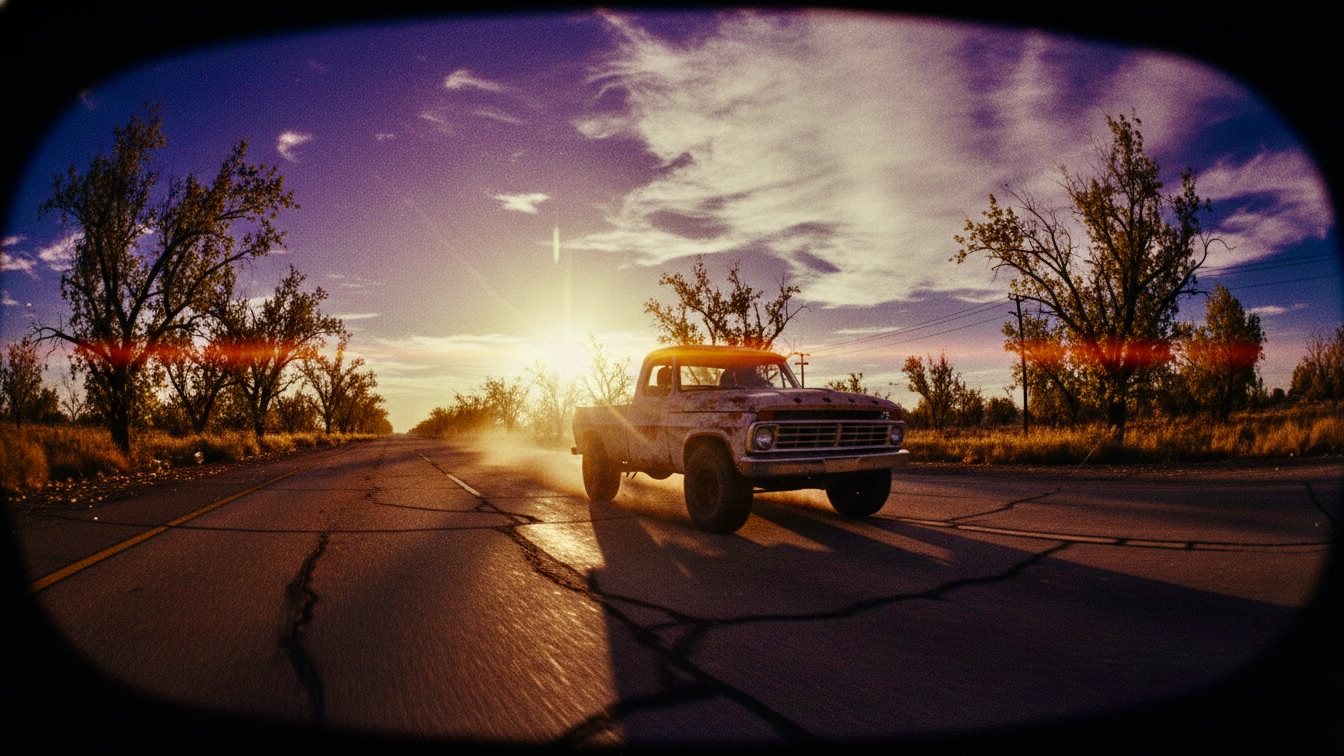
We reach the clearing where his truck is parked. It’s an old Ford, white paint rusted through to the red primer. It looks like a relic from another era. He fumbles with his keys. His hands are shaking. I’ve never seen him shake. It makes the knot in my stomach tighten until I can't breathe.
"Get in," he barks.
I jump into the passenger seat. The interior of the truck is like an oven. The vinyl seats burn my skin. Stef slides into the driver's side and cranks the engine. It coughs. It sputters. It dies.
"Come on," he mutters. "Come on, you piece of junk."
He tries again. The engine groans. Outside, the shadow mass is pooling around the tires. It looks like oil. It’s thick and shimmering. I look back at the forest. The trees are vibrating. Not moving in a breeze, but shaking with an internal frequency. The high-pitched ringing in my ears is so loud now I have to cover them.
"Stef!" I scream over the noise.
He slams his hand against the dashboard. On the third try, the engine roars to life. He shifts into gear and floors it. The tires spin in the dry dirt, kicking up a cloud of grey dust that obscures everything. We fishtail out of the lot and onto the access road.
Behind us, the park is disappearing. Not into the distance, but into itself. The shadows have swallowed the trees, the lean-to, the fountain. It’s just a black hole in the middle of the city. I look at Stef. He’s staring straight ahead, his knuckles white on the steering wheel.
"What was that?" I ask. My voice is small. I feel like a child.
"The break," he says. "The city is too hot. The earth is too dry. Something had to give. It’s a physical rejection."
"That’s impossible."
"Look out the window, Riley. Tell me what’s possible."
I look. We are driving through the industrial district. The streetlights are dark. The traffic signals are dead. People are standing on the sidewalks, their faces illuminated by the glow of their phones. They look like ghosts. The air is shimmering with heat waves. The city is a giant radiator, and someone has turned it up to eleven.
We hit the main road. The traffic is a nightmare. Cars are stalled everywhere, overheated and abandoned. Stef weaves through them with a desperation that borders on suicidal. He’s looking for something. An exit. An escape.
"Where are we going?" I ask.
"Out," he says. "Away from the concrete. It’s holding the heat. It won't let go."
I look at my hands. They are covered in the dirt from the park. The land is still with me. I realize then that I’m not just losing the organization. I’m losing the only thing that made sense. The ritual of the work. The fifteen-minute check-ins. The shared oranges. It’s all being erased by a summer that won't end.
Stef reaches over and grabs my hand. He doesn't look at me, but his grip is steady. It’s the connection I’ve been looking for all summer, but it feels like it’s happening on the deck of a sinking ship. His palm is rough and hot.
"We'll find somewhere else," he says. It’s a promise he can't keep.
"There is nowhere else. Everything is this hot."
"Then we'll make somewhere."
We drive in silence. The city is a maze of dark buildings and glowing screens. The shadow mass is following us, creeping along the edges of the buildings, filling the alleys. It’s the physical manifestation of our own exhaustion. It’s the weight of trying to save a world that doesn't want to be saved.
As we reach the city limits, I look back one last time. The skyline is a jagged silhouette against the bruised sky. A single transformer blows in the distance, a bright blue flash that lights up the horizon for a split second. Then, total darkness. The grid has finally failed. The silence from the park has caught up to us.
I lean my head against the window. The glass is hot. I close my eyes and try to remember the smell of the oranges. I try to remember the way Stef looked when he was hacking at the vines, efficient and immortal. But all I can feel is the thrumming in my blood, the slow, heavy heartbeat of a planet that is finally, violently, waking up.
We are driving into the dark, two people in a rusted truck, carrying nothing but a bag of orange peels and the memory of a forest that no longer exists. The heat is still rising. The shadows are still growing. And for the first time, I realize that the team building wasn't about the work. It was about having someone to hold onto when the lights went out.
“I looked at Stef in the dim glow of the dashboard, realizing the shadow in the rearview mirror wasn't falling behind—it was catching up.”


