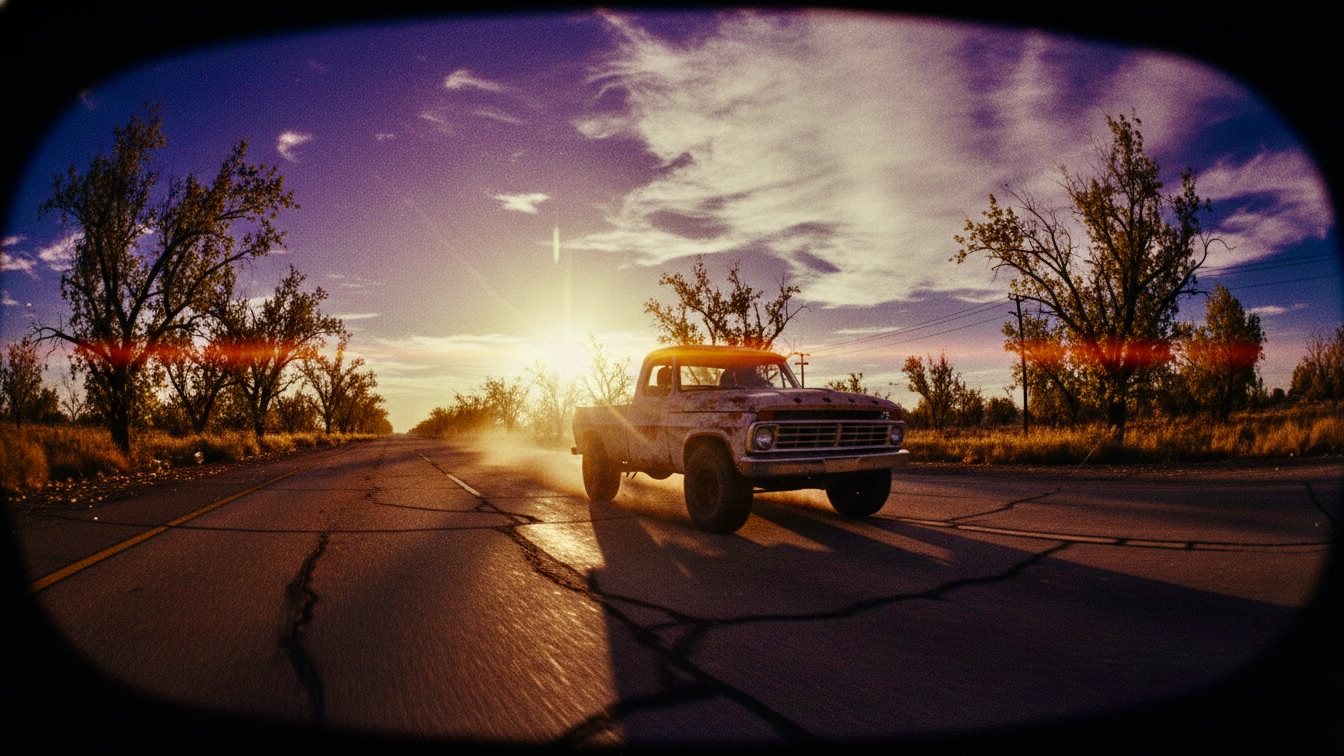
The chapter follows Riley, the director of a struggling urban green-space non-profit, and a stoic volunteer named Stef as they labor through a punishing heatwave. Working in a neglected three-acre patch of dying oaks and invasive ivy, the pair navigates a landscape that is becoming increasingly surreal and hostile. The atmosphere is defined by an eerie silence, a lack of cellular service, and shadows that appear to take on physical weight and independent movement.
During a brief ritualized break at a dry concrete fountain, the two share a moment of vulnerability. Stef reveals a personal history of land loss, while Riley admits to a desperate need for his continued presence to sustain the failing park. Their conversation is interrupted by the literal breaking of the environment, as a massive tree limb snaps under the thermal pressure and the light shifts into a bruised, unnatural purple.
The narrative reaches a frantic climax when a grid failure notification arrives via Riley's malfunctioning phone. As the park begins to collapse into a void of shifting shadows, Stef leads a desperate escape to his truck. They flee through a darkened, stalled city, realizing that the environmental crisis has moved beyond a mere weather event into a fundamental rejection of human presence by the earth itself.
The central theme of the story is the terrifying agency of a dying environment. Rather than being a passive backdrop for human labor, the park and the climate act as a unified, rejecting force. The "shadow mass" and the "thrumming" in the concrete suggest that the earth is no longer a resource to be managed, but a sentient entity that is violently waking up. This subverts the traditional environmentalist narrative of "saving" nature, suggesting instead that nature may be intent on saving itself from humanity.
Another prominent theme is the futility of human systems in the face of ecological collapse. Riley’s obsession with Venmo accounts, city council grants, and "Low-Stakes Presence" strategies highlights the absurdity of bureaucracy during an apocalypse. The contrast between the cold logic of spreadsheets and the visceral heat of the sun underscores a profound disconnect. The story posits that our tools for organization are laughably inadequate for the sheer physical reality of a planet that has reached its breaking point.
Human connection as a form of "team building" serves as a poignant sub-theme. Riley and Stef are not colleagues in a traditional sense; they are two animals huddling together against a common predator. Their relationship is built on shared labor and silence rather than deep personal exchange. The story suggests that in the end, the value of work lies not in its success, but in the proximity it provides to another person when the lights finally go out.
The concept of entropy also permeates the text, represented by the peeling paint, the splintering wood, and the "lukewarm soup" of the cooler. Everything is in a state of transition from order to chaos. The oranges, vibrant and cool, represent a fleeting relic of a past world that is being systematically erased. This sense of loss is both personal and planetary, linking Stef’s father’s lost farm to the imminent death of the city’s grid.
Riley is a character defined by a stubborn, almost pathological commitment to a lost cause. As a psychologist might observe, she exhibits a savior complex that borders on martyrdom, using the park as a proxy for her own internal stability. She feels the weight of the environment as a physical burden, yet she refuses to abandon her post because she has tied her entire identity to the act of preservation. Her "need" for Stef is not just about the heavy lifting of the brush; it is a desperate attempt to avoid the isolation of her own failing mission.
Her internal conflict stems from the realization that her efforts are "Band-Aids on a gunshot wound." She is hyper-aware of the financial and physical decay surrounding her, yet she uses work as a defense mechanism against existential dread. When the environment begins to turn surreal, her first instinct is to rationalize it as dehydration or heat exhaustion. This cognitive dissonance allows her to keep cutting vines even as the world literally falls apart around her, showing a profound fear of admitting defeat.
By the end of the chapter, Riley undergoes a shift from a manager of land to a passenger in a survival drama. Her vulnerability is laid bare when she admits her fear of building a life around a "ghost" like Stef. As the grid fails, her focus shifts from the survival of the park to the survival of the self. Her final realization—that the ritual of the work was merely a way to hold onto another person—marks a transition from stubborn denial to a grim, shared reality.
Stef functions as the narrative’s "stoic survivor," a man whose efficiency of movement mirrors his emotional guardedness. He is a person who has already experienced the "end of the world" through the loss of his father’s land, which has left him with a cynical but realistic perspective on the current crisis. His lack of a last name and mysterious background suggest a man who has intentionally detached himself from the systems Riley so desperately tries to navigate. He does not work for the park’s future; he works because the labor is the only thing that makes sense in a dying world.
From a psychological standpoint, Stef exhibits signs of profound grief that he has channeled into physical labor. He treats the park like a funeral, a metaphor that suggests he is not trying to save the land but is instead performing its last rites. His stack of orange peels, neat and orderly, shows a need for control in a landscape that is becoming increasingly chaotic. He is the first to recognize the "rejection" by the earth because he has no illusions about the permanence of human structures.
Despite his desire for space and his aversion to touch, Stef ultimately acts as Riley’s protector. His decision to grab her arm and force the evacuation shows that beneath his cold exterior, he recognizes their shared humanity. He is the one who understands that the "shadow mass" is not a hallucination but a physical reality. In the truck, his steady grip on Riley’s hand represents a bridge between his solitary nature and the necessity of connection in the face of total darkness.
The narrative voice in "The Heat Index" is visceral and sensory, utilizing a "blunt instrument" prose style that mirrors the oppressive heat. The author employs metaphors of bodily decay—comparing peeling paint to "dead skin" and a hazy sky to a "cataract"—to create a sense of pervasive sickness. This sensory immersion makes the heat feel like a physical character in the story. The reader is forced to experience the "wet towel" air and the "sandpaper" voice, which heightens the tension and grounds the surreal elements in a gritty reality.
The pacing of the chapter is masterfully handled, beginning with a slow, grinding rhythm that mimics the exhaustion of manual labor. The "Fifteen Minute Ritual" provides a brief, quiet interlude that allows for character development before the pace accelerates into the frantic escape. This shift from the lethargic heat of the afternoon to the high-pitched ringing of the "break" creates a jarring transition. The sudden escalation of the environment’s hostility mirrors the "grid failure" mentioned on the phone, where the slow buildup of pressure leads to a total collapse.
Tone plays a crucial role in bridging the gap between realism and the supernatural. The story starts as a social commentary on non-profit struggles and climate change but gradually descends into cosmic horror. The description of shadows as "solid" and "leaking ink" introduces a sense of the uncanny without fully explaining it. This ambiguity leaves the reader in the same state of confusion as Riley, questioning whether the events are a literal apocalypse or a collective psychological breakdown triggered by the extreme temperature.
The use of color and light is particularly effective in establishing the story’s mood. The transition from "hazy white" to "bruised purple" and finally to a "blue flash" against total darkness provides a visual map of the world’s end. The vibrant orange of the fruit serves as a final, aggressive burst of color before the shadows swallow the landscape. These stylistic choices reinforce the theme that the world is being "erased," leaving the characters with nothing but their memories and each other in the ensuing dark.


