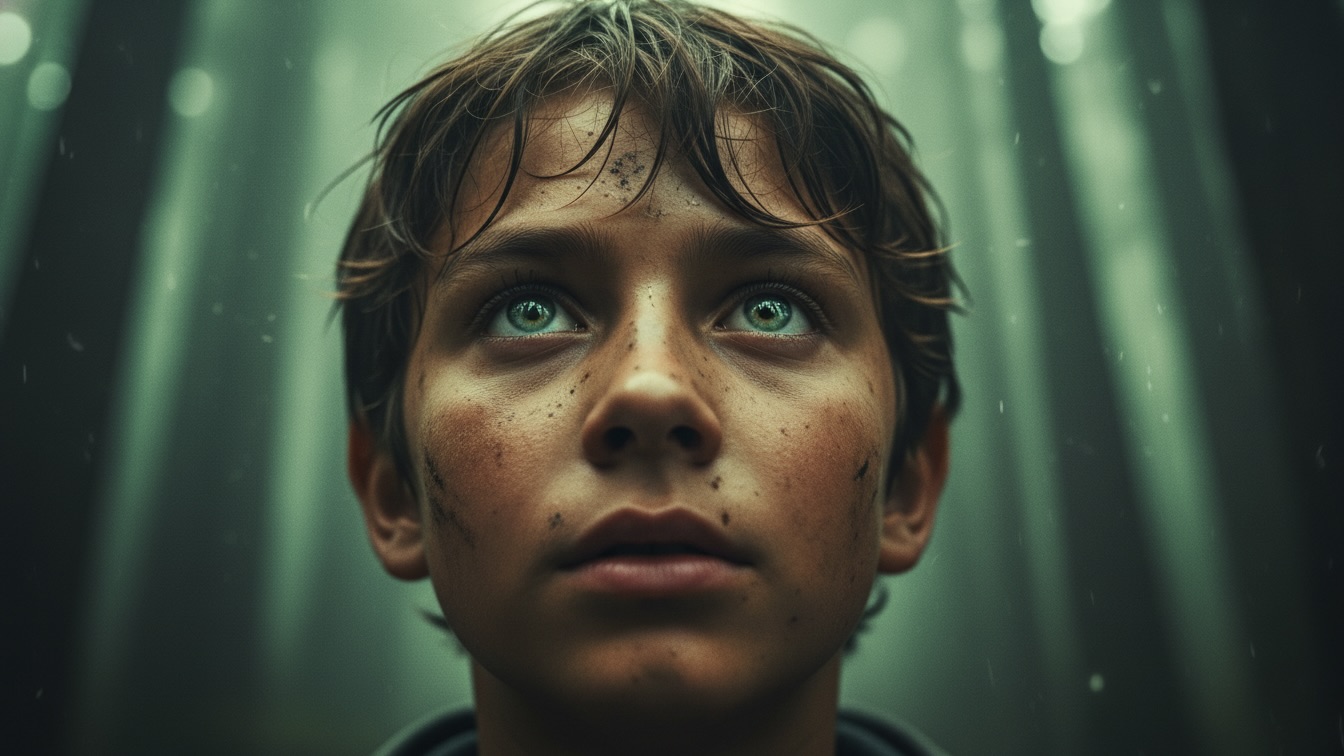
The story follows three teenagers—Jay, Sandi, and Ben—who find themselves lost during a summer hike in a Redwood forest. Their mundane struggle with a map quickly escalates into a surreal nightmare when the sky turns a neon green and birds begin falling dead from the canopy. As electronic devices fail and gravity becomes unstable, the group encounters a paranoid hermit who warns them of a perceived invasion, though the truth proves to be far more cosmic and indifferent.
Seeking shelter in a ranger station and eventually a gorge, the trio witnesses the arrival of "sky-whales," massive translucent organisms from the stratosphere pushed down by a solar flare. These creatures exert a localized gravitational pull that uproots the forest and draws debris into the sky in a terrifying "gravity storm." After surviving the night in a cave, the teenagers emerge to a scarred landscape where the world has returned to a fragile normalcy. They return to civilization carrying the heavy realization that humanity is a small, insignificant part of a much larger and more mysterious ecosystem.
The central theme of the story is the confrontation with the "Cosmic Sublime," where the characters experience a mixture of awe and absolute terror in the face of nature’s vastness. Unlike traditional horror where an antagonist has malicious intent, the sky-whales are portrayed as indifferent biological entities. Their presence is devastating not because they are evil, but because they are so large that their mere existence breaks the laws of human-scale reality. This shifts the narrative from a survival thriller to a philosophical reflection on human insignificance within the universe.
Another prominent theme is the collapse of human systems, both technological and intellectual, when confronted with the unknown. Ben’s phone becomes a burning brick, Sandi’s compass spins uselessly, and the Hermit’s conspiracy theories fail to capture the biological reality of the event. Even Sandi, who uses science as a shield, finds her logic pushed to the breaking point as the "local gravity constant" fluctuates. The story suggests that when the environment undergoes a radical shift, our tools and even our fundamental understanding of physics become fragile and inadequate.
Finally, the story explores the theme of ecological resilience and memory through the presence of the Redwoods. Jay notes at the beginning and end that the trees are older than his ancestors and have likely witnessed such events before. While the humans are traumatized and the birds are decimated, the ancient trees remain as silent witnesses to the cycles of the planet. This highlights a temporal scale that dwarfs human life, suggesting that while the world may seem "broken" to a teenager, it is simply functioning on a level beyond human comprehension.
Jay serves as the grounded protagonist and narrator, utilizing a blend of sarcasm and keen observation to navigate the crisis. He initially uses humor as a social lubricant to manage the tension between his friends, particularly when mocking Ben’s poor navigation skills. As the situation turns dire, his focus shifts toward communal survival, showing a natural leadership that prioritizes the safety of his peers over his own panic. He possesses a psychological depth that allows him to empathize even with the sky-whales, recognizing their shared fear in a displaced environment.
Sandi functions as the intellectual anchor of the group, using her "science nerd" persona as a psychological defense mechanism against the inexplicable. By categorizing the horrors around her—referencing geological signatures, ionization levels, and atmospheric density—she attempts to maintain a sense of control over a chaotic situation. Her character arc reveals the limitations of pure logic, as her voice begins to crack when the phenomena become truly "physics-breaking." Despite her fear, she remains the most observant member of the trio, providing the crucial insights that allow them to understand the nature of the sky-whales.
Ben represents the raw emotional response of the group, acting as a foil to Sandi’s clinical detachment. He is the most visibly affected by the trauma, transitioning from a defensive posturing about being lost to a state of near-paralysis as the birds begin to fall. His character highlights the vulnerability of youth, as he eventually drops his "witty" facade and admits to feeling like a child who simply wants to go home. However, he still contributes to their survival by salvaging the drone controller, proving that even in a state of high anxiety, he is capable of meaningful action.
The Hermit serves as a cautionary figure representing the psychological danger of seeking patterns in chaos. He has lived on the fringes of society for so long that his mind immediately jumps to human-centric explanations like "stealth tech" and "sonic weapons" from foreign powers. While he provides the group with the life-saving advice to seek the gorge, his worldview is limited by his own paranoia and inability to accept the purely natural, albeit alien, cause of the event. He is a man who has replaced the mystery of nature with the comfort of a conspiracy, making him both a savior and a tragic figure.
The pacing of the narrative is masterfully handled, beginning with a slow, comedic tension that mirrors a typical teenage outing before rapidly accelerating into a high-stakes survival scenario. The author uses the "flick of a light switch" metaphor to signal the transition from the mundane to the extraordinary, ensuring the reader feels the same whiplash as the characters. Once the anomaly begins, the pacing becomes relentless, punctuated by rhythmic "thuds" and "thumps" that create a percussive sense of dread. The final transition back to a quiet, ash-covered dawn provides a necessary emotional decompression while maintaining a haunting atmosphere.
Sensory details are the primary engine of the story’s immersion, particularly the use of color and sound to alienate the reader. The "neon green" sky and "bruised purple" clouds create a visual palette that feels chemically wrong, heightening the sense of an environment in distress. Sound is used with equal efficacy, from the "mute button" silence of the woods to the "whale songs" that vibrate in the characters' chests. These details move beyond mere description; they act as psychological triggers that communicate the scale of the sky-whales without needing to describe them fully until the climax.
The narrative voice is a successful first-person perspective that balances youthful relatability with poetic insight. Jay’s internal monologue is filled with contemporary references—like "lime-flavored ice pops" and "slot machines"—which ground the fantastical elements in a recognizable reality. This voice allows the story to tackle complex concepts like gravitational fluctuations and atmospheric density without feeling like a dry science textbook. By filtering the end of the world through the eyes of a teenager, the author highlights the poignancy of losing a familiar world just as one is beginning to find their place in it.


