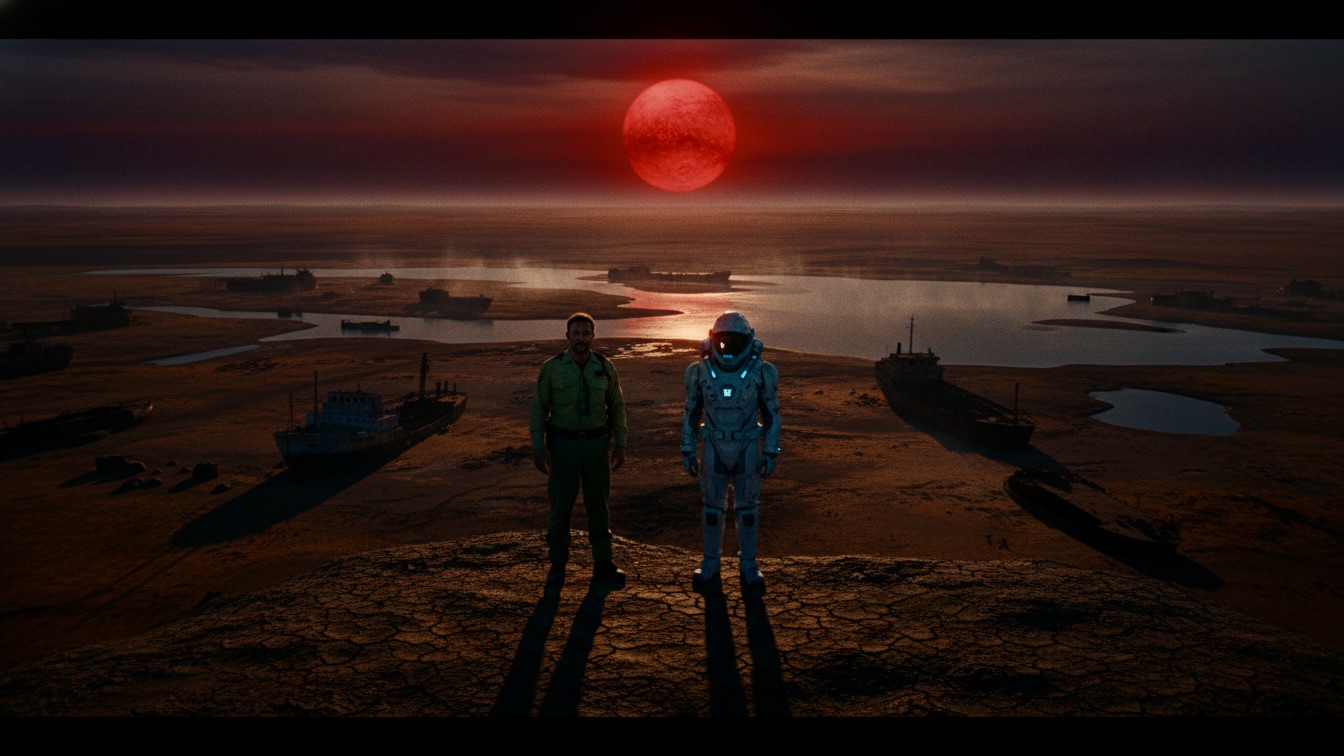
The narrative unfolds in a dystopian setting where the Earth has ceased its rotation, plunging the Whiteshell ranger station into an endless, scorching daylight. Leo and his uncle Simon, the local park ranger, watch helplessly as the unnatural heat boils the sap inside the pine trees, causing the trunks to violently explode. Their grim vigil is interrupted by Marley, a corporate scout clad in a high-tech cooling suit. Marley demands access to old government bunker maps to establish a survival hub for the wealthy.
Before a deal can be struck, a massive firestorm erupts across the dry forest, forcing the trio to abandon the cabin. Prioritizing human life over immediate escape, Simon insists on rescuing a group of tourists who have been blinded by the relentless ultraviolet radiation. The survivors barely escape the flames by taking refuge in a deep cave, where tensions boil over into a physical altercation between Simon and Marley. Ultimately, the crisis shifts dramatically when the sun begins to flicker and die, signaling a transition from a fiery apocalypse to a freezing one. Recognizing the new threat of eternal cold, Simon surrenders the bunker maps to Marley, and the group marches out into the dying red twilight to seek underground shelter.
The most prominent theme in the chapter is the devastating reality of environmental and cosmic collapse. The author paints a terrifying picture of a world where the fundamental laws of nature have failed, trapping humanity in a hostile, stagnant environment. This apocalyptic scenario serves as a stark magnification of contemporary anxieties regarding ecological destruction and climate change. The exploding trees and boiling lakes are visceral manifestations of a planet pushed far beyond its breaking point. By shifting the catastrophe from a man-made climate disaster to a cosmic anomaly, the narrative emphasizes the ultimate fragility of human existence.
Another crucial theme is the commodification of survival and the inherent class disparities revealed during a crisis. Marley represents the cold, calculating nature of corporate greed, viewing the end of the world not as a tragedy, but as a lucrative business opportunity. His high-tech cooling suit stands in stark contrast to the vulnerable, exposed bodies of Simon, Leo, and the blinded tourists. The concept of selling subterranean shade to the highest bidder highlights a grim reality where safety is a luxury reserved solely for the wealthy. This dynamic heavily critiques the ways in which disaster capitalism exploits human desperation.
The narrative also deeply explores the psychological tension between moral duty and raw survival instinct. Simon embodies the traditional protector archetype, stubbornly clinging to his role as a ranger even when the park itself is burning to ash. His decision to risk his own life to save the blinded tourists demonstrates a profound, unwavering commitment to human solidarity. Conversely, Marley initially operates purely on self-preservation and profit motives, viewing the vulnerable civilians as mere liabilities. However, as the situation deteriorates and his technological advantages fail, the story suggests that true survival requires cooperation and the sharing of critical resources.
Leo serves as the emotional anchor and the lens through which the reader experiences the apocalypse. He is a young boy thrust into an incomprehensible nightmare, struggling to process the sheer scale of the disaster unfolding around him. His internal state is characterized by a profound sense of disorientation and a desperate yearning for normalcy. He repeatedly looks to his uncle for reassurance, hoping for a plan that can magically restore the world to its proper order. This reliance highlights his vulnerability and the psychological toll of losing the predictable rhythms of day and night.
Despite his fear, Leo demonstrates remarkable resilience and acute observational skills throughout the ordeal. He registers the sensory horrors of the environment with chilling clarity, noting the specific sound of the heat and the unnatural color of the water. As the crisis deepens, his focus shifts from seeking comfort to accepting the grim reality of his situation. By the end of the chapter, he transitions from a frightened child hiding behind his uncle to a more active participant in his own survival. Taking the blind girl's hand in the final scene symbolizes his emerging maturity and his capacity for empathy amidst the ruins.
Simon is the stoic, authoritative figure who grounds the narrative in a sense of duty and practical survival. As a park ranger, he possesses a deep, almost spiritual connection to the environment, which makes the destruction of the forest particularly agonizing for him. He masks his internal despair with a gruff exterior, focusing on actionable steps like staying hydrated and seeking shelter. However, the psychological burden of his helplessness occasionally cracks his facade, revealing a man overwhelmed by the magnitude of the catastrophe. His refusal to immediately surrender the bunker maps demonstrates his deep-seated distrust of corporate exploitation.
Throughout the ordeal, Simon's moral compass remains remarkably intact, even when it threatens his own survival. He prioritizes the lives of helpless tourists over a swift escape, proving that his identity as a protector transcends his official job title. The physical altercation with Marley highlights his raw, desperate anger at the sheer injustice of the situation. Yet, Simon is ultimately a pragmatist capable of adapting to new, horrifying realities. When the sun begins to die, he swallows his pride and hands over the maps, recognizing that his moral victories mean nothing if his nephew freezes to death.
Marley represents the detached, opportunistic side of humanity that thrives on disaster. He arrives as an invader, shielded from the apocalyptic heat by his expensive, humming cooling suit. His initial demeanor is arrogant and transactional, viewing the desperate survivors merely as obstacles or leverage to secure the bunker maps. He speaks in corporate jargon, sanitizing the horror of the situation by referring to the end of the world as a simple transition. This emotional detachment makes him an unsettling foil to Simon's deeply human, empathetic approach to the crisis.
However, Marley's psychological armor crumbles as his technological advantages begin to fail him. When his suit's battery depletes, he is reduced to a frightened, vulnerable man, no different from the people he previously looked down upon. His desperate confession that he merely wants to see the stars again humanizes him, revealing the existential terror hiding beneath his corporate facade. Stripped of his power and bargaining chips, he is forced to rely on the mercy of the very man he tried to exploit. This arc transforms him from an arrogant antagonist into a pathetic, dependent survivor facing the exact same doom.
The author employs a masterfully oppressive stylistic approach, saturating the text with vivid, suffocating sensory details. The heat is not merely described; it is personified as a heavy, mean entity that pushes through eyelids and sounds like a breaking refrigerator. This intense focus on sensory deprivation and overload creates a deeply claustrophobic atmosphere for the reader. The recurring auditory motif of the popping pine trees acts as a grim countdown, heightening the tension and underscoring the inescapable nature of the threat. These elements combine to establish a tone of relentless, exhausting dread.
The pacing of the narrative perfectly mirrors the agonizing stagnation of the stalled sun before accelerating into chaotic violence. The opening sections are slow and languid, reflecting the heavy, unmoving atmosphere of the eternal high noon. However, once the firestorm ignites, the pacing becomes frantic and breathless, propelling the characters into a desperate scramble for survival. The author also makes excellent use of metaphor, such as comparing the sun to an angry orange pinned to wallpaper, which emphasizes the unnatural, artificial feel of the disaster. This transition from a stagnant, baking oven to a roaring firestorm keeps the narrative dynamic despite the frozen celestial mechanics.
The first-person narrative voice is crucial to the story's overall psychological impact. Leo's youthful perspective provides a raw, unfiltered lens that strips away complex scientific explanations in favor of immediate, visceral reactions. His internal monologue reveals the terrifying cognitive dissonance of experiencing an impossible event, such as a sun that refuses to set. The dialogue is equally effective, characterized by short, clipped exchanges that reflect the characters' exhaustion and the oppressive heat. Ultimately, the stylistic choices perfectly align with the thematic content, creating a seamless and deeply unsettling apocalyptic vision.


