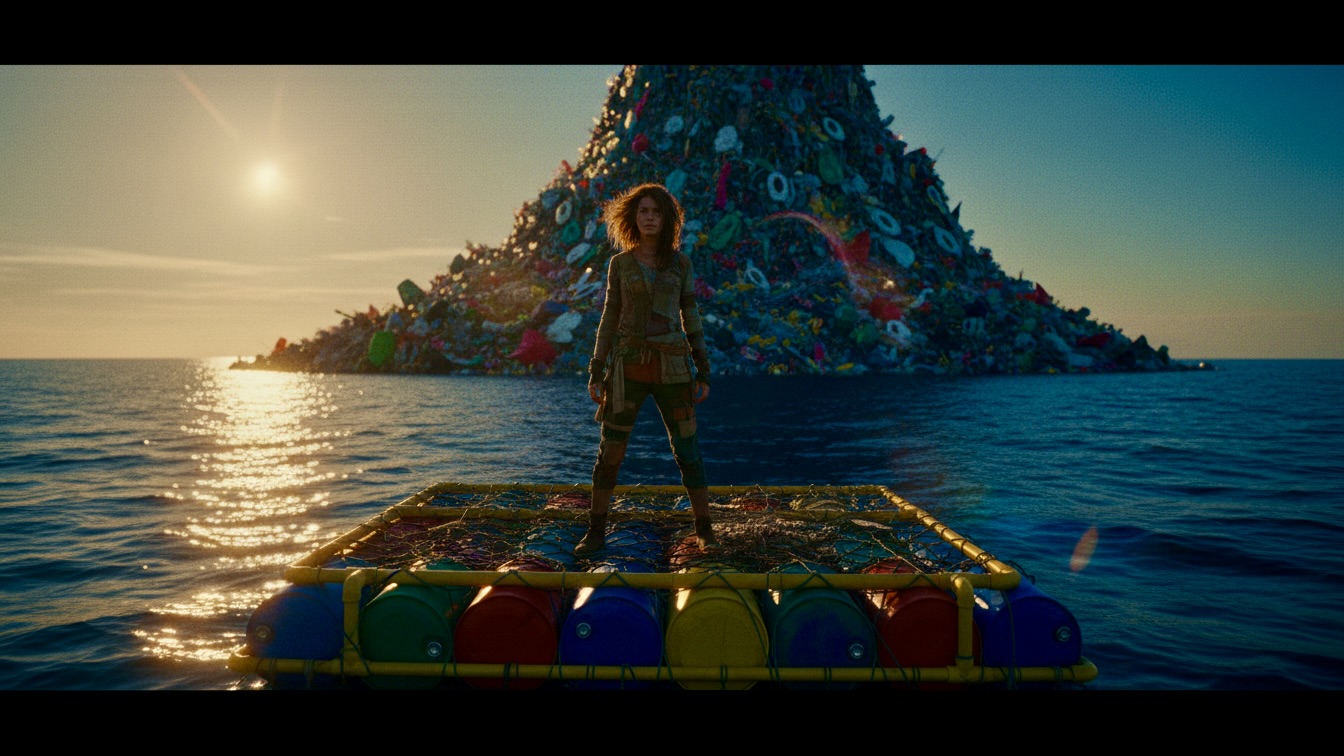
Zoe leads her team to a floating island of trash to save a bird and secure five million likes.
Zoe adjusted her sunglasses. They were oversized, polarized, and designed to hide the fact that she had only slept three hours. Behind the lenses, her eyes tracked the horizon. The Pacific was flat. It looked like hammered lead under the July sun. There was no wind. The air was thick with the scent of salt and the faint, metallic tang of the outboard motor.
"How much further?" Zoe asked. She didn't look at Pilot Pete. She looked at her phone. The signal was down to two bars.
"Few miles," Pete said. He was a man who looked like he had been cured in salt and then left in the sun to dry. He didn't care about the #SaveTheSpoonbill campaign. He cared about the five hundred dollars Zoe had paid him in cash. "Maybe less. Depends on the drift."
"We need the light," Cathy said. She was holding a gimbal-mounted camera. She was nineteen but looked thirty-five in the way people who spend their lives looking through a viewfinder often do. Her skin was impeccably matte. "If the sun gets too high, we lose the shadows. Everything goes flat. It looks cheap."
"It won't look cheap," Zoe said. "We have the 4K sensors."
"Sensors don't fix physics," Cathy replied.
Jay sat at the front of the boat. He was the only one who wasn't looking at a screen. He was looking at a pair of binoculars. He was twenty, a biology student who had been recruited because he knew the Latin name for the bird Zoe wanted to save. He looked out of place. His clothes were actual surplus gear, stained with dirt and grease. He hadn't checked his hair in the reflection of the water once.
"I see it," Jay said. He didn't point. He just stared.
Zoe stood up. The boat swayed. Pete didn't move to steady her. She grabbed the railing. It was hot enough to sting. On the horizon, a low, gray mass began to resolve. It didn't look like an island. It didn't look like land. It looked like a smudge of graphite on a clean sheet of paper. As they got closer, the smudge grew. It gained texture. It wasn't green. It wasn't brown. It was a chaotic mosaic of faded colors—sun-bleached blues, cracked oranges, and the dull, dirty white of styrofoam.
"That's it?" Cathy asked. She sounded disappointed. "It's just... garbage."
"It's the Great Pacific Garbage Patch," Jay said. His voice was flat. "Or a piece of it. A gyre. It’s an ecosystem now. A fake one."
"It’s Trash Island," Zoe corrected. She was already framing the shot in her mind. "And it’s the last habitat of the Roseate Spoonbill. That’s the narrative."
"They aren't supposed to be here," Jay muttered. "They’re coastal birds. If they're here, something is very wrong."
"Something being wrong is why we’re here, Jay," Zoe said. She turned to Cathy. "Get the drone up. I want the approach. I want the contrast between the blue water and the multicolored filth. It needs to look like a wound."
Cathy nodded. She opened a hard-shell case. The drone was black and sleek, a predatory insect of carbon fiber. It whirred to life. The sound was a high-pitched whine that cut through the low thrum of the boat.
"Launching," Cathy said.
Zoe checked her reflection in the phone screen. She wiped a smudge of sunscreen from her cheek. She pulled a few strands of hair loose from her ponytail. She needed to look 'expedition-ready.' She needed to look like she was struggling, but in a way that was still aspirational. This was the work. This was the performance of care.
"Pete, slow down," Zoe commanded. "I want to step off the boat onto the plastic. I want it to look like I'm walking on water made of human sin."
Pete spat over the side. "It’s mostly fishing nets and jugs, kid. Careful where you step. Some of that stuff is sharp."
The boat slowed. The engine died. The silence that followed was heavy. The only sound was the drone overhead and the gentle, rhythmic clinking of plastic bottles hitting the hull. It sounded like a thousand tiny bells. It was almost musical if you didn't look at what was making the noise.
Zoe stepped onto the gunwale. She looked down. The water was clear, but it was filled with confetti-sized bits of plastic. It looked like a snow globe filled with toxins. Below the surface, she could see massive, ghost-like shapes—tangled nets that went down into the dark.
"Ready?" Zoe asked Cathy.
"Ready. Go."
Zoe stepped off. Her boot landed on a compressed mass of nylon netting and high-density polyethylene. It gave slightly, like a trampoline. She wobbled, then found her balance. She stood on the island. It was a floating desert. There were no trees. There was no soil. There was only the refuse of a billion lives, knit together by time and tide.
"I’m here," Zoe whispered to the camera. "I’m on Trash Island. And we’re going to save it."
Jay followed her. He didn't look at the camera. He looked at his feet. He picked up a small, translucent shard. "Microplastics," he said. "It’s everywhere. It’s in the water, the air, the birds. We aren't saving this, Zoe. We’re just looking at it."
"We’re witnessing it," Zoe said. "There’s a difference."
"Is there?" Jay asked.
Zoe didn't answer. She was looking for the Spoonbill. She needed the bird. Without the bird, she was just a girl on a pile of trash. With the bird, she was a savior.
"Find it, Jay," she said. "Find the bird."
They began to walk. The island was unstable. Every step caused the ground to shift and groan. It was a graveyard of consumerism. Zoe saw a doll's head, its eyes missing, wedged between a detergent bottle and a flip-flop. She saw a crate from a shipping company that had gone bankrupt in the nineties. She saw a mountain of fast-fashion shirts, their synthetic fibers fused together by the heat.
"It smells," Cathy said. She was trailing behind, her camera held steady.
"It smells like the truth," Zoe said. It actually smelled like hot plastic and rotting seaweed. It was a chemical, cloying scent that stuck to the back of the throat.
Suddenly, Jay stopped. He held up a hand.
"There," he whispered.
In the center of a small clearing made of crushed milk crates, sat a bird. It was pink, a startling, vibrant shade that looked like a glitch in the gray landscape. Its beak was long and flat, shaped like a spoon. It was beautiful. It was also standing on a pile of discarded surgical masks.
"Oh my god," Zoe whispered. "It's perfect."
"It’s sick," Jay said. "Look at its feathers. They’re matted."
"Cathy, get the close-up," Zoe said. "Jay, move to the left. I want you in the frame, but blurred. I need to be the focus."
Zoe began to approach the bird. She moved slowly, her hands outstretched. She wasn't thinking about the bird’s health. She was thinking about the thumbnail. She was thinking about the caption.
The Last Hope.
Beauty in the Breakdown.
The Spoonbill tilted its head. Its eyes were black and unblinking. It didn't look afraid. It looked annoyed. As Zoe got within five feet, the bird opened its wings. They were huge, a flash of coral against the junk. It let out a harsh, guttural croak.
"It’s beautiful," Zoe said, her voice trembling with manufactured emotion.
The bird suddenly lunged. It didn't fly away. It ran at Zoe, its spoon-shaped beak snapping.
"Hey!" Zoe screamed. She tripped backward, landing hard on a pile of plastic crates.
The Spoonbill didn't stop. It went for her ring light, which Cathy had set up on a portable tripod. The bird pecked at the LEDs with a frantic, metallic clatter.
"It’s attacking the gear!" Cathy yelled.
"Save the light!" Zoe shouted.
Jay stepped in, waving his arms. "Back off! Get away!"
The bird hissed, a sound like steam escaping a pipe. It retreated a few feet, then settled back onto its pile of masks. It watched them with a territorial intensity.
"That wasn't in the script," Zoe said, rubbing her elbow.
"Nature doesn't follow scripts," Jay said. He looked at the bird, then at Zoe. "Maybe it knows why you're really here."
Zoe stood up, brushing dirt from her leggings. "It’s a bird, Jay. It doesn't know anything. It’s just a symbol."
"It’s a living thing," Jay said.
"Whatever," Zoe said. "Cathy, did you get the lunging? We can edit that to look like it was protecting its nest from the encroaching plastic. We can make it a hero."
"Got it," Cathy said. "But the light's cracked."
Zoe looked at the ring light. A spiderweb of fractures ran across the plastic casing. "We’ll fix it in post. Let's set up the main monologue. I want the sunset behind me."
They began to set up the camp. Pete stayed with the boat, anchored a few yards off the edge of the island. He watched them with a look of profound boredom. He had seen people like this before. He had seen the way they looked at the world through a five-inch screen. He knew that when the sun went down, the real island would come out.
As the afternoon wore on, the heat became unbearable. There was no shade. The plastic reflected the sun, doubling the intensity. Zoe’s skin began to burn. Her water bottle was warm and tasted like chemicals.
"We need to keep the energy up," Zoe said. She was sweating, her makeup starting to run. "This is the climax of the video. The arrival at the heart of the crisis."
"I need a break," Cathy said. "The camera is overheating."
"We don't have time for breaks," Zoe said. "The golden hour is coming."
Jay was sitting by the edge of the plastic mass, staring into the water. "The tide is coming in," he said. "The island is moving."
"Islands don't move," Zoe said.
"This isn't an island," Jay said. "It's a raft. And the current is picking up."
Zoe looked at the horizon. The sun was dipping lower, turning the sky a deep, bruised purple. But something else was happening. A wall of dark clouds was moving in from the west. The air felt charged, the pressure dropping rapidly.
"Is that a storm?" Cathy asked, pointing at the clouds.
"It’s just a squall," Zoe said. "It’ll make the shots more dramatic. The struggle against the elements."
"Pete!" Jay yelled toward the boat. "You see that?"
Pete was already pulling up the anchor. "Get back to the boat! Now!" he shouted. "That’s a cell! It’s moving fast!"
"We aren't finished!" Zoe yelled back.
"You’re finished if you’re out here in forty-knot winds!" Pete roared.
The first gust hit them then. It wasn't a breeze. It was a wall of wind that smelled of ozone and rain. It caught the plastic island, making the whole mass shudder. The clinking of the bottles became a roar.
"Pack it up!" Zoe said, finally sensing the danger.
They scrambled to grab their gear. Cathy fumbled with the drone controller. The drone was still in the air, fighting the wind. It bobbed and dipped, its motors screaming.
"I can't land it!" Cathy screamed.
"Leave it!" Zoe said.
"It’s five thousand dollars!"
A sudden, violent surge of water hit the edge of the island. The plastic groaned and buckled. A gap opened between Zoe and the boat.
"Pete!" Zoe cried out.
The boat was being pushed away by the wind. Pete was wrestling with the engine, trying to bring the bow around. But the plastic mass was huge, acting like a sail. It was moving faster than the boat could maneuver in the churning water.
"The line snapped!" Pete yelled.
They watched in horror as the boat was pulled into the deepening gloom. The rain began to fall then—huge, heavy drops that stung like pebbles.
"He’s gone," Jay said.
"He’ll come back," Zoe said. "He has to come back."
But the storm was closing in. The horizon disappeared. The world shrank to the size of their plastic raft. The internet signal on Zoe’s phone flickered, then died.
"No signal," Zoe whispered.
She looked around at her friends. They were wet, cold, and terrified. The aesthetic was gone. The performance was over. They were just four people on a pile of trash in the middle of a dark, angry ocean.
"What do we do?" Cathy asked.
Zoe looked at her phone. It was a black mirror. It showed her nothing but her own face, distorted by the rain.
"We wait," Zoe said.
But as the island tilted under the force of a massive wave, she knew that waiting might not be enough.
The darkness was absolute. It wasn't the darkness of a bedroom or a city street. It was the darkness of the deep ocean, where the only light comes from what you bring with you. Zoe sat huddled under a tarp they had managed to pull from their gear pile. It was a heavy-duty silver material, designed to reflect heat, but now it just trapped their collective shivering. Cathy was next to her, clutching her camera bag as if it contained her soul. Jay was a few feet away, staring into the blackness, his posture rigid.
"How much battery do you have?" Cathy asked. Her voice was thin, stripped of its usual professional confidence.
Zoe pulled her phone out. The screen flared, blindingly bright. "Twenty-two percent," she said. "But there’s no point. There’s no bars. Nothing."
"Maybe if we hold it higher?" Cathy suggested.
"It’s a storm, Cathy. The satellite is blocked. There’s no magic 'higher' place on a floating trash heap."
Zoe looked at the screen. She had five million followers. Five million people who, twenty-four hours ago, were liking her photos of avocado toast and sustainable swimwear. Now, they didn't even know she was missing. They were scrolling past her last post, a photo of her looking out at the ocean with the caption: The horizon is calling. It seemed like a cruel joke now. The horizon hadn't called. It had swallowed her.
"I’m hungry," Cathy said.
"We have the bars," Jay said. He reached into his pack and pulled out a box of organic, pea-protein energy bars. They were wrapped in compostable film that crinkled loudly. "There are six left."
"Six?" Zoe asked. "For how long?"
"Until we get rescued," Jay said. "Or until we stop needing to eat."
"Don't say that," Zoe snapped. "Pete will find us. He knows where we were."
"The island is moving, Zoe," Jay said. He sounded tired. "The current is taking us east. By morning, we could be ten miles from where the boat lost us. Pete’s boat isn't equipped with radar that can pick up a low-profile mass of plastic in a storm like this."
"So we’re just... drifting?" Cathy asked.
"Yes."
Silence fell over them again. The sound of the waves hitting the plastic was constant. It was a rhythmic, wet thud, followed by the hiss of water retreating through the gaps in the debris. Occasionally, a larger piece of trash—a crate or a barrel—would shift and bang against another, sounding like a gunshot.
Zoe closed her eyes. She tried to imagine her feed. She tried to imagine the comments. Where are you, Zoe? We miss your posts! Update us! The thought should have been comforting, but it felt hollow. The people in her phone weren't here. They couldn't help her. They didn't even know her. They knew the version of her that used the 'Valencia' filter to hide her tired eyes. They knew the version that spoke in curated soundbites about the environment. They didn't know the girl who was currently sitting on a pile of degraded nylon, smelling like sour sweat and old saltwater.
"Do you think the bird is okay?" Cathy asked suddenly.
"The bird?" Zoe asked. "Who cares about the bird?"
"We're here for the bird," Cathy said. "That was the whole point."
"The point was the content, Cathy. Don't be naive."
"I’m not being naive," Cathy said, her voice rising. "I spent three days prepping the gear for this. I missed my sister’s graduation. I thought we were actually doing something."
"We were doing something!" Zoe shouted back. "We were raising awareness!"
"Awareness of what?" Jay interrupted. "Awareness that a girl with five million followers can look pretty in a landfill?"
"Fuck you, Jay," Zoe said. "You took the money. You’re here too."
"I’m here because I thought I could get some actual data on the Spoonbill's migration," Jay said. "But there’s no data to get. That bird isn't a victim. It’s an opportunist."
"What does that mean?"
"It means it’s not supposed to be here," Jay said. "I looked at it while you were fixing your hair. It’s not a Roseate Spoonbill. It’s an invasive subspecies from the south. It’s thriving here because it eats the larvae that grow on the plastic. It’s part of the problem, Zoe. It’s not the hero of your story."
Zoe felt a cold knot in her stomach. "You’re lying. It looked exactly like the photos."
"To you, maybe," Jay said. "But look at the beak. Look at the legs. It’s a scavenger. It’s the seagull of the plastic age."
Zoe leaned back against the wet tarp. The narrative was crumbling. If the bird wasn't rare, if it wasn't a victim, then the whole campaign was a lie. She had led them out here for a lie.
"It doesn't matter," Zoe said, though her voice lacked conviction. "The footage is what matters. People will see the trash. They’ll see the struggle."
"What footage?" Cathy asked. "The drone is at the bottom of the ocean. My main camera has water in the lens. The only thing that works is your phone, and you’re at twenty percent."
Zoe looked at the phone again. Nineteen percent. The battery was draining even though she wasn't using it. The cold was killing the lithium-ion cells.
"I have a power bank," Zoe said. She scrambled through her bag, her fingers numb. She found the sleek, white brick. She plugged it in. Nothing happened.
"It’s dead?" Cathy asked.
"I forgot to charge it," Zoe whispered.
She felt a wave of pure, unadulterated panic. It wasn't the storm. It wasn't the hunger. It was the silence of the phone. Without the phone, she didn't have a voice. Without the phone, she wasn't Zoe 'The Activist.' She was just a wet teenager on a pile of garbage.
"If I’m not being perceived," she said, almost to herself, "do I even exist?"
Jay looked at her. In the dim, reflected light of the tarp, his eyes looked ancient. "You exist, Zoe. You’re just not a brand right now. You’re a person. It’s uncomfortable, isn't it?"
"I hate you," Zoe said.
"I know," Jay said. "But I’m the only one here who actually sees you. Cathy’s looking at you like a broken piece of equipment. I’m looking at you like a human being who’s about to have a very long night."
Cathy began to cry then. It wasn't a dramatic, cinematic sob. It was a low, wet whimper. She curled into a ball, clutching her camera bag.
"I want to go home," she said.
"We all do," Jay said. He reached out and put a hand on her shoulder. "But we’re here. We have the tarp. We have the bars. We have each other."
"Do we?" Zoe asked. "I don't even know Cathy’s last name."
Cathy looked up, her face streaked with mascara. "It’s Miller. Cathy Miller. I have two cats and I’m allergic to peanuts."
Zoe looked at her. She had worked with Cathy for six months. She had sent her thousands of messages. She had never asked her about her life.
"I’m Zoe," she said. "My last name is Chen. I... I don't actually like avocado toast. It tastes like wet grass."
Jay smiled, a small, genuine flash of teeth in the dark. "I’m Jay. Jay Singh. And I think we should all try to sleep. We’re going to need our energy when the sun comes up."
They huddled together under the tarp, three strangers on a floating monument to human waste. The storm continued to rage around them, but for the first time, the silence between them didn't feel like a void. It felt like a beginning.
Morning came not with a sunrise, but with a gradual thinning of the gray. The rain had stopped, but the sky remained a heavy, bruised color. The ocean had calmed, the violent swells replaced by a long, rhythmic roll that made the plastic island pitch and yawn.
Zoe woke with a start. Her neck was stiff, and her skin felt tacky with salt. She looked at her phone. Six percent. She immediately turned it off, the black screen reflecting her haggard face. She looked like a ghost.
"Jay?" she whispered.
Jay was already awake. He was standing at the edge of the raft, looking out at the water. "The boat’s gone, Zoe. I can't see it anywhere."
Cathy sat up, rubbing her eyes. "Maybe Pete went for help?"
"Maybe," Jay said. "But we’ve drifted. Look."
He pointed to a distant shape on the horizon. It was a jagged line of rock. "Those are the Farallon outcrops. We’re way off course. The current is pulling us into the open sea."
"We need to move," Zoe said. She stood up, her legs shaking. "We can't just sit here and wait to disappear."
"Move where?" Cathy asked. "We’re on a pile of trash."
"We build something," Zoe said. The panic of the night before had been replaced by a cold, sharp desperation. "We use what’s here. We build a raft that we can actually steer."
Jay looked at the island. He looked at the thousands of plastic jugs, the tangled nets, the lengths of PVC pipe. "It’s possible. If we can lash enough of the high-buoyancy stuff together. We need a frame."
"The pipes," Zoe said, pointing to a stack of yellow conduits that had somehow stayed together. "We use those."
They spent the next four hours working. It was grueling, physical labor. There was no camera to document it. There were no retakes. Zoe’s hands, usually manicured and soft, became blistered and raw as she pulled at the nylon ropes. Cathy used her camera strap to tie down a corner of the frame. Jay directed them, his knowledge of knots and structural integrity becoming their most valuable asset.
"This is real," Cathy said, wiping sweat from her forehead with a grimy hand. "This isn't for the feed."
"The feed is dead, Cathy," Zoe said. She was hauling a massive blue barrel toward the frame. "We’re just trying to stay alive."
As they worked, the Spoonbill—the invasive scavenger—watched them. It hopped from pile to pile, its pink feathers a mockery of their struggle. Occasionally, it would peck at a piece of plastic they were trying to move, as if defending its territory.
"Stupid bird," Zoe muttered.
"It’s just doing what it does," Jay said. "It’s surviving. Just like us."
By midday, they had a platform. It was ugly, a patchwork of barrels, pipes, and crates, held together by a web of fishing line and gear straps. But it floated. And it felt more solid than the shifting mass of the island.
"We need a sail," Jay said. "Or oars."
"The tarp," Zoe suggested. "And the camera tripods. We can make a mast."
They spent another hour fashioning a crude sail. When they finished, they sat on their new vessel, exhausted. The sun had finally broken through the clouds, and the heat returned with a vengeance.
"We have one bar left," Jay said, holding up the last protein bar. "We split it."
They ate the bar in tiny, disciplined bites. It tasted like cardboard and chemicals, but it was the best thing Zoe had ever eaten.
"I’m sorry," Zoe said suddenly.
Cathy and Jay looked at her.
"For what?" Cathy asked.
"For the performance," Zoe said. "For making everything about the aesthetic. I thought... I thought if I didn't make it look perfect, nobody would care. I thought the only way to save the world was to make it trend."
"People care about the truth, Zoe," Jay said. "They just don't get to see it very often. Especially not from people like you."
"I didn't think the truth was enough," Zoe whispered.
She looked down at her hands. The dirt was under her fingernails. Her skin was peeling. She felt more connected to the world in this moment of absolute failure than she ever had at the height of her fame. The 'social connectedness' she had preached was a shadow. This—this shared struggle, this raw honesty—was the substance.
"We should launch," Jay said. "The wind is picking up. It’s blowing toward the outcrops."
They pushed their raft off the main mass of the island. It was a slow, agonizing process. For a moment, it felt like the trash wouldn't let them go. The tangled nets clutched at the barrels. But then, with a sudden lurch, they were free.
They drifted away from the Great Pacific Garbage Patch. Looking back, Zoe saw the island for what it was: a monument to a world that took more than it gave. And in the center of it, the pink bird stood like a lonely, misplaced king.
"Goodbye, Spoonbill," Zoe said.
The raft caught the wind. The tarp billowed out, and they began to move across the water. It was slow, and the waves often washed over the side, soaking them, but they were moving.
Hours passed. The sun began to set again, painting the water in shades of gold and orange. The outcrops were closer now, the dark rocks looming out of the sea.
"Look!" Cathy yelled, pointing.
A white speck was moving against the horizon. It wasn't a bird. It was a boat.
"Pete?" Zoe asked, her heart racing.
"No," Jay said, squinting. "It’s too big. Coast Guard."
Zoe felt a surge of relief so intense it made her dizzy. She reached for her phone. She turned it on.
Four percent.
One bar of signal.
She opened her camera app. She didn't check her hair. She didn't check the lighting. She held the phone up, her hand shaking, and hit record.
"This is Zoe," she said. Her voice was cracked and raw. "We’re about four miles off the Farallons. We’re on a raft made of trash. We didn't save the bird. We didn't save anything. We’re just... we’re here. And it’s a mess. It’s all a mess."
She stopped recording. She didn't add a filter. She didn't write a clever caption. She just hit 'Post.'
The upload bar crawled across the screen. Fifty percent. Seventy percent.
Uploaded.
Then the phone died. The screen went black.
Zoe looked up at the Coast Guard cutter as it surged toward them, its siren wailing. She looked at Cathy and Jay. They were smiling. They were real.
"We did it," Cathy said.
"No," Zoe said, looking at the sinking sun. "We’re just starting."
The rescue was a blur of orange life vests, thermal blankets, and the sharp, clinical smell of antiseptic. The Coast Guard crew was efficient and unsentimental. They hauled the three of them onto the deck of the cutter, their makeshift raft left to drift and eventually disintegrate back into the sea.
Zoe sat on a bench in the galley, a heavy wool blanket wrapped around her shoulders. A medic was cleaning the cuts on her hands. It stung, but the pain felt grounding. It was a reminder that she was still there.
"You kids are lucky," the medic said. "That storm was no joke. We’ve been looking for you since the pilot called it in yesterday."
"Pete?" Zoe asked. "Is he okay?"
"His boat took on water, but he made it to shore. He’s the one who gave us your last coordinates. Though you weren't anywhere near them when we found you."
"We drifted," Jay said. He was sitting across from Zoe, drinking a cup of hot, black coffee. He looked exhausted, but there was a peace in his eyes that hadn't been there before.
Cathy was already asleep on a nearby cot, her camera bag tucked under her head.
Once the medic finished, Zoe was left alone with her thoughts. The hum of the ship’s engines was a steady, comforting vibration. She felt a strange sense of loss, not for her gear or her reputation, but for the clarity she had found on the trash island. In the world of 'likes' and 'shares,' everything was a performance. On the raft, life was a series of immediate, vital choices.
An officer approached her. "We’ll be at the pier in an hour. Your parents have been notified. And... uh... your agent has been calling the base every ten minutes."
Zoe nodded. "Thanks."
She reached into her pocket and pulled out her phone. It was still dead. She handed it to the officer. "Do you have a charger?"
Ten minutes later, the phone buzzed to life. The notifications hit like a tidal wave. The screen was a constant scroll of pings, vibrations, and banners.
@zoe_chen posted a video.
500k likes.
1.2 million views.
Trending: #TheTruthAboutTrash.
Zoe opened the app. The video she had posted from the raft was everywhere. It was grainy, the audio was muffled by the wind, and she looked terrible. Her hair was a matted mess, her skin was red and peeling, and there were dark circles under her eyes. She looked like a survivor, not a model.
She scrolled through the comments.
This is so raw. Thank you for being real.
I’ve never seen her like this. It’s terrifying.
Is the bird okay? Who cares about the bird, look at that island!
This is the most important thing I’ve seen all year.
Ironically, the most 'un-on-brand' thing she had ever done had become her most successful post. The authenticity she had stumbled into out of desperation had resonated more than any of her carefully curated campaigns ever could.
She looked at the perfectly edited footage Cathy had managed to save on a backup card before the main camera died. There were shots of Zoe looking thoughtfully at the horizon, shots of the 'rare' bird framed by a sunset, shots of the team looking heroic. It was beautiful. It was professional.
It was a lie.
Zoe looked at the trash can in the corner of the galley. She thought about the island. She thought about the way they had built the raft, the way they had actually talked to each other when the lights went out.
She selected all the 'perfect' footage on her phone. Her finger hovered over the delete button.
"What are you doing?" Jay asked, watching her.
"Cleaning up," Zoe said.
She pressed delete. The files vanished.
"You just threw away five days of work," Jay said.
"No," Zoe said. "I threw away five days of fiction. The work is what we did on the raft. That’s the only thing worth keeping."
As the cutter pulled into the harbor, the docks were lined with news crews and fans. The bright lights of the television cameras cut through the morning mist. Zoe saw her agent, a man in a sharp suit, waving frantically. She saw her mother, looking relieved but already checking her own phone.
Zoe stood up and walked to the railing. She looked at the crowd. They wanted the hero. They wanted the girl from the video.
She looked at Jay. "What now?"
"Now you tell them the truth," Jay said. "Tell them the bird was a scavenger. Tell them the island is moving. Tell them that awareness isn't enough."
Zoe nodded. She felt a lightness she hadn't felt in years. The weight of the brand was gone.
She stepped off the boat and into the glare of the lights. A reporter shoved a microphone into her face.
"Zoe! How does it feel to be a hero? How’s the Roseate Spoonbill?"
Zoe looked directly into the lens. She didn't smile. She didn't use her 'influencer voice.'
"I’m not a hero," she said. "And the bird isn't a Roseate Spoonbill. It’s an invasive species that’s eating our trash. And if we don't stop looking at our screens and start looking at what’s actually happening to the ocean, we’re all going to be drifting on a raft made of garbage soon."
The reporter blinked, stunned by the lack of a soundbite. The crowd went quiet.
Zoe walked past them. She didn't check her phone. She didn't look at the trending hashtags. She just walked toward the parking lot, her boots clicking on the pavement, feeling the sun on her face and the real, solid ground beneath her feet.
She knew the engagement would eventually drop. She knew the followers would move on to the next trend. But for the first time in her life, Zoe Chen didn't care about being perceived.
She just cared about being real.
“She reached into her bag and found the small, plastic doll head from the island, realizing the protest had only just begun.”


