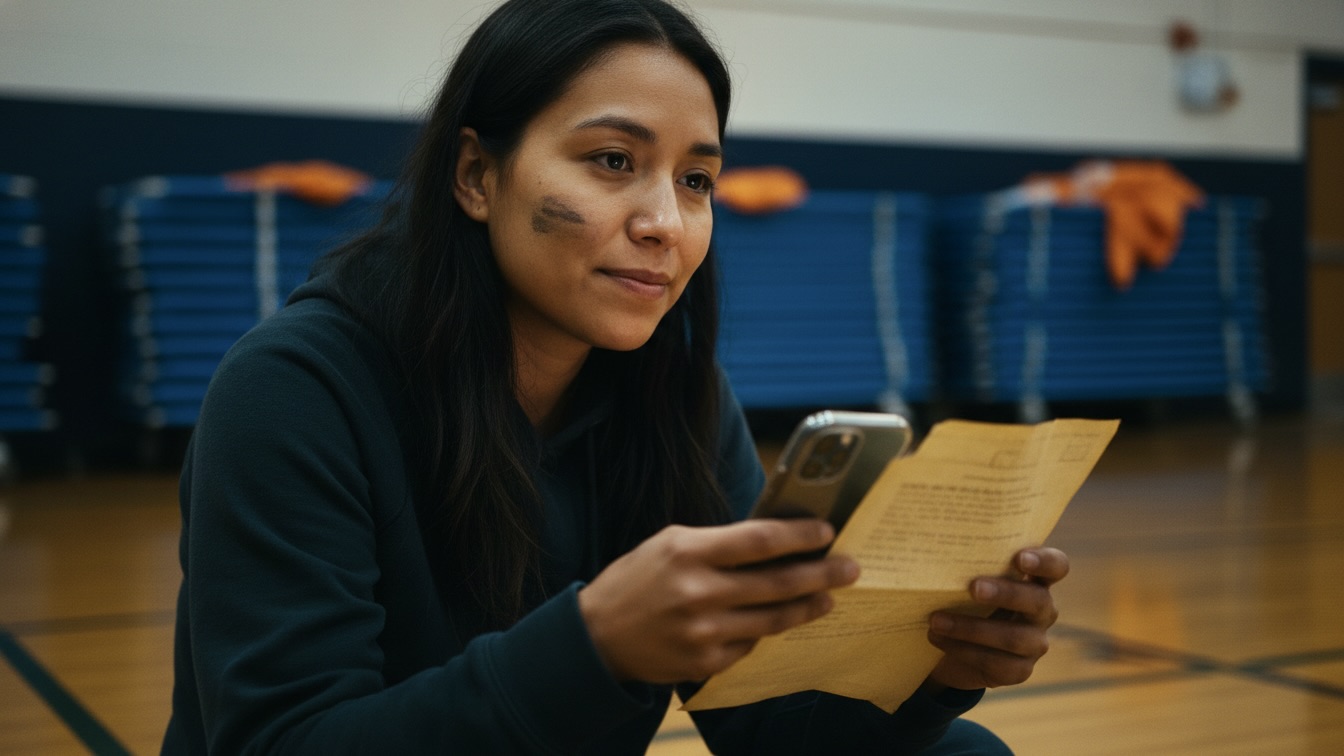
A high school gym becomes a battlefield when a developer arrives to buy out the souls of the displaced.
The fluorescent lights hum in a frequency that mimics a migraine. They flick at sixty hertz, a rhythmic strobe that turns the entire gymnasium into a glitching video file. It is July. The heat is a physical entity, a static mass that clings to the skin of the four hundred people crammed onto this hardwood floor. There is no air conditioning. There are only industrial fans that move the hot air in circles, doing nothing but redistributing the humidity. I sit on a pile of gray blankets. The texture is like sandpaper against my calves. I hold the backpack in my lap. The weight of the oilcloth bundle is a cold anchor against my stomach. It is the only thing in this room that feels solid.
I watch the shadows shift on the ceiling. The gym is a cavern of echoes. A child is crying near the basketball hoop. A group of teenagers is huddled around a single power outlet, their faces illuminated by the blue light of their phones. They look like acolytes at a digital altar. We are all waiting for the water to stop being the lead story. We are waiting for the city to remember we exist. But the city is busy. The city is underwater. The North End is a footnote in a disaster report, and we are the data points.
Lenny is asleep next to me. His chest rises and falls in a jagged rhythm. He looks smaller than he did this morning. The loss of the truck was the final blow to his architecture. He was a man built on the idea of utility. Without his tools, without his vehicle, he is just a collection of tired muscles and wet denim. I reach out and touch the zipper of the backpack. The metal is warm. I need to find a lawyer. Not a corporate suit. Not someone who works for the city. I need someone who understands that a signature in 1924 is more powerful than a bulldozer in 2026.
"You are staring at that bag like it contains the heart of a god," a voice says.
I turn my head. It is a girl. She looks about my age, maybe eighteen. She is wearing a Legal Aid t-shirt that is two sizes too big. Her hair is pulled back into a tight, professional knot that is starting to fray at the edges. She is holding a tablet with a cracked screen. She looks like she hasn't slept since the river crested.
"It contains something more dangerous than that," I say. "It contains the truth about who owns the dirt under the water."
She sits down on the floor next to me. She doesn't ask for permission. In this place, permission is a luxury no one can afford. Space is communal. Privacy is a memory. She taps her stylus against the tablet. The sound is a sharp, plastic click that cuts through the low-frequency roar of the gym.
"I am Mia," she says. "I am a junior clerk for the clinic. We are supposed to be helping people with insurance claims, but most of these people don't have insurance. They have lives that were built on handshakes and oral history. The system doesn't know how to process a life that isn't a PDF."
"I have something that isn't a PDF," I say. I lean closer to her. The heat between us is a vibrating wall. "I have a land trust agreement from a century ago. It says this neighborhood cannot be sold. It says the land belongs to the community as long as the river flows."
Mia stops tapping. She looks at the backpack. Her eyes are sharp. They are the eyes of someone who has spent too much time reading fine print. She knows the stakes. She knows that in a city like this, land is the only thing worth dying for.
"If you have that," she whispers, "you shouldn't be here. You should be in a vault. Or a bunker."
"I am in a gym," I say. "And the man who wants to burn those papers is currently the most powerful man in the province."
"Greenlee," she says. It isn't a question. It is a diagnosis.
"He is coming here, Mia. I can feel it. He's not the type to let a crisis go to waste. He's going to show up with relocation agreements and a smile that looks like a predatory loan. He's going to try to buy the future before the water even goes down."
Mia looks around the room. She looks at the families, the elders, the kids. She looks at the vulnerability of four hundred people who have nothing left but their names. She looks back at me. Her expression is a mixture of terror and a very specific kind of teenage spite.
"Then we have to be ready," she says. "Show me the papers. Let me see if the law still has teeth."
The light from the tablet screen is a harsh, clinical white. It carves deep shadows into Mia’s face as she scrolls through the photos I took of the documents. I wouldn’t let her touch the physical papers. The oilcloth stays wrapped. The ink is a century old, and the air in this gym is a biohazard of humidity. If the documents dissolve, the neighborhood dissolves with them. We are sitting in the shadow of the bleachers, a small pocket of digital resistance in a room full of analog despair.
"This is not just a trust," Mia says, her voice low and fast. "This is a sovereign covenant. Do you see this seal? This isn't from the city. This is a provincial override. It was signed during the 1924 labor strikes. It was a concession to prevent the entire North End from burning down. They traded the land for peace, and now Greenlee is trying to trade the flood for the land."
"Can he win?" I ask. My fingers are knotted together. I can feel the pulse in my thumbs.
"Legally? No. Procedurally? Easily," Mia replies. She looks at the battery icon on her tablet. It’s at twelve percent. The red bar is a countdown. "He doesn't need to win a court case, Sarah. He just needs to make sure no one challenges him for ninety days. Once the demolition permits are signed and the first bulldozer hits the silt, the trust becomes moot. You can’t protect a community that has been physically erased."
I look over toward the blue plastic curtain. Trapper is back there. The medics are busy. I can hear the occasional groan, the sound of a gurney wheel squeaking. The silence of the medical area is different from the noise of the gym. It is a heavier silence. It is the silence of bodies being repaired or failing. Trapper is a ghost in the system, but his leg is a very real, very biological problem.
"We need a judge," I say. "We need an injunction before the water even recedes."
"A judge?" Mia laughs, but it sounds like a cough. "The judges are all at their summer homes in the Whiteshell. The courts are closed. The only authority in this city right now is the Emergency Management Office, and guess who sits on their advisory board?"
"Greenlee," I say. The name is a bitter taste in my mouth.
"Exactly. He’s the one providing the 'logistics.' He’s the one paying for the private security that's guarding the bridges. He isn't just a developer anymore, Sarah. He’s the landlord of the disaster."
I feel a surge of heat that has nothing to do with the summer. It’s a sharp, jagged anger. It moves from my stomach to my chest. I look at the people around us. They are checking their phones, looking for news that isn't coming. They are looking for a signal.
"Then we change the signal," I say. "If we can't get a judge, we get the crowd. We make it impossible for him to move in secret."
"This isn't a movie, Sarah," Mia says, though she’s already typing something into an encrypted chat. "People are tired. They are hungry. They are terrified. If Greenlee offers them ten thousand dollars to walk away from a flooded house, eighty percent of them will take it. They don't care about a 1924 covenant. They care about their next meal."
"They care about their dignity," I argue. "Trapper said the shelters are cages. He was right. Greenlee wants to keep us in these cages until we’re desperate enough to sign anything. We have to show them what they’re actually giving up."
Lenny stirs next to me. He’s been listening. He sits up, his back cracking with a sound like dry wood. He looks at Mia, then at me. His eyes are bloodshot.
"The girl is right," Lenny says. "Greenlee is already here. I saw his black SUV in the parking lot. He’s not here to help with the triage. He’s here to harvest the signatures."
I stand up. My legs feel heavy, like they’re made of the same silt that’s filling my kitchen. I look toward the main doors of the gym. The light from the hallway is brighter than the gym light. It’s a clean, expensive light.
"Then let him come," I say. "I have the ledger. I have the law. And I have nothing left to lose but a house that’s already underwater."
Officer Grenley walks past us. He looks exhausted. His orange vest is stained with mud. He stops and looks at me, then at the backpack. He knows I lied about Trapper. He knows Thomas Bear isn't his name. But he doesn't say anything. He’s a child in a uniform, and he’s realized that the protocol he was taught doesn't apply to a world that’s melting.
"The manifest is being updated," Grenley says, his voice flat. "There’s a private delegation coming through. They’re calling it a 'recovery consultation.' You should stay in your assigned area."
"A recovery consultation," I repeat. "That’s a very formal way of saying a heist."
Grenley looks away. He doesn't have a script for this. He just keeps walking, his boots squeaking on the hardwood. The tension in the room is rising. It’s a physical pressure. The air feels thinner. The humming of the lights is getting louder.
Mia looks at her tablet. Seven percent.
"I’m uploading the photos to a decentralized server," she says. "If anything happens to me, or the bag, the files are out there. It’s not a legal victory, but it’s a digital footprint. In 2026, that’s almost the same thing."
"Thank you," I say.
"Don't thank me yet," she says. "Look."
The doors at the far end of the gym swing open. The sound of the heavy metal bars hitting the wall is like a gunshot. The room goes quiet. Even the crying child stops. The industrial fans keep spinning, but the air feels like it has stopped moving entirely.
Greenlee walks in. He isn't wearing a suit. He’s wearing a high-end outdoor jacket, the kind that costs more than my car. He looks like an explorer. He looks like a savior. He is followed by two men with clipboards and a woman with a professional camera. They aren't here for the disaster. They are here for the optics.
"Good evening, everyone," Greenlee says. His voice is amplified by the gym’s acoustics. It is a rich, theatrical baritone. It is the voice of a man who has never been told no. "I know you are all tired. I know you are all suffering. But I am here to tell you that the future is not underwater. The future is just beginning."
I grip the straps of my backpack. I can feel the edge of the oilcloth bundle. It’s a hard, cold reality. Greenlee starts moving through the rows of cots. He stops to shake hands. He stops to pat a shoulder. He looks like he’s running for office, but he’s actually just shopping for real estate.
He is moving toward us. He knows exactly where we are. He isn't looking at the families. He’s looking at me. He’s looking at the girl with the tablet. He’s looking at the man with the bloodshot eyes.
"The threat isn't the water," I whisper to Lenny. "The threat is the man who thinks he can buy the silence of the river."
Greenlee reaches our patch of the floor. He stands over us, his shadow stretching across the gray blankets like a dark stain. He smells of nothing. That is the most jarring part of his presence. In a room that is a sensory assault of sweat, damp wool, and the metallic tang of the industrial fans, he is a void. He is surgically clean. He looks at Lenny first.
"Lenny," Greenlee says. His voice is a smooth, polished stone. "I was sorry to hear about your truck. A 2022 Ford, wasn't it? A real workhorse. It’s a shame the city didn't get the barricades up in time."
Lenny doesn't stand up. He stays on the floor, looking up at the developer with a skeptical, burned-out stare. "The truck is scrap metal, Derek. I’m more concerned about the people who were inside it."
"Of course, of course," Greenlee says, his eyes flicking to me. "And this must be Sarah. The woman who found our resident philosopher in the crawlspace. You’ve become quite a local legend in the last six hours, Sarah. The girl who saved the ghost."
"I didn't save a ghost," I say. I stand up. I make sure I am eye-level with him. "I saved a man. And I saved a history you were hoping would drown."
Greenlee’s smile doesn't falter. It is a permanent fixture, a piece of branding. He gestures to the man behind him, who steps forward with a clipboard.
"We are here to offer a solution," Greenlee says, addressing the nearby families who are now leaning in to listen. "The North End has been a site of systemic neglect for decades. This flood is a tragedy, but it is also an opportunity. My firm is offering an immediate relocation grant to every resident of the flood zone. Ten thousand dollars, cash, tonight. We handle the demolition. We handle the debris. You get a clean start in a new development in the south end. No more basements. No more mold. No more uncertainty."
A murmur goes through the gym. Ten thousand dollars is a life-changing amount of money for most of the people in this room. It’s the difference between a motel and an apartment. It’s the difference between hunger and a full fridge. I can see the flicker of hope in their eyes. It’s a fragile, dangerous thing.
"And what do you get, Derek?" Lenny asks. "Besides a square kilometer of prime riverfront property that you just cleared for the price of a used car?"
"I get the satisfaction of rebuilding this city," Greenlee says. He turns back to me. "But I understand there’s some confusion about the title. Some talk of a trust? Sarah, you’re young. You have your whole life ahead of you. Don't spend it clinging to a piece of paper that belongs in a museum. The world has moved on since 1924. The law is a living thing. It evolves."
"The law is a promise," I say. My voice is steady. It sounds more formal than I intended, but the theatricality of the moment demands it. "You represent a systemic failure, Mr. Greenlee. You are here to prey on the exhausted. You are offering crumbs to people who own the bakery."
Greenlee’s eyes narrow. The smile stays, but the warmth leaves it. He looks at the backpack.
"You’re making a mistake," he says, his voice dropping to a confidential whisper. "That bag is a liability. If you try to fight this, you’ll be tied up in litigation for a decade. By the time a judge looks at those papers, your neighborhood will be a parking lot. Take the money. For your kids. For your future."
"My future is in that neighborhood," I say. "And so is the future of every person in this gym. You aren't offering a relocation. You’re offering an exile."
Mia holds up her tablet. "The files are already live, Mr. Greenlee. We’ve sent the metadata to the provincial land registry and three different news outlets. If you want to talk about litigation, we can start with the fraudulent transfer of the 1958 deed. My clinic has been looking for a test case for years. I think we just found it."
Greenlee looks at Mia. He looks at the tablet. For the first time, I see a flicker of something that isn't confidence. It’s not fear yet, but it’s the realization that he isn't the only one who knows how to use the system.
"A junior clerk," Greenlee sneers. "You think you can stop a ten-billion-dollar redevelopment with a cracked tablet and a sense of moral superiority?"
"I think I can make it very expensive for you to try," Mia says.
The woman with the camera starts filming. Greenlee gestures for her to stop, but it’s too late. The people in the gym are standing up now. They aren't just listening; they are moving closer. They are a wall of tired, angry humanity. They see the clipboard. They see the expensive jacket. And they see me, a girl from their block, holding a backpack like it’s a shield.
"Is it true?" an old woman asks. She is leaning on a walker. "Does the land belong to us?"
"It belongs to the trust," I say, turning to the crowd. "It means they can't kick us out. It means they can't tear down our homes to build condos. The water will go down, and when it does, the land will still be ours. Don't sign anything. Don't give him your name."
Greenlee looks around the room. The vibe has shifted. The cognitive static of the disaster has been replaced by a sharp, focused skepticism. He is no longer the savior. He is the intruder.
"This is a misunderstanding," Greenlee says, raising his hands in a gesture of peace. "We are only trying to help. If you want to stay in a flooded ruin, that is your choice. But the city will not provide services to a disaster zone. You will be on your own."
"We’ve always been on our own," Lenny says, standing up finally. He towers over Greenlee. "That’s how we survived this long. Now, why don't you take your clipboards and your 'grants' and find another disaster to harvest?"
Greenlee looks at me one last time. His expression is cold. It is the look of a man who is already calculating his next move. He doesn't say another word. He turns and walks toward the exit, his entourage trailing behind him like a retreating army. The heavy metal doors swing shut behind them with a definitive clang.
The gym erupts into a low roar of conversation. People are talking to each other, sharing stories, asking questions. The isolation of the disaster is breaking. They are becoming a community again.
But then, a medic runs out from behind the blue plastic curtain. He looks frantic. He scans the room until he sees me.
"Sarah!" he shouts. "Your father. Thomas Bear. He’s having a seizure. We need to move him to the hospital now, but we don't have his medical history. We don't even have his real name for the insurance. If we don't get him to the ICU in the next twenty minutes, he’s not going to make it."
I feel the world tilt. The victory with Greenlee evaporates. I look at the backpack. I look at the blue curtain. Trapper is dying. And the only way to save him is to give the system exactly what it wants: his identity.
The hallway of the high school is a tunnel of yellow light and the sound of rushing feet. I am running alongside the gurney. Trapper looks small. He is lost in the tangle of white sheets and clear plastic tubing. His face is the color of ash. His eyes are rolled back, showing only the whites. He is vibrating—a fine, high-frequency tremor that looks like he’s trying to shake himself out of his own skin. The medic, a man whose name tag reads 'David,' is squeezing a manual respirator. The rhythmic hiss-click of the air is the only thing keeping Trapper in the room.
"We need his name, Sarah!" David yells as we hit the double doors leading to the loading dock. A provincial ambulance is waiting, its lights painting the brick walls in a frantic strobe of red and blue. "The triage center at the hospital is rejecting all anonymous entries. The system is overloaded. They are only taking people with verified IDs and medical records. If I call him in as 'John Doe,' they’ll divert us to the overflow tent in the park. He won’t get a ventilator there."
I stop at the edge of the ambulance. The heat of the summer night hits me like a physical blow. It is 2:00 AM, but the temperature hasn't dropped. The air is a humid weight. I look at Trapper. I look at the backpack.
If I give them his real name, he becomes a ward of the state. The records will show he’s been missing for two decades. They’ll put him in a facility. They’ll take the papers as 'personal property' and lock them in a state evidence locker while they 'verify' his mental competency. Greenlee’s lawyers will be there in an hour. They’ll find a way to make Trapper sign a power of attorney. They’ll turn the protector of the trust into a ward of the developer.
But if I don't give them his name, he dies on a cot in a park.
"His name is Elias Thomas," I say. The words feel like a betrayal. "He was born in 1952. He’s O-negative. He has a history of respiratory issues from the mines. His ID is... it was lost in the flood."
David is already typing into his handheld device. "Elias Thomas. Got it. Searching the database. Okay, he’s in here. There’s a flag on his file. 'Vulnerable person.' 'Missing.' Sarah, the police are going to be at the hospital waiting for us."
"Just save him," I say. I climb into the back of the ambulance. I don't wait for permission. I sit in the corner, clutching the backpack. The doors slam shut. The siren starts—a long, mournful wail that sounds like the city itself is crying out in pain.
We move fast. I can feel every bump in the road, every turn. The water is still high in the low-lying areas. The ambulance splashes through deep puddles, the sound of the water hitting the undercarriage like gravel. I look at Trapper—Elias. He looks different now that he has a name. He looks less like a legend and more like a man. A man who is tired. A man who has been carrying a secret for too long.
"You did the right thing," Lenny’s voice says in my head, though he’s still back at the gym. Or maybe it’s not Lenny. Maybe it’s just the part of me that is trying to survive the night.
I reach into the backpack. I don't take out the bundle, but I touch it. I feel the ridges of the oilcloth. I feel the history hidden inside. I think about what Greenlee said. The world has moved on. He’s wrong. The world hasn't moved. It’s just been covered in layers of concrete and lies. The river is peeling those layers back. It’s showing us what’s underneath.
We reach the hospital. It’s a scene from a war movie. There are tents everywhere. People are sitting on the pavement. The air is filled with the sound of generators and the shouting of orders. David and another medic pull the gurney out. They disappear into the bright, white light of the emergency entrance.
I try to follow, but a security guard stops me. He’s wearing a tactical vest. He looks like he’s expecting a riot.
"Wait here," he says. "Family area is to the left."
"I need to be with him," I say.
"Everyone needs to be with someone, kid. Sit down before I have to make you sit down."
I walk to the left. The family area is just a row of plastic chairs under a flickering streetlamp. I sit down. I am alone. The backpack is a heavy weight on my knees. I check my phone. Three percent. I have one call left.
I don't call my sister. I don't call Lenny. I call the number Mia gave me. The number for the journalist who covers the land registry.
"Hello?" a voice says. It sounds sleep-deprived and skeptical.
"My name is Sarah," I say. "I have the 1924 North End Land Trust agreement. I am at the General Hospital. Greenlee is trying to bury it. I need you to get here now."
"The 1924 agreement?" The voice is suddenly alert. "That’s been a myth for fifty years. If you’re lying to me—"
"I’m not lying," I say. "But the man who kept it safe is in the ICU, and I’m pretty sure I just gave him up to the people who want him to disappear."
"I’m on my way," the journalist says.
I hang up. The phone dies. The screen goes black. I am sitting in the dark, in the heat, in the middle of a disaster. I look at the hospital entrance. A black SUV pulls up to the curb. It’s not an ambulance. It’s clean. It’s expensive.
Greenlee’s assistant gets out of the back. He’s holding a briefcase. He doesn't look at the people on the pavement. He looks at the security guard. He shows him a badge. The guard nods and lets him through.
They are here. They are already here.
I stand up. I look for an exit, but the loading dock is blocked by a line of police cars. Officer Grenley is there. He sees me. He doesn't move. He just watches.
I realize then that the papers aren't the weapon. I am the weapon. As long as I have the bag, Greenlee can't win. But as long as I have the bag, I am a target.
I look at the dark shape of the river in the distance. It is still rising. It is a slow, relentless force. It doesn't care about deeds. It doesn't care about trusts. It only cares about the path of least resistance.
I turn toward the shadows of the hospital's parking garage. I need to disappear. I need to become a ghost, just like Trapper.
But as I move, I see a figure standing by the concrete pillar. It’s Mia. She’s holding her tablet, which is connected to a portable battery pack. She looks at me and nods.
"The upload is finished," she says. "The world knows. Now we just have to stay alive long enough to see what they do with the information."
A hand grips my shoulder from behind. It is heavy. It is cold. It is not the hand of a friend.
“I turned to run, but a hand clamped over my mouth, the smell of expensive leather and rain-slicked pavement filling my senses as I was pulled into the dark.”