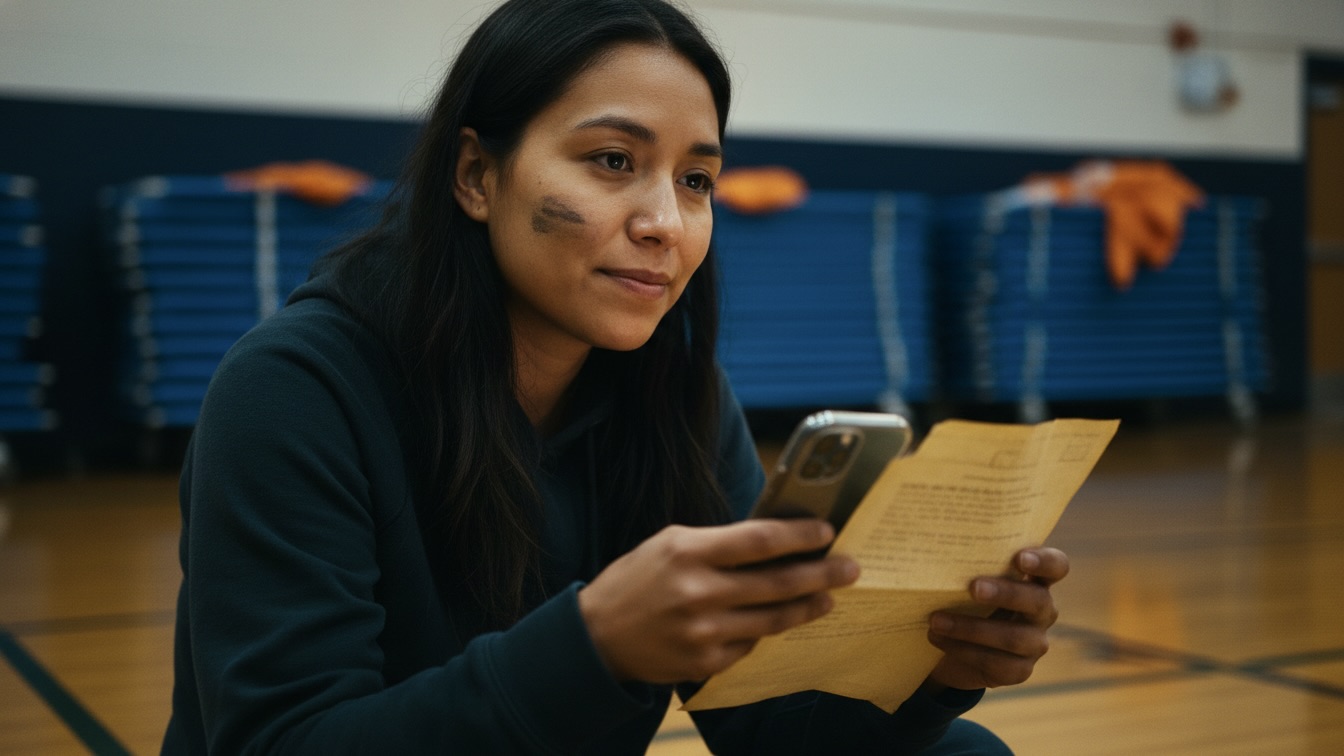
A rising river forces a mother to choose between a dying house and a hidden elder's secret.
The sky is the color of a fresh bruise. It is hot. The kind of Winnipeg summer heat that makes your skin feel like it is melting off your bones. I am shoving my life into black garbage bags. The plastic is loud. It crinkles like a scream every time I force a handful of clothes inside. My kids are already at my sister's place in Brandon. I stayed. I stayed because Mr. Henderson sent the notice via a courier who looked like he wanted to be anywhere else. Renovations. That is what the paper said. The flood is just the vibe he needed to kick us out. The Red River is a kilometer away but it is already in the basement. I can hear it. It is a low, heavy sound. It is the sound of a beast breathing in the dark.
I fold a beaded keychain into a pair of socks. My hands are shaking. The air in the kitchen is thick. It feels like I am breathing through a wet wool blanket. The humidity is a physical weight. I look at the pile of bags in the hallway. My entire existence looks like trash. That is the irony of it. You work three jobs to buy things that eventually just become debris in a flood. I check my phone. The battery is at forty percent. The cell towers are probably going to go down soon. The signal is already flickering like a dying bulb.
There is a sound. It is not the water. It is a thump. A rhythmic, deliberate hit against wood. It comes from the floor. Directly under the kitchen table. I stop moving. I hold my breath. The house is old. It creaks. It groans. But this is different. This is a person. I move the table. The legs scrape against the linoleum. The sound is sharp. It hurts my ears. I look at the hatch. It is a square of plywood painted to match the floor. We use it for the water meter. I have not opened it in months.
"Who is there?" I ask. My voice sounds thin. It does not sound like me. It sounds like a ghost. The thumping stops. Silence follows. It is the kind of silence that feels like a shadow. It fills the room. It presses against my chest. I reach for the handle. The metal is cold despite the heat. I pull. The wood resists. It is swollen from the moisture. I pull harder. My shoulder muscles ache. The wood gives way with a wet, sucking sound. The smell hits me first. It is not the river. It is old tobacco and damp wool. It is the smell of a person who has been living in a small space for too long.
I see eyes first. They are bright. They reflect the weak light from the kitchen window. An old man is curled into the corner of the crawlspace. He is surrounded by soggy blankets. He looks like he is part of the foundation. I know him. He is Trapper. I have seen him at the Friendship Center. He is the one who tells stories about the land before the concrete. He is the one who refuses to sit in the chairs because he says they ruin your spine. He looks at me. He does not look scared. He looks patient.
"Sarah," he says. His voice is a gravel road. It is deep and steady. It makes the air feel less chaotic. "The water is coming for the floorboards. You should have left an hour ago."
"What are you doing here, Trapper?" I am kneeling on the floor now. My knees hurt. The linoleum is gritty with silt. "You cannot stay here. The river is cresting. This whole block is going to be under three feet of water by tonight."
"I do not care for the shelters," he says. He tries to shift his position. He winces. His right leg is wrapped in a dirty bandage. It looks stiff. "They are cages. They have bars on the windows even when they call them schools. I will take the river over the bureaucracy of a gymnasium."
"You will drown, Trapper. This is not a metaphor. It is fluid dynamics."
"Then I will be part of the silt. It is a clean way to go. Better than being a file number in a government database."
I look at his leg. The bandage is soaked with something that is not just water. He needs a doctor. He needs to move. But he is heavy. He is solid. He looks like he is anchored to the earth. The sirens start then. They are loud. They are the sound of the end. They wail across the North End. It is a long, rising note that tells everyone to get out. It sounds like a warning from a different century.
"That is the mandatory order," I say. "I have to go. You have to come with me."
"I have nowhere to go where they will let me keep my dignity, Sarah."
"I will give you my dignity. Just get out of the hole."
I reach down. I offer him my hand. He looks at it. He looks at the bags in the hallway. He looks at the water bubbling up through the floor drain in the corner of the kitchen. The water is brown. It is the color of tea. It is spreading across the floor. It is moving toward us. It is silent and fast. It is the river claiming its territory. He takes my hand. His grip is like iron. He is stronger than he looks. I pull. He pushes. We struggle against the physics of the house. He is out. He is on the kitchen floor. He is dripping. He looks like a drowned bird. But his eyes are still sharp. He is holding a small bundle wrapped in oilcloth. He holds it like it is a child.
"We need to move," I say. "Lenny is coming with the truck. He is the only one I trust."
"Lenny," Trapper says. He spits on the floor. "The man who owns the dirt."
"He used to own the dirt. Now he just owns a Ford F-150 and a sense of guilt. It is the best we have."
I hear the truck outside. It is splashing through the street. The water is already high enough to hit the wheel wells. The sound of the engine is a roar. It is the only thing louder than the sirens. I grab a bag. I grab Trapper's arm. We move toward the door. The water is at my ankles. It is cold. It is surprisingly cold for a summer day. It feels like the river is trying to freeze my blood. We reach the porch. Lenny is there. He is wearing a yellow raincoat. He looks like a giant canary. He is waving us toward the truck.
"Sarah! Move it!" he yells. "The bridge is going to close in twenty minutes!"
I look at Trapper. He is looking at the house. He is looking at the eviction notice on the door. He reaches out and tears it off. He crumples it into a ball. He looks at me and smiles. It is a terrifying smile. It is the smile of someone who has nothing left to lose and knows exactly how much that is worth.
Lenny stares at Trapper like he is seeing a ghost from a past life. He does not say anything at first. He just holds the passenger door open. The rain is starting now. It is a hard, hot rain. It turns the dust on the truck into streaks of mud. Trapper climbs in. He moves with a calculated slowness. Every movement is a protest. He sits in the middle. I climb in next to him. The cab of the truck is small. It smells like old coffee and damp upholstery. It is the only dry place left in the world.
"Who is the guest, Sarah?" Lenny asks. He is looking at me. He is not looking at Trapper. He is afraid of what Trapper represents. He is afraid of the history that is currently sitting on his vinyl seats.
"This is Trapper. He was in the crawlspace."
"The crawlspace? Sarah, the crawlspace is a flood zone. Why was he in the crawlspace?"
"He was waiting for the water," Trapper says. He looks at Lenny. "I wanted to see if the river remembered me. It does. It has a very long memory."
Lenny shakes his head. He puts the truck in gear. The engine groans. We move forward. The water is deep now. It pushes against the front of the truck. I can feel the vibration in the floorboards. We are floating. Not literally, but the traction is gone. We are sliding through the neighborhood. The houses look like islands. The trees are drowning. It is a landscape of loss. I look at my house in the rearview mirror. It looks small. It looks fragile. It looks like it is about to be swallowed.
"We have to go to the hospital," Lenny says. "Look at his leg. That is an infection, Sarah. I can smell it from here."
"No hospitals," Trapper says. His voice is sharp. It is an order. "They will take my name. They will put me in a bed. They will treat me like a broken appliance. I am not a project for the state."
"Trapper, you are going to lose the leg," Lenny argues. He is being practical. He is being a landlord. "You cannot fix that with stories and tobacco. You need antibiotics."
"I need the truth to be told," Trapper says. He clutches the oilcloth bundle. "Do you know what is in here, Lenny? Do you know what the developers are trying to bury under the silt?"
Lenny is silent. He keeps his eyes on the road. The road is gone. We are just following the line of the telephone poles. The water is brown. It is thick with debris. A plastic cooler floats past us. A wooden chair. Someone's life is drifting toward the lake. The silence in the truck is heavy. It is more suffocating than the heat. I look at the bundle in Trapper's lap. I can see the edges of paper. It is old paper. It is thick and yellowed.
"The land trust," I whisper. I remember the stories. The rumors that this block was never supposed to be sold. That it was held in a trust for the community. That Henderson's deed is a lie built on top of a lie.
"It is the agreement," Trapper says. "Signed in 1924. It says this land belongs to the people as long as the river flows. Henderson knows. That is why he wants the flood. He wants the water to wash away the evidence. He wants the basement to collapse. He wants the records to turn into pulp."
Lenny looks at me. He looks conflicted. He is a man of property. He believes in deeds. He believes in the system. But he also knows Henderson. He knows how the city works. He knows that a flood is a perfect way to clear a ledger. He sighs. It is a long, tired sound. It is the sound of a man who is tired of being on the wrong side of history.
"If those papers are what you say they are," Lenny says, "they are worth more than the house. They are worth the whole neighborhood."
"They are worth the future," Trapper says. "But they are also just paper. If the water touches them, the ink will run. The truth will become a smudge. We have to keep them dry."
We reach the intersection of Main and Higgins. It is a disaster zone. The police have set up a perimeter. There are boats. Big, orange rescue boats. The water is too deep for the truck now. The engine is sputtering. It is sucking in water. Lenny kills the ignition. We are stuck. We are an island in the middle of the street. The water is rising around the doors. It starts to seep in through the seals. It is a thin, dark line on the floor mats.
"We have to get out," Lenny says. "We have to get to a boat."
"The papers," Trapper says. He looks at the water. He looks at the police. "They will take them. They will say they are evidence. They will put them in a locker where they will never be seen again. You have to take them, Sarah. You have to hide them."
"Me? Why me?"
"Because you have a reason to fight. You have children. You have a house that is being stolen from you. I am just an old man with a bad leg. I am a ghost. You are the one who is still alive."
He hands me the bundle. It is heavier than it looks. It feels like it is made of lead. I shove it into my backpack. I zip it tight. I can feel it against my spine. It is a cold, hard weight. I look at the police boats. They are moving toward us. One of them is steered by a young man. He looks like he is barely twenty. He is wearing a bright orange vest. He looks terrified. He is the one who is supposed to save us.
"Stay calm," Lenny says. "I will talk to them. I know the captain. Just let me do the talking."
I look at Trapper. He is leaning back against the seat. He looks exhausted. The effort of leaving the house has drained him. He looks smaller now. He looks like he is fading into the shadows of the truck. The water is at our knees. It is filling the cab. It is a dark, churning mass. It smells like old pennies and motor oil. It is the smell of the city's gut being turned inside out.
"I'm not going to leave you," I say. "We are both getting on that boat."
"We will see," Trapper says. "The river has a way of making its own choices. We are just the cargo."
The boat pulls alongside the truck. The engine is a high-pitched whine. It vibrates in my teeth. The young man at the motor is Officer Grenley. I can see his name tag. It is shiny. It is the only thing on him that isn't covered in mud. He looks at us with a mixture of pity and professional detachment. He is following a protocol that was written by someone in a dry office three hundred kilometers away. He does not see people. He sees units of evacuation.
"Three passengers?" Grenley shouts over the noise of the water. "I can only take two. The current is too strong. I'm already over the weight limit for this sector."
"Don't be a bureaucrat, kid," Lenny says. He is standing in the bed of the truck now. The water is swirling around his boots. "We've got an injured man here. Look at his leg. He needs a medic."
Grenley looks at Trapper. He looks at the blood-soaked bandage. He looks at the way Trapper is slumped against the seat. He frowns. It is a look of genuine concern fighting with the fear of getting in trouble. He is a rookie. He is a child in a uniform. He is the thin orange line between us and the river.
"I need ID," Grenley says. "I have to log everyone. For the manifest. For the insurance. If I take him, I need to know who he is."
Trapper says nothing. He just stares at the dashboard. He does not have an ID. He hasn't had one for twenty years. He is a man who exists outside the documentation of the state. He is a ghost in the machine. If he gives his name, he enters the system. If he enters the system, he goes to the hospital. If he goes to the hospital, he goes to a home. He knows the trajectory. It is a straight line to the end.
"He's my father," I say. The lie comes out of my mouth before I can think about it. It is a smooth, easy lie. It is the kind of lie you tell when you are trying to save a life. "His name is Thomas. Thomas Bear. He lost his wallet in the flood. All his papers are in the house. Under six feet of water."
Grenley looks at me. He looks at my face. He is looking for a tell. He is looking for the flicker in my eyes that says I am making it up. I don't give it to him. I stare back. I make my eyes hard. I make them look like the eyes of a woman who has lost everything except her father. I am a better actor than I thought. Or maybe I'm just more desperate.
"Thomas Bear," Grenley repeats. He writes it down on a damp clipboard. "Age?"
"Seventy-four," I say. "He has a heart condition. And the leg. We have to move now."
"Okay," Grenley says. He looks at Lenny. "You have to wait for the next boat. I can take the woman and the old man. That's it. No bags. Just the people."
"I have my backpack," I say. I clutch the straps. "It's just medicine. And some clothes for him. I'm not leaving it."
"Fine. Just get in. Quickly!"
Lenny helps me lift Trapper. It is a struggle. Trapper is dead weight. He is trying to help, but his body is betraying him. We haul him over the side of the truck and into the boat. The boat rocks violently. The water is splashing over the gunwales. I climb in after him. I sit on the floor, holding Trapper's head in my lap. He feels cold. His skin is clammy. He is shivering, even in the heat.
"I'll find you at the gym!" Lenny yells. He is standing on the roof of the truck now. The truck is almost completely submerged. He looks like a captain on a sinking ship. "Don't let them take the papers, Sarah! Keep them safe!"
Grenley looks at me. "What papers?"
"Tax documents," I say. "For the house. He's obsessed with them. Old people, you know?"
Grenley nods. He doesn't care. He just wants to get out of the current. He guns the engine. The boat lurches forward. We leave the truck behind. We leave Lenny behind. We are moving toward the center of the city. The water is a brown desert. It has erased the streets. It has erased the parks. It has turned Winnipeg into a ghost of itself. I look down at Trapper. His eyes are closed. He is breathing in shallow, ragged gasps.
"You did well," he whispers. His voice is so low I can barely hear it over the motor. "Thomas Bear. I like the name. It sounds like someone who would own a mountain."
"You own a mountain of trouble, Trapper. Just stay with me. We are almost there."
I look back at the neighborhood. I can see my house. The water is at the tops of the windows now. The basement is gone. The kitchen is gone. The hatch where I found Trapper is under ten feet of river. I feel a sharp pang of grief. It is not for the things. It is for the space. The space where my kids grew up. The space where I thought I was safe. It is being erased. It is being liquidated. Henderson is getting exactly what he wanted. A clean slate.
But I have the backpack. I can feel the weight of the land trust against my legs. It is the only thing that hasn't been washed away. It is the anchor. If I can get these to a lawyer, if I can get them to the press, the flood won't matter. The water will recede, and the truth will remain. That is the hope. It is a small, fragile thing. It is as fragile as the old man in my lap.
"The hospital is full," Grenley says. He is talking into a radio. "They're diverting everyone to the high school. We're going to the gym at St. Johns. They have a triage unit there. Tell them we have a priority-three with a leg injury."
"The gym," Trapper says. He opens his eyes. "The cage. I told you, Sarah. The cage is waiting."
"It is just for tonight, Trapper. I will be right there with you. I won't let them take you anywhere without me."
"You are a good daughter," he says. There is a flicker of irony in his voice. "Even if you are a liar."
We pass under a bridge. People are standing on the edge, looking down at us. They look like they are watching a movie. They are dry. They are safe. They are separated from us by fifty feet of concrete and a lifetime of luck. I want to scream at them. I want to tell them that the river is coming for them too. That no one is safe when the land starts to remember its own history. But I stay quiet. I just hold onto the backpack and the old man. We are the cargo. We are the silt. We are the survivors.
The gym at St. Johns is a chaos of neon and misery. It is bright. Too bright. The lights hum with a low-frequency buzz that makes my brain feel like it is vibrating. There are hundreds of people. They are sitting on cots. They are sitting on the floor. They are wrapped in gray blankets that look like they were made from recycled lint. The air is thick. It smells like wet dogs and bleach and the kind of cheap pizza the city buys for disasters. It is a sensory overload. It is cognitive static.
They take Trapper away immediately. Two medics in blue scrubs lift him onto a gurney. They don't ask for his ID. They just see the leg. They see the infection. They see a problem that needs to be solved. I try to follow them, but a woman in a vest stops me. She has a clipboard. She has a face that has seen too many floods.
"Are you family?" she asks.
"I'm his daughter," I say. I am getting better at the lie. It feels natural now. It feels like a shield. "I need to be with him."
"He's going to triage. You need to register first. Go to table four. Get your wristband. Then you can wait in the family area."
"He's scared of hospitals," I say. "He needs to know I'm here."
"Everyone is scared, honey. Just get your band. We'll find you when he's stable."
I watch them wheel him behind a curtain of blue plastic. He looks back at me once. He doesn't say anything. He just points to his chest. He is reminding me of the papers. He is reminding me of the weight. I turn away. I go to table four. I get a yellow wristband. It has a barcode on it. I am officially a unit of evacuation. I am part of the manifest. I am a number in the system.
I find a corner near the bleachers. It is a small patch of space. It is my new home. I sit on the floor. I put the backpack between my knees. I don't open it. Not yet. There are too many eyes. There are people everywhere. They are staring at their phones. They are staring at the walls. They are staring at nothing. The vibe is mid-apocalypse. It is the sound of a hundred lives being put on hold.
Lenny arrives two hours later. He looks older. He is soaked to the bone. He found a ride on a supply truck. He spots me and walks over. He looks like he's about to collapse. He sits down next to me on the hardwood floor. He doesn't say anything for a long time. He just breathes. He is a man who has spent his life building things, and he just watched the river take them all away.
"The truck is gone," he says eventually. "The house is probably gone too. I saw Henderson at the bridge. He was talking to the adjusters. He looked happy, Sarah. He looked like he just won the lottery."
"He hasn't won yet," I say. I reach into the backpack. I pull out the oilcloth bundle. I move slowly. I make sure no one is watching. I peel back the cloth. The papers are dry. They are beautiful. They are covered in elegant, handwritten script. There are seals. There are signatures. There are maps of the neighborhood that show a different world. A world where the land wasn't just a commodity.
"Look at this, Lenny. This is the trust agreement. It says the land can't be developed. It says it has to be held for the community in perpetuity. Henderson's deed is based on a fraudulent transfer from 1958. It's right here. It's all right here."
Lenny leans in. He looks at the papers. He touches the edge of one. His hands are rough. They are the hands of a man who knows the value of a solid foundation. He reads the words. I can see his eyes moving fast. I can see the realization hitting him. He is a landlord, but he is also a person. He is a person who was born in this city. He is a person who knows the difference between a law and a lie.
"This is real," he whispers. "This isn't just a story. This is a legal bomb. If you take this to the right people, Henderson doesn't just lose the eviction. He loses the land. He might even go to jail."
"Trapper saved this," I say. "He lived in a crawlspace for months just to make sure the water didn't get these. He risked his life for a pile of paper."
"He didn't risk it for paper, Sarah. He risked it for us. For the people who live there."
I look across the gym. I see the families. I see the kids playing with a deflated basketball. I see the old women clutching their purses. They don't know it yet, but their world is sitting in my lap. The river is rising, but so is the truth. It is a slow process. It is a painful process. But it is happening.
A medic comes out from behind the blue curtain. He looks around the room. He sees me. He walks over. He looks tired. He looks like he has bad news, and he's practiced the way he's going to deliver it.
"Are you the daughter of Thomas Bear?" he asks.
"Yes," I say. My heart stops. "How is he?"
"He's stable. We've started him on antibiotics. But he's refusing to go to the hospital. He says he's staying here. He's being very... vocal about it."
"That sounds like him," I say. I feel a rush of relief. He is still fighting. He is still the man who refused the chair.
"He wants to see you. He says you have his 'ledger.' He won't sleep until he sees it."
I look at Lenny. I look at the papers. I wrap them back in the oilcloth. I shove them into the backpack. I stand up. I feel the weight of the future on my shoulders. It is a heavy weight, but it is a good one. It is a weight that means I am still here. It means we are all still here.
"Go," Lenny says. "I'll stay here. I'll watch your spot. We have a lot of work to do when the water goes down."
I walk toward the blue curtain. The gym is still loud. The lights are still too bright. The sirens are still wailing in the distance. But the silence is gone. The shadow mass is lifting. I can feel the ground beneath my feet. It is wet. It is muddy. It is a disaster. But it is our ground.
I pull back the curtain. Trapper is sitting up in bed. He has a clean bandage on his leg. He looks like a king on a throne of lint. He sees me and smiles. He sees the backpack and nods. He knows. He knows that the flood was just the beginning.
"Did the river tell you anything else?" I ask. I sit on the edge of his cot. I take his hand. His grip is still like iron.
"It told me to keep my head up," he says. "And it told me that the silt is a very good place to plant a new garden."
We sit there in the light of the gym. We look at the letters by the light of my phone. We plan. we plot. We wait for the morning. The water is still rising, but for the first time in my life, I'm not afraid of drowning.
“I looked at the water line on the gym door and realized that while the river had taken our homes, it had finally given us the weapons to take back the land.”


