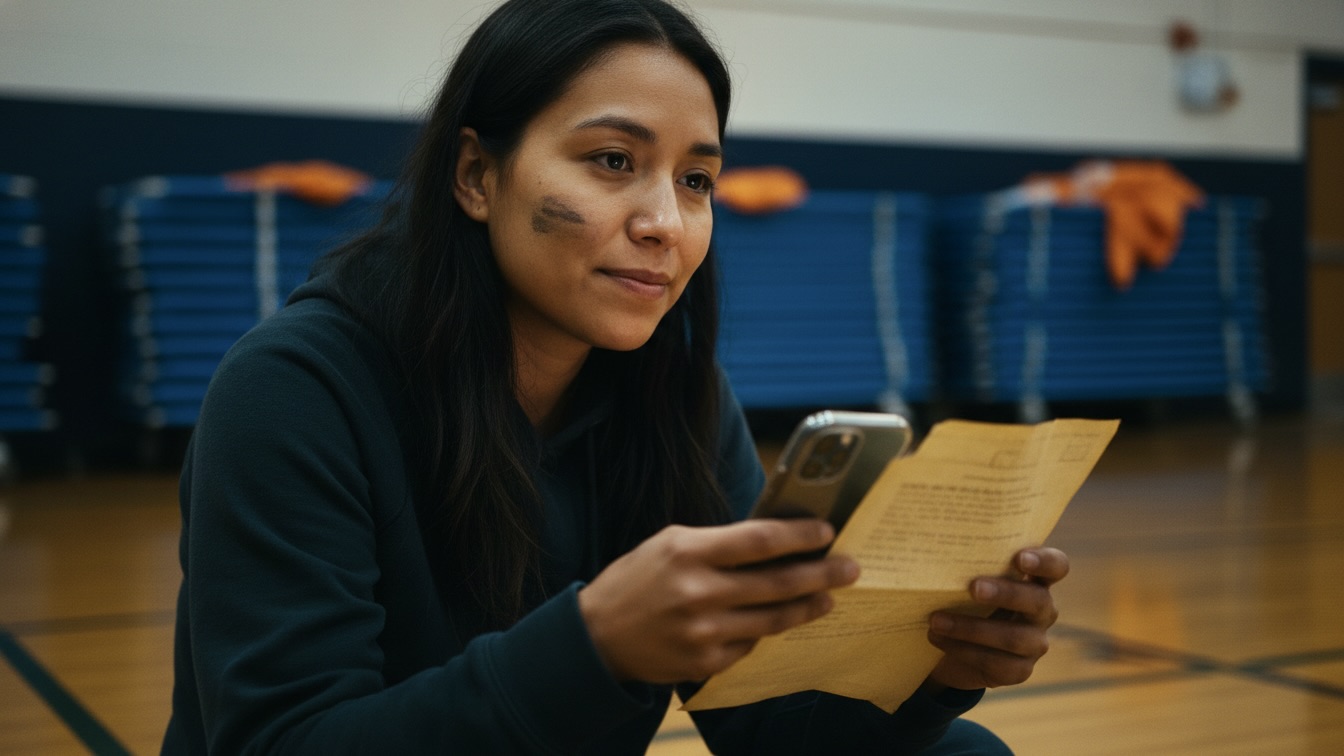
The story follows Sarah, a mother in Winnipeg’s North End, as she desperately packs her belongings amidst a dual crisis of a mandatory flood evacuation and an opportunistic eviction by her landlord, Mr. Henderson. While preparing to leave, she discovers Trapper, an Indigenous elder, hiding in her crawlspace with an infected leg and a mysterious oilcloth bundle. Despite the rising waters of the Red River and Trapper’s deep-seated distrust of state institutions, Sarah manages to convince him to flee with the help of her friend Lenny.
As they navigate the submerged streets in Lenny’s truck and eventually a rescue boat, the narrative shifts from a survival horror to a socio-political thriller. Sarah lies to a rookie police officer to ensure Trapper remains with her rather than being processed as a nameless ward of the state. Once they reach the safety of a high school gymnasium, the contents of Trapper’s bundle are revealed to be a 1924 land trust agreement. This document proves that the neighborhood was never meant for private development, providing Sarah and her community a powerful weapon against the predatory developers seeking to profit from the disaster.
A primary theme of the narrative is the intersection of natural disaster and systemic exploitation. The Red River flood is not merely a meteorological event but a catalyst for "renovations" and evictions, showing how those in power use chaos to displace the vulnerable. The water acts as a literal and metaphorical force of erasure, threatening to wash away both physical homes and the historical records that prove the inhabitants' right to the land. This creates a tension between the "vibe" of the flood and the "physics" of the bureaucracy that Trapper so vehemently resists.
The conflict between institutional categorization and human dignity is also central to the text. Trapper’s refusal to go to a shelter or a hospital stems from a psychological scars left by "cages" and "government databases" that strip individuals of their identity. Sarah’s decision to lie about Trapper’s name, calling him "Thomas Bear," serves as a protective act that reclaims agency from a system that views people as "units of evacuation." This theme suggests that true safety is found in community and shared secrets rather than the sterile, barcoded "security" of the state.
Finally, the story explores the concept of the land as a living archive. Trapper speaks of the river as having a "long memory," contrasting with the developers who wish to treat the earth as a "clean slate." The land trust documents represent a bridge between the ancestral past and a liberated future. By preserving these papers, the characters are not just saving a neighborhood; they are honoring a covenant that predates the concrete and the "lies built on top of lies" that define the modern urban landscape.
Sarah begins the story in a state of psychological fragmentation, symbolized by her act of shoving her "entire existence" into garbage bags. She views herself and her life through the lens of poverty, noting the irony of working three jobs only for her possessions to become "debris." However, her discovery of Trapper shifts her internal focus from victimhood to guardianship. She transitions from a woman being "liquidated" to a woman who is "the one who is still alive" and capable of carrying the weight of history.
Her decision to lie to Officer Grenley marks a significant psychological turning point where she abandons her reliance on the "system" to protect her. By claiming Trapper as her father, she creates a chosen family bond that transcends biological or legal definitions. This lie is not a moral failing but a strategic adaptation to a world that does not value Trapper’s humanity. By the end of the chapter, her fear of "drowning" has been replaced by a grounded sense of purpose, as she realizes she holds the "anchor" of the community’s future in her backpack.
Trapper serves as the story’s moral and historical anchor, embodying the resilience of the land itself. He is physically broken, with an infected leg that symbolizes the "rot" of the current social order, yet his spirit remains "solid" and "anchored to the earth." He views the flood as a moment of reckoning and the river as a peer rather than a threat. His refusal to sit in chairs because they "ruin your spine" is a metaphor for his lifelong refusal to conform to the structures of colonial society.
Psychologically, Trapper is a man who has already experienced the "end of the world" and thus does not fear the rising water. He is more afraid of the "bureaucracy of a gymnasium" than he is of the river’s current. He recognizes in Sarah a successor, someone who has a "reason to fight" because she has children and a future. His willingness to finally leave the crawlspace and trust Sarah with the oilcloth bundle shows a transition from a solitary protector of the past to a mentor for the next generation.
Lenny represents the middle ground between the exploitative landlord class and the displaced working class. He is described as a man who "used to own the dirt" but now only owns a truck and a "sense of guilt." This guilt is his primary motivation, driving him to risk his vehicle and his safety to help Sarah and Trapper. He is a practical man, focused on "antibiotics" and "deeds," yet he is capable of recognizing the profound value of the "legal bomb" Trapper has preserved.
His internal conflict is evident when he looks at the land trust documents; he is a "man of property" who must confront the fact that the property system he believes in is built on fraud. By choosing to stay at the gym and "watch the spot," he commits himself to the community’s struggle. He moves from being a passive observer of Henderson’s greed to an active participant in the "work" required to reclaim the neighborhood. Lenny’s arc suggests that even those complicit in the system can find redemption through solidarity.
The narrative voice is characterized by a gritty, visceral realism that emphasizes the oppressive atmosphere of the Winnipeg summer. The opening metaphor of the sky being the "color of a fresh bruise" immediately sets a tone of trauma and impending violence. Sensory details are used to create a sense of claustrophobia, such as the "wet wool blanket" of humidity and the "sucking sound" of the wooden hatch. These descriptions ground the psychological tension in a physical reality that feels both decaying and dangerously alive.
Pacing in the chapter is masterfully handled, moving from the slow, tense discovery in the kitchen to the frantic, high-stakes escape through the flooded streets. The use of short, punchy sentences during the truck and boat sequences mirrors the characters' heightened heart rates and the urgency of the rising water. This contrasts with the longer, more reflective paragraphs in the gymnasium, where the immediate physical danger has passed, allowing the deeper thematic and historical implications of the land trust to surface.
The narrative also employs a "shadow" motif to describe the silence and the systemic forces at play. The silence in the kitchen "feels like a shadow," and the gymnasium is described as a place of "cognitive static" and "neon misery." By personifying the river as a "beast breathing in the dark" and the state as a "machine," the author elevates the story from a simple disaster tale to a mythic struggle. This stylistic choice emphasizes that while the water is a physical threat, the true monsters are the invisible structures of greed and erasure that the characters must fight.


