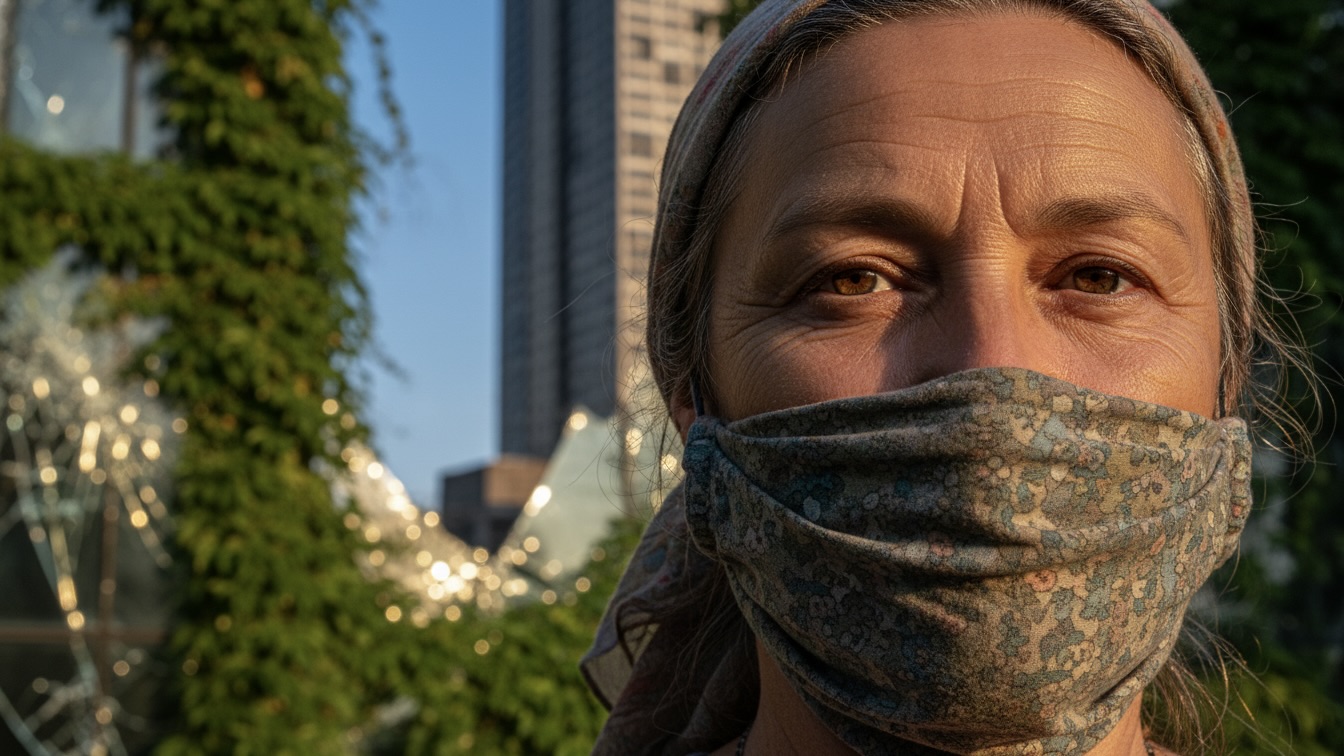
Martina watches the Chicago asphalt shatter as ancient, intelligent roots rise to reclaim the city for the wild.
The heat in Chicago always felt heavy, but this July afternoon carried a weight that made the air feel like wet wool. Martina stood on the corner of Wacker Drive, her fingers tracing the worn leather strap of her field bag. She was fifty-five, and her knees usually told her when the weather was about to change, but today they were silent. Instead, the ground itself was talking. A low, rhythmic vibration hummed through the soles of her sturdy hiking boots. It wasn't the rhythmic thud of the L-train or the distant rumble of construction. This was deeper. It was the sound of something massive moving beneath the bedrock.
She looked at the sidewalk. A hairline fracture appeared in the concrete, snaking out from the base of a decorative planter. Inside the planter, a stunted Japanese maple seemed to shiver, though there was no wind. Martina stepped back, her eyes narrowing. She had spent twenty years in the National Park Service, and she knew the strength of a root system. She knew how a single seed could split a boulder over decades. But this was happening in seconds. The crack widened. The gray surface of the sidewalk buckled upward, the cement groaning as it was forced into an unnatural arch.
"The structural integrity is failing," a man next to her said, holding up his phone to record the scene. He looked barely twenty-five, dressed in a crisp white shirt that was already stained with sweat at the armpits. "This is going to be a massive insurance claim for the city."
"You should move back," Martina said. Her voice was steady, the formal tone of a woman used to giving safety briefings to unruly tourists. "The pressure under that slab is immense. When it breaks, the shrapnel will not care about your video."
He scoffed, but before he could retort, the world exploded. The sidewalk didn't just crack; it detonated. Chunks of concrete the size of dinner plates flew into the air. One caught the man in the shoulder, spinning him around and dropping him to the ground. From the wound in the earth, a thick, gnarled root erupted. It was the color of old iron, wet and glistening with a dark, viscous sap. It didn't taper like a normal root. It was uniform in thickness, nearly three feet across, and it moved with the fluid, terrifying grace of a constrictor snake.
Martina didn't scream. She moved. She grabbed the young man by his collar and dragged him toward the lobby of the nearest office building. Behind them, the 147 bus was pulling to the curb. The root didn't just grow past the bus; it targeted it. The iron-hard wood slammed into the side of the vehicle, punching through the metal skin as if it were parchment. The bus tilted, its tires screeching as it was dragged toward the yawning chasm in the street. The screams of the passengers were muffled by the sudden, deafening roar of more roots breaching the surface all along the block.
"What is that?" the young man gasped, clutching his bruised shoulder. "Is that a bomb? Did someone plant a bomb?"
"Nature is not a bomb," Martina replied, her eyes fixed on the bus as it disappeared into the dark hole in the street. "It is a system. And the system has decided to expand."
Above them, the outdoor speakers of the city’s emergency alert system began to wail. It was a sound Martina hadn't heard outside of a test in years. The long, undulating tone of an invasion siren. People poured out of the buildings, their faces pale, their eyes glued to the screens in their hands. Martina looked at a nearby digital kiosk. The news feed was a chaotic blur of helicopter footage. It wasn't just Chicago. New York, London, Tokyo, Mumbai—the headlines were identical. 'Coordinated Biological Attacks.' 'Unknown Organic Weaponry.'
Martina watched the screen as a massive vine, thick as a redwood, coiled itself around the spire of a skyscraper in Dubai and pulled. The building didn't snap; it crumbled, the glass falling like rain. She felt a cold chill that had nothing to do with the summer heat. This wasn't a weapon. She knew the way a plant sought light and water. She knew the predatory patience of a vine. This was a global reclamation. The Earth was finally treating the human infection with a dose of its own medicine.
She reached into her bag and pulled out a small glass vial and a piece of cloth. She had been studying the unusual growth patterns in the city's parks for months, sensing the shift long before the concrete broke. She had been distilling the pheromones of the aggressive new species she’d found in the undergrowth of the forest preserves. She soaked the cloth in the pungent, herbal liquid and tied it over her nose and mouth. It was a gamble, but she was a ranger. She understood the language of the forest, even when the forest was eating the city.
"You cannot stay here," Martina told the young man. He was staring at the hole where the bus had been. "The sewers are now the primary conduits for the root systems. The buildings will be pulled down from their foundations. You must head for the open water. The lake is the only place the roots cannot easily anchor."
"I have a car in the basement," he stammered. "I can get us out."
"The basement is a tomb," Martina said. "Look at the walls."
As if on cue, the marble panels in the lobby began to pop off the studs. Thick, green tendrils, tipped with thorns the size of kitchen knives, were threading through the electrical conduits. They weren't looking for soil. They were looking for the hum of the power grid. They were seeking the heat of the servers. Martina turned away from the man and stepped back out into the chaos of the street. The air was thick with the smell of wet earth and pulverized stone. She had to get to the Sears Tower. If her theory was correct, the plants were using the tallest structures as relay points. She needed to see what they were broadcasting.
Walking through downtown was like navigating a vertical shipwreck. The street was no longer a flat surface but a series of jagged concrete islands floating on a sea of churning green. Martina moved with a deliberate, slow grace, her eyes scanning the movement of the 'strangler vines' that were currently weaving a web across the face of the Sears Tower. They moved with a slow, muscular intent, reacting to the vibrations of the panicked crowds. She saw a group of businessmen try to sprint across a patch of what looked like moss. The moment their weight hit the surface, the moss curled upward, trapping their legs in a sticky, fibrous grip. They didn't scream for long.
Martina adjusted her mask. The smell of the pheromones was cloying, like crushed mint and rotting peaches, but it was working. As she approached a thicket of thorns that blocked the entrance to a subway stairwell, the vines recoiled. They didn't retreat in fear; they simply didn't recognize her as prey. To the plants' sensory organs, she was just another piece of the forest, a neutral element in the landscape. She stepped over a discarded briefcase, the leather already being etched by acidic sap dripping from a nearby overhang.
"Please! Help me!"
The voice was muffled, coming from inside a luxury clothing store. Martina paused. She shouldn't stop. The mission was the Tower. But the ranger in her—the woman who had spent years pulling hikers out of ravines—wouldn't let her walk past. She pushed open the shattered glass door. The interior of the store was a humid nightmare. The air conditioning had failed, and the humidity had spiked to tropical levels. In the center of the room, a young man was pinned against a display rack.
He was younger than the man on the street, dressed in a tech-vest and expensive joggers. He was currently being circled by a Venus flytrap that was the size of a sedan. Its jagged lobes were tinged with a deep, bruised purple, and its triggers were long, sensitive hairs that twitched in the stagnant air.
"Do not move," Martina commanded. Her voice was sharp, cutting through his whimpering. "If you brush against those trigger hairs, the lobes will snap shut with enough force to crush your ribcage."
"I can hack this!" the man yelled, his voice cracking. He was holding a tablet with a shaking hand. "I'm sending a high-frequency pulse! It should disrupt the nervous system of the plant! I just need a second!"
"Your silicon toys have no jurisdiction here," Martina said, stepping into the store. She kept her movements fluid and rhythmic. She reached into her bag and pulled out a spray bottle filled with a concentrated version of the pheromone mix. "The plant does not have a nervous system you can reach with a wireless signal. It has a chemical intent. Be silent."
She walked toward the flytrap. The man, whom she later learned was named Jason, stared at her as if she were a ghost. Martina sprayed a fine mist into the air between Jason and the plant. The flytrap’s lobes, which had been slowly angling toward the heat of Jason’s body, suddenly stilled. The purple hue faded to a dull green. It sensed the 'forest' around it and decided there was nothing worth eating in this particular spot.
"Move toward me. Slowly," Martina said.
Jason scrambled away from the display, nearly tripping over a pile of silk ties. He didn't stop until he was behind her. "How did you do that? That thing was... it was looking at me. I swear it was looking at me."
"It was sensing your infrared signature and your carbon dioxide output," Martina explained, her eyes never leaving the plant. "My name is Martina. I am a former park ranger. You are Jason, I assume? Based on the ID badge hanging from your vest."
"Yeah. Jason. I'm a senior dev at Apex. We were supposed to have a launch today," he said, wiping sweat from his forehead. He looked at her mask. "What's that smell? It's disgusting."
"It is the reason you are still breathing," Martina replied. "I am heading to the Tower. The plants are targeting the infrastructure. They are dismantling the power grid and the communication hubs first. If we can reach the observation deck, I might be able to confirm the broadcast signal."
"Broadcast signal? It's a plant, Martina. It's not a radio tower," Jason said, his cockiness returning now that he was six feet away from the flytrap. "It's just some crazy mutation. Probably a lab leak from that bio-tech firm in the suburbs."
Martina turned to him, her expression grim. "A lab leak does not coordinate a global strike across seven continents in three minutes. Look out the window, Jason. The Sears Tower is being used as a trellis. They aren't just growing on it. They are integrating with it. They are using the steel skeleton to amplify something. If you want to live, you will come with me. If you want to wait for the military, you can stay here and see how long your 'hacking' lasts against a species that has been perfecting war for four hundred million years."
Jason looked at the flytrap, then back at the street where a car was being slowly crushed by a rising root. "Fine. But I'm keeping the tablet. I can still find a way to bypass their logic."
"There is no logic to bypass, Jason. There is only the drive to survive," Martina said. She handed him a spare cloth soaked in the pheromone. "Tie this around your face. And do not, under any circumstances, touch the orange sap. It is an irritant that will melt the skin off your bones."
They stepped back out into the sweltering afternoon. The city was changing by the minute. The skyscrapers were no longer symbols of human achievement; they were the scaffolding for a new, greener world. The sound of sirens was being replaced by something else—a low, rhythmic thrumming that vibrated in the very air, a sound that felt like a heartbeat. The Earth was waking up, and it was very, very hungry.
By the time they reached the base of the Sears Tower, the sky had turned a sickly, bruised shade of orange. It wasn't the sunset. Far to the west, the military had begun its response. Martina could hear the distant, heavy thud of artillery and the high-pitched scream of jet engines. Then came the fire-bombing. Long streaks of napalm fell from the clouds, intended to incinerate the vines that had choked the highways.
"Finally," Jason muttered, looking up. "The cavalry. They’ll burn this stuff back to the Stone Age."
Martina shook her head. "They are making a grave mistake. They are treating this like a brush fire. It is not."
As the flames touched the massive vines clinging to the buildings, the plants didn't shrivel. Instead, they began to pulsate. From thousands of hidden pores, a thick, milky-white sap began to ooze. It wasn't just sap; it was a sophisticated chemical heat-shield. As the fire hit the liquid, it didn't ignite. It produced a dense, suffocating smoke that settled over the city like a heavy shroud. The smoke was sweet and heavy, cloying in the back of the throat. Within minutes, the jets were flying blind, their engines choking on the particulate matter. One F-22, flying too low, clipped the top of a vine-covered crane and spiraled into the Chicago River, the explosion muffled by the thick green canopy now covering the water.
"The plants are turning the weapons against us," Martina said, her voice strained through her mask. "The smoke is a byproduct of their defense. It will starve the city of oxygen while they remain unaffected. They breathe the carbon we provide."
"We have to get inside," Jason coughed, his eyes watering. "I can't breathe out here."
They pushed through the revolving doors of the Tower, which were jammed halfway by a thick rope of ivy. Inside, the lobby was a cavern of shadows. The power was out, but the space was illuminated by a faint, bioluminescent glow coming from the walls. Fungi, shaped like delicate lace umbrellas, grew in clusters along the security desk, emitting a soft, pulsing blue light.
"This is impossible," Jason whispered, his tablet glowing as he tried to scan the fungi. "The growth rate... it's breaking every law of thermodynamics. You can't create this much biomass this quickly without a massive energy source."
"The energy source is the city itself," Martina said, pointing to the floor. The marble tiles had been ripped up, revealing the massive electrical cables that fed the building. The vines weren't just near the cables; they had grown into them, their fibers weaving between the copper strands. "They are tapping the grid. They are eating the electricity. They aren't just plants, Jason. They are bio-electrical interfaces."
As they climbed the emergency stairs, the air became cooler but thinner. Martina’s lungs burned, each step a testament to her age. She had to stop every three floors to catch her breath, leaning against the concrete walls that were vibrating with the building’s new, organic pulse. Jason, despite his youth, was struggling too. The lack of oxygen in the smoke-filled city was taking its toll.
On the 50th floor, they encountered the infantry.
Martina pulled Jason into a side hallway just as a heavy, shuffling sound echoed down the main corridor. She peered around the corner. They weren't animals, but they weren't stationary plants either. They were humanoid in shape, roughly seven feet tall, constructed from tightly wound brambles and hardened bark. Their 'limbs' ended in long, jagged thorns, and they moved with a jerky, mechanical gait.
"Thorn-Walkers," Martina whispered.
"You've seen these before?" Jason asked, his voice trembling.
"In my nightmares, perhaps," she replied. "But look at how they move. They are patrolling. They aren't looking for food. They are guarding the infrastructure. They are the forest’s immune system, and we are the pathogen."
One of the creatures stopped near their hiding spot. It tilted its 'head'—a bulbous mass of moss and sensory tendrils. It seemed to be sniffing the air. Martina felt her heart hammering against her ribs. She reached for her pheromone spray, her fingers trembling. If the scent didn't work on these mobile units, they were dead. The creature took a step toward them, its wooden joints creaking like an old ship.
Suddenly, a radio on a fallen security guard’s belt crackled to life. "This is General Peters to all units. The fire-bombing is ineffective. We are transitioning to chemical defoliants. All civilian personnel are advised to seek underground shelter."
The Thorn-Walker spun toward the sound. With a speed that defied its wooden construction, it lashed out, its thorned arm smashing the radio into plastic splinters. It stood over the broken device for a moment, then continued its patrol down the hall.
"They hate the noise," Jason whispered. "They hate the tech."
"They are silencing the competition," Martina corrected. "We have to reach the top. If the military uses defoliants, they will kill everything left in the city, including us. And I suspect the plants have an answer for that, too."
They reached the observation deck after two hours of climbing. The view was unrecognizable. Chicago was no longer a city of steel and glass; it was a rolling sea of emerald green, punctuated by the jagged peaks of skyscrapers that looked like overgrown mountain tops. In the center of it all, in Millennium Park, a massive structure had grown. It was a floral 'heart,' a pulsing, translucent bulb the size of a stadium. It was connected to every major building by a network of glowing vines. From the top of the bulb, a beam of concentrated green light shot straight into the sky, piercing the smoke and reaching for the stars.
"It's a jammer," Jason said, looking at his tablet, which was finally showing a signal. "That light... it's not light. It's a high-frequency bio-pulse. It’s knocking the satellites out of orbit. GPS is down. Comms are down. The world is going dark."
"It’s not just going dark," Martina said, looking at the city below. "It’s going quiet. Look at the air, Jason. The smoke from the fires... it’s being absorbed. The plants are scrubbing the atmosphere. For the first time in a century, the air in Chicago is actually clean. They aren't just killing us. They are resetting the room."
Inside the observation deck, the air was strangely sweet. Martina walked to a fallen section of the perimeter wall where a cluster of strange, pale flowers had sprouted through the carpet. She knelt down, pulling a small magnifying glass from her bag. She had seen thousands of species in her life, but these were different. The petals were translucent, revealing a complex network of veins that looked disturbingly like human capillaries.
"Jason, come here," she said, her voice barely a whisper.
He approached cautiously, still clutching his tablet. "What is it? More killer weeds?"
"Look at the structure of the stamen," she said, pointing with a steady finger. "And the DNA sequence your tablet was trying to flag earlier. Does it look familiar?"
Jason knelt and ran a localized scan. His face went pale. "This... this can't be right. The protein markers. They're human. Not just similar. These are human sequences. Specifically, they match the local census data from the last decade."
Martina stood up, looking out over the verdant ruins. "They didn't just come from the earth. They used us. Every person who died in the first wave, every body in the morgues, every person caught in the roots... they were recycled. The Earth didn't just create a new army. It built one out of the very things that were destroying it. We are the guardians now, Jason. Just not in the way we intended."
"That’s sick," Jason spat, backing away from the flowers. "It’s a horror movie. We have to kill it. We have to kill the Heart in the park. Look, I found the schematics for the city’s old chemical disposal system. There’s a high-pressure line that runs right under Millennium Park. If we can get to the control valve in the basement of this building, we can flood the Heart with 'Agent Green.' It’s a specialized herbicide the city kept for invasive species. It’ll rot that thing from the inside out."
Martina looked at the vial of herbicide he had identified on his screen. Then she looked back at the window. The sky was clearing. The orange haze was gone, replaced by a deep, vibrant blue. The birds were returning—species she hadn't seen in the city for decades. The silence was not the silence of death, but the silence of a forest at noon.
"The air is clean, Jason," she said quietly. "The water in the lake is turning from gray to turquoise. If we kill the Heart, the military will move back in. They will pave over the roots. They will restart the refineries. They will begin the cycle of decay all over again."
"And we get our lives back!" Jason yelled. "I want to go home! I want to order a pizza and sit in my air-conditioned apartment! I don't want to be a 'recycled guardian'! There’s a ten-million-dollar bounty for anyone who provides a viable solution to the 'infestation.' I'm taking that Heart down."
He turned toward the stairwell, but Martina stepped in his way. Her face was set in the hard lines of a woman who had spent a lifetime protecting things that couldn't protect themselves.
"I cannot allow you to do that," she said, her voice formal and theatrical. "You are a creature of short-term gains and digital echoes. You see a bounty. I see a chance for the world to breathe. The era of the air-conditioned apartment is over. We have been weighed, Jason. We have been measured. And we have been found wanting."
Jason lunged for her, his face contorted with greed and fear. He was younger and stronger, but Martina had the leverage of a woman who knew how to move in a forest. She dodged his clumsy tackle, tripping him with the heel of her boot. As he fell, a vine from the ceiling—one she had been subtly feeding with her pheromone spray to keep it calm—suddenly dropped. It wasn't an attack; it was a reaction to the sudden, violent movement.
"Martina! Help!" Jason screamed as the vine coiled around his waist.
She looked at him, then at the tablet he had dropped. The screen was still showing the 'Agent Green' deployment sequence. She picked up the tablet and, with a single, deliberate motion, smashed it against the concrete pillar.
"The forest does not negotiate, Jason," she said. She reached out and sprayed a light mist of pheromones on the vine holding him. The plant relaxed its grip, lowering him to the floor, but it didn't let go entirely. It kept him pinned, a prisoner of the new world. "And neither do I."
She walked to the edge of the observation deck and looked down. The military jets were gone, either crashed or retreated. The city was a fortress of green. She realized then that she didn't want to leave. She belonged here, among the things that grew and the things that endured.
Hours later, as the sun began to set behind the vine-shrouded horizon, Martina sat on a bench she had dragged to the window. She had found a few other survivors in the building—older people, mostly, who had the patience to wait and the wisdom to stay quiet. They sat together in the 'Green Zone,' watching the bioluminescent flowers begin to glow in the twilight. The air was cool, the scent of the city replaced by the deep, rich smell of loam and life. They would have to learn to live differently. No more power grids, no more digital echoes. Just the soil, the sun, and the quiet, watchful presence of the new masters.
Martina reached out and touched a leaf that was growing through the floor. It was warm to the touch. It felt like a heartbeat. She closed her eyes and, for the first time in her life, she felt like she was truly home.
“As the sun dipped below the horizon, the green beam from the Heart pulsed one final time, and every screen in the world went black forever.”


