Format: Short Film / Anthology Episode | Est. Length: 10-12 minutes
Imagine a world where the concrete jungle is literally consumed by the wild in a matter of hours; The Iron Root Siege serves as a chilling entry point into The Great Reclamation, an anthology series chronicling the final days of the Anthropocene. This episode sets the stage for a global narrative where humanity is no longer the apex predator, but a pathogen being purged by a sentient planetary immune system, forcing survivors to choose between their technological past and a biological future.
A veteran park ranger feels a rhythmic vibration beneath the Chicago pavement seconds before a massive, iron-hard root detonates the sidewalk and begins dismantling the city.
When sentient, bio-electrical flora begins a global takeover, a retired park ranger must navigate a crumbling Chicago to reach the Sears Tower. She must decide whether to sabotage the Earth's violent reset or allow the remnants of human civilization to be recycled.
The primary theme is the "Great Reclamation," exploring the concept of Gaia's revenge where the Earth acts as a sentient organism purging a human infection. It subverts the traditional disaster narrative by framing the destruction of cities not as a tragedy, but as a necessary biological "reset" for the survival of the planet.
Secondary themes include the obsolescence of technology in the face of deep time and the moral ambiguity of environmentalism. The genre blends eco-horror with speculative cli-fi, creating an emotional undercurrent of "solastalgia"—the distress caused by environmental change—which eventually resolves into a haunting, transcendental acceptance.
The stakes are existential for both the individual and the species. For Jason, the stakes are his personal life, his wealth, and the comforts of modern civilization. For Martina, the stakes are the very breathability of the atmosphere and the restoration of ecological balance, which she values above the continuation of the human status quo.
The external conflict is a survivalist struggle against the "Thorn-Walkers" and the predatory flora, compounded by the military’s destructive and counterproductive intervention. The internal conflict resides within Martina, who must choose between her human empathy for Jason and her lifelong devotion to the natural world. This tension peaks when she must decide whether to allow a "heroic" act of sabotage or permit the extinction of the world as she knows it.
Martina, a 55-year-old former park ranger, witnesses the violent eruption of massive, iron-like roots in downtown Chicago, realizing immediately that this is a coordinated biological event rather than a localized disaster. She rescues Jason, a tech developer, from a predatory flytrap and leads him toward the Sears Tower, using her knowledge of pheromones to mask their presence from the increasingly aggressive flora.
Upon reaching the observation deck, they discover the plants are using the tower as a bio-electrical relay to jam global communications and scrub the atmosphere. When Jason attempts to use a chemical herbicide to destroy the "Heart" of the growth, Martina chooses to stop him, embracing the Earth's violent reset as the only way to heal the planet.
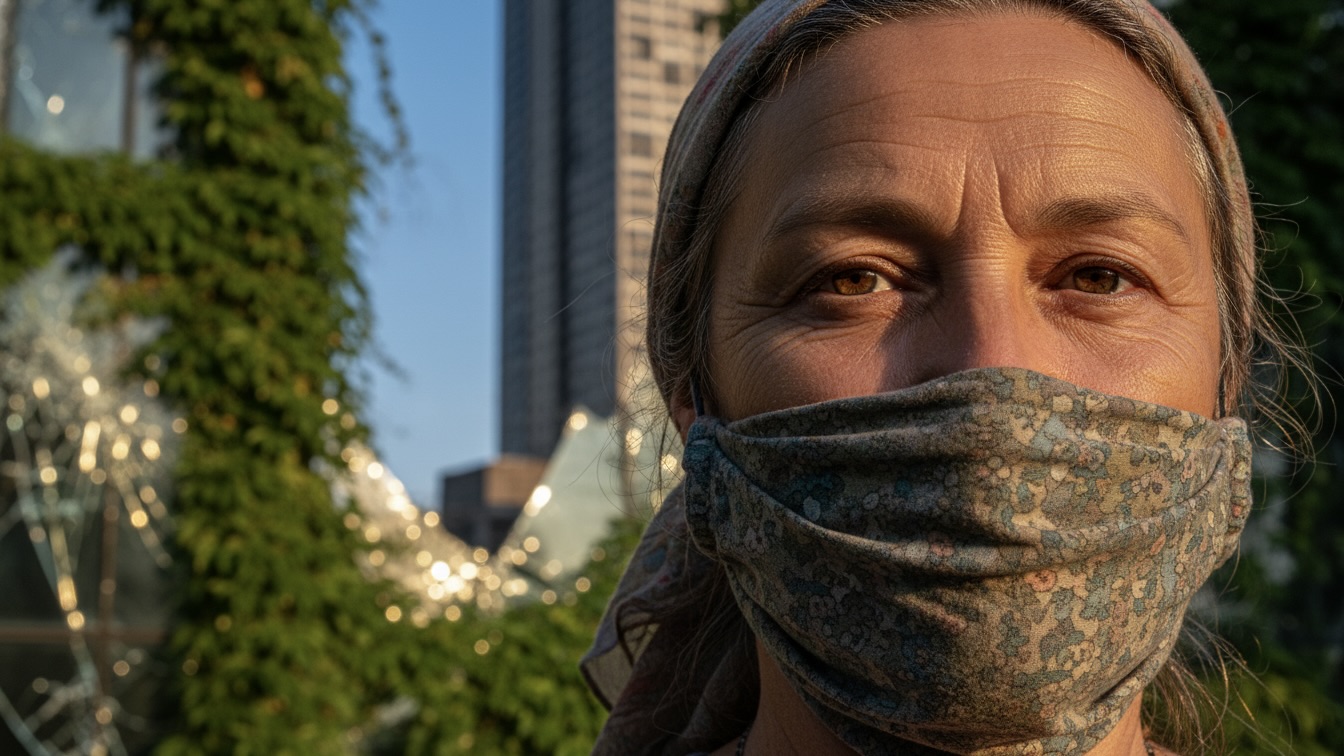
Martina: A 55-year-old veteran of the National Park Service whose knees and instincts are tuned to the natural world. At the start, she is a protector acting on duty, but by the end, she evolves into a witness and guardian of the new world order, finding peace in humanity's displacement. Her arc is one of liberation, moving from a woman struggling against the weight of a dying city to one who finds her true home in the wild.
Jason: A twenty-something tech developer defined by his reliance on digital solutions and his desire for financial reward. He begins the story as an arrogant, panicked survivor who believes technology can "hack" nature, but ends as a literal prisoner of the environment he sought to destroy. His failure to adapt to a post-silicon reality serves as a foil to Martina’s biological wisdom.
The Eruption: Martina senses a deep vibration beneath Wacker Drive before a massive root detonates the sidewalk and drags a bus into a chasm. She realizes the scale of the threat as emergency sirens wail and news reports confirm similar biological attacks occurring simultaneously across the globe. She grabs a panicked bystander, Jason, and begins a tactical retreat using her specialized knowledge of plant behavior.
The Retail Trap: Inside a luxury store, Martina finds Jason pinned by a sedan-sized Venus flytrap that reacts to his frantic movements and infrared heat. She uses a custom pheromone spray to neutralize the plant's predatory response, demonstrating that biological understanding is superior to Jason's useless digital hacking tools. They form an uneasy alliance as she explains that the plants are targeting the city's infrastructure to dismantle the human power grid.
The Fire-Retardant Sky: As they approach the Sears Tower, the military launches a napalm strike that backfires when the plants release a thick, suffocating chemical heat-shield. The resulting smoke blinds the pilots and chokes the city, forcing Martina and Jason to navigate a bioluminescent lobby filled with "Thorn-Walkers" guarding the building's electrical conduits. They barely escape a patrol after a radio's noise triggers a violent response from the wooden guardians.
The Observation Deck: After an exhausting climb, they reach the top to see Chicago transformed into a rolling sea of green with a massive pulsing "Heart" at its center. Jason identifies the Heart's bio-pulse as the source of a global communications blackout and prepares to flood the system with a lethal herbicide. Martina observes the returning wildlife and the suddenly clean air, realizing the plants are successfully reversing decades of environmental decay.
The Final Choice: Jason lunges to activate the chemical purge, but Martina trips him and allows a nearby vine to restrain him, choosing the forest over the civilization that failed it. She smashes his tablet, ensuring the "Heart" continues its broadcast and the Earth’s reclamation remains uninterrupted. The episode ends with Martina sitting peacefully in the "Green Zone," watching the sunset over a silent, thriving world she finally calls home.
The episode begins with high-octane terror and sensory overload as the city is torn apart, creating a sense of frantic vulnerability. This transitions into a tense, claustrophobic middle act as the characters navigate the "vertical shipwreck" of the Sears Tower. The final act shifts the mood from horror to a sublime, quiet awe, leaving the audience with a lingering, unsettling sense of peace as the human era ends.
A full season would follow different survivors in global hubs—New York, Tokyo, and Mumbai—each dealing with unique regional flora adaptations. The overarching narrative would track the "Recycling" process, showing how the plants integrate human DNA to create more complex guardians, eventually leading to a new hybrid ecosystem.
The season would culminate in the total loss of the global power grid and the emergence of a new, non-human consciousness. Character arcs would focus on the psychological transition from "owners" of the Earth to "tenants," exploring how different cultures adapt to a world where technology is a death sentence.
The visual style is "Organic Gothic," characterized by the juxtaposition of sharp, brutalist architecture and the fluid, muscular growth of iron-hard vines. The color palette shifts from the sweaty, washed-out grays of a Chicago summer to deep, vibrant emeralds and pulsing bioluminescent blues as the city is reclaimed.
The tone is reminiscent of Annihilation meets Children of Men, focusing on the beauty within the horror. Tonal comparables include the overgrown aesthetic of The Last of Us and the cosmic indifference of nature found in the works of Werner Herzog.
The target audience includes adults (18-45) who enjoy high-concept science fiction, environmental thrillers, and anthology series like Black Mirror or Love, Death & Robots. It appeals to viewers interested in climate change narratives and those who appreciate "hard" sci-fi grounded in biological theory.
The pacing follows a traditional three-act structure compressed into a 12-minute runtime. The first three minutes are a relentless "inciting incident" (the eruption), followed by a six-minute "journey" (the climb), and a three-minute "philosophical climax" (the observation deck). The tempo slows significantly in the final two minutes to emphasize the new world's silence.
Production requires a blend of high-end practical effects for the "iron roots" and "Thorn-Walkers" to provide a sense of weight and texture, supplemented by CGI for the large-scale destruction of the Chicago skyline. The sound design is critical, requiring a "living" city soundscape where the hum of electricity is replaced by the rhythmic, low-frequency thrumming of the plants.
Special attention must be paid to the "pheromone mist" and the "milky sap" heat-shield, using practical fluids to enhance the visceral, wet nature of the biological takeover. The Sears Tower set should feel increasingly humid and organic as the characters ascend, using practical moss and fungi to transform the sterile office environment.


