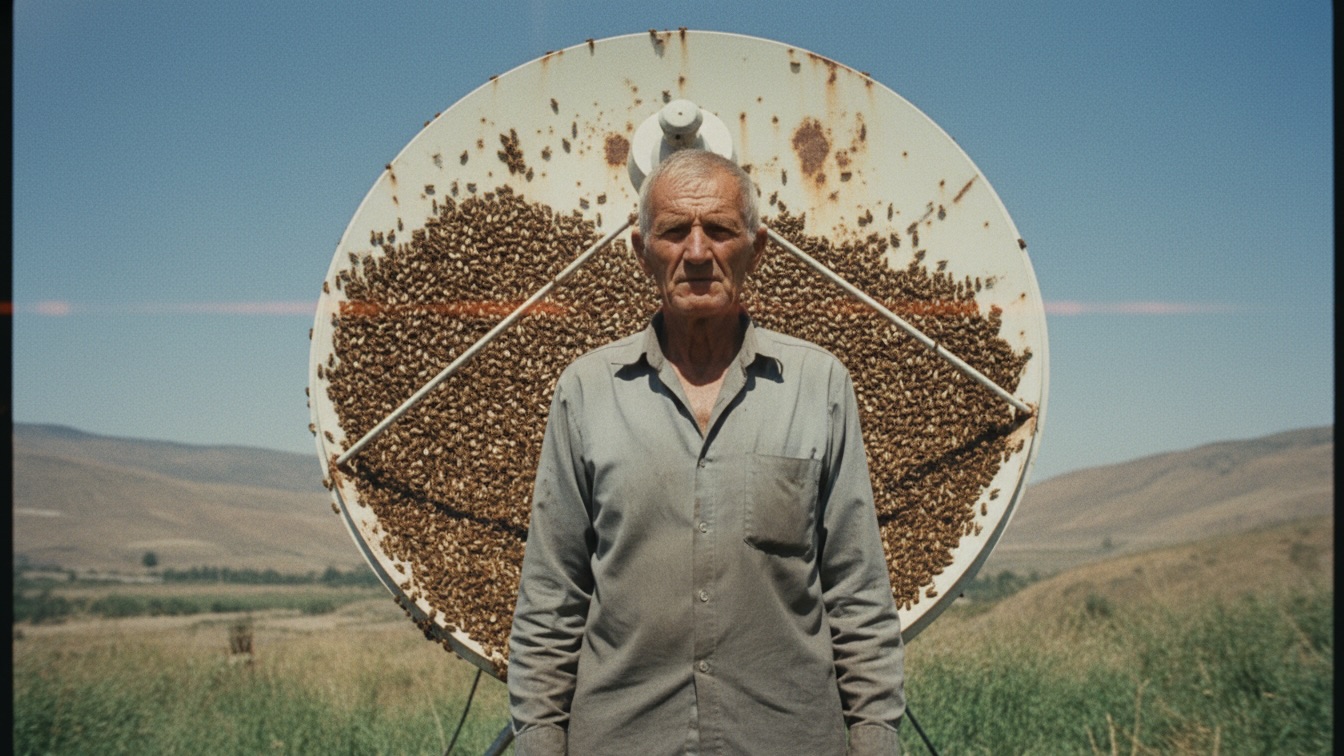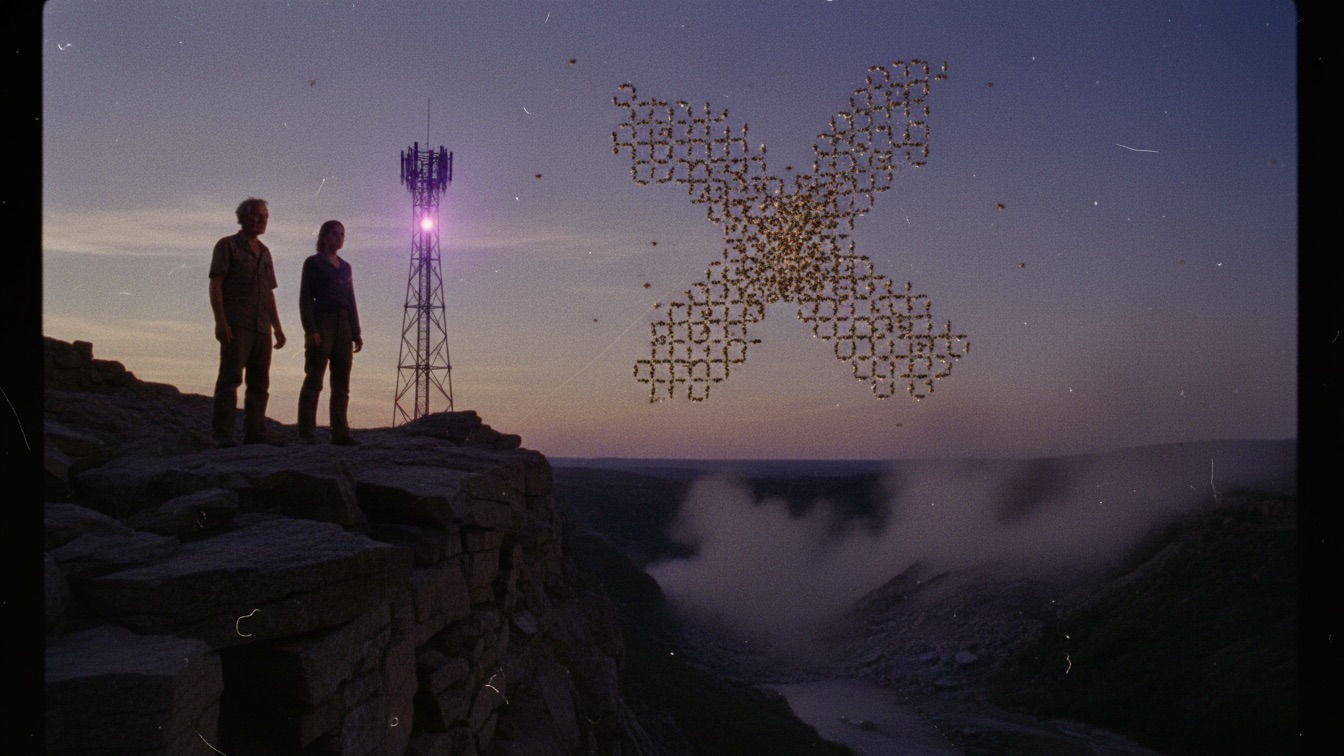
Sam and Sarah build a device to translate the bees' radio signals, discovering the gas leak was intentional.
The garage smelled of flux and old grease, a scent that usually anchored Sam Edisten to the earth, but today it felt like he was breathing through a damp wool blanket. The summer heat hadn't relented after the incident at the ridge; if anything, it had grown more aggressive, a heavy, white light that bleached the color out of the valley. Sam sat at his workbench, his back a map of dull aches.
He was seventy-two, and the way his hands shook as he tried to seat a microscopic capacitor into a breadboard made him feel every second of those years. Across from him, Sarah was a blur of frantic energy. She hadn't slept more than four hours at a stretch since the night the bees had held the mountain together. Her laptop was propped up on a stack of old 'Radio-Electronics' magazines, the screen flickering with waterfalls of green and blue data that meant nothing to Sam’s analog-trained eyes.
"It’s not just a signal, Dad," Sarah said, her voice tight. She didn't look up from the screen. Her fingers moved with a staccato rhythm, tapping out commands that bridged the gap between the humming hives outside and the silicon on the table. "It’s a protocol. I’ve been running the captures through a heuristic analyzer. It’s not just mimicking the geology. It’s responding to it. Every time the seismic sensors in Fayette pick up a micro-tremor, the bees adjust their carrier frequency within milliseconds. It’s a closed-loop system."
Sam squinted at the induction coil he’d spent the morning winding. It was a crude thing compared to the sleek hardware Sarah was used to, but he knew how to move electrons through wire better than anyone in the state. He’d built the first version of this in 1984 for a project that never saw the light of day. Back then, they were looking for Soviet signals in the ionosphere. Now, he was trying to listen to insects. "You’re saying they’re a filter," Sam said, his voice raspy. He reached for a bottle of lukewarm water, the plastic crinkling in his grip. "Like a noise-canceling headphone for the planet."
"Exactly," Sarah said, finally looking up. Her eyes were rimmed with red, the skin beneath them bruised with exhaustion. "But headphones only work if there’s a source. I’ve been looking at the logs from the gas company. The ones Graham 'leaked' to us yesterday. That pressure spike wasn't a malfunction, Dad. They were pushing the line to 150 percent of its rated capacity. On purpose."
Sam felt a cold knot tighten in his stomach, a physical reaction that had nothing to do with the outside temperature. He knew the men who ran the local utility. They were shortcuts-and-handshakes men, the kind who thought a safety regulation was just a suggestion written by someone who’d never worked in a trench. But this was different. This was systemic. "They were testing the structural integrity of the entire ridge," he whispered. "Using the valley as a laboratory."
"And the bees knew," Sarah added. She pointed to a spike on the graph. "Look at this. The bees started their broadcast six hours before the pressure hit critical. They didn't just react to the leak. They anticipated the failure. They knew the pipe was going to buckle because they could feel the stress fractures forming in the rock. They were trying to damp the resonance before the gas even started venting."
Sam leaned back, the wooden chair groaning under his weight. He looked out the open garage door toward the white boxes lined up in the tall, yellowed grass. The bees were active, a golden haze shimmering in the afternoon light. They looked like they always did—busy, mindless, focused on the immediate. But he knew better now. He knew that each one of them was a node in a processor that spanned the entire valley. They were the defense mechanism for a world that was being pushed to the breaking point by people who didn't know how to listen.
"We need the coil finished," Sarah said, her tone shifting back to the pragmatic. "If we can get the induction loop calibrated to the hives' baseband, we can use the SDR to translate the modulated bursts into something we can read. Not just pictures or maps. I think we can get the actual data packets. I want to know what they’re saying about the other sites."
"Other sites?" Sam asked, his hand pausing over the soldering iron. The tip was already hot, a faint wisp of smoke curling into the stagnant air.
"There are six other regions in the country showing the same EM anomalies," Sarah said, her voice dropping to a whisper. "The Black Hills, the Appalachian trail near Roanoke, the desert outside Sedona. All of them are seeing massive bee swarms hovering over critical infrastructure. All of them are broadcasting on the same 440 megahertz band. It’s a network, Dad. A global one. And it’s lighting up."
Sam picked up the iron. The heat from the tool radiated against his palm, a sharp contrast to the dull humidity of the room. He felt a sudden, terrifying clarity. They weren't just saving their town. They were looking at the first signs of a planetary immune response. He lowered the iron to the wire, the silver solder melting into a bright, perfect bead. He had to be precise. He had to be fast. Because if Sarah was right, the world was about to have a conversation that humanity wasn't prepared for.
"Hold the lead," Sam said, his hand steadying as the work took over. The tremor vanished, replaced by the muscle memory of five decades of engineering. "Let’s see if we can hear what they’re shouting about."
Sarah reached out, her fingers pressing the thin copper wire against the board. Her touch was light, but he could feel the tension radiating from her. They were a team again, just like they had been when she was a child building crystal radios on this very bench. But the stakes were no longer a science fair trophy. They were listening to the heartbeat of the end of an era, and the summer sun was only getting hotter.
The knock on the garage door frame was sharp, a metallic rapping that cut through the low-frequency hum of the equipment. Sam didn't need to look up to know it was Graham. The man had a specific way of standing, a heavy-footed lean that suggested he was always ready to run but too tired to start. Graham was the lead field tech for the gas company, a man whose face was a road map of thirty years spent in the sun and the mud. He stepped into the workshop, his uniform shirt dark with sweat, clutching a heavy, ruggedized tablet like it was a holy relic he wasn't sure he should be carrying.
"You still at it?" Graham asked. He didn't wait for an invitation. He pulled a crate over and sat down, his knees popping. He looked at the array of hardware on the bench with a mix of suspicion and awe. "The office is in a panic, Sam. They’ve got auditors coming in from Houston. They’re looking for 'electronic interference' sources. They’re not calling it a leak. They’re calling it a 'unauthorized resonance event'."
"Fancy words for a pipe that almost turned into a claymore," Sam said, not looking away from his work. He was trimming the excess lead from the capacitor. The snip of the pliers was the only sound for a moment. "Did you find the logs I asked for? The ones from the automated shut-off system?"
Graham looked at Sarah, then back at Sam. He sighed, a long, weary sound that seemed to deflate his chest. "I shouldn't be giving you this. If they find out I accessed the back-end from my home terminal, I’m not just fired. I’m looking at federal charges. They’ve classified the incident as a security breach."
"It wasn't a breach, Graham. It was a failure," Sarah said, her voice sharp. She didn't have her father's patience for the corporate dance. "The bees didn't hack your system. They filled the gap in your engineering. Now, did you get the pressure deltas or not?"
Graham handed over the tablet. The screen was cracked, a spiderweb of fractures across the bottom right corner, but the data was clear. Sarah grabbed it, her eyes scanning the columns of numbers with a speed that made Sam’s head spin. He watched her face. He watched the way her jaw tightened, the way her breath hitched.
"Dad," she whispered. "Look at the timestamp on the valve override."
Sam leaned in, squinting at the small text. "10:02 PM. That’s when the power went out."
"No," Sarah said, pointing to a different line. "The manual override was triggered at 9:58. Two minutes before the surge. Someone in the central office tried to force the valves open when the pressure was already at 110 percent. They weren't trying to vent the gas. They were trying to create a rupture."
Sam felt a cold chill wash over him. The room felt smaller, the air thicker. "Why? Why would they blow their own line?"
"Insurance?" Graham suggested, though he sounded unconvinced. "Maybe they wanted to claim a force majeure to get out of the storage contracts. The market is shifting, Sam. Natural gas isn't the king it used to be. But if they can blame it on a 'geological anomaly' or a 'terrorist signal'..."
"They didn't count on the bees," Sam said. He looked at the induction coil. It was finished. He picked it up, the weight of the copper and the iron core feeling substantial in his hand. "They wanted a catastrophe to cover their losses, and the bees gave them a miracle instead. Now they’re trying to find a way to finish what they started."
Graham wiped his forehead with a grimy handkerchief. "There’s a crew coming out tonight. They’re bringing 'diagnostic equipment'. Big trucks. High-frequency emitters. They’re saying they need to 'clear the line' of any residual static. But Sam, I saw the manifests. Those aren't diagnostics. Those are the same disruptors the Colonel had."
"They’re coming back for the hives," Sarah said, her voice flat with realization. "They realize the bees are the only thing standing between them and their payout. If they can kill the colony, the ground resonance will return to its natural frequency. The stress fractures are still there, Dad. The ridge is still unstable. If they vibrate the ground now, without the bees to damp it..."
"The whole thing goes," Sam finished. He felt a sudden, fierce protectiveness. He’d spent ten years alone on this ridge, mourning his wife and drifting through his days. The bees had been his only companions. They hadn't asked for anything but a bit of sugar water in the winter and a place to build their world. They’d saved the town, and now the town—or the people who ran it—was coming to murder them for a line on a spreadsheet.
"How long do we have?" Sam asked, turning to Sarah.
"The manifests say they deploy at sunset," Graham said. "They want the cover of darkness. People don't ask as many questions when the lights are out."
Sam looked at his watch. 4:30 PM. The shadows were starting to stretch across the workshop floor, long and jagged. "We need to get the translator running. Now. If we can prove the bees are communicating a specific warning about the structural integrity, maybe we can get Connor to block the road. He’s a good man, but he needs more than my word and a swarm of insects to stand up to the utility company."
"I’m on it," Sarah said, her fingers already flying across the keyboard. She plugged the induction coil into the SDR, the blue light of the device illuminating her face. "Dad, get the backup generator ready. If they try to cut the power again, we can't lose the signal."
Sam nodded. He moved to the back of the garage, his boots crunching on the grit. He felt a sense of purpose he hadn't felt in decades. He wasn't just an old man in a field anymore. He was a part of something larger, a node in the network. He looked at the bees through the window. They were clustering now, a thick carpet of gold on the front of the hives. They knew. He could feel the hum in his teeth, a low, vibrating chord that spoke of preparation and sacrifice.
"We’re not letting them do it, Graham," Sam said over his shoulder. "You might want to decide which side of the line you’re standing on before those trucks get here."
Graham looked at the tablet, then at the hives. He stood up, his jaw set in a line of grim determination. "I’ve spent thirty years fixing their messes, Sam. I think I’m done. What do you need me to do?"
"Go to the substation," Sam said. "If they start the emitters, I need you to pull the primary breakers. It’ll leave the town in the dark, but it’ll starve their machines. Can you do that?"
"I can do better than that," Graham said, a small, dangerous smile touching his lips. "I can lock the cabinets from the inside. They’ll need a torch to get to the switches."
"Then go," Sam said. "And Graham? Be careful. These people aren't playing for small stakes anymore."
Graham nodded and vanished into the bright, blinding heat of the afternoon. Sam turned back to the bench, his heart hammering against his ribs. He looked at Sarah. She was staring at the screen, her eyes wide.
"Dad," she said, her voice trembling. "I’m getting a signal. But it’s not coming from our hives."
Sam leaned over her shoulder. On the screen, a new frequency was pulsing. It was stronger, deeper, and coming from the north. Toward the deep woods where the old-growth cedar stood.
"It’s a second pulse," Sarah whispered. "And it’s answering them."
The trek up the north ridge was a slow, grueling battle against the terrain and the humidity. Sam’s lungs felt like they were filled with hot ash, and every step over the tangled roots of the old-growth forest was a reminder that his balance wasn't what it used to be. Sarah walked ahead of him, her tablet held out like a compass, the glowing screen the only thing guiding them through the deepening shadows of the canopy. The heat here was different—less direct than in the open fields, but heavier, trapped by the dense leaves and the rotting floor of the woods. It smelled of damp earth and something sharp, like crushed pine needles and static electricity.
"It’s getting stronger, Dad," Sarah whispered. She stopped by a massive, lightning-scarred oak, her face pale in the blue light of the screen. "The frequency is shifting into the lower kilohertz. It’s almost audible now. Can you hear that?"
Sam leaned his head against the rough bark of the tree, closing his eyes. He didn't hear it with his ears at first. He felt it in his chest, a deep, resonant thrum that seemed to vibrate his very bones. It wasn't the high-pitched buzz of the bees. It was slower, more rhythmic. It was the sound of the earth itself groaning under a weight it couldn't sustain.
"It’s not bees," Sam said, opening his eyes. "It’s the trees. Look."
He pointed toward the base of a nearby cedar. A swarm was there, but they weren't flying. Thousands of bees were crawled into the deep fissures of the bark, their bodies vibrating in unison. They were acting as a bridge, connecting the living tissue of the tree to the ground. As they watched, a wave of motion rippled through the swarm, a synchronized pulse that sent a visible tremor through the surrounding ferns.
"They’re using the root system," Sarah realized, her voice hushed with awe. "The mycelial network. They’re injecting the signal directly into the forest’s nervous system. They’re not just broadcasting into the air anymore. They’re grounding the warning into the bedrock."
"Which means the danger isn't just the gas line," Sam said, his stomach turning. "If they’re using the old-growth to amplify the signal, they’re trying to reach something much deeper than a pipe. They’re looking at the fault lines, Sarah. The whole valley is a pressure cooker."
Before she could respond, the sound of a heavy engine echoed from the valley floor below. It was a low, metallic growl that didn't belong in the silence of the woods. Sam looked through a break in the trees. Far below, a line of headlights was snaking up the access road. The utility company’s 'diagnostic' trucks had arrived. They were massive, blacked-out vehicles with heavy equipment mounted on the flatbeds. Even from this distance, Sam could see the skeletal frames of the high-output disruptors.
"They’re early," Sarah said, her hand tightening on the tablet. "We haven't calibrated the translator yet. I need more data from the root pulse to lock the phase."
"We don't have time for calibration," Sam said. He looked around, his eyes landing on a familiar silhouette standing near the trailhead a hundred yards away. A man in a tan uniform, his arms crossed over his chest, watching the convoy with a grim expression. "Connor."
They scrambled down the slope, Sam’s boots sliding on the dry needles. By the time they reached the Sheriff, Sam was gasping for air, his heart fluttering like a trapped bird. Connor turned toward them, his face etched with worry. He looked like a man who had seen too much and understood too little.
"Sam. Sarah," Connor said, his voice low. "I tried to stop them at the highway. They’ve got a state-level authorization. Signed by the governor’s office. They’re saying there’s a 'national security risk' involving localized electromagnetic interference. They’ve got the right to clear any source of the signal."
"Jim, you have to block them," Sam said, grabbing the Sheriff’s arm. "Those trucks aren't here to fix anything. They’re here to kill the bees. And if they do that, they’re going to trigger a collapse. I’ve seen the logs. They want the line to break."
Connor looked at the convoy, then back at Sam. He was a man of the law, a man who believed in the system, but he’d known Sam Edisten for forty years. He knew Sam wasn't a liar, and he knew he wasn't crazy. "I can't arrest them for having a permit, Sam. But I can slow them down. I can 'inspect' every vehicle for safety violations. I can make them sit on that road for an hour while I check their tire pressure."
"Do it," Sarah said. "Give us sixty minutes. That’s all I need to finish the handshake. If I can get the signal onto the public emergency band, they won't be able to hide what they’re doing. The whole county will hear the warning."
Connor nodded, a sharp, decisive movement. "Get to the top of the ridge. The cell tower up there has a backup relay. If you can patch into that, you can broadcast to every radio from here to Fayette. I’ll keep them busy as long as I can, but Sam? If they push past me, I can't shoot them. You understand?"
"I understand," Sam said. "Just give us the time."
Connor walked toward the lead truck, his hand resting on his belt, his shoulders squared. He looked every bit the lawman as he signaled for the convoy to stop. Sam and Sarah didn't wait to watch. They turned and began the final ascent toward the cell tower.
The climb was steeper now, the air thinning as they rose above the valley. Sam’s legs were screaming, a dull, throbbing pain that threatened to buckle his knees. He focused on Sarah’s back, on the way she never faltered, her determination a physical force that pulled him up the mountain. She was her mother’s daughter—fierce, brilliant, and utterly unwilling to accept defeat.
They reached the summit just as the sun dipped below the horizon, painting the sky in a bruised purple. The cell tower stood like a skeletal giant against the fading light, its red beacon pulsing in the dark. At its base was a small concrete bunker, the door reinforced with heavy steel.
"The relay is inside," Sarah said, her breath coming in ragged bursts. She pulled a set of tools from her bag—not the elegant electronics from the workshop, but a heavy pry bar and a set of lock picks. "Dad, I need you to watch the road. If those trucks start moving, I need to know."
Sam stood at the edge of the ridge, looking down. He could see Connor’s cruiser, its blue and red lights flashing, parked horizontally across the gravel drive. The utility trucks were lined up behind it, their engines idling, a line of predatory shadows. For a moment, everything was still. The forest held its breath.
And then, the second pulse hit.
It was louder this time, a physical shockwave that knocked Sam back a step. The ground beneath his boots didn't just vibrate; it shifted. He heard the sound of rock grinding against rock, a deep, subterranean groan that echoed up from the bowels of the mountain. The bees on the summit—thousands of them, clinging to the tower’s guide wires—began to glow with that eerie, violet light.
"Sarah!" Sam yelled. "It’s starting! The pressure is breaking!"
"I’m in!" she screamed from inside the bunker. "I’m patching the SDR into the main transmitter! Dad, look at the tablet!"
Sam grabbed the device she’d left on the grass. The screen was a chaotic mess of waveforms, but in the center, a single line of text had appeared, translated from the bees' digital heartbeat. It wasn't a map. It wasn't a technical warning. It was a single, repeated phrase that sent a shiver of pure terror down Sam’s spine.
THE SYSTEM IS RESETTING. THE ANCHORS ARE WITHDRAWN.
"What does that mean?" Sam whispered.
He looked toward the horizon, expecting to see the lights of the town. But the valley was dark. The blackout hadn't just hit their county. As far as he could see, the world was vanishing into the shadows. The second pulse wasn't a local event. It was a signal to the entire network. The bees weren't just protecting the ridge anymore. They were preparing for the transition.
The air at the summit had become a physical weight, thick with the smell of ozone and the dry, metallic tang of an approaching storm that wasn't made of rain. Sam gripped the cold steel of the perimeter fence, his knuckles white. Below, the stalemate on the road had broken. He could see the flash of movement—the utility trucks were no longer idling. They had swerved around Connor’s cruiser, the heavy vehicles bouncing over the embankments with a reckless, violent urgency. The Sheriff’s lights were still spinning, a lonely beacon of lost authority.
"They’re coming, Sarah!" Sam shouted, his voice cracking. "The trucks are past the checkpoint!"
Inside the bunker, the sound of rapid typing was punctuated by the shrill whine of a cooling fan pushed to its limit. "Almost there! I’m bypassing the encryption on the emergency broadcast system. If I can just lock the phase of the root-signal, I can overlay the translation on every frequency!"
Sam looked back at the valley. The ground groaned again, a deep, stomach-churning sound that felt like the mountain was trying to turn itself inside out. The violet glow from the bees on the guide wires was intensifying, the light pulsing in time with the subterranean tremors. It wasn't just a warning anymore; it was a containment field. The bees were literally holding the atoms of the ridge together with a harmonic frequency, their tiny bodies sacrificing themselves to the heat of the energy they were channeling.
He saw the first truck round the final bend, its massive floodlights cutting through the dark, washing out the violet shimmer. It looked like a monster from a fever dream, all steel and malice. The disruptor dish on the back began to rotate, a low-pitched hum rising from the machinery that set Sam’s teeth on edge. It was a predatory sound, the sound of a silence-maker.
"Sarah, they’re setting up!" Sam scrambled toward the bunker door. "They’re going to fire the pulse!"
Sarah emerged from the shadows of the concrete room, her face illuminated by the green glow of a handheld transmitter. She looked aged, her features sharpened by the terror of what she was seeing on her screens. "It’s not just here, Dad. I got a handshake back from the Black Hills. And Sedona. They’re all seeing the same thing. The utility companies, the militaries... they’re all moving in at the same time. It’s a coordinated strike against the network."
"Why?" Sam asked, his heart hammering. "Why kill the only thing saving us?"
"Because they don't see it as saving," Sarah said, her voice trembling. "They see it as a loss of control. If the world has its own operating system, they’re obsolete. They’d rather rule a graveyard than be part of a garden they can't manage."
She held up the transmitter. "I’m going live. Three... two... one..."
A massive surge of static erupted from the cell tower above them, a crackling, white-noise roar that drowned out the hum of the trucks. For a second, every radio in the valley—every car, every phone, every emergency scanner—screamed with the sound of a million bees. And then, the noise cleared.
It wasn't a human voice that came through the speakers. It was a composite sound, a rhythmic, melodic pulsing that felt like it was being spoken directly into the mind. It was the translation.
STABILITY IS A LOAN, the voice echoed, a thousand-fold resonance. THE DEBT IS OVERDUE. THE FOUNDATION IS FLUID. PREPARE FOR THE SHIFT.
Down on the road, the lead truck stopped. The men in tactical gear spilled out, but they weren't aiming their weapons. They were clutching their heads, falling to their knees as the frequency washed over them. The disruptor dish sparked, a plume of blue fire erupting from its core as it tried to fight a signal that was rooted in the very earth it sat upon.
"It’s working," Sam whispered, watching the chaos below. "They can't fight the truth when it’s vibrating in their own lungs."
But the mountain wasn't finished. The second pulse, the one from the old-growth forest, reached its crescendo. The ground beneath the tower split, a jagged crack opening in the concrete pad. Sam grabbed Sarah, pulling her back as the bunker groaned and settled. From the fissure, a swarm of bees erupted—not golden, but a deep, shimmering black, their wings moving so fast they were invisible. They didn't fly toward the trucks. They flew toward the sky.
"Look!" Sarah pointed upward.
All across the horizon, from every corner of the dark valley, similar swarms were rising. They were joining together, forming a massive, shifting lattice that blotted out the stars. It wasn't a map of the ridge anymore. It was a map of the atmosphere. They were creating a new layer, a living filter between the earth and the sun.
"The anchors are withdrawn," Sam said, the words from the tablet echoing in his mind. "They’re not holding the ground together anymore, Sarah. They’re letting it go."
As if on cue, the ridge finally gave way. Not in a violent explosion, but in a slow, fluid subsidence. The gas line, pushed to its limit by the company's greed, finally buckled, but there was no fire. The black swarm above dived, a literal river of insects smothering the leak before a single spark could ignite. The trucks were swallowed by the shifting earth, buried in a slow-motion landslide that felt more like a burial than a catastrophe.
Sam and Sarah stood on the last remaining piece of solid ground by the tower, watching the world redefine itself. The heat of the summer suddenly broke, replaced by a cool, sharp breeze that smelled of ozone and new growth. The claustrophobia of the last week vanished, replaced by a sudden, terrifying clarity.
"They’re gone," Sarah said, looking at the spot where the trucks had been. "The company, the disruptors... they’re all under the ridge."
"And the town?" Sam asked.
He looked toward Fayette. The town was still there, its lights beginning to flicker back to life as the surge subsided. But it looked different. The valley had been reshaped, the hills smoothed, the forest expanded. It was as if the earth had taken a deep breath and reset its posture.
Sam looked at his digital watch. The screen was no longer showing the time. It was showing a sequence of numbers, a countdown that was mirrored by the pulsing violet light of the bees still clinging to the tower.
"What happens when it hits zero?" Sam asked.
Sarah didn't answer. She was looking at the black lattice in the sky, her eyes filled with a mix of fear and a strange, desperate hope. The world they knew—the world of shortcuts, handshakes, and hidden logs—was over. Something new was being born in the heat of the summer, and they were the only ones left to witness the first breath.
In the distance, a third pulse began, deeper and more powerful than the others, radiating not from the forest or the ridge, but from the very center of the valley floor, right where the town hall stood.
“In the distance, a third pulse began, deeper and more powerful than the others, radiating not from the forest or the ridge, but from the very center of the valley floor, right where the town hall stood.”