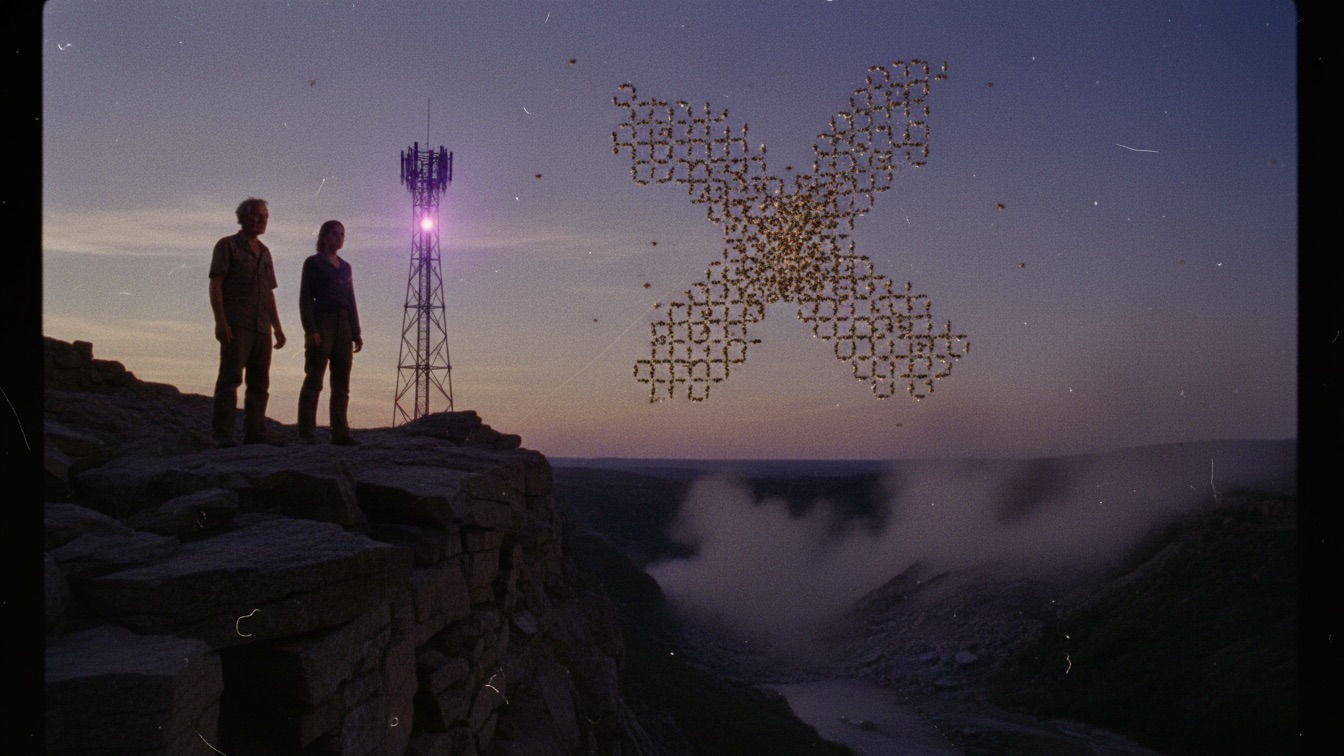
Sam Edisten and his daughter Sarah work feverishly in a sweltering garage to decode a mysterious electromagnetic signal emitted by local bee populations. They discover that the insects are not merely reacting to environmental changes but are actively functioning as a biological defense mechanism against the predatory practices of a local gas utility company. With the help of Graham, a disillusioned technician, and Sheriff Connor, they realize that the company is deliberately sabotaging its own infrastructure to trigger a catastrophic insurance event. The narrative culminates in a dramatic ascent to a mountain ridge where Sarah patches the bees' warning signal into a global emergency broadcast system. As the earth begins a massive, planetary-scale "reset," the bees intervene to stabilize the geological fractures caused by human greed, signaling the end of one era and the birth of a new, living interface between nature and technology.
The primary theme of the narrative is the concept of a sentient, self-regulating Earth that possesses its own immune system to counter human-driven destruction. The bees are depicted not as simple insects but as sophisticated nodes in a global biological processor that monitors and adjusts the planet's structural integrity. This theme explores the limits of human arrogance, suggesting that our industrial systems are merely superficial layers atop a much deeper, more complex operating system. The "planetary immune response" serves as a cosmic correction to the Anthropocene, where the Earth finally asserts its own agency to prevent a human-caused collapse.
Another significant theme is the synthesis of generational knowledge and the bridge between analog and digital worlds. Sam’s mastery of physical circuitry and Sarah’s expertise in high-level data analysis are both required to understand the crisis at hand. This collaboration suggests that the survival of the species depends on integrating historical wisdom with modern innovation rather than discarding the old for the new. Their partnership stands in stark contrast to the utility company’s exploitative mindset, which views the world only in terms of profit and control. The story ultimately argues that humanity must learn to listen to the planet's frequencies or face obsolescence.
Sam is a seventy-two-year-old engineer who finds himself caught between his fading physical capabilities and a sudden, world-altering purpose. He is portrayed as a man of the "analog" era, one who understands the tangible movement of electrons and the physical weight of a soldering iron. This deep connection to the physical world makes him the perfect observer for the bees’ grounding of the signal into the bedrock. He struggles with the tremors of age, yet he finds a renewed sense of stability and clarity when he engages in the technical work he has mastered over five decades.
His internal conflict centers on his transition from a mourning widower to a vital guardian of the natural world. For years, he viewed the bees as simple companions in his isolation, but he must now accept them as superior architects of the planet’s safety. This realization forces him to confront the failure of the human systems he once helped build and his own previous lack of awareness. By the end of the chapter, he is no longer an old man waiting for the end, but a crucial node in a larger ecological network, rediscovering his value through service to a cause greater than himself.
Sarah represents the bridge between human technology and natural intelligence, possessing a frantic, high-stakes energy that drives the narrative forward. She is characterized by her intellectual intensity and her refusal to yield to the corporate authorities that threaten her home. Her physical exhaustion is a manifestation of the mental load she carries as she attempts to translate a non-human language into something the world can comprehend. She functions as the visionary of the pair, seeing the global implications of the local crisis long before the other characters.
Her motivation is rooted in a fierce protectiveness that mirrors her father’s, though her methods are purely digital and data-driven. She exhibits a profound sense of urgency, recognizing that the "handshake" between the bees and the earth is a fleeting opportunity for human awareness. Sarah’s character arc involves a shift from clinical observation to a state of awe and fear as she witnesses the scale of the planetary reset. She is the one who ultimately delivers the warning, stepping into the role of a global messenger for a world that has decided to speak back to its inhabitants.
Graham serves as the moral pivot point within the story, representing the working-class individual caught in the gears of corporate corruption. He is a man defined by his weariness and the physical toll of thirty years spent in the service of a company that views him as an expendable asset. His decision to leak the pressure logs and later sabotage the utility’s equipment marks his final rejection of a system that prioritizes "line items" over human and ecological life. He is motivated by a desperate desire for atonement, having spent his career fixing the "messes" of men who take dangerous shortcuts.
When he chooses to lock himself in the substation to starve the disruptors of power, he finds a grim sense of agency that his corporate life had previously denied him. He understands the personal risks involved, including the likelihood of federal charges and the total loss of his livelihood, but he prioritizes the immediate survival of the ridge. Graham’s transformation from a compliant technician to a proactive saboteur highlights the breakdown of corporate loyalty in the face of an existential threat. He stands as a surrogate for the potential of the individual to resist systemic greed when the stakes become undeniable.
The pacing of the chapter is masterfully handled, beginning with a slow, claustrophobic atmosphere in the grease-scented garage and accelerating into a high-stakes mountain ascent. The initial focus on microscopic capacitors and crinkling water bottles grounds the reader in Sam’s sensory reality before expanding to the global scale of the "black lattice" in the sky. This expansion of scope mirrors the characters' own realization of the magnitude of the event. The transition from the stagnant heat of the workshop to the ozone-charged air of the summit creates a palpable sense of mounting pressure and inevitable change.
The tone is a sophisticated blend of hard science fiction and ecological mysticism, using technical jargon like "heuristic analyzer" and "induction loop" to lend credibility to the supernatural events. This "techno-organic" language reinforces the idea that nature and technology are not separate entities but different expressions of the same underlying physics. The author uses violet light and rhythmic thrums to create an eerie, otherworldly aesthetic that signals the arrival of a new era. These sensory details ensure that the planetary shift feels like a physical, inevitable process rather than a mere metaphorical change, leaving the reader with a sense of profound unease and wonder.


