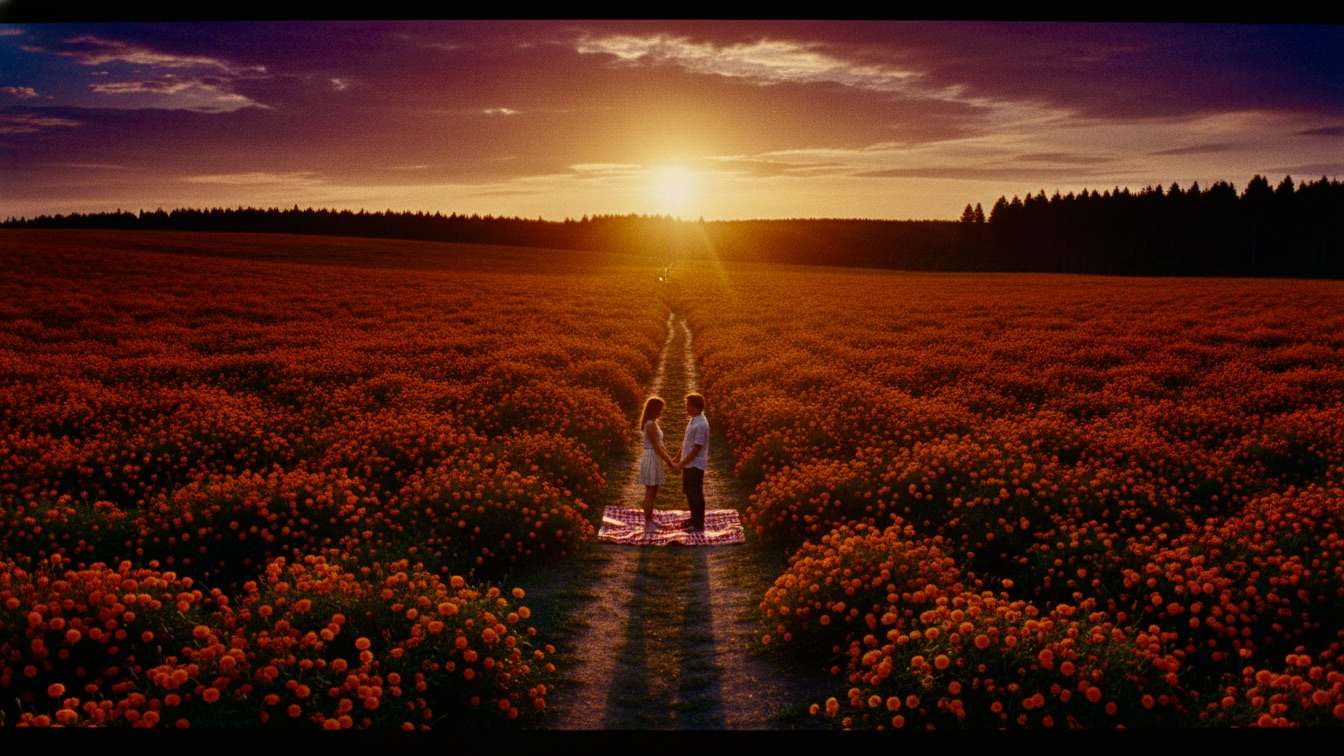
Wendy takes ten steps away from her failing marriage, only to teleport back onto the same picnic blanket.
The heat didn't just sit on the skin; it pushed. It was a heavy, physical weight that made every breath feel like inhaling warm wool. Wendy stared at the car. It was maybe fifty yards away, a silver speck glinting under a sun that looked too big for the sky. The red checkered blanket beneath her was the only thing that felt solid. Everything else—the endless sea of bright orange marigolds, the vibrating air, the silence—felt like a badly rendered video game. Alek was sitting next to her, poking at a piece of lukewarm brie with a plastic knife. He looked tired. Not just 'long day at the office' tired, but the kind of tired that gets into the bone marrow and stays there. He didn't look up when Wendy stood.
"I’m going to the car," Wendy said. Her voice sounded flat, stripped of its usual sharp edges. She didn't wait for a reply. She didn't want one. She wanted the air conditioning. She wanted the highway. She wanted the lawyer's office and the signature that would finally end the slow-motion car crash of their three-year marriage. She stepped off the blanket. The grass was dry, crunching under her white sneakers. One step. Two. The marigolds brushed against her shins, their orange heads bobbing in a breeze she couldn't actually feel. Three. Four. She kept her eyes on the silver glint of the SUV. Five. Six. Seven. Her heart started to sync up with the rhythm of her feet. Eight. Nine. Ten.
There was no sound. No flash of light. No stomach-flipping sensation of travel. One millisecond Wendy was staring at the trunk of their car, and the next, her sneakers were back on the red polyester of the picnic blanket. She was standing exactly where she had been ten seconds ago. Alek didn't even look up from his cheese. He just sighed, a long, weary sound that made Wendy want to scream. "Forgot the keys?" he asked, his voice thick with a sarcasm that had become their primary language.
Wendy didn't answer. She looked down at her feet. She was definitely on the blanket. She looked back at the car. It was still fifty yards away. She felt a cold spike of adrenaline pierce through the heat. "I just walked ten steps," she said. Her voice was climbing an octave. "Alek, I was halfway there."
"You were standing right there, Wendy. You haven't moved." Alek finally looked up, squinting against the aggressive glare of the sun. He looked at her like she was a difficult client he had to manage. "Is this a thing? Are we doing a thing now? Because I really just want to finish this and go home. We have the 4:00 PM call with the mediator, remember?"
"I am not doing a thing!" Wendy snapped. She turned and bolted. She didn't walk this time. She ran. She ignored the way the orange petals stained her jeans. She pushed through the thick, floral density of the meadow, her eyes locked on the car. She counted. One, two, three, four... she hit ten. Zip.
She was back on the blanket. She stumbled, her momentum carrying her forward until she tripped over the wicker picnic basket. A plastic container of grapes spilled out, rolling across the red checks. Alek jumped back, his eyes wide now. "What the—"
"Did you see that?" Wendy scrambled to her feet, her chest heaving. Sweat was stinging her eyes. "Tell me you saw that."
Alek stood up slowly. He looked at the spot where she had been, then back at the car, then at the blanket. The skepticism in his eyes was being replaced by a frantic, analytical search for logic. "You just... you didn't run back. You were there, and then you were here. It was like a frame skip."
"A frame skip?" Wendy laughed, a jagged, hysterical sound. "This isn't a YouTube video, Alek. This is real life. Or it was."
He looked at his watch. The hands weren't moving. He tapped the glass, then held it to his ear. "Watch is dead. Phone?" He pulled his phone from his pocket. The screen was a flat, glowing white. No icons. No signal. Just a blank, luminous rectangle that reflected the harsh sun. "Okay. This is weird. This is very weird."
"Weird?" Wendy paced the small perimeter of the blanket. It was maybe six feet by six feet. A tiny island in a sea of orange. "Weird is when the Wi-Fi goes out. This is... we're trapped. We're in some kind of loop."
"Don't panic," Alek said, though his hand was shaking as he put his phone away. "It’s probably some kind of atmospheric phenomenon. Heat stroke. We're both having a shared hallucination because of the temperature."
"A shared hallucination of a teleporting picnic blanket?" Wendy stopped pacing and looked at him. "Is that the best your big brain can come up with?"
"I'm trying to be rational, Wendy! Someone has to be."
"Rationality left the building three loops ago, Alek!" Wendy felt the familiar heat of an argument rising to meet the heat of the sun. It was comfortable. It was what they knew. "Why are we even here? Whose idea was a 'final picnic' anyway? It’s ninety-five degrees out and we hate each other."
"It was the therapist's idea," Alek reminded her, his voice tightening. "'Closure in a natural setting.' His words. Not mine. I wanted to do it over Zoom."
"Of course you did. God forbid you leave your ergonomic chair for five minutes to acknowledge that our life is ending."
Wendy turned away from him, her eyes scanning the horizon. The meadow went on forever. There were no trees, no hills, just the flat, orange carpet of marigolds and the silver SUV that seemed to be mocking them. She felt the urge to run again. She needed to know the boundaries. She needed to know if there was a way out that didn't involve sitting on this stupid red fabric with a man who couldn't even look her in the eye without a spreadsheet in front of him.
Alek didn't like things he couldn't optimize. He spent his life fixing backend code, finding the bugs that crashed systems, and smoothing out the friction in digital workflows. Looking at the meadow, he felt the itch to find the exploit. There had to be a logic. There was always a logic.
"Move," he said, stepping to the edge of the blanket.
"Where are you going?" Wendy asked, her arms crossed tightly over her chest. She looked small against the vastness of the orange.
"I'm going to test the parameters. If it's a ten-step limit, maybe it's directional. Maybe if I run at a different angle, I can break the cycle."
"Alek, you're wearing loafers. You're going to break an ankle."
"Better than sitting here waiting for the sun to melt us," he snapped. He didn't wait for her to point out the obvious futility. He took a breath, the air tasting like dust and sun-baked petals, and he bolted. He didn't head for the car. He headed ninety degrees to the left, toward the empty horizon.
He counted. One. Two. Three. His lungs burned. Four. Five. Six. He pushed harder, his loafers slipping on the dry earth. Seven. Eight. Nine. Ten.
Zip.
He was back on the blanket, stumbling into Wendy. She caught him by the shoulders, her grip unexpectedly strong. They stood there for a second, chest to chest, the heat of their bodies adding to the oppressive atmosphere. He could smell her shampoo—something citrusy and sharp—and the metallic tang of the sun on his own skin. He pushed her away, breathing hard.
"Left doesn't work," he panted. "Okay. Right. I'll try right."
"Alek, stop it. You're just going to give yourself a heart attack."
"I'm not just going to sit here, Wendy!" He ran to the right. Ten steps. Zip.
He tried backwards. Ten steps. Zip.
He tried jumping at the tenth step. Zip.
Every time, he ended up back on the red squares, his heart hammering against his ribs like a trapped bird. The frustration was a physical thing now, a knot in his stomach that felt like it was made of lead. He looked at Wendy. She was sitting back down, her legs tucked under her. She looked resigned.
"It’s a cage," she said. "A ten-step cage."
"It’s a glitch," Alek corrected, though he had no idea what he was correcting it to. He sat down heavily, his knees popping. "There has to be a trigger. A reason. Things don't just loop for no reason."
"Maybe the reason is us," Wendy said quietly. She was tracing the pattern of the blanket with her fingernail. "Maybe we're so stuck in our own patterns that the universe decided to make it literal."
"Don't start with the metaphorical crap, Wendy. Please. I'm too hot for poetry."
"I'm not being poetic! Look at us. We've been having the same argument for two years. We've been taking the same ten steps away from each other and ending up right back in the same mess. How is this any different?"
"It’s different because I can't leave!" Alek shouted. The sound seemed to be swallowed by the flowers instantly. There was no echo. No bird song. Just the flat, heavy silence. "In the real world, I can walk out the door. I can go to my apartment. I can block your number if I want to."
"But you don't," Wendy said, looking up at him. Her eyes were red-rimmed, whether from the sun or the situation, he couldn't tell. "You don't block me. You just stay in the loop. You complain about the friction, but you never actually change the code, do you?"
Alek felt a flash of genuine anger. "I change the code every day! I'm the one who suggested the mediator. I'm the one who's trying to make this process as efficient as possible so we can both move on."
"Efficient," Wendy spat the word out. "That’s your favorite word. You wanted an efficient divorce. You wanted to optimize the end of our life together. Well, look at this, Alek. This isn't efficient. This is a disaster."
They sat in silence for a long time. The sun didn't move. It stayed pinned to the center of the sky, a white-hot eye watching them. Alek noticed a bead of sweat rolling down the back of Wendy's neck. He felt a strange, misplaced urge to wipe it away, but he stayed still. The blanket felt smaller than it had ten minutes ago. Every move he made seemed to result in his elbow hitting hers or their knees knocking together.
"I'm taking my shirt off," Alek said. He didn't wait for permission. He unbuttoned his linen shirt, his fingers feeling clumsy. The air hit his damp skin, but it didn't offer any relief. It was just more heat.
Wendy watched him, her expression unreadable. After a moment, she pulled her hair up into a messy bun and shed her light cardigan, leaving her in a thin tank top. The physical intimacy was jarring. For months, they had lived in the same house like ghosts, avoiding eye contact, avoiding touch, maintaining a polite, refrigerated distance. Now, they were stripped down, sweating, and forced into a six-foot square of reality.
"You have a freckle on your shoulder I don't remember," Alek said. He hadn't meant to say it out loud.
Wendy looked at her shoulder. "It’s new. From the beach trip you didn't go on last summer."
"I had the release for the banking app, Wendy. You know that."
"I know. I always know. There's always a release. There's always a bug. There's always a reason why you can't be where I am."
As she spoke, Alek noticed something. A marigold near the edge of the blanket—one that had been a standard, flat orange—suddenly pulsed with a soft, golden light. It lasted only a second, a gentle throb of luminosity that made the flower look like it was made of glass.
"Did you see that?" he whispered.
"See what?"
"The flower. It glowed."
Wendy looked at the flower. It was back to normal. "Alek, you're hallucinating. I told you, it’s the heat."
"I'm telling you, it glowed! It happened right when you said that. Right when you said I'm never where you are."
Wendy sighed, a sound of pure exhaustion. "Maybe it's just happy that someone finally told the truth in this relationship."
As the words left her mouth, three more flowers pulsed. Bright, vibrant gold, like tiny suns hiding in the petals. Wendy gasped, her hand flying to her mouth. "Oh. Okay. So that's happening."
The discovery of the glowing marigolds changed the energy on the blanket. It wasn't just a prison anymore; it was a laboratory. Alek leaned forward, his eyes narrowed, his brain already trying to map the variables.
"It’s an emotional sensor," he whispered. "A bio-reactive interface. The flowers respond to authentic input."
Wendy rolled her eyes, but she didn't look away from the marigolds. "Can you please stop talking like we're in a tech demo? It’s not an interface, Alek. It’s... I don't know what it is. But it’s not software."
"Everything is software if you look at it the right way," Alek muttered. He reached out to touch a flower, but as his fingers hovered an inch away, the orange petals turned a dull, bruised gray. A faint, bitter scent, like rotting vegetables and old pennies, drifted up. Alek pulled his hand back as if he'd been burned. "What was that?"
"Maybe it doesn't like your attitude," Wendy suggested. She reached out her own hand. She didn't try to touch it, she just looked at it. "I feel like I'm losing my mind," she said. "I feel like I've been losing it for a long time, and this is just the final break."
The flower she was looking at didn't turn gray. It didn't glow gold, either. It stayed a steady, vibrant orange.
"That wasn't a lie, but it wasn't a deep enough truth," Alek noted. He was sitting cross-legged now, his back straight. "Try something else. Something real."
Wendy looked at him, her gaze sharp and defensive. "Why do I have to be the guinea pig? You do it."
"Fine. I'm... I'm confused by what's happening."
Nothing. The flowers remained motionless.
"That’s a surface-level observation, Alek. That’s not a truth. That’s a weather report," Wendy said.
Alek took a breath. He looked at the silver car in the distance. He thought about his apartment, the one he'd already put a deposit on. It was clean. It was quiet. It was empty. "I'm relieved we're getting divorced," he said.
The flowers nearest to him immediately wilted. They didn't just turn gray; they shriveled, their stems snapping as they collapsed into the dust. The foul smell returned, stronger this time, a thick, cloying stench of stagnant water and decay.
"Liar," Wendy said softly.
"I'm not lying! I am relieved! It’s been miserable!"
"You're relieved that the fighting is over, maybe. But you're not relieved about the divorce. You're terrified of being alone in that white-walled box of an apartment with nothing to do but work until you die."
Alek opened his mouth to argue, to give her a list of all the reasons why he was looking forward to his new life, but the words died in his throat. He looked at the shriveled flowers. They were a physical manifestation of his own self-deception. He felt a flush of shame that had nothing to do with the sun.
"I've been feeling invisible for years," Wendy said. She wasn't looking at him now. She was looking at her own hands, which were resting in her lap. "I'd stand in the kitchen, right next to you, and I'd feel like I was made of glass. Like you were looking through me at a screen that wasn't even there. I started wondering if I'd disappeared and just hadn't noticed yet."
A huge patch of flowers, maybe ten feet wide, suddenly erupted in a brilliant, blinding gold. The light was so intense they had to squint. And then, a scent hit them. It wasn't the foul rot from before. It was sweet—not like sugar, but like rain hitting hot pavement, like fresh-cut grass and the smell of the air right before a storm. It was the smell of relief.
"Wendy," Alek started, but she cut him off.
"Don't. Don't 'fix' it, Alek. Don't tell me you were just busy or that you were doing it for us. Just let it be true."
He nodded slowly. The heat seemed to pulse in time with the glowing flowers. He felt a bead of sweat drip from his chin onto the blanket. He looked at the red checks, then at Wendy's bare knees. They were so close. If he moved two inches, he'd be touching her. He found that he wanted to move those two inches. He found that the idea of the white-walled apartment felt like a tomb.
"I work because I don't know how to do anything else," he said. He forced the words out. They felt heavy, like stones. "I work because if I'm not fixing something, I feel like I'm breaking. I feel like if I stop, I'll realize that I'm not actually good at being a person. I'm just good at being a machine."
The flowers around his feet began to throb with light. It wasn't as bright as Wendy's patch, but it was steady. The gray, shriveled plants began to straighten, their color returning in slow, pulsing waves.
"I know," Wendy said. Her voice was softer now. "I knew that. I just didn't know how to help you stop."
"You shouldn't have had to," Alek said. "It’s not your job to keep me human."
More flowers joined the glow. The meadow was beginning to look like a sea of embers. The sun above them seemed to lose some of its jagged, cruel edge. A breeze—a real, cool breeze—stirred the air, ruffling Wendy's loose hair and chilling the sweat on Alek's back. It felt like the first drink of water after a long hike.
"This is a game of truth," Wendy said, a small, sad smile touching her lips. "A very literal, very high-stakes game of truth."
"I guess we're playing until we get it right," Alek said. He looked at her, really looked at her, for the first time in months. He saw the fine lines around her eyes, the way her bottom lip trembled just slightly, the smudge of orange pollen on her cheek. She was beautiful. She was also furious and hurt and exhausted. And she was right there. Ten steps away was nowhere. Here was everything.
"I cheated," Wendy said suddenly.
Alek felt his heart stop. The world seemed to tilt. The flowers around her didn't glow. They didn't wither. They waited.
"Not with a person," she said quickly, seeing his expression. "I cheated on our life. I started an apartment search six months ago. I have a Pinterest board for a life that doesn't include you. I've been living in a different future while I was still sleeping in our bed."
The flowers glowed. A soft, amber light that felt like a confession.
"I did the same," Alek admitted. "I took that promotion in the London office without telling you. I was going to wait until the papers were signed to mention that I was moving across the Atlantic."
The amber light intensified. The breeze picked up, carrying away the last of the bitter, rotten scent. They were sitting in a circle of light now, a small sanctuary of honesty in the middle of a world that had stopped making sense.
The silence that followed wasn't the heavy, dead silence from before. It was a waiting silence. The sun had begun to dip toward the horizon, the aggressive white light softening into a deep, bruised purple and gold. The heat was still there, but it was no longer a threat. It was just the background of a summer evening.
Alek looked at Wendy. She was crying now, quiet tears that traced clean paths through the dust and pollen on her face. He reached out, his hand shaking, and covered hers. Her skin was hot, but she didn't pull away. Her fingers twitched, then settled, locking into the spaces between his. It was a gesture they hadn't shared in what felt like a lifetime. It felt ancient and new all at once.
"I’m scared," Alek said. The words felt small in the vast meadow. "I’m scared that even if we get out of here, we'll just go back to the way it was. That we'll get back to the car and the lawyer will call and we'll just... reset."
"We might," Wendy said, her voice thick. "The real world doesn't have glowing flowers to tell us when we're being full of it. We'd have to do it ourselves."
"I don't want to be a machine anymore, Wendy. I don't want to be efficient. I want to be here. Even if 'here' is a mess. Even if 'here' is us screaming at each other about brie and ergonomic chairs."
The flowers in front of them began to move. It wasn't the wind. They were shifting, their roots moving through the soil with a low, rustling sound. They were pulling apart, weaving themselves into two dense, vibrant walls that flanked a clear path of pressed dirt. The path started at the edge of the red blanket and wound away through the meadow, heading toward a distant line of dark trees that hadn't been there before.
"A way out," Wendy whispered. She stood up, her hand still gripped in Alek's. He stood with her, his legs feeling heavy and uncertain.
They looked at the path. It was narrow, barely wide enough for two people to walk side-by-side. Beyond the walls of marigolds, the meadow was dark now, the flowers losing their glow as the sun touched the horizon. The car was gone. The SUV, the highway, the lawyer's office—all of it had been swallowed by the deepening shadows. There was only the blanket and the path.
"What if it's a trap?" Alek asked. "What if we take ten steps and we're back here?"
"Then we stay on the blanket and we keep talking," Wendy said. She looked at him, her eyes bright in the twilight. "But I think we're done with the blanket, Alek. I think the blanket is for people who have nothing left to say."
Alek looked down at their feet. He saw a single marigold, right at the edge of the path. It was different from the others. It wasn't just glowing; it was pulsing with a steady, warm light that looked like a heartbeat. He let go of Wendy's hand for a second to lean down and pluck it. The stem broke with a clean snap. He held it out to her.
"For the beach trip," he said. "The one we're going to take. Together."
Wendy took the flower. She didn't tuck it behind her ear or put it in her hair. She held it against her chest, right over her heart. "Okay," she said. "Okay."
They stepped off the blanket together.
One step. The red polyester was behind them.
Two steps. The air felt cooler, smelling of damp earth and evening bloom.
Three. Four. Five. Alek felt his heart rate climb. He was waiting for the zip. He was waiting for the world to glitch and dump them back onto the checkered fabric.
Six. Seven. Eight. Nine.
Ten.
They were still on the path. The eleventh step landed on solid ground. The twelfth carried them further into the orange walls. They didn't stop. They didn't look back. They walked hand in hand, the glowing marigold in Wendy's hand casting a soft light on the dirt in front of them.
Behind them, the red blanket sat empty in the middle of a meadow that was slowly fading into the night. The grapes they had spilled were still there, tiny dark jewels on the fabric. The breeze picked up, fluttering the corners of the blanket, but there was no one left to hold it down.
The sun finally dipped below the horizon, leaving a thin streak of fire across the sky. The path ahead was long and winding, disappearing into the shadows of the trees, but for the first time in years, they weren't counting their steps. They were just walking.
“As they entered the shadow of the trees, the path behind them simply ceased to exist.”


