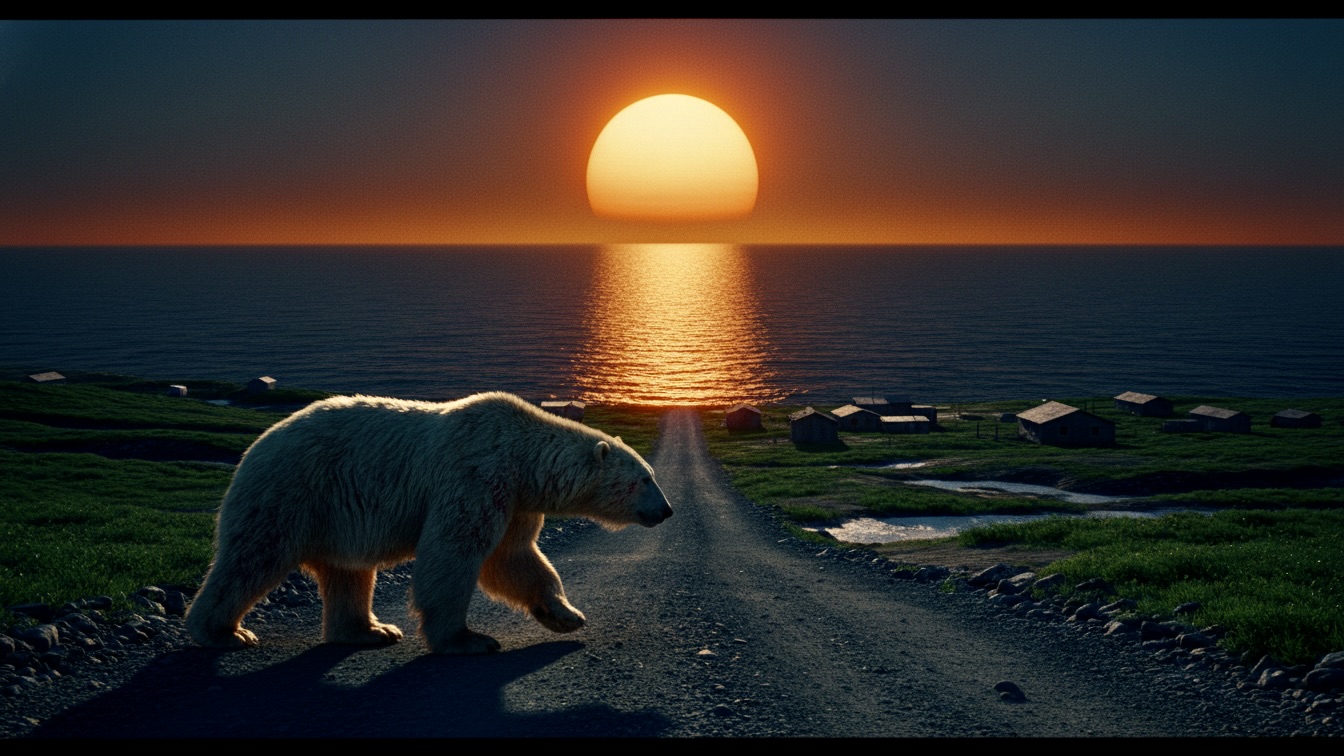
The sun refuses to go down and the bears are starting to figure out we have no place to hide.
The sun is a problem. That is the only way I can think to describe it. For months, we lived in the Big Dark, a time when the world was just different shades of charcoal and the wind felt like it was trying to erase your skin. Now, the sun has come back, and it does not know how to leave. It is ten o'clock at night and the light is hitting the side of the rusted-out shipping containers with a flat, aggressive yellow. It makes everything look fake. It makes the gravel look like plastic and the water of the Hudson Bay look like cold, unmoving oil. I am sitting on the back of my quad, feeling the heat from the engine seep through my jeans. It is a messy kind of heat. It is not the clean warmth you see in travel ads. It is the kind of heat that smells like old gasoline, rotting kelp, and the sweat trapped under my helmet.
I look at my phone. The screen is cracked in a spiderweb pattern across the top left corner, a souvenir from when I dropped it on the ice back in April. It says 10:14 PM. If I were anywhere else, it would be dark. I would be able to close my eyes and feel like the day was over. But here, the day never ends. It just sags. The light stays at this weird, late-afternoon angle for hours. It is exhausting. It is the kind of exhaustion that gets into your bones, making your movements slow and heavy. I can feel my pulse in my eyelids. They itch. Everything itches. The mosquitoes are starting to wake up, too. They are not the small, polite bugs you find down south. These are prehistoric. They are thick clouds of vibrating hunger that follow you like a bad reputation.
Renee is standing about twenty feet away, looking through a pair of binoculars. She has been standing there for ten minutes. She does not move. She is wearing a faded hoodie that used to be blue but is now a kind of dusty grey. Her hair is pulled back in a knot that looks like it was tied in a hurry three days ago. She is obsessed with the bear. Not just any bear, but the one we saw near the old rocket range. It was a big male, thin for this time of year, with a scar running down its left shoulder that looked like a jagged piece of lightning. We call him the ghost, though that is too poetic for what he actually is. He is a three-hundred-kilo killing machine that is confused by the lack of ice.
"Do you see him?" I ask. My voice sounds like it is coming from someone else. It is dry and flat.
"No," Renee says. She does not lower the binoculars. "But he is there. He has to be. The tracks didn't just stop."
"The tracks went into the scrub, Renee. We aren't going in there. Not at ten at night."
"It isn't night, Hank. Look at the sky. It is literally bright out."
"You know what I mean. My brain says it's night. My body says it's night. I am about five minutes away from vibrating out of my skin."
She finally lowers the glasses and looks at me. Her eyes are bloodshot. We all have bloodshot eyes this time of year. It is the price you pay for the light. "If we lose him now, we won't find him again until he's in someone's backyard. You want that? You want to explain to the council why we let a hungry male wander into town because you were sleepy?"
"I'm not just sleepy. I'm cooked. There is a difference."
I stand up and stretch. My back pops. The sound is loud in the silence of the tundra. There is no wind today, which is rare. Usually, the wind is a constant character in your life, a screaming roommate you can't kick out. Today, it is still. The stillness is worse. It makes the world feel like it is holding its breath. It makes every sound—the click of Renee's binoculars, the ticking of the cooling quad engine, the hum of the bugs—sound amplified. It is a sensory overload. The sun is reflecting off a piece of broken glass near my foot, and the glare is so sharp it feels like a needle in my eye.
"Let's just go back," I say. "We can come out at four in the morning. It'll be the same light."
"It'll be colder then," Renee counters. "The ground will be harder. It'll be easier for him to move without making noise. Right now, he's heavy. He's sinking into the muskeg. We have the advantage."
"The advantage? We're on quads that sound like chainsaws and we're glowing in the sun. He's white against a landscape that is slowly turning white with cotton grass. We don't have the advantage. We're targets."
I look toward the horizon. The sun is just hovering there. It is the cruel mirror of our own exhaustion. It refuses to quit, so we refuse to quit. It is a toxic relationship. I reach into the small storage box on the back of the quad and pull out a lukewarm bottle of water. I take a sip. It tastes like plastic and iron. I pour a little bit onto my hand and wipe it across the back of my neck. It doesn't help. The heat is internal. It is the fever of the long day.
"I think I see something," Renee says suddenly. Her voice drops an octave. It is that tone she gets when she is actually worried, not just being stubborn.
"Where?"
"By the old radar tower. That white shape near the base. It moved."
I squint. The glare is brutal. The radar tower is a skeleton of rusted steel, a relic from the Cold War that nobody bothered to tear down. It sits on a ridge about half a mile away. Everything around it is a blur of brownish-green scrub and grey rocks. I see the shape she is talking about. It is small from this distance, just a speck of cream against the dark metal.
"Is it him?" I ask, my hand instinctively moving toward the scabbard on the side of the quad where the rifle is holstered. I don't want to use it. Nobody wants to use it. But the rules change when the ice goes away early. The bears get desperate. A desperate bear doesn't care about the rules of engagement.
"It's him," Renee whispers. "He's looking right at us."
I pull the binoculars from her hand. It takes a second to focus. The world jumps into sharp, shaky detail. The bear is sitting on its haunches, its head tilted slightly to the side. It looks almost curious. But I can see the ribs. I can see the way its fur is matted with mud. It isn't a majestic animal from a documentary. It is a starving predator that has been awake as long as we have. Its eyes are dark pits in its head. It doesn't blink. It is watching us with a kind of intense, singular focus that makes the hair on my arms stand up. It isn't afraid of the noise. It isn't afraid of the quads. It is calculating.
"He's not moving," I say, handing the glasses back. "He's just... waiting."
"Waiting for what?" Renee asks.
"For the sun to stay right where it is," I mutter. "For us to get tired enough to make a mistake."
I look at the sun again. It is a mocking, unblinking eye in the sky. It isn't going anywhere. We are stuck in this moment, in this light, with a bear that has nothing left to lose. My phone buzzes in my pocket. A text from my brother, Toby. Where are you guys? The sun is weird tonight. Feels like it's getting closer.
I don't reply. I don't know what to say. The sun is weird every night now. It is the season of the long stare, and we are losing the staring contest.
We don't head back to town. Not yet. Renee is convinced that if we leave now, the bear will follow the scent of our exhaust right to the edge of the housing units. It sounds paranoid, but paranoia is a survival trait up here. We decide to circle around the ridge, keeping the radar tower in our sightline. The quads groan as we hit a patch of wet muskeg. The tires spin, throwing up chunks of black peat and moss. The smell is intense—like an old basement that's been flooded for a decade. It is the smell of the earth waking up, and it is disgusting.
"Keep your distance!" Renee shouts over the roar of her machine. "If he charges, don't try to outrun him uphill!"
"I know the drill, Renee!" I yell back. I am annoyed. I have lived here my whole life. I know how to handle a bear charge. You don't outrun them. You just hope your aim is better than their momentum. But Renee is in 'researcher mode,' which means she thinks she is the only person in the world who understands the mechanics of nature. It's her defense mechanism. If she can categorize it, it isn't scary.
We reach the base of the ridge. The light is changing, but not getting darker. It is turning a deeper shade of orange, like the yolk of an egg. It’s that heavy, syrupy light that makes shadows look ten feet long. I look over my shoulder. The bear is gone. He was there a minute ago, a white ghost against the rust, and now the space near the tower is empty. My heart rate spikes. A bear you can see is a problem. A bear you can't see is a nightmare.
"Renee, stop!" I kill my engine. The silence that follows is deafening. It rushes in like a physical weight, pressing against my eardrums. Renee slows down and cuts her power too. We sit there, the only sound being the 'ping-ping-ping' of the hot metal cooling and our own ragged breathing.
"Where did he go?" she asks, her voice barely a whisper.
"I don't know. He was there, and then he wasn't."
We scan the horizon. The tundra is a mess of optical illusions. Every white rock looks like a bear. Every clump of cotton grass looks like a moving paw. The light is playing tricks on us. It is the Cruel Mirror. It shows you everything and tells you nothing. My eyes are straining so hard they feel like they are going to pop out of my skull. I rub them with the heels of my hands, seeing stars and purple blotches.
"We need to go back to town," I say. I am not asking this time. "Toby is worried. I'm worried. This is stupid. We're two twenty-somethings on quads with one rifle and about four hours of sleep between us. We aren't the Arctic Rangers."
"Just five more minutes," Renee says. She is gripping the handlebars so hard her knuckles are white. "If we leave now, he'll be in the trash bins by midnight. You know how the kids play out late because of the sun. It's dangerous, Hank."
"It's dangerous right here!" I snap. "Look at us. We're sitting ducks."
Suddenly, the radio on my belt crackles to life. It’s a burst of static, then a voice. It’s Toby. He sounds out of breath, like he’s been running.
"Hank? You there? Answer the damn radio."
I grab the handset. "I'm here, Toby. What's up? Are you at the house?"
"No, I'm... I'm out by the old docks. I thought I saw something. I think... I think there's another one. Or maybe the same one. I don't know. It's huge, Hank. It's right by the shipping containers."
My stomach drops. The shipping containers are less than a mile from the main street. "Toby, get inside. Now. Don't try to take a picture, don't try to be a hero. Just get into the warehouse and lock the door."
"I'm in the truck," Toby says, his voice shaking. "But the window is cracked and I can't get it to roll up. The motor is fried. I can hear him breathing. It's so loud. How can a bear breathe that loud?"
I look at Renee. Her face has gone pale. The academic curiosity is gone, replaced by raw, cold fear. She starts her quad before I even have a chance to speak. The engine screams as she floors it, tearing back toward the town road. I'm right behind her, my tires throwing gravel like shrapnel.
This is the reality of summer here. The light makes you feel invincible, like you have all the time in the world to solve a problem. It lies to you. It tells you that because you can see the danger, you can control it. But the sun doesn't give you any extra speed. It doesn't make the bear less hungry. It just gives you a front-row seat to your own panic.
We hit the gravel road that leads into town. The dust cloud we're kicking up is massive, a golden veil in the perpetual sunset. I can see the town lights—not that they're needed, but they're on anyway, a habit from the winter. The town looks like a toy set. Tiny houses, tiny trucks, all bathed in this sickly, beautiful glow.
"Toby!" I yell into the radio. "We're two minutes out! Stay in the truck!"
There’s no answer. Just the sound of the wind rushing past the microphone on his end. Then, a low, guttural rumble. It isn't a growl. It's deeper than that. It's the sound of a thousand pounds of muscle and hunger making a decision.
I push the quad harder. The handlebars are vibrating so much I can barely hold on. My eyes are watering from the wind, the dust, and the sheer, relentless glare of the sun. It’s right in my face now, mocking me. It’s the ultimate spectator. It’s going to watch this whole thing happen and it isn't going to blink. It isn't going to offer a single shadow for us to hide in.
We round the corner by the fuel tanks. The shipping containers come into view. They are painted bright primary colors—red, blue, yellow—but in this light, they all look like bruised fruit. I see Toby's truck. It's a beat-up white Ford, parked crookedly near the water's edge.
And I see the bear.
He isn't the one from the radar tower. This one is bigger. Much bigger. He is standing on his hind legs, his front paws resting on the hood of Toby's truck. He looks like a giant, pale man trying to look inside a shop window. The truck's suspension is groaning under the weight.
"Hey!" I scream, though I know he can't hear me over the quads. "Get away from him!"
Renee swerves, trying to get between the bear and the truck. It’s a suicidal move. The bear doesn't even look at her. He’s focused on the cracked window. I see Toby's face through the glass. He’s pressed against the passenger door, his eyes wide, his phone held up like a shield. It’s the most 2026 thing I’ve ever seen—a kid trying to record his own death because he doesn't know what else to do with his hands.
I reach for the rifle. My fingers are numb. The light is so bright I can't see the sights properly. Everything is a silhouette. Everything is a blur of orange and black. I pull the quad to a sliding stop, the gravel spraying the bear's legs.
He finally turns. He looks at me. And for a second, the world stops. There is no town, no Renee, no Toby. Just me, the bear, and the sun that won't go down. He isn't angry. He isn't even aggressive. He’s just... there. He’s the physical manifestation of a world that has gone off the rails. He’s the consequence of a summer that started too early and won't end.
"Hank, shoot!" Renee screams.
But I can't. Not yet. Because the bear isn't attacking. He’s just staring. He’s looking at me with a weirdly human expression of exhaustion. He’s as tired of this light as I am. He’s been wandering for days, looking for ice that isn't there, hunting in a world where he can't hide. He’s a ghost in a spotlight.
Then, he drops back down to all fours. The truck bounces. He huffs—a sound like a giant bellows—and begins to walk away. Not toward the bush, but toward the water. He walks with a heavy, rhythmic gait, his fur swaying. He doesn't look back. He just walks into the freezing, oily water of the bay and starts to swim.
He swims toward the horizon, toward the sun that is still stuck, refusing to set. He swims until he is just a tiny black dot in a sea of liquid gold.
I let out a breath I didn't know I was holding. My hands are shaking so hard I drop the rifle. It hits the gravel with a dull thud.
"Is he gone?" Toby's voice comes from the truck. It’s small and thin.
"He's gone, Toby," I say. I sit down on the ground. The gravel is warm. The sun is still there. It hasn't moved an inch. "He's gone."
But I know he isn't. He’s just out there, waiting for the next long day. And the one after that. And the one after that. We are all just waiting for a darkness that isn't coming.
The aftermath isn't like the movies. There is no dramatic music. No slow-motion hugs. Just the sound of Toby’s truck door finally clicking open and the heavy, humid air of the Hudson Bay summer rushing in. Toby steps out, looking like he’s aged five years in ten minutes. He doesn't say anything. He just walks over to my quad and leans against it, his chest heaving. Renee is still on her machine, her hands frozen on the grips. She’s staring at the water where the bear disappeared.
"That wasn't the same one," she says. Her voice is brittle. "The one at the tower had a scar. This one... this one was clean. And bigger. Way bigger."
"Does it matter?" Toby asks. He sounds angry now. The adrenaline is turning into a sour, metallic taste in his mouth. "There's two of them. Right here. Practically in the driveway. Why aren't the sirens going off? Why isn't anyone doing anything?"
"Because it's summer, Toby," I say, standing up and brushing the dust off my knees. "Everyone is out. Everyone is working. They think the bears are all miles away on the remaining pack ice. Nobody expects them to be lounging on the shipping containers at eleven PM."
"It's not eleven," Renee says, checking her watch. "It's 11:45. We've been out here for three hours."
"Feels like three days," I mutter.
We stand there in a weird triangle of exhaustion. The light has shifted into a deep, bruised purple near the zenith, but the horizon is still a flaming, radioactive orange. It’s the 'Golden Hour' that never ends. It sounds romantic until you're living it. Then it's just a reminder that your internal clock is broken. My brain is screaming for a dark room and a heavy blanket, but my eyes are wide open, absorbing the glare.
"We need to report this," Renee says, finally getting off her quad. She looks like she’s walking through waist-deep water. "Two males, both showing zero fear of humans. That's a Tier 1 threat."
"Report it to who?" Toby scoffed. "The wildlife office is closed. Old Man Thompson is probably three beers deep into his 'sun-watching' ritual on his porch. He won't care unless a bear actually tries to open his fridge."
"I'll call my dad," I say. My dad works for the municipality. He’s the guy who has to deal with the messy stuff—broken water mains, gravel road washouts, and displaced predators. "He can at least get the word out on the community page. Tell people to keep their kids inside."
"Inside?" Toby laughs, a sharp, jagged sound. "It’s eighty degrees in those houses, Hank. Nobody has AC that works. They’re all outside with the fans blowing, trying to catch a breeze. You tell them to go inside, they’ll laugh at you."
He’s right. The town is built for the cold. The houses are thick-walled, heavily insulated boxes designed to trap every bit of heat. In the winter, they’re a godsend. In a summer like this, they’re ovens. People live on their porches and in their yards during the long days. They sleep when they can, usually in the few hours when the sun is at its lowest and the temperature drops to something manageable.
"Let's just get back to the house," I say. "Renee, you coming?"
"No," she says, reaching for her binoculars again. "I want to see if he comes back. If he swims to the Point, he could circle back behind the airport. I need to track the direction."
"Renee, no. You're exhausted. You're going to fall off that quad and get eaten by the bugs before a bear even finds you."
As if on cue, the mosquitoes descend. The wind has stayed dead, and now that the sun is slightly lower, the swarm is becoming a solid mass. It’s a low, vibrating hum that vibrates in your teeth. They aren't just biting; they're exploring. They're in our ears, our nostrils, the corners of our eyes.
"Fine," Renee says, swatting at her face with a frantic, uncoordinated motion. "Fine. But we're coming back out at three."
"Sure, Renee. Whatever you say."
We ride back in silence. The town is alive in a way that feels feverish. I see groups of teenagers sitting on the hoods of their trucks, their faces illuminated by their phones and the eternal sunset. They look like ghosts. They aren't talking, just scrolling, their thumbs moving in a rhythmic, hypnotic dance. Nobody looks up as we pass. They’re all trapped in the same loop—too tired to be awake, too wired to sleep.
We pull up to our house, a small, faded green bungalow with a sagging porch. My dad is sitting there, just like Toby predicted. He has a lukewarm can of soda in his hand and he’s staring out at the bay. He looks like a statue.
"Dad," I say, killing the engine. "We saw two of them. One at the rocket range, one right here at the docks. The one at the docks almost got Toby."
My dad doesn't move for a long time. Then he sighs, a long, weary sound that seems to deflate his whole body. "I know. I heard the quads. I saw the big one swim out."
"You saw him? And you didn't do anything?" Toby yells, his voice cracking.
"What am I supposed to do, Toby?" Dad asks, finally looking at us. His eyes are deep in shadow, the only part of his face the sun can't reach. "I don't have a tranquilizer gun. I don't have a cage. All I have is a shotgun and a town full of people who are already on edge. You want me to start a gunfight in the middle of a heatwave?"
"He was on my truck, Dad!"
"And now he's in the water. He's the bay's problem now."
"That's not how it works!" Renee interjects. She’s standing at the edge of the porch, looking like a bedraggled bird. "He’ll be back. They don't just leave. There's no ice for them to go to. This is their home now. Our streets are their hunting grounds."
Dad looks at her, then back at the water. "Everything is changing, Renee. You don't have to tell me that. I’ve lived here fifty years. I’ve never seen the sun stay this hot this long. I’ve never seen the bugs this bad. The world is breaking, and we're just the ones stuck watching it happen."
He stands up, his knees cracking like gunshots. "Go inside. Try to sleep. Cover the windows with the black garbage bags. It’s the only way to trick your brain."
We follow him in. The air inside is thick and stagnant. It smells like old laundry and fried onions. I go to my room and start taping the black bags over the window. It feels like a funeral rite. I’m burying the day. I’m trying to create a lie—a little pocket of midnight in a world of noon.
When I’m done, the room is pitch black. But it’s not a real dark. I can still hear the town. I can hear the distant hum of quads, the occasional shout, the vibration of the bugs against the siding. And I can feel the sun. Even through the plastic, I can feel its weight. It’s pressing against the house, demanding to be seen.
I lie down on top of my sheets. My skin is tacky with sweat and bug spray. I close my eyes, but all I see is the bear. I see him standing on the truck, looking in the window. I see the ribcage. I see the hunger. And I see the sun, that horizontal yellow glare that makes everything look like it’s on fire.
I drift into a shallow, fitful doze. In my dream, I’m swimming in the bay. The water is warm, which is wrong. It should be freezing. But it’s like a bath. I’m swimming toward the sun, and the bear is swimming next to me. We’re both trying to reach the horizon, to push the sun down, to make it stop. But the further we swim, the higher it gets. It starts to grow, filling the whole sky, until there’s nothing left but light.
I wake up screaming, but the sound stays in my throat. I look at my phone. 2:14 AM.
I can hear someone moving in the kitchen. I get up, my legs feeling like lead. It’s Renee. She’s sitting at the table, her head in her hands. She hasn't even tried to sleep. She’s still wearing her dusty hoodie.
"I can't do it," she whispers. "The silence is too loud."
"I know."
"We have to go back out, Hank. I have a feeling. Something is wrong. It's not just the bears."
"Renee, it's two in the morning. We're hallucinating."
"Look at the thermometer," she says, pointing to the small digital display on the wall.
It says 84 degrees. At two in the morning. In the Arctic.
"The permafrost," she says. "It's not just melting. It's collapsing. That's why the bears are here. The ground is literally falling out from under them."
I look at her, and for the first time, I see the real fear. Not the fear of a predator, but the fear of a world that has stopped making sense. The Cruel Mirror isn't just showing us the bears. It's showing us the end of the world we knew. And it’s doing it in high definition, under a sun that refuses to turn away.
We are back on the quads by 2:45 AM. The town is different now. The manic energy of the evening has curdled into something exhausted and grim. The teenagers are gone, leaving behind a trail of crushed cans and plastic wrappers that glow like jewels in the relentless light. The silence is absolute, except for the mechanical whine of our engines. We head north, toward the flats. This is where the permafrost is thinnest, where the land meets the sea in a messy, shifting boundary of salt and silt.
"Do you feel that?" Renee shouts over the wind.
"Feel what?"
"The vibration! Under the wheels!"
I pay attention. She's right. It isn't the usual bounce of gravel or the soft drag of muskeg. It’s a low-frequency hum, a shudder that seems to be coming from deep within the earth. It feels like the ground is a giant drum being hit by a padded mallet.
We reach the edge of the flats. The sight is unbelievable. In the two hours we were gone, the landscape has changed. A section of the coastline, maybe fifty yards wide, has simply vanished. It hasn't eroded; it has slumped. The dark, frozen soil that has been hard as concrete for ten thousand years has turned into a slurry of mud and ancient peat. It’s sliding into the bay in slow, heavy waves.
And in the middle of it, trapped in the mud, is the bear.
The big one. The one from the docks. He’s waist-deep in the muck, his massive paws churning the ground, trying to find purchase. Every time he moves, he sinks deeper. He isn't roaring. He isn't fighting. He’s just... struggling. He looks like a toy trapped in chocolate pudding.
"Oh my god," Renee whispers, bringing her quad to a halt. "The methane. It's venting."
I see it then. Small bubbles are breaking the surface of the mud around the bear. The air smells like rotten eggs and old death. It’s the gas that’s been trapped for millennia, finally escaping as the ground thaws. It’s invisible, but it’s there, shimmering in the heat haze.
"We have to help him," Renee says, reaching for a tow rope on the back of her machine.
"Are you insane?" I grab her arm. "Renee, look at him. He's five hundred pounds of predator. And that mud is a death trap. You go out there, you're not coming back. And neither am I."
"We can't just watch him drown in the earth, Hank! It's not right. It's not his fault the world is melting!"
"It's not our fault either!" I yell. "We can't fix this! We can't rope a polar bear and pull him out of a permafrost slump! We aren't gods!"
We stand there, arguing in the middle of a collapsing world. The sun is just a few degrees above the horizon now, its lowest point of the night. It’s a deep, bloody red, casting long, distorted shadows across the mud. The bear looks at us. He’s stopped struggling. He’s just resting his chin on a clump of un-melted turf, his black eyes fixed on ours. He knows. He’s a smart animal, and he knows this is the end of the line.
Suddenly, the ground beneath my own feet gives way.
It isn't a big drop—just a few inches—but the sensation is terrifying. It’s like the floor of a house suddenly becoming a trampoline. I stumble back, pulling Renee with me. My quad tilts precariously as the kickstand sinks into the softening earth.
"Move!" I scream. "Back to the road! Now!"
We scramble back to the gravel, which is still reinforced by the roadbed. We watch as the section of land where we were standing thirty seconds ago begins to tilt toward the water. It’s a slow-motion disaster. A boulder the size of a fridge rolls into the bay with a wet 'thump.' The water is churning, white foam mixing with the black mud.
"Look," Renee says, pointing.
Another bear is appearing. It’s the one from the radar tower—the one with the scar. He’s standing on the edge of the slump, looking down at the trapped male. He doesn't try to help. He doesn't move closer. He just stands there, a silent witness to his rival's demise. He looks like a king surveying a fallen kingdom.
Then, he turns and looks at us.
In the red light of the 3 AM sun, he looks demonic. The scar on his shoulder is a dark line of shadow. He doesn't growl. He doesn't charge. He just... stares. It’s that same human look of absolute, soul-crushing exhaustion. He’s done. He’s tired of the sun. He’s tired of the heat. He’s tired of the ground disappearing.
He walks toward us.
I reach for the rifle, but my hands are shaking so much I can't find the safety. "Renee, get on the quad! Get on the quad now!"
She doesn't move. She’s transfixed. "He’s not going to attack, Hank. Look at him."
She’s right. The bear isn't in a hunting stance. He’s just walking. He walks past us, so close I could reach out and touch his matted fur. He smells like salt, wet dog, and something ancient. He doesn't even glance at us as he passes. He just keeps walking, heading straight for the town.
He’s not looking for food. He’s looking for shade. He’s looking for a place where the light doesn't reach.
I watch him go, a white silhouette against the grey gravel of the road. He’s heading for the houses, for the alleys between the shipping containers, for the dark corners under the porches. He’s becoming a part of our world because his world is gone.
"What do we do?" Renee asks. She’s crying now, the tears making clean tracks through the dust on her face.
"We follow him," I say. I don't know why I say it. It’s the only thing that makes sense. We have to be there when he reaches the town. We have to be the ones to tell people not to shoot. We have to be the ones to explain that he’s not a monster, he’s just a refugee.
We mount our quads and follow the bear at a distance. The sun is beginning its slow climb back up the sky. The red is turning to orange, then to that sharp, aggressive yellow. The day is starting again, even though the last one never ended.
As we enter the town limits, I see the first signs of life. A door opens. A man steps out onto his porch, squinting against the glare. He sees the bear. He freezes. He looks at me, then back at the bear.
I raise my hand, a gesture of peace or a warning, I don't know which.
The bear stops in the middle of the main street. He looks around at the rusted trucks, the peeling paint, the satellite dishes, and the garbage bags taped over the windows. He finds what he’s looking for—the long shadow cast by the community center. He walks into the darkness, lies down on the cool gravel, and closes his eyes.
He’s the only one who can sleep.
I pull my quad up next to the community center. I look at the sun. It’s higher now, brighter. The Cruel Mirror is back in full effect, reflecting our tired faces and our broken world. I look at Renee. She’s looking at her phone.
"It's 4:00 AM," she says. "The sun is gaining three minutes today."
"Great," I say. "I can't wait."
I look down at my hands. They’re covered in the black mud of the permafrost. It’s cold, a lingering ghost of the winter we’ll never have again. I look back at the bear in the shadow. He’s breathing deeply, his flank rising and falling.
I hear a sound behind me. It’s the click of a bolt-action rifle.
“I hear a sound behind me—the unmistakable, metallic click of a bolt-action rifle being readied.”


