Format: Short Film / Anthology Episode | Est. Length: 10-12 minutes
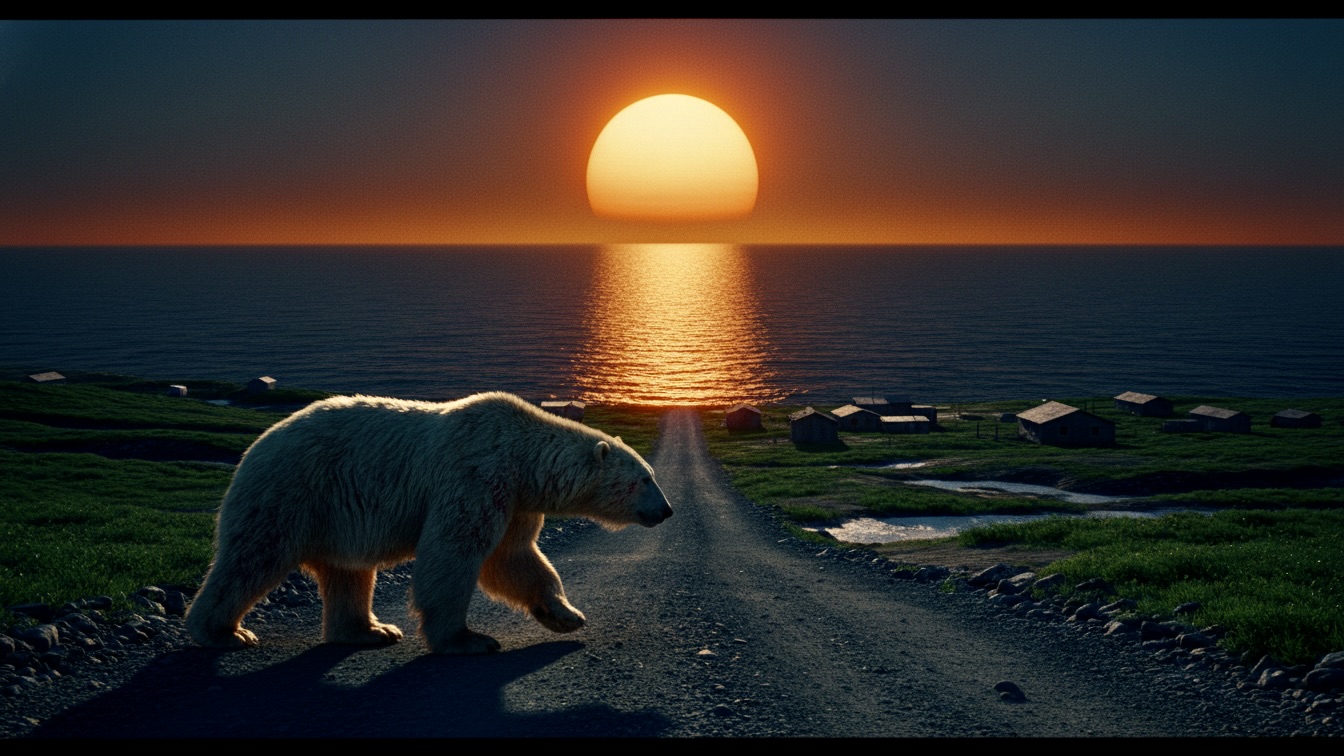
Imagine a world where the natural rhythms of the planet have fractured, leaving the inhabitants of the far north to navigate a reality that no longer makes sense. This story serves as a visceral entry in "The Long Light," an anthology series exploring the psychological and physical toll of ecological collapse, where the traditional "Big Dark" of the Arctic has been replaced by a never-ending, aggressive glare that strips away both sleep and sanity.
Under a ten o'clock sun that hits rusted shipping containers with a flat, aggressive yellow, Hank sits on his quad feeling the engine's heat seep through his jeans. The day refuses to end, and a starving predator is watching from the shadows that no longer exist.
In a town where the sun never sets and the ground is turning to liquid, two exhausted locals must decide if a desperate polar bear is a threat to be killed or a fellow refugee. As the permafrost collapses, the line between man and beast blurs under the unblinking eye of the Arctic summer.
The primary theme is ecological displacement, framed as a "toxic relationship" with a sun that refuses to set, stripping away the privacy of darkness and the relief of cool air. It explores the genre of "Solar Horror," where the threat is not hidden in the dark but is instead overexposed, making the familiar landscape of the Hudson Bay look like a fake, plastic imitation of life.
The emotional undercurrent is one of profound, collective exhaustion—a "bone-deep" weariness that mirrors the state of the planet itself. The story suggests that as the environment breaks, the human psyche breaks with it, leading to a state where survival is no longer about dominance, but about finding a shared shadow in a world on fire.
For Hank and Renee, the stakes are immediate physical survival against a starving predator and a landscape that is literally liquefying beneath their feet. On a broader level, the stakes involve the total loss of their community's infrastructure and safety as the permafrost melts, threatening to swallow their homes and their history while they are too tired to fight back.
The external conflict is a "Tier 1" bear threat exacerbated by a record-breaking heatwave and a collapsing terrain that turns solid ground into a methane-venting death trap. Internally, the characters struggle with "sun-sickness"—a psychological breakdown caused by sleep deprivation that leads to paranoia, irritability, and a loss of the will to maintain the boundaries between the human and animal worlds.
Hank and Renee are tracking a scarred polar bear near an old rocket range during a relentless Arctic summer where the sun never sets. Their exhaustion is pushed to the limit when they discover a second, larger bear threatening Hank’s brother, Toby, at the town docks, revealing that the predators are moving into human territory as the sea ice vanishes.
The situation escalates when the permafrost begins to vent methane and collapse into the bay, trapping one bear in a slurry of ancient mud. After witnessing the landscape dissolve, they follow a second bear back into town, not as hunters, but as witnesses, as the animal seeks shade under a community center, ending in a tense standoff with a local armed with a rifle.
Hank begins as a pragmatist just trying to survive the "long stare" of the sun, but ends in a state of hollowed-out empathy for the creatures he once feared. His psychological arc moves from a desire to control his environment to a quiet acceptance of its collapse, realizing that he and the bear are both victims of the same broken world.
Renee starts as an obsessive researcher using science and binoculars as a shield against fear, eventually breaking down when she realizes her data cannot stop the ground from melting. Her arc is one of disillusionment, transitioning from a belief in "the advantage" of human technology to a raw, visceral terror of the changing climate.
Toby represents the vulnerable youth of the town, transitioning from digital-age detachment—recording his own potential death on a phone—to a state of raw, speechless shock. His arc reflects the loss of innocence in a world where the "sirens aren't going off" despite the obvious presence of monsters at the door.
Hank’s Dad serves as the voice of resigned doom, a man who has seen the world change over fifty years and has no solutions left to offer. His state remains static throughout the episode, representing the "new normal" of a generation that is simply watching the world break in high definition.
The Long Stare: Hank and Renee sit on their quads at 10 PM in blinding yellow light, tracking a scarred bear while battling prehistoric mosquitoes and bone-deep exhaustion. The tension is established through sensory overload—the smell of old gasoline, the itch of the light, and the unblinking presence of the "Ghost" bear near a rusted radar tower. They argue over the futility of the hunt, highlighting the psychological strain of a day that never ends.
The Dockside Siege: A frantic radio call from Toby reveals a second, larger bear is stalking him at the shipping containers, leading to a high-speed chase through a "golden veil" of dust. They arrive to find the massive predator leaning on Toby’s truck, a surreal image of a starving giant peering into a window while a terrified teenager records the encounter. The midpoint is reached when the bear, exhausted and hungry, chooses to walk into the oily water rather than attack, signaling a shift in the predator's behavior.
The Slump: Following the bear to the coast at 3 AM, the characters witness the permafrost turn into a methane-venting slurry, swallowing a section of the coastline and trapping the dock bear in the mud. Hank and Renee argue over a futile rescue attempt as the ground literally liquefies beneath their feet, forcing them to flee back to the reinforced road. This beat serves as the climax of the environmental threat, showing the physical dissolution of their world.
The Refugee: The scarred bear from the radar tower reappears, ignoring the humans to watch his rival sink, before walking past Hank and Renee with a "soul-crushing exhaustion" that mirrors their own. Instead of attacking, the bear enters the town limits, seeking the only darkness left—the shadow of the community center—where he finally collapses into sleep. This turning point shifts the bear from an antagonist to a sympathetic refugee of the climate crisis.
The Final Stand: Hank pulls up to the community center as the sun begins its aggressive morning climb, finding the bear asleep in the shade. The episode ends on a sharp, auditory cliffhanger as a local resident racks a bolt-action rifle, preparing to kill the sleeping animal while Hank watches in silent, muddy despair. The final image is the unblinking sun, the "Cruel Mirror" that refuses to offer a single moment of peace.
The episode begins with a sense of "grimy" irritation and physical discomfort, transitioning into high-octane panic during the bear encounter at the docks. As the ground begins to melt, the mood shifts into existential dread, finally settling into a hollow, quiet melancholy as the characters recognize their shared fate with the predator. The audience experience is designed to be claustrophobic and overstimulating, ending with a lingering sense of unresolved tension.
If expanded, the season would follow the "Great Thaw" as it moves from the outskirts into the heart of Arctic settlements, forcing mass evacuations and "bear wars" in the streets. The narrative would track the collapse of the town's social fabric as the permafrost destroys the foundations of houses, leading to a state of permanent emergency where the sun becomes a symbol of inescapable surveillance.
The thematic escalation would focus on the loss of the "Big Dark" entirely, as the characters become nomadic refugees searching for a night that no longer exists. Character evolution would center on Hank and Renee leading a faction that advocates for co-existence with the displaced wildlife, clashing with a desperate town council that views the bears as the primary source of their problems.
The visual style is "Arctic Noir" meets "Solar Horror," characterized by overexposed frames, high-contrast yellows, and a shallow depth of field to simulate the disorientation of sleep deprivation. The camera work should feel heavy and handheld, capturing the "syrupy" quality of the light and the constant, vibrating presence of mosquito swarms.
Tonal comparables include the gritty realism of Wind River mixed with the surreal, environmental dread of True Detective: Night Country and the "sun-drenched" horror of Midsommar. The tone is unapologetically grim, emphasizing the "messy kind of heat" that smells of rotting kelp and old gasoline, rather than the clean warmth of a travel advertisement.
This episode is designed for adult audiences (18-45) who appreciate prestige "cli-fi" (climate fiction) and psychological thrillers. It appeals to viewers of anthology series like Black Mirror or The Terror, offering a grounded, terrifying look at a near-future environmental reality that feels both alien and inevitable.
The pacing is deliberate and "heavy," mimicking the characters' exhaustion, with sudden bursts of violent kinetic energy during the quad chases and the ground collapse. The narrative follows a three-act structure: the "Stare" (Setup), the "Siege" (Rising Action), and the "Slump/Shadow" (Climax and Resolution), fitting a tight 10-12 minute runtime that emphasizes atmosphere over dialogue.
The production requires a blend of high-end practical animatronics for close-up bear interactions and seamless CGI for the permafrost collapse and wide-angle bear movements. Location filming in a sub-Arctic environment during the midnight sun is essential to capture the unique, "flat" quality of the light and the authentic textures of rusted shipping containers and tundra scrub.
Sound design is a critical consideration, specifically the use of low-frequency "brown noise" to represent the methane venting and the constant, maddening hum of mosquitoes that should vibrate in the audience's teeth. The contrast between the mechanical roar of the quads and the "deafening" silence of the tundra should be used to heighten the sensory overload of the perpetual day.


