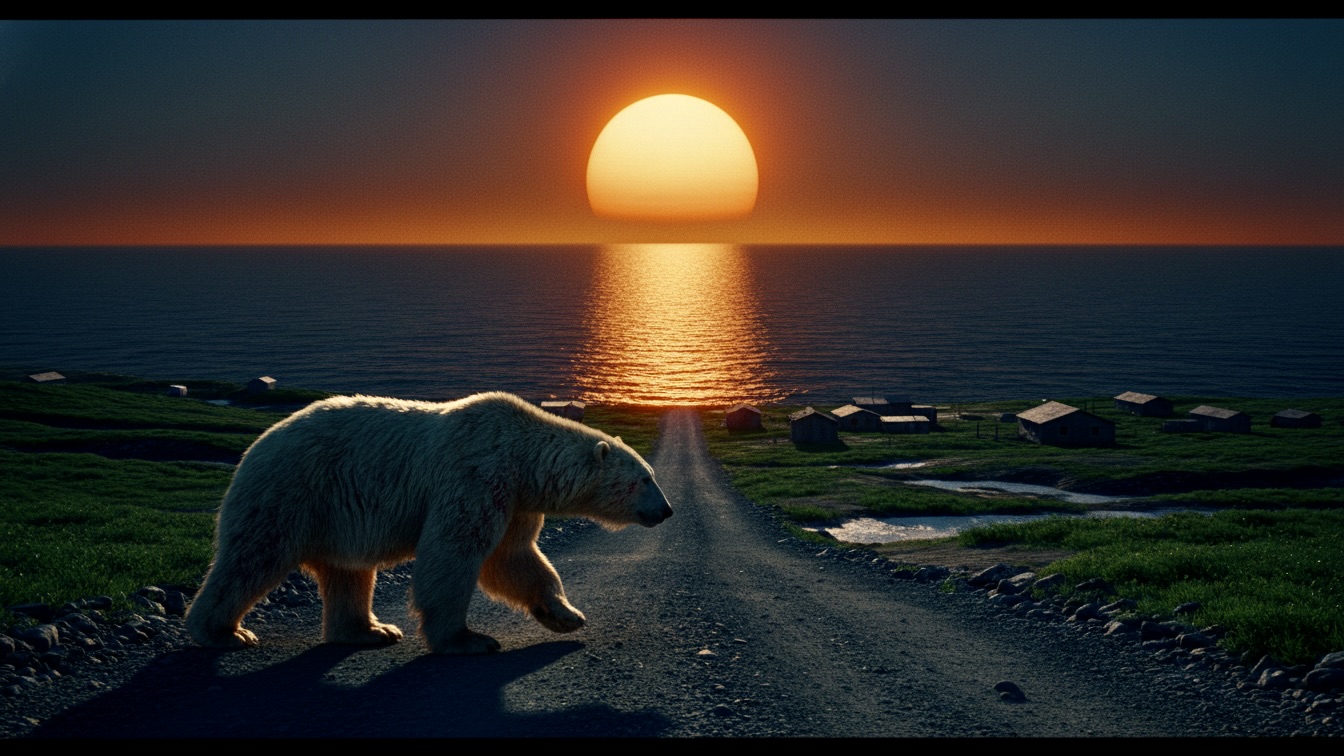
The story follows Hank and his companion Renee as they navigate a grueling Arctic summer characterized by the "Big Light," a period of perpetual, aggressive sunshine. They are tracking a large, starving polar bear that has been displaced by the early melting of the sea ice. Tensions rise when Hank’s brother, Toby, is cornered by a different, massive bear near some shipping containers, though the animal eventually retreats into the water without attacking.
As the heat reaches an unprecedented eighty-four degrees at two in the morning, Hank and Renee witness the literal collapse of the landscape. A permafrost slump traps one bear in a slurry of ancient mud and escaping methane gas, while another bear, seemingly exhausted by the changing world, walks directly into the human settlement. The narrative concludes with this weary predator seeking shade under a community center, while the sound of a rifle being readied suggests a violent end to the encounter.
The central theme of the narrative is the psychological and physical erosion caused by the Anthropocene. The "horizontal yellow glare" serves as a relentless antagonist that strips away the boundaries between day and night, safety and danger, and human and animal. This perpetual light acts as a "Cruel Mirror," reflecting the characters' internal exhaustion and the external decay of their environment. The melting permafrost is not just a geological event but a metaphor for the collapse of the world as the characters know it.
Another prominent theme is the breakdown of the traditional predator-prey relationship in the face of ecological catastrophe. The bears in the story are not depicted as monstrous killers, but as "refugees" and "ghosts" who are just as victimized by the heat as the humans. Their entry into the town signifies a desperate search for shade and stability, suggesting that nature is no longer a separate entity to be managed. Instead, the humans and animals are now bound together in a shared, claustrophobic struggle for survival in a world that has lost its rhythm.
Finally, the story explores the theme of sensory and psychological overload. The characters suffer from a specific type of Arctic delirium brought on by the lack of darkness and the "vibrating hunger" of prehistoric mosquitoes. This environment creates a state where the characters are "too tired to be awake, too wired to sleep." The "messy heat" and the smell of "rotting kelp" emphasize a world that is festering rather than thriving. This sensory saturation leads to a paralysis of action, as seen when Hank finds himself unable to fire his rifle at the bear.
Hank serves as the grounded, albeit exhausted, witness to the environmental collapse. He is characterized by a deep, bone-weary pragmatism that contrasts with Renee’s academic obsession. He experiences the world through his physical discomfort, feeling the heat "seep through his jeans" and the pulse in his itchy eyelids. His internal conflict stems from his desire for the "Big Dark" and the normalcy of a setting sun, which represents a psychological need for closure that the environment refuses to provide.
He possesses a latent empathy for the predators he is supposed to fear, recognizing his own exhaustion in the bear’s "weirdly human expression." When he looks at the bear, he does not see a target, but a fellow sufferer of the "long stare." This connection prevents him from acting as a traditional protector, as he realizes that the rules of engagement have been rendered obsolete by the climate. He is a man who has replaced his survival instincts with a grim, observational resignation.
Renee is driven by a need to categorize and understand the natural world, using her "researcher mode" as a psychological defense mechanism. By treating the bears as subjects to be tracked and analyzed, she attempts to maintain a sense of control over a situation that is fundamentally chaotic. Her obsession with the scarred bear near the rocket range highlights her desire to find patterns in the madness. However, this facade crumbles when she witnesses the permafrost slump, revealing the raw fear beneath her clinical exterior.
Her character arc moves from detached observation to overwhelming empathy. When she attempts to use a tow rope to save a drowning polar bear, she demonstrates a desperate, perhaps irrational, desire to fix a world that is breaking. She is the moral heart of the story, crying for the loss of the animal’s habitat and recognizing that the bear’s presence in town is an act of seeking refuge rather than aggression. Her constant checking of the time and the temperature shows her struggle to reconcile scientific data with a reality that no longer makes sense.
Toby represents the vulnerability and detachment of the younger generation living through the climate crisis. His reaction to being cornered by a bear—holding up his phone to record the encounter—is described by Hank as "the most 2026 thing," suggesting a reliance on digital mediation to process trauma. He is less concerned with the ecological implications of the bears' presence and more focused on the immediate, terrifying threat to his safety. His anger toward his father and brother reflects a feeling of abandonment by the older generation who cannot protect him.
Hank’s father embodies the weary, cynical acceptance of those who have watched the world change over decades. He is a man of few words, preferring to sit in the "horizontal yellow glare" with a lukewarm soda rather than fight a losing battle against nature. He recognizes that the town’s infrastructure, built for the cold, has become a trap in the new heat. His refusal to "start a gunfight" with the bear suggests a wisdom born of exhaustion; he knows that the bear is merely a symptom of a much larger, unstoppable problem.
The prose is heavy with sensory details that evoke a sense of rot and stagnation. The author uses vivid, often grotesque imagery, such as water looking like "cold, unmoving oil" and the "prehistoric" mosquitoes that follow the characters like a "bad reputation." These descriptions create a tone of oppressive dread, where even the light is described as "aggressive" and "sickly." The use of the "Cruel Mirror" as a recurring motif reinforces the idea that the environment is actively hostile to the characters' mental well-being.
The pacing of the narrative mirrors the "sagging" quality of the Arctic day. Long stretches of atmospheric description and internal monologue are punctuated by sharp bursts of adrenaline, such as the bear encounter at the shipping containers or the sudden collapse of the permafrost. This creates a rhythmic tension that mimics the characters' own experience of being "too wired to sleep." The silence of the tundra is described as a "physical weight," making the mechanical sounds of the quads and the "pinging" of cooling metal feel intrusive and amplified.
The narrative voice is first-person and highly subjective, allowing the reader to feel Hank’s physical and mental degradation. The language is often flat and dry, reflecting the narrator's emotional depletion. However, the prose becomes more lyrical and haunting when describing the bears, elevating them to the status of "ghosts" or "demons." This shift in tone highlights the spiritual and existential weight of the environmental tragedy, culminating in the final, chilling sound of the rifle bolt, which cuts through the "absolute silence" of the 4:00 AM sun.


