I stared at the nine-dollar price tag on a bruised apple, my stomach cramping with cheap noodle salt.
"Nine dollars?" I stared at the yellow sticker on the apple. It was bruised. A soft, brown thumbprint pushed into the skin near the stem.
"Fuel costs," the clerk said. He didn't look up from his phone. He leaned against the counter of the island outpost, the only store within a forty-minute boat ride. The air conditioning was broken. Sweat pooled at the collar of his uniform shirt.
"It's an apple," I said. I picked it up. It felt light, like the juice had already evaporated out of it. "It's rotting."
"Don't buy it then, Sammy."
I put it back down on the slanted wooden display. My stomach performed a slow, painful roll. I had been living on instant ramen for two weeks. My gums felt weird. My joints ached when I woke up. I looked down the aisle. A box of wilting greens was priced at fourteen dollars. A loaf of bread was ten. The wealthy cottagers from Toronto and Chicago didn't care. They just tapped their metal credit cards and loaded coolers onto their massive wakeboard boats. But the marina workers, the dockhands, the locals who actually lived on the lake year-round? We were starving in slow motion.
"You want the noodles or not?" the clerk asked.
I looked at the stack of MSG-heavy bricks in my hands. Three packs. It was all I could afford until Friday. "Yeah. Ring them up."
I paid with crumpled bills and walked out onto the dock. The heat hit me like a physical blow. Northwestern Ontario in July was a humid, relentless oven. The glare off Lake of the Woods forced me to squint. I tossed the plastic bag into the bottom of my aluminum work skiff, untied the bowline, and shoved off the wood.
The outboard motor sputtered, choked, and finally caught. I steered away from the outpost, the wake spreading out behind me. I needed a distraction. I needed a project. Most of all, I needed a vegetable that didn't cost a day's wages.
I decided to take the long way back to the marina, cutting through a narrow channel lined with jagged granite cliffs. I wasn't paying attention. I was doing the math in my head, trying to figure out how many hours of pumping premium gas into luxury boats it would take to afford a head of lettuce. That's when I saw it.
Tucked into the back of a stagnant, weed-choked bay behind Old Man Coot's property. An abandoned pontoon boat.
It was a massive, flat-decked beast. The fencing was gone. The console was ripped out. The aluminum tubes were covered in thick green algae, but it was floating. It was riding high in the water.
I cut the engine. The skiff drifted forward, pushing through a thick mat of lily pads. The silence of the bay settled around me, broken only by the buzzing of horseflies. I stared at the flat wooden deck of the pontoon. It was maybe twenty feet long and ten feet wide. Two hundred square feet of floating real estate.
Dirt.
If you boxed in the sides. If you laid down a tarp. If you filled it with dirt.
My brain started moving too fast. A floating garden. You could anchor it anywhere. You could pump lake water directly onto it. No property taxes. No rocky island soil to fight. Just sun and water.
"Hey!"
The voice cracked like a dry branch. I jumped, rocking the skiff.
Old Man Coot stood on the rocky shoreline above the bay. He was shirtless, wearing stained canvas pants held up by suspenders. He had a pellet gun pressed to his shoulder, aiming right at my chest.
"Get off my water!" Coot yelled.
"I'm not on your water, Coot!" I yelled back. I held my hands up. "Navigable waterways are public!"
"I'll put a dent in your skull, Sammy!"
"You're holding a Red Ryder! You couldn't dent a soup can!"
Coot lowered the gun. He spit into the weeds and marched down the granite slope, his boots slipping on the moss. He stopped at the edge of the water, glaring at me. "What are you creeping around here for? Trying to steal my scrap?"
"That pontoon," I said. I pointed at the rotting deck. "What are you doing with it?"
"None of your business."
"It's rotting."
"It's aging. Like fine wine."
"It's a navigation hazard. It's covered in bird crap."
Coot scowled. He looked at the pontoon, then back at me. "I'm going to build a party barge. Soon as I get the time."
"You're seventy-two and you hate people," I said. I grabbed my paddle and pushed the skiff a little closer to the shore. "Let me have it."
"Have it?" Coot laughed. It sounded like gravel in a blender. "Nothing is free, kid."
"I'll work for it. What do you need?"
Coot rubbed his jaw. He looked back up the hill toward his small, off-grid cabin. The roof was a patchwork of tin and tar paper. "My solar generator is shot. Batteries are completely dead. Wires are corroded. I've been eating cold beans for three days."
"I can fix that."
"You're a gas jockey."
"I rewire the marina's golf carts every spring. I know DC power."
Coot stared at me. The horseflies buzzed in the heavy air. "You fix my power, you can drag that piece of junk out of my bay. But if you blow up my cabin, I'm taking your skiff."
"Deal," I said.
I tied my skiff to a dead tree root and grabbed my tool bag. I hiked up the hill behind him, my boots sinking into the soft pine needles. The heat was suffocating.
The generator shed was attached to the back of the cabin. I opened the door and coughed. The heat inside was easily a hundred and twenty degrees. The setup was a disaster. Four deep-cycle marine batteries wired in a haphazard series, the terminals caked in thick blue and white corrosion.
"Don't just stand there," Coot said from the doorway. He blocked the only breeze. "Fix it."
I pulled out a wire brush and a can of terminal cleaner. I got to work. The next three hours were a blur of sweat, battery acid stinging the cuts on my knuckles, and stripping heavy-gauge copper wire. I unhooked the entire array, cleaned every connection down to bare metal, and re-crimped the loose lugs. My shirt clung to my back. A mosquito bit me right on the eyelid, and I couldn't wipe it away because my hands were covered in toxic dust.
"Hand me the multimeter," I muttered.
Coot passed the yellow plastic box. I touched the probes to the main bank. Twelve-point-eight volts. The charge controller blinked green. I flipped the main breaker. From inside the cabin, an old radio instantly clicked on, blasting static and a faint country music station.
"Well," Coot said. He sounded almost disappointed. "I'll be."
I packed my tools. My head throbbed from the heat and the lack of food. "The boat is mine."
"Take it," Coot said. He walked away toward his cabin. "Don't come crying to me when it sinks."
I walked back down to the bay. I waded into the warm, murky water, ignoring the slick feeling of the weeds against my calves. I tied a heavy nylon tow line from the pontoon's front eyelet to the stern cleat of my work skiff.
I climbed into the skiff, started the engine, and hit the throttle. The line pulled taut with a violent jerk. The outboard whined. For a long second, nothing happened. The pontoon was dug deep into the mud.
I pushed the throttle to the max. Smoke puffed from the exhaust. Slowly, agonizingly, there was a wet sucking sound. The mud let go. The massive aluminum tubes began to slide through the lily pads.
I looked back at the giant, empty deck following me out of the bay. My stomach rumbled loudly over the noise of the engine. I was going to grow food. I was going to grow so much food.
Now I just needed someone who actually knew how to do it.
The tow took two hours. The pontoon was heavy, waterlogged, and fought the skiff the entire way. By the time I dragged it into the shallow cove behind the marina's breakwall, the sun was beginning to dip, casting long, harsh shadows across the water.
I tied the pontoon to a set of rusted metal pilings. I sat down on the dock, exhausted. The adrenaline was fading, replaced by a deep, hollow hunger. I ate one of the raw ramen bricks dry, crunching the dry noodles between my teeth because I was too tired to boil water.
I needed help. Not just physical labor, but actual knowledge. I knew how to fix engines. I knew nothing about seeds, soil pH, or root rot.
The next morning, I walked the main dock. The luxury cruisers were lined up, their fiberglass hulls gleaming. At slip number twelve, a massive Cobalt R8 sat tied to the cleats. Sitting on the swim platform, dangling her legs over the water, was Kyla.
She wore a faded oversized t-shirt that said 'Boring' across the front. She had a pair of heavy headphones over her ears and was furiously tapping on an iPad with a cracked screen. Her dad was a tech executive from Chicago who spent his weekends yelling into his phone while Kyla sat on the dock looking like she wanted the earth to swallow her.
I walked up to the slip. "Hey."
She didn't hear me. I waved my hand. She pulled one earphone back. "What."
"I have a weird question," I said.
"If it's about my dad's boat, the bilge pump is fine, he's just paranoid because he doesn't understand how boats work."
"It's not about the boat. It's about your iPad."
She narrowed her eyes. "Are you trying to steal my iPad? Because it's a piece of garbage and the battery lasts twelve minutes."
"No. Last week, when I was filling your gas tank, I saw what you were looking at on the screen. It was a bunch of diagrams. PVC pipes. Water flow charts. Hydroponics."
Kyla looked away. Her jaw tightened. "So?"
"So, why are you researching that?"
"Because I'm bored out of my mind," she said. "My dad dragged me here for the entire summer. There's no cell service half the time. The Wi-Fi is worse. I like systems. I like making things efficient. Growing food in a closed-loop water system without soil is efficient. It's a hyper-fixation. It keeps me from throwing myself into the propeller."
"I have a pontoon boat," I said. "A big one. It's empty. I want to build a floating farm on it. I need someone who knows how to design it."
Kyla stared at me. She looked at the gas pump, then back at me. She closed her iPad. "You're serious."
"I'm tired of eating instant noodles. The grocery prices are a joke. I want to grow actual food. Tomatoes, lettuce, cucumbers. Whatever grows fast."
She stood up. She slid the headphones down around her neck. "Show me the boat."
I took her to the back cove. She stood on the edge of the dock, looking at the algae-covered tubes and the rotting wooden deck.
"It's a disaster," she said.
"I know."
"The deck is structurally compromised. If we put heavy wet soil on this, it'll snap in half."
"So we don't use soil," I said. "We use your pipe thing."
"Hydroponics," she corrected. "Or aeroponics. But we're on a lake. We have literally millions of gallons of nutrient-rich fresh water right under us. We don't need a closed loop. We can pump lake water up, run it through the root systems in PVC channels, and let it drain right back out. It's an open-loop aquaponics hybrid."
She was talking fast now. The boredom was gone from her face. She opened her iPad and started swiping violently.
"We need four-inch PVC pipes. A twelve-volt submersible pump. A solar panel to run the pump. Net cups. Clay pebbles to hold the stems. And seeds. Lots of seeds."
"I have zero money," I said.
"I don't need money," Kyla said. She pointed toward the marina's dumpster. "My dad threw away a massive solar panel last week because it had a scratch on the glass. There's a pile of leftover PVC from the plumbing repair at the main lodge. I can get the seeds. My dad has an Amazon Prime account and zero impulse control. I'll order them to the outpost."
The work began that afternoon. It was brutal. The sun beat down on the cove, turning the air thick and stagnant. We spent the first two days just scraping the rotten wood off the aluminum crossbeams. My hands blistered. Kyla dragged a heavy battery down to the dock and we wired up an angle grinder to cut the rusty bolts.
Mosquitoes swarmed us in thick, black clouds. We wore long sleeves despite the heat, sweating until our clothes were heavy and soaked.
"Hold the pipe straight!" Kyla yelled over the whine of my drill.
I pressed my knee into the white plastic tube, drilling two-inch holes every six inches. Plastic shavings stuck to my sweaty arms, itching like crazy. Kyla was measuring and cutting the end caps, gluing them with primer that made my eyes water.
By day five, the deck was replaced with scavenged plywood. Six long rows of PVC pipe ran the length of the pontoon, connected by flexible tubing at the ends. A small bilge pump hung over the side, wired to the scratched solar panel mounted on a slanted wooden frame.
Kyla flipped the switch.
The pump hummed. Water from the lake sucked up through the clear hose, gurgled into the top PVC pipe, and began to flow down the slight incline we had built. It trickled from row to row, eventually spilling out the bottom pipe back into the lake.
"It works," Kyla whispered. She looked like she might cry or punch something.
We spent the next week planting. Kyla had ordered rapid-growth varieties. Cherry tomatoes, butterhead lettuce, kale, radishes. We placed the tiny seeds into rockwool cubes, slotted them into the plastic net cups, and dropped them into the drilled holes in the pipes.
Then, we waited.
Old Man Coot showed up on day ten. He putted into the cove in his battered aluminum fishing boat, the two-stroke engine choking out blue smoke. He tied off to the pontoon and stepped onto the plywood.
"Looks like a science experiment gone wrong," Coot said. He poked one of the PVC pipes with his cane. "You're wasting your time. Birds will eat everything. Or the wind will blow it over."
"Thanks for the support, Coot," I said. I was tightening a hose clamp.
He grunted. Then he reached into his pocket and pulled out a crumpled, dirty paper bag. He tossed it onto the deck. "Found these in my shed. Heirloom beefsteak tomatoes. Fifty years old. Probably won't sprout. But you can try."
He got back in his boat and sped away without another word.
Two days later, the first sprouts appeared.
Tiny, fragile green hooks pushing up through the brown rockwool. I stared at them for twenty minutes. It felt like a magic trick. Against the rot of the old boat, against the harsh heat and the dirty water, something was actually growing.
Word spread around the island fast. The locals started showing up. Jerry, the guy who ran the pump-out boat, brought a bag of rare cucumber seeds. Mrs. Higgins, who cleaned the rental cabins, brought a stack of clean two-by-fours to reinforce the solar panel mount. The pontoon wasn't just my crazy idea anymore. It belonged to the docks.
By week four, the barge was an explosion of green. The lettuce was thick and leafy. The tomato plants were two feet tall, tying themselves to the wooden stakes Kyla had rigged. The roots hung down inside the pipes, bathed in the constant flow of nutrient-heavy lake water.
I ate my first piece of lettuce on a Tuesday. I just ripped it off the stem and shoved it in my mouth. It was crisp. It tasted like water and earth and absolute victory. I didn't eat ramen that night.
Everything was perfect.
Which meant it was about to fall apart.
The wake was the first warning. A massive wall of water rolled into the cove, violently rocking the pontoon. The PVC pipes groaned. Water sloshed out of the channels and spilled onto the plywood deck.
I looked up from tying off a heavy tomato vine. A thirty-foot luxury speedboat idled at the entrance of the cove. The hull was jet black. The stereo was loud enough to rattle my teeth. Standing at the helm was a guy in a pristine white polo shirt and mirrored sunglasses. Todd. He was a property developer who had recently bought the massive point of land overlooking our cove.
He pointed at the barge. Beside him, in a smaller, official-looking grey Zodiac boat, was Officer Miller of the local Marine Patrol.
Miller steered the Zodiac toward us. He cut the engine and grabbed the edge of the pontoon. Miller was a local guy, but he wore the badge and followed the rules. He looked uncomfortable.
"Hey, Sammy," Miller said.
"Miller. What's the problem?"
Todd cut the engine on his speedboat and drifted closer. "The problem," Todd yelled over the water, "is that this floating garbage heap is ruining the sightlines from my property. I paid four million dollars for that lot. I don't want to look at a squatter's camp."
"It's a garden," Kyla said. She stepped up to the edge of the pontoon. She glared at Todd. "We're growing food."
"It's an eyesore," Todd snapped. "And it's a hazard to navigation. What if it breaks loose in a storm and hits my dock?"
"It's tied to steel pilings," I said. I pointed at the thick ropes. "It's not going anywhere."
Miller sighed. He pulled a clipboard from his console. "Sammy, he filed a formal complaint with the Ministry. I have to act on it. This vessel has no registration numbers. It has no navigation lights. It's not moored in a designated slip."
"It's not a vessel," I argued. My heart started hammering against my ribs. "It has no motor. It's a raft. An agricultural platform."
"It's built on boat pontoons," Miller said. He ripped a yellow piece of paper off the clipboard. He reached over and slapped it onto the wooden frame holding the solar panel. It was thick with adhesive. "I have to issue a forty-eight-hour tow notice. You have two days to remove it from this waterway, or I have to bring the heavy tug, crush it, and impound the scrap."
"You can't do that!" Kyla yelled. Her voice cracked. "There's food here! People need this!"
"I'm sorry, kids," Miller said. He actually looked sorry. "The Ministry doesn't care about tomatoes. They care about bylaws. Move it, or lose it."
Miller backed the Zodiac away. Todd revved his massive engines, throwing another deliberate wake into the cove, and sped off.
I stood on the deck, the water from the wake washing over my boots. I stared at the yellow sticker. The bright red letters read: WARNING OF SEIZURE.
"What do we do?" Kyla asked. Her hands were shaking. She touched one of the tomato plants, tracing the stem.
"We move it," I said.
"Where? Todd owns the whole point. The Ministry patrols the main channels."
"There's a hidden cove," I said, thinking fast. "Behind the Devil's Gap rock formation. The water is treacherous. Huge submerged boulders. The rich guys never take their fiberglass boats in there because they'll tear their hulls open. But the pontoon has a shallow draft. If we can get it in there, no one will see it."
"How far?"
"Three miles. Across open water."
Kyla looked at the sky. It was late afternoon. The heat was oppressive, heavy and still. Too still. The air felt thick, like breathing through a wet towel.
"We have to do it tonight," I said. "Before Miller comes back to check."
We spent the next four hours prepping. We strapped down the PVC pipes with bungee cords. We secured the solar panel with extra lag bolts. I went to the marina, filled two extra red jerry cans with gas, and loaded them into my skiff.
By 8:00 PM, the sun was gone. But the sky wasn't dark. It was a weird, bruised purple.
I tied the heavy tow line to the pontoon. I climbed into the skiff and started the engine. Kyla stayed on the barge, armed with a long wooden pole to push us off any rocks.
We crept out of the marina cove. The lake was completely flat. Glassy. It was eerie. The outboard motor sounded too loud in the silence. We hit the open water of the main channel. The pontoon trailed behind, a dark, heavy shadow covered in rustling leaves.
We were halfway across the three-mile stretch when the temperature dropped fifteen degrees in a single second.
A cold wind ripped across the water, hitting my face like a physical slap. I looked west. The purple sky was gone, replaced by a solid wall of black clouds. Lightning flashed inside the clouds, illuminating them like an X-ray.
"Sammy!" Kyla yelled from the barge. Her voice barely cut through the sudden roar of the wind.
"Hold on!" I screamed back.
The water went from flat glass to two-foot rolling chops in less than a minute. The skiff slammed down into a trough, sending a sheet of cold spray over the console. I wiped my eyes, gripping the steering wheel.
The tow line snapped tight, then went slack, then snapped tight again. The pontoon was too heavy. It was surfing down the waves and jerking the skiff backward.
Another gust hit us. This one was violent. The skiff tilted dangerously to the right. I looked back. The barge was pitching wildly. The PVC pipes were flexing. Water from the lake was washing completely over the plywood deck. Kyla was clinging to the solar panel frame, her hair plastered to her face by the rain that had just started falling in heavy, stinging sheets.
We weren't going to make it. The pontoon was too top-heavy with the frame and the plants. It was going to capsize, and it was going to drag my skiff down with it.
"Cut the line!" Kyla screamed. She was pointing at the heavy rope tied to the front of the pontoon. "It's pulling you under!"
"No!" I yelled. I shoved the throttle forward. The engine screamed, but we weren't moving forward. We were just holding our ground against the wind.
A massive wave crashed over the bow of the pontoon. I heard the sickening crack of wood. One of the PVC rows snapped, dumping clay pebbles and lettuce into the dark water.
Suddenly, a beam of harsh yellow light pierced the rain.
I squinted. A boat was coming up fast on our port side. It was a battered aluminum tin boat, riding the waves like a cork. The engine was screaming.
It was Old Man Coot.
He pulled up alongside the skiff. He was soaked, his suspenders hanging loose, his face twisted in a fierce scowl. He didn't say a word to me. He steered his boat straight past my skiff, maneuvering dangerously close to the pitching pontoon.
He threw a heavy grappling hook. The metal tines caught the front crossbeam of the pontoon. Coot tied the other end to his rear cleat and slammed his engine into gear.
With both boats pulling, the pontoon straightened out. The violent jerking stopped.
"Follow me!" Coot bellowed over the thunder. He pointed toward a jagged silhouette of rocks in the distance. Devil's Gap.
We fought the storm for another brutal hour. My hands were locked onto the wheel, cramped and bleeding. Every wave felt like driving into a brick wall. But slowly, painfully, we dragged the heavy, waterlogged garden out of the open water and into the narrow channel between the granite cliffs.
The wind instantly died down, blocked by the towering rock walls. The water in the hidden cove was choppy but safe.
I cut the engine. Coot did the same. The silence in the cove was absolute, broken only by the rain drumming against the metal boats and our heavy breathing.
I tied off to a submerged stump. I climbed out of the skiff and onto the pontoon. Kyla was sitting on the deck, her arms wrapped around her knees, shivering.
I looked at the garden. It was a disaster. Half the PVC pipes were shattered. The solar panel was cracked. Tomatoes were scattered across the deck like red golf balls. But the main structure was intact. The deep roots of the kale and the surviving tomatoes were still holding strong in the remaining pipes.
Coot stepped onto the deck. He looked at the mess. He picked up a crushed tomato, examined it in the dim light, and wiped the rain from his face.
"Told you it was a waste of time," Coot grumbled.
But he didn't leave. He walked over to the broken PVC pipe, pulled a roll of heavy waterproof tape from his pocket, and started wrapping the crack.
We survived the night. But the real fight was waiting for us in the morning.
The morning sun was brutally bright, burning away the mist that hung over Devil's Gap. The storm had washed the air clean, leaving a sharp, pine-scented chill that quickly gave way to the rising heat.
My back screamed as I stood up from the hard plywood deck. Kyla was already awake, frantically trying to re-seat the surviving root balls into the cracked net cups. Coot was asleep in his tin boat, his hat pulled over his eyes.
The garden was battered, but it was alive. The thick green stalks of the heirloom tomatoes had bent, but not broken. The smell of crushed basil and wet earth filled the small cove.
Then, I heard it. The low, unmistakable rumble of a heavy diesel engine.
I walked to the edge of the pontoon and looked down the narrow rock channel. A massive, grey Ministry tugboat was pushing its way through the gap. Behind it, acting like a pilot fish, was Todd's black speedboat.
They had found us.
Todd stood on the bow of his boat, pointing aggressively at the pontoon. Officer Miller was standing on the deck of the tug, looking through binoculars.
"Wake up," I kicked the side of Coot's boat.
Coot snorted, sat up, and squinted down the channel. He spit into the water. "Vultures."
Kyla dropped the tape she was holding. She stood beside me, her fists clenched. "They can't tow it from here. The tug is too deep. It'll hit the rocks."
She was right. The tug slowed down, the captain reversing the engines to stop their forward momentum. But Todd's speedboat had a shallow draft. He detached from the tug and slowly idled into the cove, stopping fifty feet from the pontoon.
"You kids are persistent, I'll give you that!" Todd yelled across the water. He sounded entirely too cheerful. "But the forty-eight hours are up. Miller is bringing the Zodiac in to hook the tow line. We're dragging this trash out of here."
"It's not trash!" I yelled back. "It's food! Look at it!"
"It's a liability!" Todd countered.
Miller launched the small grey Zodiac from the back of the tug. He started the small outboard and began motoring toward us. He had a heavy yellow tow strap coiled in his hands.
I grabbed the long wooden push pole. I stood at the edge of the pontoon. "Don't hook that line, Miller."
"Sammy, put the pole down," Miller said. His voice was tired. "Don't make this a criminal thing. You moved it, but it's still in Ministry waters. It's illegal."
"It's a garden!"
"It's a hazard."
Miller tossed the heavy metal hook of the tow strap. It clattered onto the plywood deck. I immediately kicked it off. It splashed into the water.
"Sammy!" Miller warned.
He motored closer to retrieve the line. I raised the pole, ready to push his bow away. My heart was pounding. I was exhausted, hungry, and angry. I wasn't going to let some rich guy who bought his way onto the lake destroy the only good thing we had built.
Before Miller could grab the line, a high-pitched whine echoed off the rock walls.
I looked past the tugboat.
A small, beat-up aluminum fishing boat came flying through the gap, bouncing off the wake of the tug. It was Jerry, the pump-out guy. He slowed down, steering his boat directly between Miller's Zodiac and the pontoon.
Then came another noise. A louder, chaotic buzzing.
Two more boats entered the channel. A pontoon boat loaded with local carpenters. A rusty inboard ski boat driven by the kid who worked the bait shop.
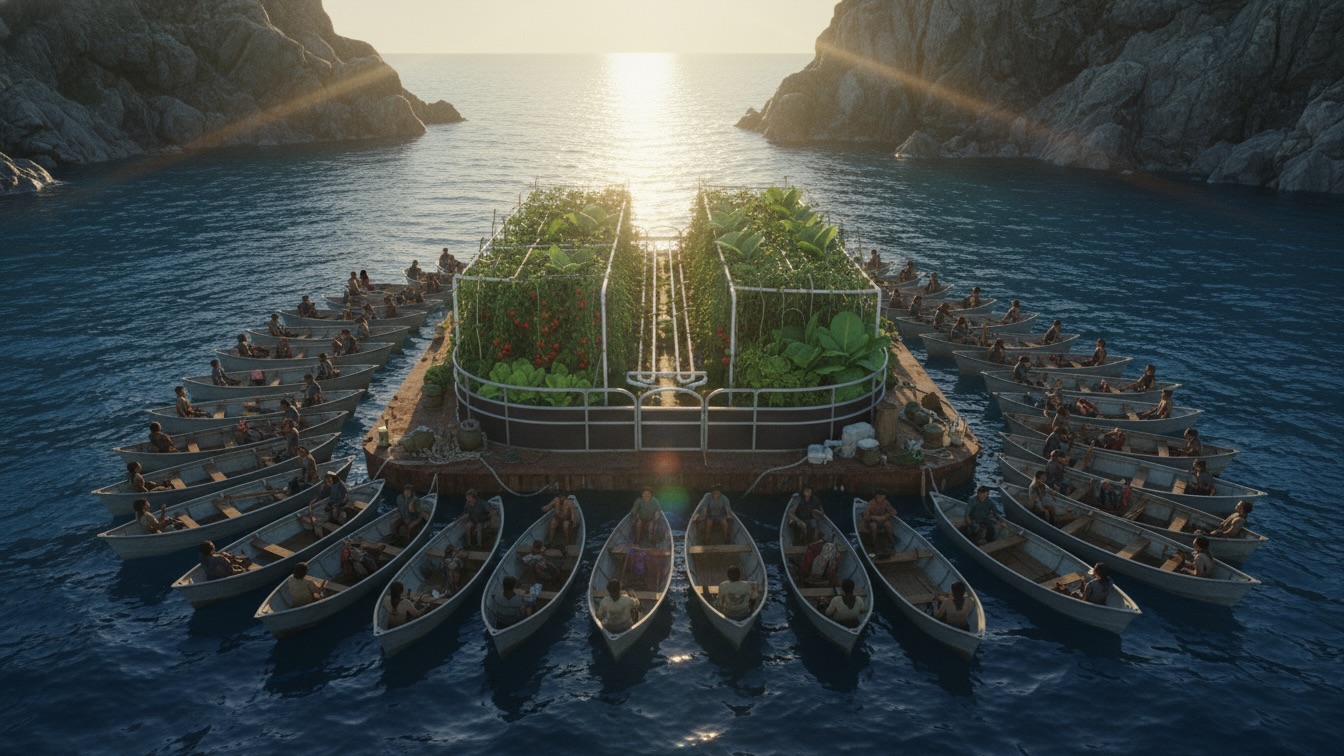
Then came a fleet.
Canoes. Kayaks. Jon boats. Outboards choking on two-stroke oil. It looked like a junkyard armada. Dozens of small, battered vessels poured through the gap, filling the narrow channel. They completely surrounded the tugboat and Todd's speedboat.
Mrs. Higgins was in a canoe, paddling hard. She positioned herself right off the port bow of Todd's black fiberglass hull.
"Hey!" Todd yelled, suddenly looking panicked as the small boats boxed him in. "Watch the gel coat! Back off!"
"Navigable waterways are public, Todd!" Jerry yelled from his boat. He dropped a heavy cinderblock anchor into the water with a loud splash. "We're just fishing!"
The other boats followed suit. Anchors splashed. Ropes were tossed from boat to boat, tying them together in a massive, floating web. They created a solid physical wall of aluminum, wood, and fiberglass between the Ministry tug and our garden.
Miller cut his engine. He looked at the wall of locals. He rubbed his face with both hands.
"Miller!" Todd shrieked, his composure completely gone. "Arrest them! Clear the channel!"
Miller picked up his radio. He spoke into it for a moment, then clipped it back to his vest. He looked at Todd.
"I can't," Miller said.
"What do you mean you can't?"
"I don't have the jurisdiction to disperse a peaceful gathering of registered vessels in a public waterway," Miller said calmly. "And my captain just radioed. The Ministry office in Kenora got flooded with calls this morning. Someone tipped off the local news about a community garden being crushed to protect a millionaire's view."
Miller looked past the blockade, right at Kyla. Kyla smiled and held up her iPad. The screen was cracked, but the recording light was blinking red.
"The Ministry is placing a temporary stay on the tow order," Miller announced loudly, his voice echoing off the rocks. "Until a judge can determine if this structure is classified as a marine vessel or a stationary agricultural platform."
Todd's face turned completely red. He slammed his hand against his steering wheel. He pointed a shaking finger at me. "This isn't over! You hear me? I will bury you in legal fees!"
Todd threw his boat into reverse, nearly swamping Mrs. Higgins' canoe. He spun the wheel, squeezed his massive boat through a gap in the blockade, and sped away, leaving a furious wake behind him.
The tugboat sounded its horn once, a deep, resonant blast, and slowly backed out of the channel.
The moment they were out of sight, the cove erupted. Jerry blew an air horn. People banged paddles against aluminum hulls. The noise was deafening, echoing wildly against the granite cliffs.
I let the wooden pole drop to the deck. My legs felt like jelly. I sat down heavily on a plastic crate.
Kyla walked over to the thickest tomato plant. The one Old Man Coot had brought. Hanging from the bottom branch was a single, perfectly round tomato. It was bright red, heavy, and flawless.
She picked it, wiped it on her dirty shirt, and handed it to me.
I looked at it. The skin was warm from the morning sun. I took a bite. The juice exploded over my tongue, sweet and sharp and entirely real. It was the best thing I had ever tasted in my life.
I looked out at the fleet of battered boats, at the people who had shown up when it mattered. Coot was leaning against his console, pretending not to smile.
We had won. For today.
But as I chewed the warm tomato, I saw Todd's black speedboat idling way out in the main channel, a tiny speck against the blue water, the sun glinting off the phone pressed hard against his ear.
“But as I chewed the warm tomato, I saw Todd's black speedboat idling way out in the main channel, a tiny speck against the blue water, the sun glinting off the phone pressed hard against his ear.”


