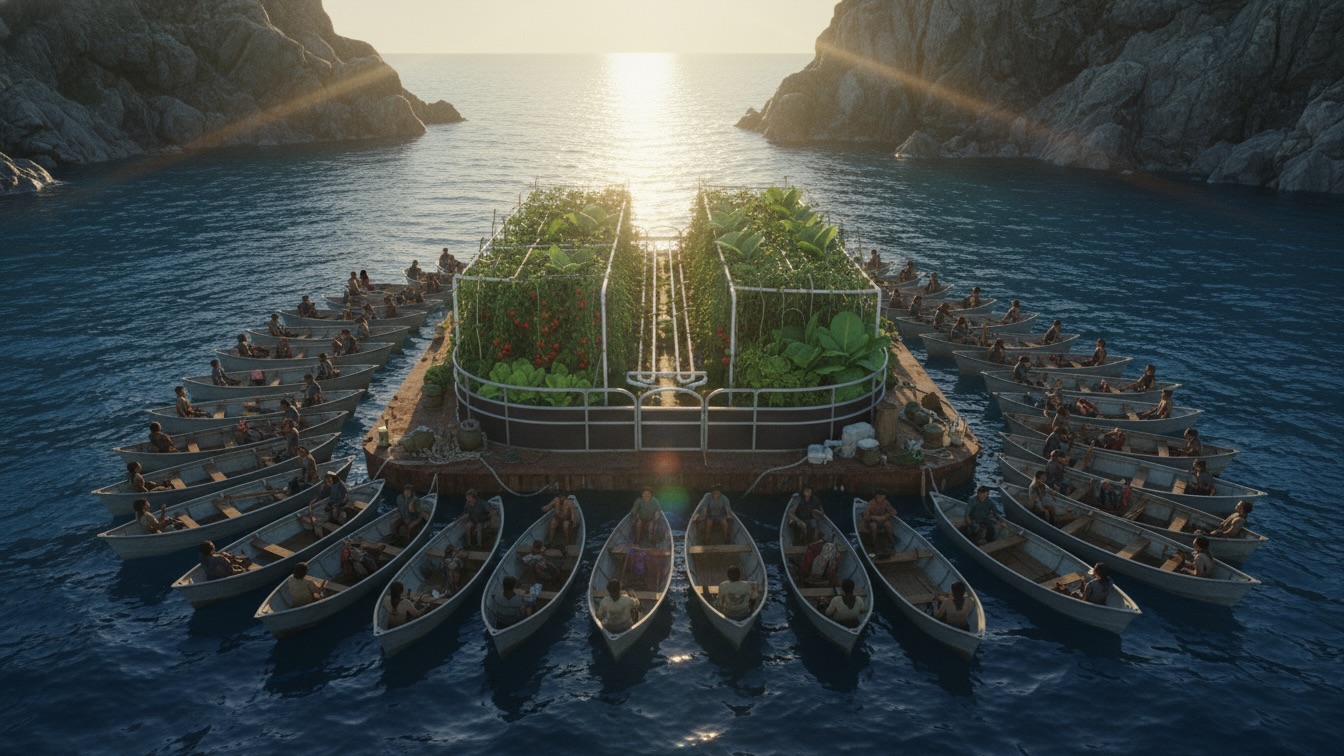
In the story "Floating Tomato Barge," the protagonist Sammy faces a desperate economic reality in a resort town where basic nutrition has become a luxury. After realizing he can no longer afford to eat despite working long hours at a marina, he spots an abandoned pontoon boat on the property of a local hermit named Old Man Coot. Sammy negotiates a trade, repairing Coot's failing solar array in exchange for the derelict vessel, which he intends to transform into a floating garden to bypass the high costs of land-grown produce.
Sammy enlists the help of Kyla, the daughter of a wealthy tech executive, who uses her technical knowledge of hydroponics to design a soil-free agricultural system. Despite the harsh weather and physical exhaustion, they successfully grow a lush variety of vegetables using lake water. Their success is soon threatened by Todd, a wealthy property developer who views the barge as an eyesore and uses his influence to have the Ministry of Natural Resources issue a seizure notice.
The narrative culminates in a high-stakes relocation of the barge during a violent storm, aided by the unexpected intervention of Old Man Coot. The following morning, the local community forms a maritime blockade of small fishing boats to prevent the authorities from towing the garden. Through this collective act of defiance, the locals secure a temporary legal victory, allowing the barge to remain as a symbol of self-sufficiency and communal resilience against corporate encroachment.
The primary theme of the story is the stark class divide between seasonal wealthy residents and the year-round working class. This is manifested through the "slow-motion starvation" Sammy describes, where the locals are priced out of their own environment by those who view the lake as a mere playground. The apple priced at nine dollars serves as a visceral symbol of this inequality, highlighting how basic human needs are sacrificed at the altar of luxury commerce.
Another central theme is the concept of food sovereignty and creative resistance. By building the barge on "navigable water," Sammy and Kyla attempt to bypass the traditional power structures of land ownership and property taxes. Their garden is not just a source of calories; it is an assertion of their right to exist in a space that is increasingly being privatized by developers like Todd. The barge represents a literal and figurative platform for autonomy.
The story also explores the redemptive power of community and shared labor. Initially, Sammy is a solitary figure struggling in isolation, but the project eventually draws in Kyla, Coot, and the broader local population. This transition from individual desperation to collective action suggests that the only way to combat systemic oppression is through the formation of mutual aid networks. The "tin boat blockade" at the end of the story serves as a powerful visual metaphor for the strength found in communal solidarity.
Sammy is a character defined by physical and psychological desperation. His internal monologue is dominated by the math of survival, reflecting a mind that has been narrowed by the constant pressure of hunger. He exhibits symptoms of scurvy and malnutrition, which grounds his motivations in the most basic human instincts rather than abstract idealism. This physical suffering makes his eventual success with the garden feel like a literal salvation.
His resourcefulness as a boat mechanic allows him to navigate the technical challenges of the story, but his true growth lies in his transition from a passive victim to an active architect of his own destiny. He possesses a deep-seated sense of justice, seen in his willingness to confront both the intimidating Coot and the entitled Todd. Sammy's victory is not just in the food he grows, but in the restoration of his dignity through productive, meaningful work. He proves that he is more than just a "gas jockey" for the elite.
Kyla serves as the intellectual engine of the project, using her "hyper-fixation" on systems and hydroponics as a psychological defense mechanism against the boredom and isolation of her privileged life. She is a foil to her father, the tech executive, as she chooses to apply her knowledge toward a tangible, humanitarian goal rather than corporate profit. Her character represents the potential for the younger generation to bridge class divides through shared purpose.
Her involvement in the barge represents a search for agency in a world where she is usually a passenger on her father’s luxury boat. By getting her hands dirty and enduring the physical hardships of the construction, she finds a sense of belonging that her wealth could not provide. Her iPad, though cracked, becomes a tool for social justice rather than just a distraction. This transformation highlights her need for authentic connection and real-world impact.
Old Man Coot represents the hardened, cynical remnant of the old lake culture. He initially appears as a hostile antagonist, using a pellet gun to defend his territory, but this aggression is revealed to be a protective shell against a world that has largely forgotten him. His willingness to trade the pontoon for solar repairs shows a pragmatic side beneath his gruff exterior. He is a survivor who recognizes a kindred spirit in Sammy's desperation.
His character arc is one of quiet reintegration into the social fabric of the lake. By assisting Sammy during the storm and offering heirloom seeds, he demonstrates a hidden desire to see the younger generation succeed where he perhaps has struggled. He embodies the "crusty" mentor archetype, providing the necessary grit to ensure the garden's survival. His participation in the final blockade signifies his return to the community he once shunned.
The narrative voice is grounded in a gritty, sensory-heavy realism that emphasizes the physical toll of the environment. The author uses vivid descriptions of heat, humidity, and rot to create a sense of atmospheric pressure that mirrors the characters' economic stress. Phrases like "sweat pooled at the collar" and "the smell of crushed basil and wet earth" anchor the reader in the immediate physical reality of the lake. These details make the struggle for food feel urgent and visceral.
The pacing of the story follows a traditional dramatic arc, beginning with the slow, simmering tension of the grocery store and accelerating into the frantic action of the storm. This shift in speed reflects the changing stakes of the narrative, moving from a private struggle to a public battle for community rights. The use of short, punchy dialogue during the confrontation with Todd adds to the sense of urgency and conflict. This contrast keeps the reader engaged with both the technical and emotional aspects of the plot.
The tone of the story is one of defiant hope. While it does not shy away from the harsh realities of poverty and legal bullying, it maintains an undercurrent of resilience through the characters' ingenuity. The recurring motif of the "tin boat blockade" serves as a powerful visual metaphor for the strength found in numbers. The ending is bittersweet, acknowledging that while a battle was won, the systemic forces of wealth and power remain a constant threat.


