Format: Short Film / Anthology Episode | Est. Length: 10-12 minutes
Floating Tomato Barge serves as a pilot or standalone entry in The Hollow Lake, an anthology series exploring the friction between "year-rounders" and ultra-wealthy seasonal residents in the remote wilderness of Northwestern Ontario. The series focuses on the desperate ingenuity required to survive in a natural paradise that has been economically colonized by the elite. Each episode highlights a different facet of local resistance, using the harsh, beautiful environment of Lake of the Woods as a backdrop for stories of food sovereignty, environmental decay, and class warfare.
Sammy, a malnourished dockhand, stares at a bruised, nine-dollar apple in a sweltering outpost before spotting a rotting pontoon boat in a stagnant bay. This derelict "junk" becomes his only hope for a meal that doesn't come from a ramen packet.
A starving marina worker and a bored tech-heiress transform a derelict pontoon boat into a high-tech floating garden to bypass predatory grocery prices. Their survival project becomes a flashpoint for class warfare when a wealthy developer attempts to seize the barge for "ruining his view."
The story explores the theme of "Food Sovereignty" in a modern landscape where basic nutrition has become a luxury good reserved for the elite. It examines the bridge between traditional survivalism—represented by Old Man Coot’s grit—and modern technological efficiency, represented by Kyla’s hydroponic systems.
The secondary theme is "Community Resilience," illustrating how shared desperation can bridge the gap between disparate social classes. The barge itself is a metaphor for the local population: battered, algae-covered, and underestimated, yet capable of sustaining life when the traditional systems fail.
For Sammy, the stakes are physical survival and dignity; failure means returning to a diet of MSG-laden ramen and the slow physical decline of malnutrition. For the community, the barge represents a proof-of-concept for independence from exploitative local monopolies, making its destruction a symbolic defeat for every local worker on the lake.
The primary external conflict is the legal and physical pressure from Todd, a developer who views the lake as a curated aesthetic rather than a living ecosystem. Internal conflict stems from Sammy’s desperation and Kyla’s isolation, while the environment itself—storms, heat, and pests—acts as a constant, indifferent antagonist that threatens to sink their progress.
Sammy, a marina worker suffering from the early signs of scurvy, trades grueling electrical labor with the cantankerous Old Man Coot to acquire a derelict pontoon boat. He teams up with Kyla, a tech-savvy seasonal resident looking for an escape from her father's shadow, to build a floating hydroponic garden using scavenged PVC pipes, a scratched solar panel, and nutrient-rich lake water. As the garden flourishes and becomes a symbol of local resilience, other marina workers contribute seeds and supplies, creating a communal resource that bypasses the exorbitant prices of the local outpost.
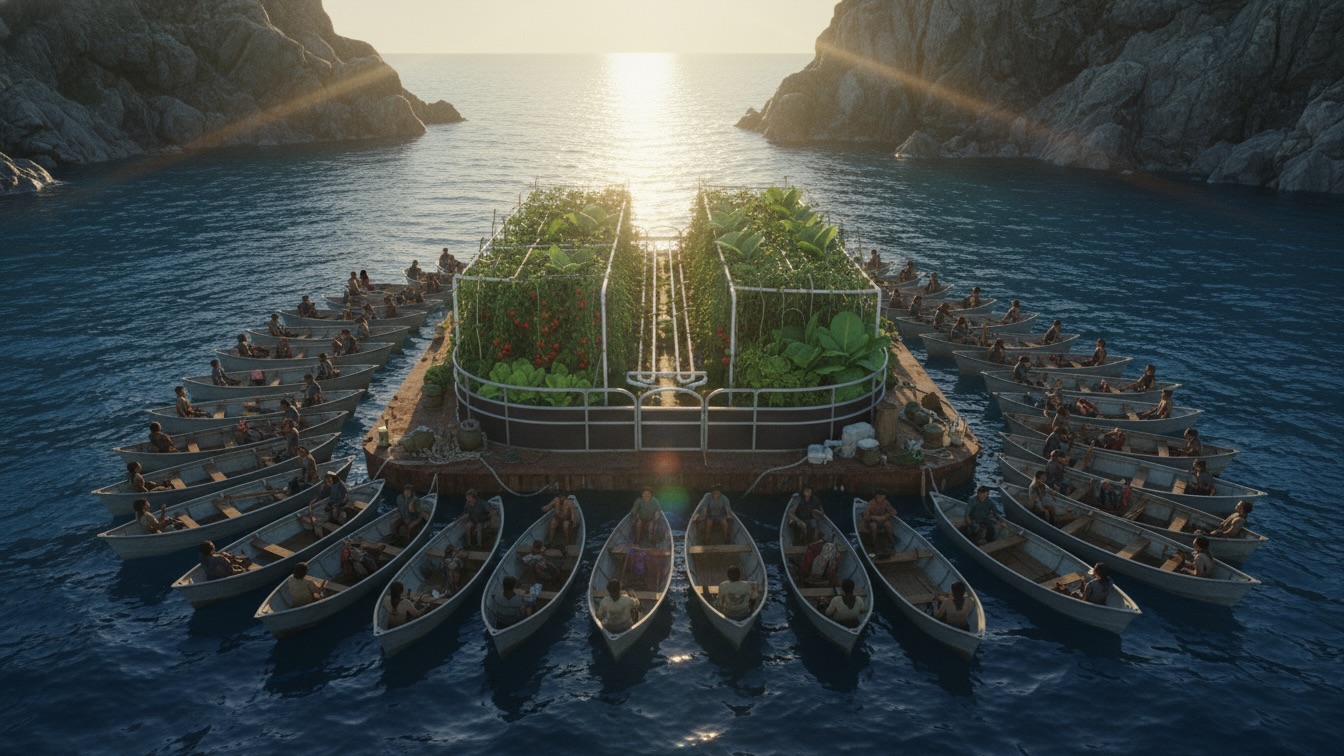
The success of the barge draws the ire of Todd, a property developer who views the "squatter's garden" as an eyesore that devalues his multi-million dollar view. Todd influences the local Marine Patrol to issue a forty-eight-hour seizure notice, forcing Sammy and Kyla to attempt a treacherous midnight relocation through a violent summer storm. Just as the barge is about to capsize, Old Man Coot intervenes, leading them to a hidden cove. In a final standoff, the local community forms a "tin boat blockade" to protect the barge from a Ministry tugboat, securing a temporary victory for the workers of the lake.
Sammy: A resilient but exhausted dockhand whose psychological arc moves from passive desperation to active defiance. At the start, he is a victim of his environment, but by the end, he becomes a community leader who realizes that ingenuity is a form of power.
Kyla: A brilliant, isolated teenager from a wealthy family who finds purpose in the project. She begins the story as a cynical "summer kid" looking for a distraction and ends as a vital engineer who has found a genuine connection to the local landscape and its people.
Old Man Coot: A survivalist hermit who acts as the bridge to the lake’s past. He starts as a hostile gatekeeper but evolves into a silent protector, proving that the old ways of the lake still hold weight against modern encroachment.
Todd: A narcissistic property developer who represents the "extractive" nature of the summer residents. His arc is one of escalating frustration as he realizes that his wealth cannot easily steamroll the collective will of the locals.
The Outpost and the Deal: Sammy faces the reality of food inflation at a sweltering island store, unable to afford a rotting apple. He discovers the abandoned pontoon in Coot’s bay and strikes a high-stakes deal to fix the old man’s solar power in exchange for the scrap. After a grueling afternoon of battery-acid burns and heat exhaustion, Sammy successfully tows the "junk" back to the marina.
The Build and the First Sprout: Sammy recruits Kyla, and together they scavenge PVC and solar panels to construct a high-tech floating garden amidst the heat and mosquitoes. The first sprouts emerge from the rockwool, signaling a shift from desperation to hope as the local workers begin to contribute heirloom seeds and supplies. The barge transforms into a lush, green oasis that stands in stark contrast to the sterile luxury boats surrounding it.
The Notice and the Storm: Todd arrives with the Marine Patrol, serving a forty-eight-hour seizure notice that threatens to crush the thriving garden. Sammy and Kyla attempt a midnight relocation through a violent summer storm, fighting rising waves that threaten to snap the PVC channels. Just as the barge begins to pull the skiff under, Old Man Coot arrives in the darkness to help them navigate into the safety of Devil's Gap.
The Blockade and Victory: The Ministry tugboat arrives to seize the barge, but they are met by a "tin boat blockade" of local residents who protect the garden with their own vessels. Kyla uses her iPad to record the confrontation, threatening a PR disaster for the Ministry and the developer. Todd is forced to retreat, and Sammy tastes the first harvest—a perfect heirloom tomato—realizing the community has claimed a small piece of the lake for themselves.
The episode begins with a stifling, claustrophobic sense of poverty and heat, creating a mood of quiet desperation. As the garden grows, the mood shifts to one of kinetic energy and "maker" satisfaction, before peaking in a high-tension, rain-slicked survival sequence. It concludes on a note of defiant triumph, though the lingering presence of Todd suggests a "calm before the storm" resolution.
If expanded, the season would track the "Floating Garden" as it grows from a single barge into a decentralized network of food production across the lake. This escalation would lead to a broader legal battle over "water rights" vs. "property rights," forcing the locals to organize into a formal resistance against corporate development.
The thematic arc would move from individual survival to collective action. Characters like Kyla would have to choose between their family's wealth and their loyalty to the lake, while Sammy would evolve into a reluctant political figurehead for the "year-rounders."
The visual style is "North-Western Gothic" meets "Lo-Fi Sci-Fi," utilizing handheld cameras and natural lighting to capture the grit of the marina. The palette should shift from the washed-out, overexposed yellows of the heatwave to the vibrant, saturated greens of the thriving garden, emphasizing the life-giving nature of the project.
The tone is reminiscent of Winter's Bone but with the mechanical ingenuity found in The Martian. It focuses on tactile details—the sound of a drill through plastic, the texture of algae, and the spray of lake water—to ground the social commentary in a physical, high-stakes reality.
The target audience includes viewers of prestige survival dramas and social-commentary thrillers (Ages 18-45). It appeals to those interested in environmentalism, "solarpunk" aesthetics, and stories of the working class triumphing over corporate interests in a "David vs. Goliath" format.
The pacing is brisk, utilizing a three-act structure compressed into 12 minutes. Act One (0-4m) establishes the hunger and the acquisition; Act Two (4-8m) covers the construction and the storm; Act Three (8-12m) delivers the blockade and the emotional payoff. The tempo should feel relentless, mirroring the oppressive heat and the ticking clock of the seizure notice.
Practical effects are paramount, particularly the construction of the barge and the storm sequence. Filming requires a controlled water environment or a safe cove to manage the "tin boat blockade" and the movement of the heavy pontoon structure.
The "blockade" scene requires a diverse fleet of period-accurate, weathered fishing boats to maintain the authentic "local" aesthetic. Special attention must be paid to the "growth stages" of the garden, requiring multiple sets of PVC pipes with varying levels of plant maturity for the filming schedule.


