Greg wiped sweat from his eyes, unaware the dirt beneath his boots was filing for corporate personhood.
The July heat in Winnipeg did not just sit on the skin; it pressed down. It was a physical weight, thick with humidity and the exhaust of idling cars on River Avenue. Greg stood in the center of the Osborne Village Community Garden, a laminated clipboard pressed against his damp chest. His khaki shorts clung to his thighs. Sweat dripped from his chin, spotting the ink on the plot assignment map. The garden was a chaotic rectangle of raised beds, chicken wire, and aggressively blooming sunflowers. It was supposed to be a sanctuary. It was currently a headache.
"You cannot put the zucchini next to the nightshades," Simon said.
Greg did not look up. He dragged a red pen across a grid square. "Plot four is yours, Simon. Plot five is Brenda's. Brenda grows tomatoes. Tomatoes are nightshades. Zucchini goes in plot four. This is the geometry we are working with."
Simon adjusted his linen shirt. It was unbuttoned to the sternum, revealing a silver pendant that caught the brutal afternoon sun. He was thirty-five but cultivated the exhaustion of a six-hundred-year-old monk. He also paid his plot fees late. "It is not about geometry, Greg. It is about the energetic alignment. The ley-lines beneath this specific grid are fractured. If you cross the masculine energy of a squash with the chaotic void of a nightshade, you disrupt the soil's frequency."
"The soil's frequency," Greg repeated. He pressed his thumb against his temple. A mosquito landed on his wrist. He slapped it, smearing a tiny line of blood across his skin. "Simon. I am a volunteer. I work in logistics for a freight company. I do not care about the masculine energy of squash. I care that we have thirty people who want to grow food, and we have twenty-eight boxes. You get plot four."
Simon stared at him. The druid's eyes were pale, watery, and entirely unblinking. The heat seemed to warp the air between them, making the sunflowers shudder. "You disrespect the earth. You treat it like a spreadsheet."
"It is a spreadsheet," Greg said. He tapped the clipboard. "Literally. It is an Excel document I printed at the library."
"The earth remembers," Simon whispered.
"Great. Tell the earth to water plot four by six PM or I'm giving it to the waitlist."
Simon did not move. He crouched. The dry dirt crunched under his leather sandals. He pressed his palms flat against the baked topsoil of plot four. Greg watched, annoyed. This was classic Simon. Performance art. Simon muttered something. The words were low, guttural, vibrating in the back of his throat. It did not sound like language. It sounded like the low grind of tectonic plates, scaled down to a whisper.
For a second, Greg felt a strange pressure in his ears, like the drop in a commercial airplane. The soil beneath Simon's hands shifted. It was a microscopic movement, a sudden settling of dust, as if the dirt had inhaled.
Simon stood up, dusting his hands on his linen pants. He looked tired, but smug. "I have corrected the power dynamic. The flora will now self-advocate."
"Self-advocate," Greg said.
"I am going to get a matcha latte," Simon said, turning his back. "Do not touch my dirt."
Greg watched him walk away, weaving through the raised beds and out the chain-link gate toward the café on the corner. The silence left behind was heavy. The cicadas in the nearby elm trees screamed. Greg looked down at plot four. The dirt looked completely normal. Dry. Clumpy. Pathetic. He sighed, checked off Simon's name on the clipboard, and moved to the hose to fill the watering cans.
He stayed for another three hours, untangling hoses, fixing a broken latch on the tool shed, and listening to the distant sirens from Osborne Street. By the time the sun dipped below the apartment buildings, casting long, bruised shadows across the garden, Greg was exhausted. His back ached. His throat was dry. He coiled the hose, the brass nozzle clanking against the wooden frame of plot twelve.
As he walked past plot four, he stopped.
He frowned. The dirt was no longer flat. It had piled itself into small, deliberate mounds. It looked organized. Symmetrical. Like a miniature subdivision. Greg blinked, rubbing his tired eyes. He figured it was the shadows playing tricks. He locked the gate behind him and walked home, unaware that beneath the soil, a radical restructuring was taking place. The roots were braiding together. The seeds were communicating. A charter was being drafted.
Greg arrived at six the next morning. The air was cool, carrying a brief, deceptive promise of relief before the sun began its daily assault. He unlocked the padlock on the main gate. The metal chain was cold. He stepped inside and stopped dead.
There was a low murmur. It sounded like a crowded waiting room at a dental clinic. A collective, irritated whispering.
Greg walked slowly down the central woodchip path. The sound grew louder as he approached the back section. He rounded the corner of the tool shed and dropped his keys into the woodchips.
The vegetables were looking at him.
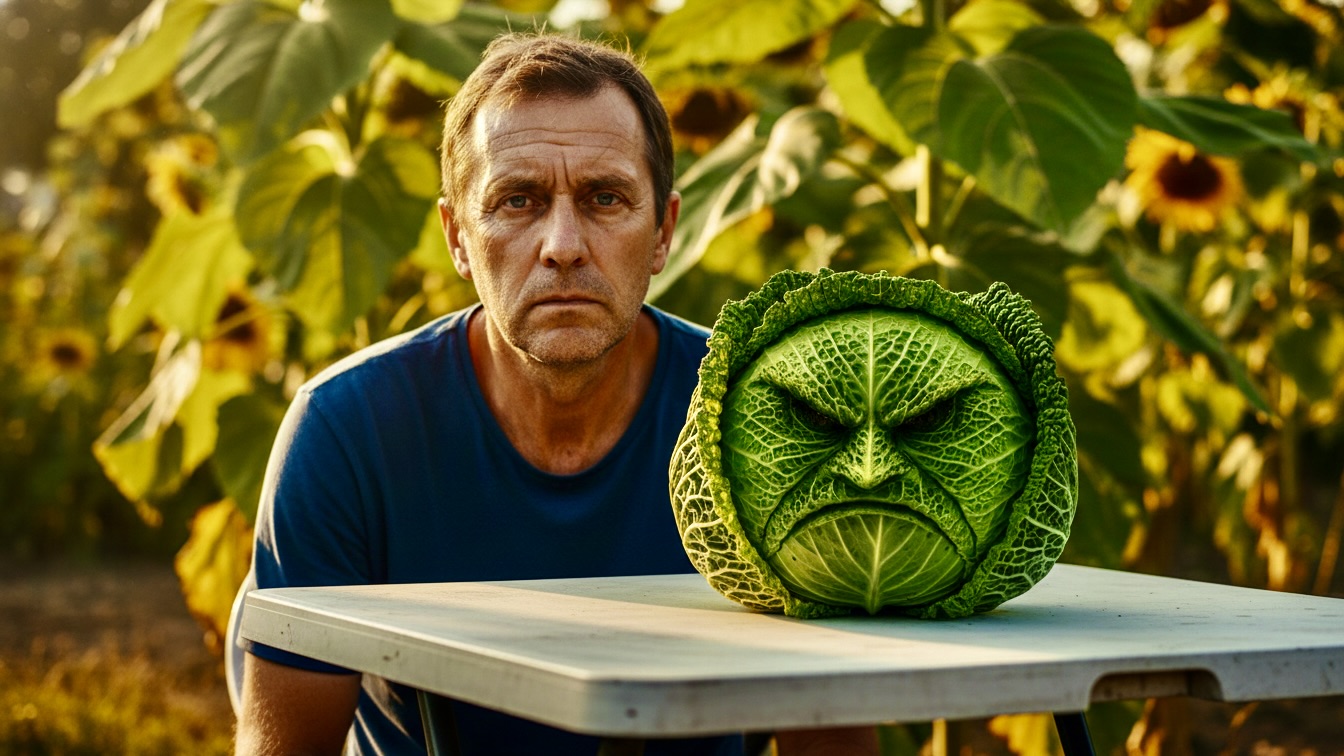
In plot seven, a massive, densely packed green cabbage sat atop the soil. It had not been there yesterday. It was the size of a bowling ball. More importantly, the folds of its outer leaves had wrinkled and shifted to form a distinct, scowling face. Deep crevices served as eyes. A tough, fibrous stem protruded like a blunt nose. The mouth was a tight, horizontal slash of pale green tissue.
Around the cabbage, the rest of the garden was alive. Carrots had pushed themselves halfway out of the dirt, twisting their orange bodies to face the path. Tomatoes hung heavy on their vines, their red skins stretched tight over bulbous, angry features. A row of zucchini lay on the soil like disgruntled torpedoes.
"Excuse me," the cabbage said.
The voice was shocking. It was raspy, deep, and sounded exactly like a woman who had smoked two packs a day for forty years and spent her weekends screaming at referees.
Greg took a step back. His stomach turned over. He looked around. The street was empty. A single bus rumbled past on the avenue. He looked back at the cabbage. "Did you just speak?"
"Are you Gregory Miller?" the cabbage demanded. Its mouth-slit opened and closed, revealing pale, wet layers beneath.
"Yes."
"I am Petunia. I am the newly elected President of the Osborne Village Garden Homeowners Association. You are standing in violation of Section 4, Paragraph B of the Root Vegetable Accord."
Greg stared. His brain, desperate to categorize the impossible, immediately defaulted to his professional training. "There is no Homeowners Association here. This is a city-owned lot. You are a cabbage."
"I am an administrative entity," Petunia corrected. She shimmied slightly, rustling her outer leaves. A large, jagged leaf detached from her base and floated to the ground at Greg's feet. It was covered in raised, dark green sap that formed perfectly legible text. "That is your first citation."
Greg picked it up. His hands shook. The leaf felt thick, like construction paper.
CITATION 001: IMPROPER WEEDING TECHNIQUES. Offender: Gregory Miller. Fine: Immediate cessation of all harvesting activities pending review.
"This is a joke," Greg said. "Simon put you up to this. Where is the speaker? Is there a Bluetooth speaker in the dirt?"
He lunged forward and grabbed a carrot by its green top, intending to yank it out and expose the trick.
The moment his skin touched the rough orange crown, the carrot snapped its jaws. It didn't have teeth, but the dense, fibrous root clamped down on Greg's index finger with the force of a closing door.
Greg shouted, jerking his hand back. The carrot held on for a second before dropping back into the soil, glaring up at him with tiny, dark divots for eyes.
"Assault!" a nearby tomato screamed. Its voice was high and reedy. "Assault on a resident! Document it!"
"Stand down, Timothy," Petunia barked at the tomato. She turned her attention back to Greg. "As you can see, we are organized. Due to a recent shift in zoning—specifically, the energetic grid you humans so callously ignored—we have achieved sentience and incorporated. We own the means of our own production. And we find your management style lacking."
"You're food," Greg said, cradling his bruised finger. Panic was starting to edge out the confusion.
"We are stakeholders," Petunia countered. "And we are going on strike."
By noon, the situation was a disaster. The community fridge volunteers arrived with their plastic crates, expecting the Tuesday harvest. Brenda, a retired nurse who ran the distribution, marched up to Greg with an empty crate.
"Greg, what is going on? The gate is locked. You're just sitting here."
Greg sat on an overturned bucket near the entrance. He had his head in his hands. He looked up at Brenda. He looked at the three other volunteers behind her. "We can't harvest."
"Why not? The tomatoes are practically bursting. The squash needs to come out today."
"They formed a union, Brenda."
Brenda adjusted her glasses. "Who? The volunteers? We don't get paid."
"No," Greg said. He stood up. His legs felt heavy. "The vegetables. The vegetables formed a Homeowners Association. They issued me a citation for aggressive pruning. If we try to take them, they bite."
Brenda stared at him for a long, terrible moment. Then she pushed past him. "I don't have time for heatstroke nonsense, Greg. Families need this food." She walked down the path toward plot five.
Greg followed slowly. "Brenda, wait."
Brenda reached for a large, ripe beefsteak tomato.
"Do not touch me," the tomato shrieked.
Brenda froze. The color drained from her face. She dropped her crate. It clattered against the woodchips. The entire row of tomato plants rustled, turning their red, swollen faces toward her.
"Uninvited guests must sign in at the gate," Petunia's raspy voice echoed from plot seven. "Failure to comply will result in a property lien."
Brenda backed away, her hands raised. She turned and ran out of the garden. The other volunteers fled with her. Greg stood alone in the center of the path, surrounded by murmuring, litigious produce. The community fridge would be empty tonight. The city would demand answers. He was a freight logistics coordinator fighting a bureaucratic war against a cabbage. He needed a plan.
The digital clock on Greg's nightstand read 2:14 AM. He had not slept. Every time he closed his eyes, he saw the bylaws written in sap. He thought about the empty shelves at the community fridge. He thought about the single mother on Wardlaw Avenue who relied on those Tuesday drops.
He sat up. He pulled on black jeans and a dark grey sweatshirt. He grabbed a heavy metal trowel from the hallway closet and shoved it into his belt. He was going to steal the carrots.
The streets were dead quiet. The heat of the day had finally broken, leaving behind a damp, stagnant chill. Greg walked the three blocks to the garden, keeping to the shadows. He didn't know why he was being stealthy. It was a garden. But the memory of the carrot's bite throbbed in his finger.
He bypassed the locked gate and climbed the chain-link fence at the back corner, near the compost bins. He dropped onto the dirt with a soft thud. He stayed crouched. He waited.
The garden was silent. The vegetables appeared to be asleep. Their features were slack, their eyes closed. Petunia was just a large, lumpy shadow in plot seven.
Greg crept toward plot two. The carrots. He knelt in the dirt. He reached out, his hand hovering over the leafy green tops. He held his breath. He grabbed a handful of greens and pulled, hard and fast.
Three carrots came loose with a wet tearing sound. They woke up instantly, thrashing in his grip.
"Kidnapping!" one of them squeaked.
"Shut up," Greg hissed, trying to shove them into his backpack.
Suddenly, the dirt around his ankles erupted.
Small, round, red projectiles shot out of the soil. Radishes. Dozens of them. They didn't have mouths, just deep, furious slashes for eyes. They launched themselves at Greg's shins, bouncing off his jeans like angry rubber balls.
Greg kicked out, stumbling backward. "Get off!"
The radishes swarmed. They were coordinated. A group of them rolled onto his boots, weighing down his feet. Another squad launched themselves at his knees. Then, the worst part happened. The radishes began to sweat.
A pungent, eye-watering aerosol sprayed into the air. It was pure, concentrated mustard oil. It hit Greg's face like tear gas. His eyes burned instantly. He dropped the carrots. He choked, coughing violently as the spicy vapor coated the back of his throat.
"Vigilante justice!" a zucchini yelled from across the path.
Greg turned and scrambled back up the fence, his eyes streaming, his lungs burning. He vaulted over the top and hit the pavement hard, scraping his palms. He lay there for a minute, coughing, listening to the muffled cheers of the radishes from inside the fence.
By Thursday, the garden had escalated from physical violence to psychological warfare.
Greg returned in the daylight, wearing safety goggles and heavy leather work gloves. He found the human volunteers standing outside the gate, but they weren't trying to get in. They were arguing with each other.
"I know what you said, David!" Brenda was yelling at a man in a bucket hat.
"I didn't say anything!" David yelled back.
Greg pushed through them. "What is going on?"
Brenda pointed a trembling finger at plot five. "The tomatoes told me. They heard David talking to his wife. He thinks my compost is just municipal waste. He said I'm ruining the nitrogen levels!"
"The tomatoes are liars!" David shouted.
"We are sworn to transparency under the Freedom of Information Act!" Timothy the tomato yelled back, his red face smug. "We have the transcripts!"
Greg realized with horror what was happening. The vegetables weren't just guarding their plots. They were listening. They had spent months absorbing the passive-aggressive chatter of the human gardeners, and now they were weaponizing it. They were sowing dissent.
"They told Sarah that Mark steals her watering can," Brenda said, crossing her arms. "And they told Mark that Sarah votes for the conservative party."
"It's tearing us apart," David moaned.
Greg left them arguing on the sidewalk. He walked straight to the café on the corner. The bell above the door jingled. The air conditioning hit him like a physical blow.
Simon was sitting at a small table by the window, reading a thick, leather-bound book. A half-empty matcha latte sat next to him.
Greg pulled out the chair across from Simon and sat down heavily. He slammed his leather gloves onto the table. "Fix it."
Simon did not look up from his book. "Fix what?"
"The garden. They formed a government. They pepper-sprayed me with radishes. They are destroying Brenda's social life. You cursed the soil. Un-curse it."
Simon slowly marked his page and closed the book. He looked at Greg. "I did not curse the soil. I awakened it. I gave them agency. If they are choosing to establish a bureaucratic framework, that is their right as sovereign entities."
"They are produce! They rot!"
"We all rot, Greg," Simon said calmly. "They just do it with better zoning policies than the city council. Have you seen their irrigation charter? It's remarkably equitable. They've redistributed the groundwater based on root depth rather than arbitrary plot lines."
"I don't care about their charter! People are going hungry because the cabbage won't let us harvest."
Simon took a sip of his green drink. "Then negotiate. Or submit to their jurisdiction. I will not interfere with an indigenous flora uprising just because it inconveniences your supply chain."
Greg stared at the druid. The sheer, immovable stubbornness in Simon's eyes was infuriating. Simon actually believed this was a victory.
Greg stood up. He left the gloves on the table. "Fine. You want to play bureaucracy? We'll play bureaucracy."
Greg did not go back to the garden. He went home. He booted up his laptop. He opened the City of Winnipeg municipal website. It was a terrible website, a labyrinth of dead links and outdated PDFs. But Greg was a freight logistics coordinator. He navigated terrible databases for a living.
He bypassed the agricultural zoning codes. He bypassed the community garden guidelines. He went straight to By-Law No. 1/2008: The Neighbourhood Liveability By-Law.
He scrolled down to Part 5: Noise Control.
He began typing.
Location: Osborne Village Community Garden. Complaint: Excessive and sustained vocalizations exceeding 60 decibels during daytime hours. Source: Sentient nightshades.
He hit submit. He knew the automated system would flag the keyword 'nightshades' as an error, so he filed six more complaints under 'unregistered barking.' He flagged them as urgent.
At 9:00 AM on Friday, a white city fleet vehicle pulled up to the curb outside the garden. A man in a high-visibility vest and a blue polo shirt stepped out. He carried an electronic tablet. He looked bored.
Greg was waiting for him at the gate. "You the inspector?"
"Yeah. Name's Terry. Got seven complaints about noise. Dogs?"
"Not exactly," Greg said. He unlatched the gate. "Listen."
Terry stepped inside. The garden was chaotic. The vegetables were holding a morning assembly. Petunia was yelling about unauthorized aphid incursions, and the tomatoes were screaming over each other in a heated debate about shade equity. The noise was a cacophony of raspy squawks and high-pitched shrieks.
Terry stopped. He stared at the moving, speaking vegetables. He looked at his tablet. He looked back at the garden. He did not look surprised. He looked profoundly annoyed.
"I don't have a code for this," Terry said.
"They're loud," Greg said. "They're a nuisance."
Terry tapped his stylus against the screen. "Technically, if they're making this much noise, it's a zoning violation. This is zoned for passive agricultural use. If they're operating as an active political body, they need a commercial assembly permit. Which they don't have."
Petunia, noticing the city worker, rolled herself to the edge of plot seven. "State your business! You are trespassing on sovereign HOA territory!"
Terry sighed. He looked at Greg. "Look, buddy. I don't care if they talk. But they're violating noise ordinances and operating an unpermitted assembly. If this doesn't get shut down, the city's going to revoke the lot lease. They've been wanting to bulldoze this corner for a paid parking lot for three years anyway. This is all the excuse they need."
Terry turned around and walked back to his truck. "You have forty-eight hours to abate the noise, or the dozers come Monday."
The truck drove away.
Silence fell over the garden. It was absolute. Not a single leaf rustled. The threat of the bulldozer was universal. It did not care about root depth. It did not care about charters. It was the ultimate, unfeeling bureaucracy.
Greg turned to look at Petunia. The cabbage looked smaller. Her outer leaves were drooping. The deep crevices of her face looked less angry and more terrified.
"A parking lot?" Petunia whispered.
"Asphalt," Greg said. "Six inches thick. Painted lines. No sunlight. No water. Just hot tires and spilled motor oil."
Timothy the tomato began to cry. It was a pathetic, wet sound.
Greg walked over to the tool shed. He pulled out a folding plastic table and set it up in the middle of the woodchip path. He grabbed two plastic chairs. He sat in one. He looked at the cabbage.
"Let's talk."
It took four hours. The sun beat down on the plastic table. Greg sweated through his shirt again. Petunia had to be misted with a spray bottle every twenty minutes to prevent her from wilting.
The negotiations were brutal. Petunia was a shrewd bargainer, but she had no leverage. The bulldozer was the sword hanging over all their heads.
"We concede the noise complaint," Petunia rasped, a fresh leaf of sap-writing curling onto the table. "We will restrict all vocalizations to a whisper between the hours of eight AM and eight PM. Absolute silence at night."
"Accepted," Greg said. "Now, the harvest. We need food."
"You cannot butcher us at will. We have families. The carrots have a rich oral history."
"Thirty percent," Greg countered. "We take thirty percent of the mature crop. Selected by lottery. You handle the lottery. You decide who goes. But we get the yield."
Petunia's mouth-slit tightened. "Thirty percent. But we dictate the soil quality. The compost Brenda provides is inadequate. We require premium, organic, worm-cast compost. Delivered weekly."
Greg calculated the budget in his head. It would be tight, but he could get the funds from the community center. "Done. But the psychological warfare stops. No more gossip. You don't listen to the humans, and you don't repeat what you hear."
"Agreed," Petunia said. She hesitated. "And one more condition."
"What?"
"Ban the cilantro. They are anarchists. They refuse to recognize the HOA, they bolt too early, and they taste like soap. We want them eradicated."
Greg didn't particularly like cilantro either. "I'll strike them from the planting grid next season."
"Then we have an accord." Petunia extended a thick, green leaf.
Greg reached out and shook it. It was cool and slightly damp.
That evening, the garden was quiet. The sun set, casting long shadows across the organized beds. The human volunteers came in shifts, silently collecting the crates of vegetables left at the edge of the plots by the HOA. The community fridge was restocked.
Greg stood by the gate, locking the padlock. He looked back at plot four. Simon's plot. The dirt there was perfectly tilled, awaiting new seeds. The rest of the garden was still, functioning under the tense, quiet weight of the new treaty. Greg pocketed his keys. The heat was finally breaking. He walked down the avenue, the heavy silence of the night feeling entirely earned.
“As Greg walked away, he didn't hear the faint, soapy whispering rising from the discarded compost bin, plotting a revolution of their own.”


