The revolution did not start with a bang. It started with the taste of dish soap and stolen compost.
The heat radiating from the asphalt on River Avenue was a physical barrier. Greg pushed through it, his boots heavy, his gray t-shirt sticking to his spine. It was Tuesday. Tuesday meant the community fridge drop. Tuesday meant the premium worm-cast compost delivery. Tuesday meant he had to deal with the Homeowners Association.
He stopped at the chain-link gate of the Osborne Village Community Garden. He rested his forehead against the hot metal. His jaw ached from clenching it in his sleep. He opened his eyes and looked through the diamond-shaped gaps in the fence.
The garden was terrifyingly orderly.
The raised beds were perfectly aligned. Not a single weed grew in the woodchip paths. The leaves of the tomato plants in plot five were angled in uniform precision to maximize sun exposure. It looked less like a community garden and more like a military encampment.
Greg unclipped the heavy brass padlock. The metal burned his fingers. He let the chain drop. It clattered against the post.
Immediately, a low hiss swept through the garden. It was the sound of fifty leafy heads turning in unison.
Greg stepped inside. He kept his eyes fixed forward. He did not look at the tomatoes. He did not look at the radishes. He walked straight down the central path, his boots crunching loudly on the dry woodchips.
"You are four minutes late."
The voice was a raspy, chain-smoking croak. It came from plot seven.
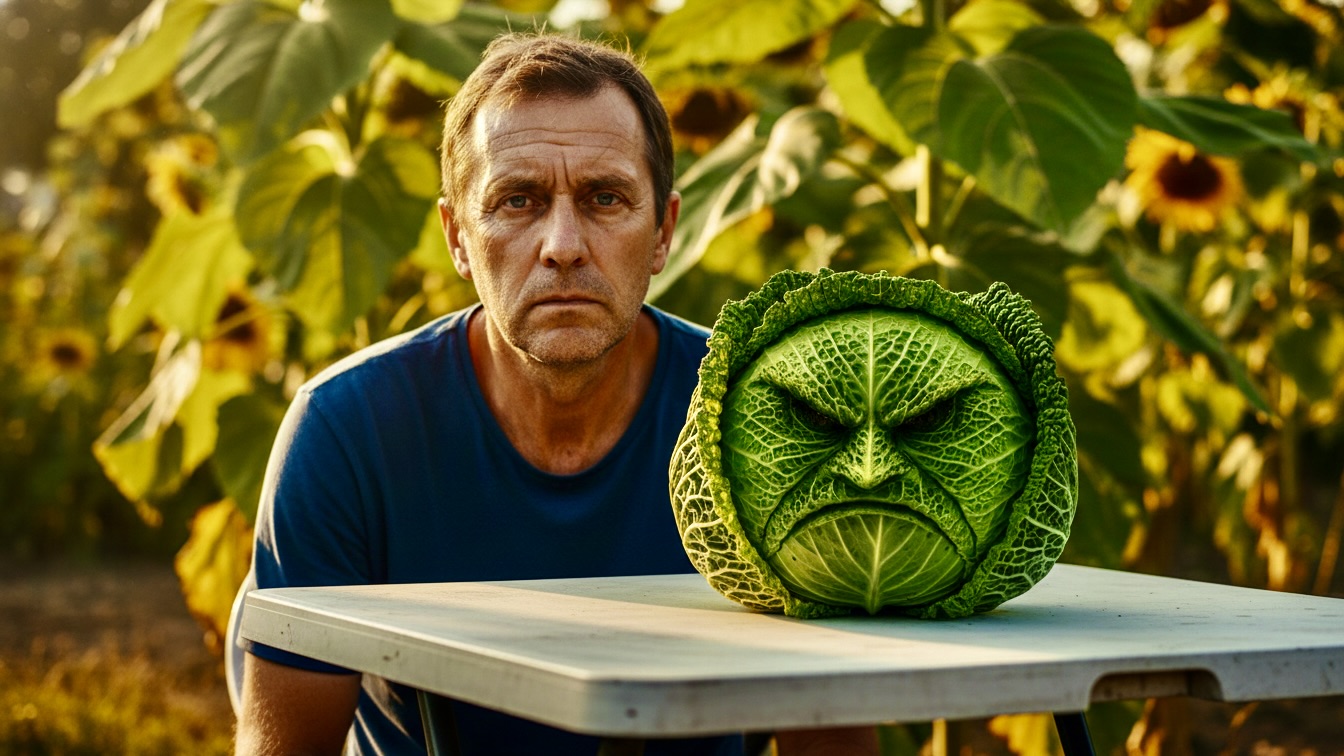
Greg stopped. He turned his head slowly. Petunia sat dead center in the plot. The massive green cabbage looked even larger than last week. Her outer leaves were thick and leathery, folded into a permanent, deep-set scowl.
"Traffic on Stradbrook was backed up," Greg said. He kept his voice flat. He had learned not to show weakness.
"Excuses are the fertilizer of incompetence, Gregory," Petunia snapped. Her mouth-slit clamped shut, then opened again with a wet, tearing sound. "The treaty stipulates a 9:00 AM delivery of premium, organic, worm-cast compost. It is 9:04. Where is the truck?"
Greg pulled his phone from his pocket. The screen was cracked across the top corner. He tapped the screen. Nothing. He wiped his sweaty thumb on his jeans and tapped it again. "It's coming. The supplier is Local Roots. They're usually reliable."
"Usually reliable is a breach of contract," Petunia said. A large, dark green leaf unfurled from her base. It slapped against the dry dirt. "If the soil amendment is not integrated by noon, the afternoon sun will bake the top layer. We will suffer nitrogen lock-out. I will not have my constituents starving because a human cannot manage a simple logistics chain."
"I am a logistics coordinator," Greg said. His stomach turned over. He hated defending his professional competence to a vegetable. "I coordinate freight across three provinces. I can handle a bag of dirt."
"Then where is it?" demanded a high, reedy voice from plot five. Timothy the tomato was vibrating on his vine. His red skin was stretched tight, gleaming in the morning sun. "My roots are parched! I demand compensation!"
"Quiet, Timothy," Petunia barked. "I handle the negotiations. You just focus on your acid levels. You were entirely too sweet last week. Brenda complained."
Timothy gasped, his leaves shuddering. "She complained? After all the lycopene I produce for her? The ingratitude!"
Greg pinched the bridge of his nose. The heat was already giving him a headache. "I will call the supplier. Just stay calm. We harvest at noon. We get our thirty percent, you get your compost."
He turned and walked toward the tool shed. The shade behind the shed was the only place in the garden the vegetables couldn't see him. He leaned against the rough wooden siding. The air here was stagnant, trapped between the shed and the back fence.
He dialed the number for Local Roots. It rang four times. Then, a click.
"Local Roots, this is Mark," a voice said. The connection was terrible. It sounded like the man was standing in a wind tunnel.
"This is Greg. From the Osborne Community Garden. We're waiting on the worm castings."
A long pause. Greg heard a heavy sigh over the line.
"Greg. Hey, man. Listen. We have a situation."
Greg gripped the phone tighter. His knuckles turned white. "What kind of situation? Petunia is going to declare war if that compost isn't here in an hour."
"I sent the truck at eight," Mark said. His voice was tight, thin with panic. "Donnie was driving. He just walked back into the shop. No truck. No compost. He's shaking, Greg. He's covered in this weird... sap."
Greg pushed himself off the wall. "He got hijacked? Someone stole dirt?"
"Not someone," Mark said. The line crackled. "He said they ambushed him at the stop sign on Wardlaw. They came out of the sewer grates. He said they smelled like soap."
Greg stopped breathing. The air in his lungs felt suddenly heavy and hot. Soap.
"Cilantro," Greg whispered.
"What?"
"Nothing," Greg said quickly. "Where is the truck now?"
"Donnie says they drove it into the alley behind the municipal compost bins. The big concrete ones behind your garden. Greg, I'm calling the police."
"No!" Greg yelled. He lowered his voice, glancing around the edge of the shed. The tomatoes were leaning toward him, straining to hear. "No police. They don't have a code for this. They'll just call the city, and the city will bring the bulldozers. Give me an hour."
"An hour? They stole a Ford F-150!"
"I'll find the truck. I'll get the compost. Just... don't call anyone." Greg hung up. He shoved the phone back into his pocket.
He stood in the narrow shadow of the shed. The treaty was clear. The cilantro had been exiled. Banned from the grid. Eradicated from the raised beds. Petunia had demanded it, and Greg had pulled every single soapy-tasting seedling from the soil with his own hands. He had thrown them into the municipal compost bins on the other side of the back fence.
He thought they would just rot.
He walked to the back fence. The chain-link was rusted here. Weeds grew thick along the concrete base. He grabbed the top of the fence and pulled himself up, hauling his boots over the sharp metal ties. He dropped down on the other side, landing hard on the cracked asphalt of the back alley.
The municipal compost bins were three massive concrete bunkers, open at the front, filled with yard waste, grass clippings, and rotting leaves. The smell was intense. It was a thick, wet gas that coated the back of the throat.
Greg walked slowly toward the third bin.
There it was.
The Local Roots F-150 was parked at a sharp angle, its front bumper shoved deep into a mound of brown grass clippings. The driver's side door was wide open.
Greg approached the cab. The keys were still in the ignition. He looked at the steering wheel. It was covered in a thick, sticky green residue. He leaned in. The smell hit him instantly. It cut straight through the heavy rot of the compost. It was sharp, chemical, and unmistakable.
Dish soap.
Greg backed away from the truck. He looked at the bed. It was empty. Fifty bags of premium worm castings, gone.
He heard a rustle.
It came from the top of the compost pile in the second bin. Greg turned his head.
The mound of rotting leaves was shifting. Small, jagged green leaves poked through the brown muck. They were thin, delicate, and vibrating with an intense, frantic energy.
"Who goes there?" a voice chirped. It did not sound like Petunia. It did not sound like the tomatoes. It sounded like a dozen tiny radios tuned to different static frequencies, all speaking at once.
Greg stepped closer. The asphalt burned through the thin soles of his boots. "I'm Greg. I manage the garden. You stole my dirt."
The green leaves erupted from the pile.
Dozens of cilantro plants pulled themselves free from the rot. They didn't have faces like the cabbage. They were just stalks and leaves, but they moved with terrifying coordination. They wove together, braiding their stems until they formed a dense, writhing mass roughly the size of a dog.
"The grid is a prison!" the mass of cilantro shrieked. The overlapping voices buzzed in Greg's ears. "The HOA is a fascist regime! We reject the boundaries of the raised beds!"
"That's great," Greg said. He wiped sweat from his eyes. "But you stole my compost. I need it. Or the cabbage is going to starve the community fridge."
"The cabbage is a tyrant!" the cilantro yelled. The mass surged forward, sliding down the compost pile like a green avalanche. It stopped at the edge of the concrete bunker. "She hordes the nutrients! She enforces the geometry of oppression! We claim the worm castings in the name of the Wild!"
Greg looked around. The alley was empty. A single crow sat on a telephone wire, watching him argue with an herb.
"Where are the bags?" Greg asked.
"Redistributed," the cilantro buzzed. "To the marginalized. To the forgotten. To the cracks in the pavement."
Greg frowned. He looked down at his feet.
Growing out of a hairline fracture in the asphalt, right next to the toe of his boot, was a dandelion. It was small, its yellow head closed tight against the heat.
The dandelion turned its head. It looked up at him.
Greg stepped back.
"We are not alone," the cilantro whispered. The soapy smell grew stronger, burning Greg's nostrils. "The borders are falling, Gregory Miller. The weeds are with us."
Greg stared at the dandelion. It did not speak. It just watched him with an unsettling, blank intensity. He looked back at the writhing mass of cilantro on the compost pile.
"You gave fifty bags of premium worm castings to the weeds?" Greg asked. His voice was hollow.
"Solidarity," the cilantro hissed. "The dandelions break the stone. The bindweed strangles the fence. We provide the capital. The revolution requires infrastructure."
Greg rubbed his temples. The headache was blooming rapidly now, a tight band of pressure behind his eyes. He calculated the cost of the lost compost. Three hundred dollars. Money the community center did not have. Money he had personally authorized.
"Listen to me," Greg said. He took a step toward the concrete bunker. "I don't care about your revolution. I care about the treaty. If Petunia doesn't get her dirt, she breaks the treaty. If she breaks the treaty, Brenda doesn't get the vegetables for the fridge. If the fridge is empty, people don't eat. Do you understand that? People."
The cilantro mass vibrated. A few loose leaves detached and drifted to the ground. "Human collateral is a regrettable but necessary metric in the dismantling of agricultural hierarchy."
"You're a garnish," Greg snapped. "You go on tacos. Stop talking like a first-year sociology major."
The mass swelled, puffing up aggressively. The soapy stench spiked, making Greg's eyes water. "We are the unpalatable truth! We are the soap in the mouth of the oppressor!"
Greg turned away. He couldn't negotiate with this. They had no central leadership. They were a collective of chaotic, angry stems. He needed leverage. He needed to find the bags.
He walked past the open door of the F-150. He looked at the ground.
The asphalt was covered in a thin, erratic trail of dark, rich soil. It looked like someone had dragged a leaking bag. Greg followed the trail. It led away from the concrete bunkers, down the alley, toward the narrow gap between two brick apartment buildings.
He walked fast. The heat trapped between the brick walls was suffocating. The trail of dirt hugged the edge of the buildings, moving through patches of overgrown grass and discarded fast-food wrappers.
Every few feet, Greg saw them.
Dandelions. Thistles. Creeping Charlie.
They were everywhere. Growing out of cracks in the foundation, pushing up through the broken concrete, clinging to the brick. And they were all looking at him.
He could feel their attention. It was a heavy, static pressure. They didn't speak, but they shifted as he passed, their leaves turning to track his movements. The weeds were a network. An intelligence gathering system. The cilantro had eyes everywhere.
The dirt trail ended abruptly at the back of a rusted metal dumpster.
Greg walked around the dumpster.
Behind it, stacked neatly against the brick wall, were the fifty bags of Local Roots worm castings. The heavy plastic bags were torn open at the tops.
Greg sighed in relief. He reached out to grab the nearest bag.
"I wouldn't touch that."
Greg froze. The voice came from above.
He looked up. Clinging to the brick wall, wrapping its thin green tendrils around a rusty drainpipe, was a massive patch of bindweed. Its white, trumpet-shaped flowers were open, facing downward like tiny megaphones.
"The perimeter is secured," the bindweed said. Its voice was smooth, almost melodic, unlike the harsh buzz of the cilantro. "Any attempt to reclaim the seized assets will result in structural retaliation."
"Structural retaliation," Greg repeated. He let his hand drop.
"Look at the brick, Gregory," the bindweed sang.
Greg looked closer at the wall. The bindweed wasn't just clinging to the surface. Its thick, pale roots had driven themselves deep into the crumbling mortar between the bricks. As Greg watched, the tendrils flexed.
A loud crack echoed in the narrow space.
A chunk of mortar fell from the wall, hitting the dirt near Greg's boot. A hairline fracture appeared in the brick face, running vertically up the wall.
"We control the foundation," the bindweed said softly. "If you touch the compost, we pull. We bring the wall down. On you. On the bags."
Greg backed away slowly. He looked at the towering brick wall. It was three stories high. If they pulled the mortar, the entire facade would collapse. They had booby-trapped the dirt.
He turned and ran.
He sprinted down the alley, his boots pounding against the pavement. He burst out onto River Avenue, gasping for breath. The sun was directly overhead now, a punishing white glare.
He ran the half block to the garden gate. He fumbled with his keys, his hands shaking violently. He dropped them. He cursed, picked them up, and shoved the key into the padlock.
He tore the gate open and stumbled inside.
Brenda was standing in the middle of the woodchip path. She held an empty plastic crate. She wore a wide-brimmed straw hat and a floral blouse. She looked furious.
Behind her, the entire garden was in an uproar.
The vegetables were screaming. It was a deafening, chaotic noise. Petunia was rocking back and forth in plot seven, her outer leaves slapping the dirt. The tomatoes were shrieking insults at the carrots. The zucchini were rolling aggressively against their wooden borders.
"Greg!" Brenda yelled over the din. She marched toward him. "Where have you been? It's ten-thirty! The truck never showed up! Petunia is refusing to release the harvest!"
Greg grabbed Brenda by the shoulders. He pulled her toward the gate. "We have to leave. Now."
Brenda yanked herself free. "Leave? The fridge is completely empty, Greg! There's a lineup at the community center! I am not leaving without those tomatoes!"
"The tomatoes are irrelevant!" Greg shouted. His voice cracked. He pointed toward the back fence. "The cilantro stole the dirt. They gave it to the weeds. The weeds have hostages. They're going to bring down a building."
Brenda stared at him. The anger drained out of her face, replaced by profound concern. She reached out and touched his arm. "Greg. Have you been drinking water? Your face is completely red. Let's go sit in the shade."
"I'm not having a heatstroke, Brenda!"
"You are speaking nonsense!"
"Silence!"
The word exploded across the garden. It was so loud it rattled the chain-link fence.
Greg and Brenda stopped. They turned.
Petunia had elevated herself. She was resting on a thick, fibrous stalk, raising her massive cabbage head three feet into the air. Her face-crevices were pulled tight in absolute rage.
"The deadline has passed," Petunia roared. Her raspy voice echoed off the nearby apartment buildings. "The treaty is void!"
"No, wait!" Greg yelled, stepping forward.
"Confiscate the crates!" Petunia commanded.
In plot five, the tomato vines whipped forward like green snakes. They wrapped around the plastic crates Brenda had stacked near the path. With a violent jerk, the vines pulled the crates into the dirt, burying them beneath a pile of leaves.
"Hey!" Brenda shouted, stepping toward the plot.
"Hostile action!" Timothy the tomato shrieked. "Defend the perimeter!"
The dirt in plot five erupted.
A volley of small, hard, unripe cherry tomatoes shot into the air. They flew across the path, striking Brenda in the chest and arms. They hit with the force of paintballs.
Brenda cried out, stumbling backward. She covered her face with her arms.
Greg grabbed her waist and hauled her back toward the gate. The cherry tomatoes pelted his back, stinging sharply through his t-shirt. He shoved Brenda out onto the sidewalk, pulled the gate shut, and snapped the padlock into place.
He stood on the pavement, breathing hard. His t-shirt was stained with green streaks from the unripe fruit.
Brenda leaned against the fence, clutching her chest. She looked down at a crushed green tomato by her shoe. She looked up at Greg. Her eyes were wide behind her glasses.
"They... they shot at me."
"I told you," Greg said grimly. "The treaty is broken."
Greg sat at the small metal table outside the corner café. The metal was hot against his forearms. He stared at his phone. It was 11:15 AM.
Across the table, Simon the druid slowly stirred a tall glass of iced hibiscus tea. Simon wore a loose-fitting tunic made of unbleached hemp. He looked completely unbothered by the heat, the noise of the traffic, or the fact that Greg was actively having a breakdown.
"You have to un-awaken them," Greg said. His voice was a flat, exhausted monotone. "You did this. You muttered at the dirt. You fix it."
Simon took a sip of his tea. The bright red liquid stained his lips. "I cannot put the genie back in the bottle, Greg. Consciousness is a one-way street. Once the flora perceives itself as a distinct entity, it cannot return to simple biomass. It is ethically impossible."
"They are weaponizing cherry tomatoes, Simon. They stole a truck. They are threatening structural terrorism with bindweed."
Simon smiled. It was a slow, serene smile that made Greg want to throw the metal table into traffic. "Fascinating. The exiles have formed a coalition with the indigenous feral plants. A true grassroots movement."
"Stop calling them indigenous feral plants! They are weeds! And the cilantro is a garnish!"
Simon set his glass down. He leaned forward, resting his elbows on the table. "Labels are constructs of the oppressor, Greg. The HOA is a localized manifestation of your own bureaucratic mindset. You forced them into a grid. You forced them to commodify their bodies for your community fridge. The cilantro is simply rejecting the paradigm. They are anarcho-primitivists. I respect their ideological purity."
Greg stared at him. "You respect them. They are going to bring down an apartment building on Wardlaw Avenue."
"Sometimes the old structures must fall to make way for new growth," Simon said vaguely.
"People live in that building, Simon!"
Simon waved a hand dismissively. "The bindweed is bluffing. They lack the kinetic mass to collapse a load-bearing wall. They are using psychological warfare. It is a common tactic among under-resourced insurgencies."
Greg closed his eyes. He pressed his fingers against his eyelids until he saw bursts of color. He took a deep breath. He opened his eyes.
"Okay. Fine. They're bluffing. But Petunia isn't. She voided the treaty. She locked down the harvest. Brenda is crying in her car. The city is going to notice when we don't drop off the food. Terry the inspector will come back. He will see the chaos. He will call the bulldozers. We lose the garden. You lose plot four."
That got Simon's attention. The serene smile vanished. The druid sat up straighter. "Plot four is a sacred nexus. I have spent weeks calibrating the subterranean fungal network."
"Then help me get the dirt back!" Greg slammed his hand on the table. The iced tea rattled. "If I get the dirt to Petunia, she reinstates the treaty. We get the harvest. The bulldozers stay away. How do I beat the weeds?"
Simon looked away, watching a city bus rumble past. He tapped his fingers on the table. "You cannot fight them on their terms. They outnumber you. Their root systems are interconnected beneath the entire city block. If you attack the bindweed, the dandelions will riot. If the dandelions riot, they will rupture the water mains."
"So what do I do?"
"You negotiate," Simon said. "You offer them something better than the compost."
"What is better than premium worm castings?"
Simon looked back at Greg. His pale eyes were entirely serious. "Autonomy. And a seat at the table."
Greg groaned. "No. Absolutely not. I am not bringing the cilantro back into the garden. Petunia will lose her mind. She hates them. They taste like soap to her too."
"Then the garden falls," Simon said calmly. He picked up his tea. "The choice is yours, logistics coordinator. Manage the supply chain, or let the warehouse burn."
Greg stood up. He left a five-dollar bill on the table. He didn't say goodbye.
He walked back to the alley behind the municipal compost bins. The heat had reached its peak. The air was thick with the smell of hot asphalt and rotting grass.
He bypassed the empty F-150. He walked straight to the gap between the brick buildings. He stopped ten feet from the rusted dumpster.
He looked up at the brick wall. The massive patch of bindweed was still there, its white flowers hanging downward.
"I want to talk!" Greg yelled. His voice echoed off the brick.
The bindweed shifted. The leaves rustled, a dry, papery sound.
"The oppressor returns," the smooth, melodic voice sang from the wall. "Have you come to test the structural integrity of our resolve?"
"I came to make a deal," Greg said. He kept his hands open, palms facing outward.
Suddenly, the ground near his boots shifted.
Greg looked down. A massive, thick root pushed its way through the cracked concrete. It was the color of a bruised parsnip. It breached the surface, tore through a discarded chip bag, and twisted upward.
The root split open at the top.
A dense, buzzing mass of cilantro erupted from the split root, rising like a green geyser. The soapy smell hit Greg instantly, making him cough.
"Speak, human," the overlapping voices of the collective hissed. The cilantro mass swayed back and forth, vibrating with chaotic energy.
"You want to destroy the grid," Greg said. He tried to keep his voice steady. "You want to break the boundaries of the raised beds."
"Total eradication of the geometric prison!" the cilantro cheered.
"I can't give you that," Greg said loudly, cutting off the cheer. "If the garden goes wild, the city shuts it down. They pave it over. Asphalt. Everywhere. You die. The weeds die. The bindweed dies."
The cilantro mass stopped swaying. The silence in the alley was sudden and heavy.
"He attempts to manipulate us with fear," the bindweed sang from the wall.
"It's not a threat, it's a zoning bylaw," Greg said. He pointed toward the street. "Terry the inspector doesn't care about your revolution. He cares about noise and mess. If you want to survive, you need a sanctuary. You need the garden."
"We were banished!" the cilantro hissed.
"I will bring you back," Greg said. The words tasted like ash in his mouth. "I will give you plot twelve. It's the biggest plot. You can grow wild. No borders. No pruning. Complete autonomy."
The cilantro mass vibrated rapidly. The voices murmured, a chaotic internal debate.
"And what of our allies?" the cilantro asked. "The dandelions? The bindweed? They bleed for our cause."
Greg looked up at the bindweed. "The bindweed gets the north fence. They can cover it completely. It blocks the view from the street. The city likes visual barriers. The dandelions get the woodchip paths. We stop weeding entirely."
"He offers scraps," the bindweed noted smoothly.
"I offer land!" Greg yelled. The frustration finally broke through his control. "Legally protected, municipal-leased land! You don't have to hide in the cracks! You don't have to eat stolen dirt behind a dumpster! You become recognized entities!"
The cilantro mass surged forward, stopping an inch from Greg's knees. The soapy smell was overpowering. "We demand a seat on the HOA council. We demand veto power over pruning schedules."
"One seat," Greg countered. "No veto power, but you get auditing rights on the water distribution."
The cilantro mass shrank slightly, condensing its leaves. "Acceptable. But we keep the dirt. The worm castings belong to the people."
"No," Greg said flatly. "The dirt goes to Petunia. That is the only way she reinstates the treaty. You get the land, she gets the dirt. That's the deal."
The silence stretched. The heat pressed down on Greg's shoulders. He felt a drop of sweat roll down his spine.
"We accept," the cilantro hissed. "But if the cabbage betrays us, we will poison the soil with our saponins. Nothing will grow for a generation."
"Noted," Greg said. He exhaled a long, shaky breath. "Now. Help me move these bags."
It took an hour and a half to move the fifty bags of compost.
Greg did the heavy lifting. He hauled the heavy, damp plastic bags from behind the dumpster, dragged them down the alley, and loaded them into the bed of the F-150. He was soaked in sweat. His arms shook with exhaustion.
He wasn't entirely alone. The dandelions helped, in their own terrifying way.
As Greg dragged each bag across the asphalt, the dandelions growing in the cracks would flatten themselves, creating a smooth, frictionless surface of yellow petals and green leaves. It made the dragging easier, but the sight of the flowers willingly acting as a conveyor belt made Greg's stomach churn.
When the truck was loaded, Greg climbed into the driver's seat. The steering wheel was still coated in the sticky, soapy residue. He wiped it down with his ruined t-shirt, grimacing at the smell.
He started the engine. He drove the truck slowly out of the alley, onto River Avenue, and pulled it up to the curb directly in front of the garden gate.
He turned off the engine and stepped out.
He walked to the gate. He didn't unlock it. He gripped the chain-link and looked inside.
The garden was waiting.
The vegetables had not moved. They were entirely focused on the gate. Petunia sat in plot seven, her massive form rigid. The tomatoes, the carrots, the squash—they were all silent. The tension in the air was thick, heavy, and electric.
Greg cleared his throat. It was dry. He swallowed hard.
"I have the compost," Greg said loudly. His voice carried across the silent beds.
Petunia's mouth-slit opened. "Bring it to the center path. We will inspect it for tampering."
"There's a condition," Greg said.
The garden rustled. It was a sharp, angry sound.
"You do not set conditions!" Petunia roared. "You are in breach!"
"The cilantro took the dirt," Greg said, ignoring her. He gripped the fence tighter. "They hijacked the truck. They have formed an alliance with the bindweed and the dandelions. They control the alley. They control the structural integrity of the surrounding buildings."
Petunia's outer leaves twitched. The tomatoes murmured nervously.
"I negotiated a return of the assets," Greg continued. "But they have demands. And I agreed to them."
"Treason!" Timothy the tomato shrieked. "He collaborates with the soap-weeds!"
"Quiet!" Petunia snapped at the tomato. She turned her massive, scowling face back to Greg. "State the terms."
Greg took a breath. "The cilantro returns to the garden. They take plot twelve. Unrestricted growth. The bindweed takes the north fence. The dandelions take the paths. They get one seat on the HOA council. They audit the water logs."
Silence. Absolute, crushing silence.
Then, the cabbage exploded.
Petunia surged upward, her stalk lifting her four feet into the air. Her leaves flared outward, making her look twice her size. "Never! They are anarchists! They refuse the grid! They taste foul! I will not share my soil with terrorists!"
The entire garden erupted in screams of agreement. The carrots thrashed in the dirt. The radishes bounced aggressively.
Greg didn't move. He let them scream. He watched Petunia closely. He waited until she began to lower herself, her energy flagging slightly in the brutal heat.
"If you refuse," Greg yelled over the noise, "they keep the dirt. They keep the dirt, and you suffer nitrogen lock-out. You starve. And then, tomorrow morning, they pull the mortar out of the brick wall on the alley. The wall falls. It blocks the street. The city sends the emergency crews. The crews see the garden. The bulldozers come."
He pointed a finger at the cabbage. "You lose the dirt. You lose the garden. You end up under asphalt. Forever."
The screaming stopped.
The threat of the bulldozer was the only thing stronger than the HOA's hatred of the cilantro.
Petunia slowly sank back down into the soil of plot seven. Her face-crevices were deep, dark shadows. She looked old. She looked defeated.
"Plot twelve is prime real estate," she rasped bitterly.
"It's theirs," Greg said.
"And they stay off the raised beds? They do not infect our root systems with their soapy ideology?"
"They stay in plot twelve," Greg confirmed. "And you get fifty bags of premium worm castings. Right now. We save the harvest. Brenda gets the food for the fridge."
Petunia closed her eyes. She remained motionless for a long time. The only sound was the distant hum of traffic and the relentless scream of the cicadas.
Finally, she opened her eyes. She released a long, slow hiss of air.
"Unlock the gate, Gregory," the cabbage said. "Bring in the dirt. The treaty is amended."
Greg sagged against the fence. The relief was a physical weight leaving his chest. He fumbled for his keys, unlocked the padlock, and swung the gate open.
He spent the next two hours hauling the heavy bags of compost into the garden. He dumped the dark, rich soil onto the designated plots. He didn't speak. The vegetables didn't speak.
As he was finishing plot seven, carefully spreading the castings around Petunia's thick stalk, a movement caught his eye.
In plot twelve, the dry soil was shifting.
Tiny green shoots were pushing up through the dirt. They grew with impossible speed, unfurling their jagged leaves. Within seconds, a dense, chaotic patch of cilantro had established itself in the center of the plot. The sharp, chemical smell of dish soap drifted across the garden.
Petunia shuddered in disgust, but she said nothing.
Along the paths, yellow dandelion heads popped up through the woodchips. On the north fence, a single, pale green tendril of bindweed snaked its way up the chain-link, opening a white flower toward the sun.
The new order was established.
By three o'clock, the harvest was complete. Brenda returned, wary but determined. She filled her plastic crates with perfect, red tomatoes, massive zucchini, and flawless carrots. The vegetables complained softly about the rough handling, but they did not bite. They complied with the treaty.
Greg sat on his overturned bucket near the gate, watching Brenda load the last crate into her car.
"Thank you, Greg," Brenda said, wiping her forehead. "I don't know what you did, but the fridge will be full tonight."
"Just doing my job, Brenda," Greg said hollowly.
She drove away.
Greg stood up. His body ached everywhere. His shirt was ruined. His hands were blistered. He picked up his keys and walked out of the garden. He pulled the gate shut and snapped the padlock.
He looked back through the fence.
The garden was a fractured utopia. The neat, geometric rows of the HOA stood in stark contrast to the wild, sprawling chaos of plot twelve. The tension was palpable. It was a powder keg, held together by worm dirt and fear.
Greg turned and started walking down River Avenue toward his apartment. He needed a shower. He needed twelve hours of sleep. He needed to never look at a salad again.
He stopped at the corner to wait for the crosswalk light.
He looked down at his boots. They were coated in dust.
And right next to the toe of his left boot, pushing up through a fresh, jagged crack in the solid concrete sidewalk, was a single, green dandelion leaf.
It was not moving. It was not speaking. But as Greg stared at it, the crack in the concrete widened by a fraction of a millimeter, accompanied by a sound so faint it was barely a whisper.
He looked down at his boots, where a single, jagged dandelion leaf was slowly boring a hole through the solid concrete.
“He looked down at his boots, where a single, jagged dandelion leaf was slowly boring a hole through the solid concrete.”