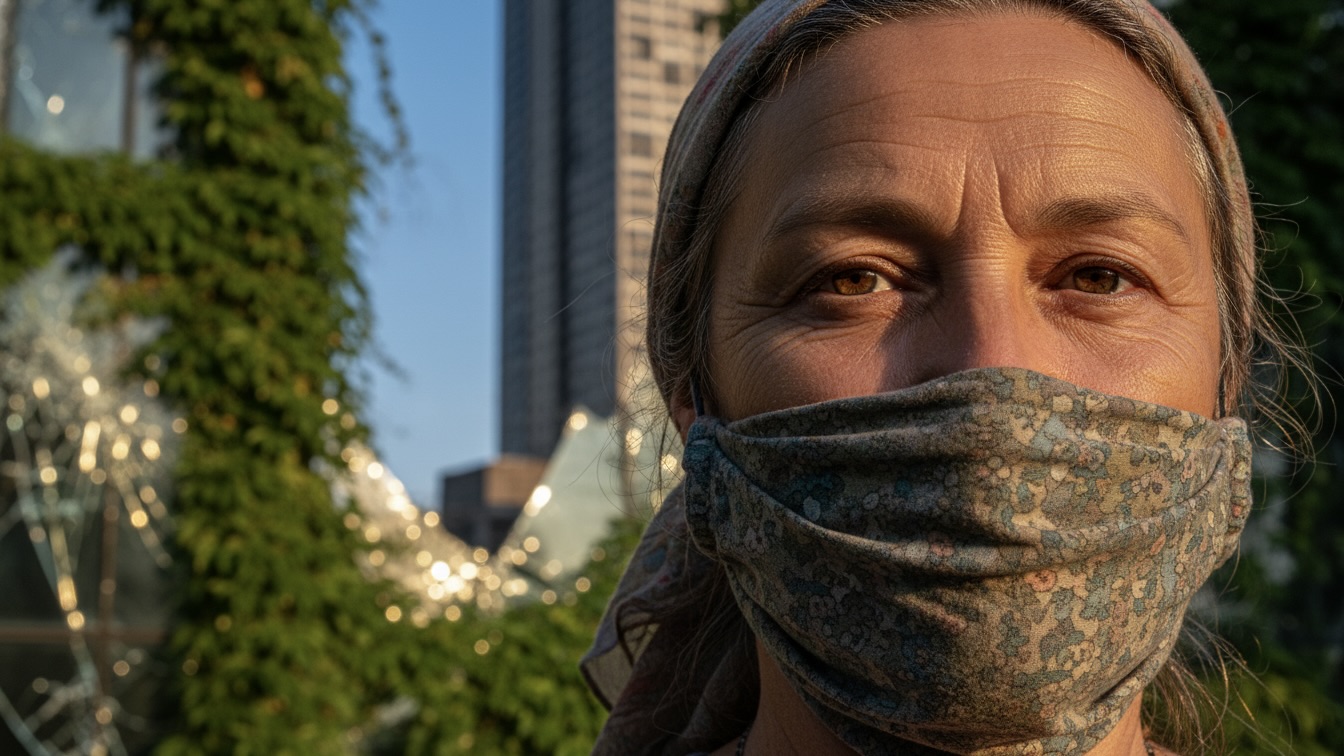
The story begins on a sweltering July afternoon in Chicago, where Martina, a seasoned former park ranger, senses an impending disaster that transcends typical urban disturbances. A rhythmic vibration beneath the bedrock precedes a violent biological eruption as massive, iron-like roots shatter the city’s infrastructure. This phenomenon is quickly revealed to be a coordinated global event, as nature begins a rapid and aggressive reclamation of urban landscapes across the planet.
As the city descends into chaos, Martina rescues a young tech developer named Jason from a predatory plant in a luxury store. She utilizes her knowledge of forest systems and a self-made pheromone cocktail to navigate the new, lethal environment. Together, they ascend the Sears Tower, which has been repurposed by the vegetation as a biological relay station. Martina realizes that the plants are not merely destroying humanity but are integrating human remains and electrical grids into a new, sentient ecosystem.
The narrative reaches its climax on the observation deck when Jason attempts to use a chemical herbicide to destroy the "Heart" of the infestation in Millennium Park. Martina, recognizing the environmental restoration occurring amidst the destruction, chooses to protect the new world over the old one. She disables Jason and his technology, fully embracing her role in a world where nature has finally asserted its dominance over human industry.
The primary theme of the narrative is the inevitable reclamation of the Earth and the fragility of human hubris. Throughout the text, the author emphasizes that human structures—both physical skyscrapers and digital networks—are merely temporary scaffolding for a much older and more patient biological system. The "Iron Root" serves as a literal and metaphorical force that deconstructs the artificial barriers humans have built against the natural world.
Another significant theme is the transition from a consumerist society to a primal, biological reality. Jason represents the pinnacle of modern human dependency, attempting to "hack" a nervous system that does not exist and seeking a monetary bounty for a world that no longer values currency. In contrast, Martina understands that the era of "short-term gains and digital echoes" has been judged and found lacking by the planet itself.
The story also explores the concept of biological recycling and the ethics of survival. The revelation that the new flora is constructed from human DNA suggests a dark but poetic form of immortality and justice. The Earth is not merely killing its "infection" but is repurposing the materials of its destroyers to create a new class of guardians. This shift suggests that humanity’s only path forward is not through resistance, but through a total, and perhaps involuntary, integration with the biosphere.
Finally, the narrative touches upon the idea of environmental restoration through cataclysm. Martina observes that while the city is being destroyed, the air is becoming breathable and the water is clearing for the first time in a century. This presents a moral dilemma: is the preservation of human comfort worth the continued decay of the planet? The story concludes by suggesting that the "silence" of the new world is a more profound state of peace than the noisy progress of the old one.
Martina is depicted as a stoic, hyper-observant individual whose psychological foundation is built on decades of interaction with the natural world. At fifty-five, she possesses a weary wisdom that allows her to remain calm while the world literally breaks apart around her. Her background as a park ranger is not just a profession but a lens through which she views the apocalypse as a necessary systemic adjustment. She does not see the roots as monsters, but as a "system" that has decided to expand, displaying a clinical and almost reverent detachment.
Psychologically, Martina undergoes a transition from a protector of humans within nature to a protector of nature from humans. Her decision to stop Jason is the culmination of years of witnessing human encroachment on the wild. She finds a sense of belonging in the carnage because the rules of the forest are ones she understands and respects. By the end of the chapter, she has shed her identity as a citizen of Chicago and fully embraced her role as an inhabitant of the "Green Zone."
Jason serves as the psychological foil to Martina, embodying the anxiety and entitlement of the digital age. He is characterized by his reliance on technology, attempting to solve a biological crisis with a tablet and high-frequency pulses. His immediate reaction to the crisis is to think of insurance claims and monetary rewards, which highlights his inability to grasp the magnitude of the shift occurring. He represents the "human infection" that Martina believes the Earth is currently curing.
His desperation turns into a violent greed when he realizes his world of air-conditioned apartments and digital status is under threat. He is driven by a fear of the unknown and a refusal to adapt to a world where he is no longer at the top of the food chain. When he lunges at Martina, it is a final, pathetic gasp of the old world trying to assert dominance over the new. His ultimate fate, being pinned by a vine and held prisoner, symbolizes the total subjugation of human technology by biological intent.
The author employs a heavy, atmospheric prose style that mirrors the "wet wool" humidity described in the opening paragraph. Sensory details are used effectively to create a sense of visceral discomfort, from the "cloying" smell of rotting peaches to the "acidic sap" etching into leather. The pacing is deliberate, starting with a low, rhythmic hum and escalating into a series of sharp, violent "detonations" of concrete and steel. This creates a narrative rhythm that mimics the pulsing, muscular growth of the vines themselves.
The tone of the story shifts from one of urban thriller to a form of eco-horror, and finally to a meditative, almost spiritual conclusion. The use of technical language, such as "bio-electrical interfaces" and "infrared signatures," grounds the fantastical elements in a pseudo-scientific reality. This makes the biological invasion feel like a plausible, albeit extreme, evolutionary event. The contrast between the "blue light" of the fungi and the "sickly orange" of the military's napalm highlights the aesthetic conflict between the organic and the artificial.
The narrative voice is closely aligned with Martina’s perspective, providing a sense of authoritative calm amidst the chaos. The descriptions of the "Thorn-Walkers" and the "Heart" are handled with a sense of awe rather than pure terror, which guides the reader toward Martina’s eventual conclusion. The final imagery of the turquoise lake and the sunset behind a green horizon provides a sense of closure. It suggests that while the human story has ended, a more ancient and enduring story is just beginning.


