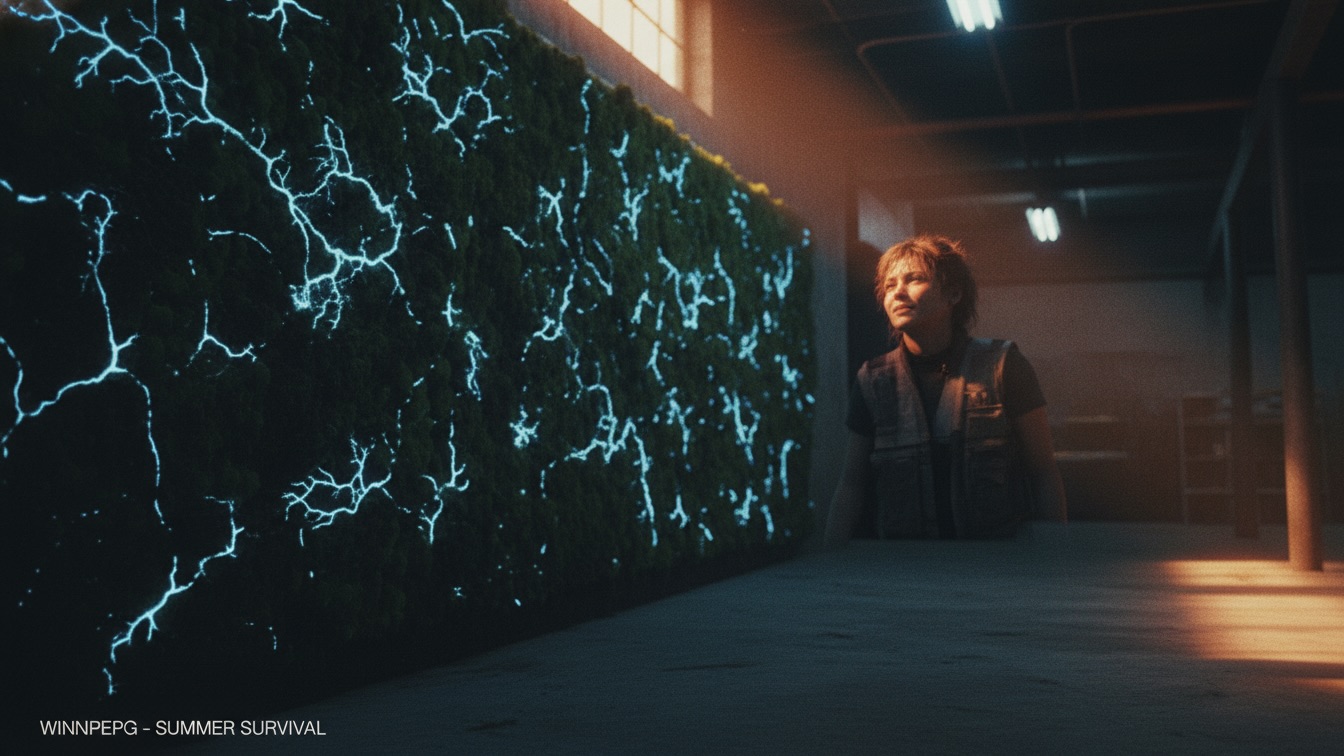
In a smoke-choked Winnipeg, Kelli hides a forbidden moss wall that offers the only clean air left to breathe.
The air in Winnipeg didn't just look like soup; it tasted like a campfire's funeral. My throat felt like I’d been gargling fiberglass for three days straight. I pulled my N95 tighter, the elastic digging a permanent trench into the skin behind my ears. It was mid-July, but you couldn't see the sun. Just a bruised, orange smudge hanging in a sky the color of a dirty penny. This was Code Purple. The boreal forest was basically one giant charcoal briquette, and we were the ones trapped in the smoker.
I stepped over a rusted tricycle abandoned on the sidewalk of Selkirk Avenue. The North End was usually loud, a chaotic mix of shouting kids and rattling mufflers, but today it was dead. Everyone was inside, praying their DIY air filters—heaping piles of MERV-13s taped to box fans—would hold out another hour. I ducked into the basement entrance of the derelict community center. The door groaned, a heavy, metallic sound that echoed too long in the empty hall. I didn't care about the noise. I just needed to get to the humidity sensor.
Inside, the hallway was a tunnel of grey dust and peeling linoleum. I kept my head down, counting the steps. Twelve to the staircase, fifteen down, three to the heavy steel door of the old boiler room. I swiped a stolen keycard. The lock clicked, a sweet, mechanical sound that made my chest loosen just a fraction. I stepped inside and slammed the door behind me.
I stripped the mask off.
The air hit me like a physical weight. It wasn't just clean; it was vibrant. It felt heavy with moisture, cold and crisp in a way that didn't exist in the world outside. I leaned my back against the door and just breathed. One. Two. Three. No coughing. No burning. Just the sharp, electric scent of crushed mint and wet earth. I looked up at the wall.
It was glorious. The Lung was thriving. A ten-foot-high vertical carpet of deep, iridescent green moss clung to the concrete. It wasn't the stuff you find under a damp log. This was my masterpiece. Modified Bryophyta, spliced with hyper-efficient chloroplasts and a proprietary sequencing of air-scrubbing enzymes I’d lifted from the BioGen archives before I went rogue. It didn't just sit there; it pulsed. Every few seconds, a soft, bioluminescent ripple of pale blue light would travel across the surface, a visual heartbeat indicating it was busy turning carbon monoxide and particulate matter into pure, unadulterated O2.
"You’re late," a voice said from the shadows near the old furnace.
I jumped, my heart slamming against my ribs. Jake stepped out, holding a crate of wilted lettuce. He was wearing his usual uniform: a stained Carhartt vest, faded jeans, and a look of permanent suspicion. He ran the local food bank, which was basically the only thing keeping this neighborhood from eating itself alive. He also happened to be the one who’d given me the keys to this basement, thinking I was just using it to store 'experimental fertilizer.'
"I had to dodge a drone patrol on Main Street," I said, my voice still sounding raspy from the walk over. "The Air Police are everywhere today. They're looking for unregistered HVAC systems. Apparently, people are getting desperate enough to hack the city grid."
Jake walked over to the moss wall, his eyes narrowing. He didn't touch it—nobody touched the moss unless they wanted a chemical burn or a very strange rash—but he leaned in close. "It’s bigger. It grew like four inches since Tuesday, Kelli. And the air... it feels weird in here. It’s too good. Like, suspicious-good."
"It’s doing its job," I said, walking over to my laptop setup on a stack of plastic crates. I checked the levels. Oxygen saturation was at 24 percent. Atmospheric pressure was slightly higher than the rest of the building. We were literally creating a pressurized bubble of life in a tomb. "The humidity is stable. I need to calibrate the nutrient drip, though. If it grows too fast, it’ll start looking for minerals in the concrete."
"Is that bad?" Jake asked, crossing his arms.
"Only if you like the building staying upright," I muttered. I started tapping away at the keys, adjusting the flow of the greywater I was siphoning from the building's main line. "But hey, at least we won't die of lung cancer before the ceiling falls in. Silver linings."
Jake didn't laugh. He never laughed. He just stared at the moss, the green light reflecting in his dark eyes. "People are dying out there, Kelli. The elders at the manor... they can't even stand up without turning blue. I’ve got three people on my floor who haven't left their rooms in a week because their filters are black with soot. And here you are, growing a magic carpet."
"It’s not a magic carpet," I snapped, turning to face him. "It’s a prototype. If I can prove it stabilizes here, we can scale it. We can seed the whole block."
"With what money?" Jake asked. "The Air Police will bulldoze this place the second they pick up a thermal signature. You know the law. Anything that isn't city-sanctioned bio-tech is a biohazard. They don't want people fixing the air. They want people paying for the subscription-model canisters."
"Then we don't tell them," I said. I felt that familiar spark of defiance, the one that got me fired and nearly arrested six months ago. "We make a sanctuary. Bring the elders here. Tell them it's a 'refrigerated storage unit.' They won't know the difference. They'll just know they can breathe."
Jake looked at me for a long time. I could see the internal struggle—the part of him that wanted to play by the rules to protect his food bank versus the part of him that knew the rules were designed to kill us. Finally, he spat on the floor. "Fine. But if the cops come, I’m telling them you’re a squatter and I’ve never seen you before in my life."
"Deal," I said, turning back to the screen. "Now, help me haul these water jugs. The Lung is thirsty."
The next three days were a blur of adrenaline and dampness. We started bringing people in under the cover of the smoke. It wasn't hard; visibility was so low you could move a whole choir down the street and the drones wouldn't see anything but grey blobs. Jake brought the elders from the manor first. Mrs. Gable, who was eighty and had a cough that sounded like a gravel crusher, sat on a folding chair in front of the moss and just stared. After ten minutes, she stopped coughing. She looked up at me, her eyes watery and clear, and said, "It smells like the lake. Like it used to, back in the nineties."
I didn't have the heart to tell her it actually smelled like a lab-grown fungal colony with a hint of bleach, but I nodded and gave her a glass of water. By Thursday, we had twelve regulars. We called it the 'Breathing Room.' It was a tiny, humid miracle. But the more people came, the more the risk skyrocketed.
I was checking the pH levels of the runoff when a heavy thud vibrated through the ceiling. Then another. Boots. Heavy, rhythmic, and definitely not the sound of Jake moving cans of beans.
"Kelli," Jake hissed, ducking into the room. His face was pale. "Cops. Front entrance. They’ve got a localized air-quality sensor on a stick. They’re tracking a 'purity spike.'"
My stomach dropped. A purity spike. Of course. We were pumping out so much oxygen it was leaking through the cracks in the foundation and showing up on their maps like a neon sign. "Hide everyone," I whispered. "Get them into the back storage locker. Now!"
Jake scrambled to move the elders. I frantically threw a tarp over my laptop and the nutrient tanks, but there was no hiding the wall. It was ten feet of glowing green evidence. I grabbed a spray bottle of industrial cleaner and started dousing the floor near the entrance, trying to mask the scent of life with the scent of chemicals.
Then the door opened.
Sergeant Lunne stepped in. He was wearing the full Air Police kit: a sleek, black respirator with a digital display on the side and a tactical vest stuffed with sensors. He looked like a beetle. He didn't say anything at first. He just stood there, his eyes scanning the room behind his visor. The sensor in his hand was chirping like a panicked bird.
"Quite the setup you've got here," Lunne said. His voice was distorted through the comms, metallic and cold. "The air in this basement is 98 percent cleaner than the air on the street. That’s a statistical impossibility for a building this old."
"We have a lot of fans," I said, my voice steady despite the fact that my palms were sweating buckets. I held up the spray bottle. "And I’m a bit of a clean freak. Mold is a bitch in this humidity."
Lunne walked toward the moss wall. My heart stopped. He stopped a foot away, reaching out a gloved hand. He didn't touch it, but he traced the outline of the blue light with his finger. "This isn't mold, Kelli. I know your face. You’re the one BioGen flagged for 'intellectual property theft' last winter. They said you walked out with a hard drive full of genomic sequences and a pocketful of spores."
"I don't know what you're talking about," I said. "I was a janitor. I got laid off."
Lunne turned to me. I couldn't see his face, but I could feel the smirk. "A janitor who knows how to build a high-pressure hydroponic delivery system? You’re larping as a savior, kid. But all you’re doing is making yourself a target. This 'illegal greenery' is a bio-safety level 3 violation. Unregulated genetic modification in a residential zone. Do you have any idea what this moss would do if it got into the water table?"
"It would clean it," I snapped. "It would fix the mess your bosses made."
"It would out-compete every native species in the province," Lunne countered. "It’s an invasive pathogen. And I have orders to neutralize it."
He reached for a canister on his belt—defoliant. My brain went into overdrive. If he sprayed that, not only would the moss die, but the elders in the back would be breathing toxic sludge. Jake stepped out from behind a pillar, holding a heavy iron pipe.
"Don't," Jake said. He wasn't a fighter, but he looked like he was willing to try. "There are people here. Old people. You spray that stuff, you kill them too."
Lunne paused. He looked at Jake, then back at me. The silence stretched, filled only with the hum of the moss and the distant roar of the wind outside.
"You think you're helping?" Lunne asked. "You're just delaying the inevitable. The city is burning. The whole world is burning. This little patch of green isn't going to save anyone."
"It saved Mrs. Gable today," I said. "That's enough for me."
Lunne sighed, a hiss of air through his respirator. He lowered the canister. "I'm going to report a sensor malfunction. I’ll say the purity spike was a ghost in the software. But you have forty-eight hours to get this out of here. If I come back and the air is still this clean, I’m bringing the bulldozer. And I won't check the back rooms first."
He turned and walked out, the heavy door clanging shut behind him.
I collapsed onto a crate, my legs shaking. Jake dropped the pipe. We didn't speak for a long time. The moss pulsed blue, oblivious to the fact that it was a death sentence.
"He's right, you know," Jake said quietly. "We can't keep it here."
"I know," I said, looking at the wall. "So we move it. We don't just keep it in the basement. We put it everywhere."
The heatburst hit at 2:00 AM on Friday. The temperature outside spiked to 45 degrees Celsius in a matter of minutes. It was a weather phenomenon that shouldn't have been possible, a literal wall of heat being pushed ahead of the fire front. Inside the community center, the pipes started to groan. The building was old, and the sudden expansion of the metal was making it sound like the place was being torn apart by a giant.
I woke up on my cot in the boiler room to a sound like a rushing river. I scrambled up, grabbing my flashlight.
"Kelli! The moss!" Jake yelled from the hallway.
I ran to the wall and gasped. The moss wasn't just growing anymore; it was evolving. The extreme heat and humidity had triggered a survival response I hadn't seen in the lab. It was doubling in size every hour. Thicker, darker green tendrils were snaking out from the main body, reaching toward the ceiling. But more importantly, they were diving into the floor.
"It’s in the plumbing," I said, watching as a thick mat of roots forced its way into the seal of the main greywater intake.
"Is that what that sound is?" Jake asked, pointing to the ceiling. The sound of water rushing wasn't coming from the pipes; it was coming from the moss. It was acting like a massive, organic sponge, pulling every drop of moisture out of the building's system.
I checked the sensors. "It’s cleaning the water, Jake. Look at the outflow meter. It’s pulling in the greywater from the upstairs sinks and toilets, filtering it through its root system, and pumping out distilled water. It’s... it’s integrated itself."
"It’s also cracking the concrete," Jake pointed out. A jagged line was forming along the base of the wall where the moss had anchored itself. "If this keeps up, the foundation is toast."
"I can't stop it," I said, my fingers flying across the keyboard. "The metabolism is off the charts. It’s feeding on the heat. It’s like a biological engine."
We spent the next six hours trying to contain the spread. We hacked away at the edges with garden shears, but it was like trying to trim a forest with a pair of scissors. For every inch we cut, it grew two. By dawn, the entire boiler room was a jungle. The air was so thick with oxygen it felt like we were breathing pure energy. My head was light, my vision sharper than it had ever been. It was intoxicating.
Around noon, the heat reached its peak. The smoke outside was so dense it was basically night. Jake and I sat on the floor, exhausted, surrounded by a wall of green that was now humming. A literal, low-frequency hum.
"I didn't just make it for the air, you know," I said, staring at a bioluminescent vein in a moss leaf.
Jake looked at me. "Your mom?"
I nodded. "She had COPD. In the 2034 fire season, she spent three months in a mask. The hospital ran out of canisters. I was working at BioGen, watching them patent the technology that could have saved her. They were sitting on these spores because they wanted to wait for the market to 'mature.' Which is corporate-speak for 'wait until enough people are dying that they'll pay anything.'"
"So you stole them," Jake said. It wasn't a question.
"I stole the base spores. I spent a year in my apartment kitchen with a second-hand centrifuge and a lot of stolen reagents, trying to make them hardy enough for the North End. My mom died two weeks before I got the first colony to survive. She never got to breathe this air."
Jake reached out and put a hand on my shoulder. His skin was rough and calloused, a sharp contrast to the soft, damp moss. "You're not larping, Kelli. I'm sorry I said that. You're just... you're the only one who didn't give up."
"I'm terrified," I admitted. "If this stuff gets out and it really is invasive, I’ve just traded one disaster for another."
"Look around," Jake said, gesturing to the green sanctuary. "The world outside is a disaster. This? This is a choice. I’d rather go out fighting for a forest than choking on a corporate smog-cloud."
He stood up and grabbed a backpack. "Lunne is coming back tomorrow. We need to start the kits."
I looked at the moss. It was already producing spore pods—tiny, translucent spheres filled with a concentrated emerald liquid. If we could get those into the hands of the neighborhood leaders, the moss could be planted in every basement, every community garden, every abandoned subway tunnel.
"They’re going to call us eco-terrorists," I said, a small smile tugging at my lips.
"Good," Jake said. "I’ve always wanted a cool nickname."
The raid didn't happen at noon. It happened at 4:00 AM, the hour when the smoke is the thickest and the human spirit is at its lowest. I heard the sirens first—not the standard police wail, but the low, thrumming pulse of the Air Police tactical units.
"They’re here," I said, standing up. I was covered in green slime and sweat, looking like I’d just crawled out of a swamp.
Jake was already at the door. "The kits are gone. Mrs. Gable took three. The guys at the auto shop took ten. It’s out there, Kelli. Even if they kill the source, the seeds are planted."
We went upstairs. I expected to see the street empty, but I was wrong. The North End had woken up. Despite the heat, despite the Code Purple air that should have kept everyone behind sealed doors, there were people on the sidewalk. Dozens of them. They weren't shouting. They weren't throwing rocks. They were just standing there, forming a human chain in front of the community center.
I saw Mrs. Gable in the middle, her hand linked with a young guy in a tech-hoodie. They all had their masks on, but their eyes were fixed on the black vans pulling up to the curb.
Sergeant Lunne stepped out of the lead vehicle. He wasn't alone this time. He had a squad of twelve, all carrying industrial-grade sprayers and demolition tools. He stopped at the edge of the crowd, his respirator glowing in the dark.
"Move aside," Lunne’s voice boomed over his external speakers. "This building is a bio-hazard. We have a warrant for its immediate decontamination."
Nobody moved.
"There’s a localized weather anomaly here," one of the other officers muttered, checking a handheld device. "The AQI is dropping. It’s... it’s 50. Right here on the sidewalk. How is that possible?"
I stepped out onto the front steps, Jake right behind me. I took off my mask. The air was incredible. The moss had worked better than I’d ever dreamed; it had turned the entire building into a giant air purifier, and the clean air was spilling out of the open windows like a visible mist, pushing back the grey smoke.
"It’s not an anomaly," I shouted. "It’s a solution. You want to decontaminate? Go ahead. But you’ll have to go through every person on this block who can finally take a deep breath for the first time in years."
Lunne looked at me. Then he looked at the crowd. I could see him calculating. He could order his men to charge, but the optics would be a nightmare—Air Police gassing people who were just standing in clean air.
"You're playing a dangerous game," Lunne said, walking up to the edge of the human chain. He leaned in close to Mrs. Gable. I saw him look at her face, at the way she wasn't gasping for air.
He stayed there for a long beat. Then, he turned back to his squad.
"Pack it up," Lunne said.
"Sir?" the lead officer asked. "The orders are clear."
"The orders are to mitigate bio-hazards," Lunne said. "I don't see a hazard. I see a technical error in the sensors. The smoke is interfering with the readings. We’re returning to base."
The officers looked confused, but they didn't argue. They climbed back into the vans and vanished into the orange gloom.
A cheer went up from the crowd—a muffled, masked cheer, but it was the most beautiful thing I’d ever heard.
Jake and I didn't stay to celebrate. We climbed the fire escape to the roof. Up here, above the immediate influence of the moss, the smoke was still thick, but you could see the change. In the distance, in the windows of the Exchange District, I saw a faint, blue glow. Then another. And another. The seed kits were being activated.
The 'Green Tide' was spreading. It wouldn't stop the fires—not yet—but it gave us a fighting chance. It was a modified, synthetic, beautiful middle finger to a world that had tried to price us out of existence.
We sat on the edge of the gravel roof, our legs dangling over the side. The sun was setting, a violent, blood-red orb sinking into the grey horizon. But as I looked down at the streets of my neighborhood, I didn't see the ash. I saw the emerald light reflecting off the cracked pavement.
“I leaned my head on Jake’s shoulder, breathing in the cold, mossy air, and for the first time in my life, I wasn't afraid of what the morning would bring.”


