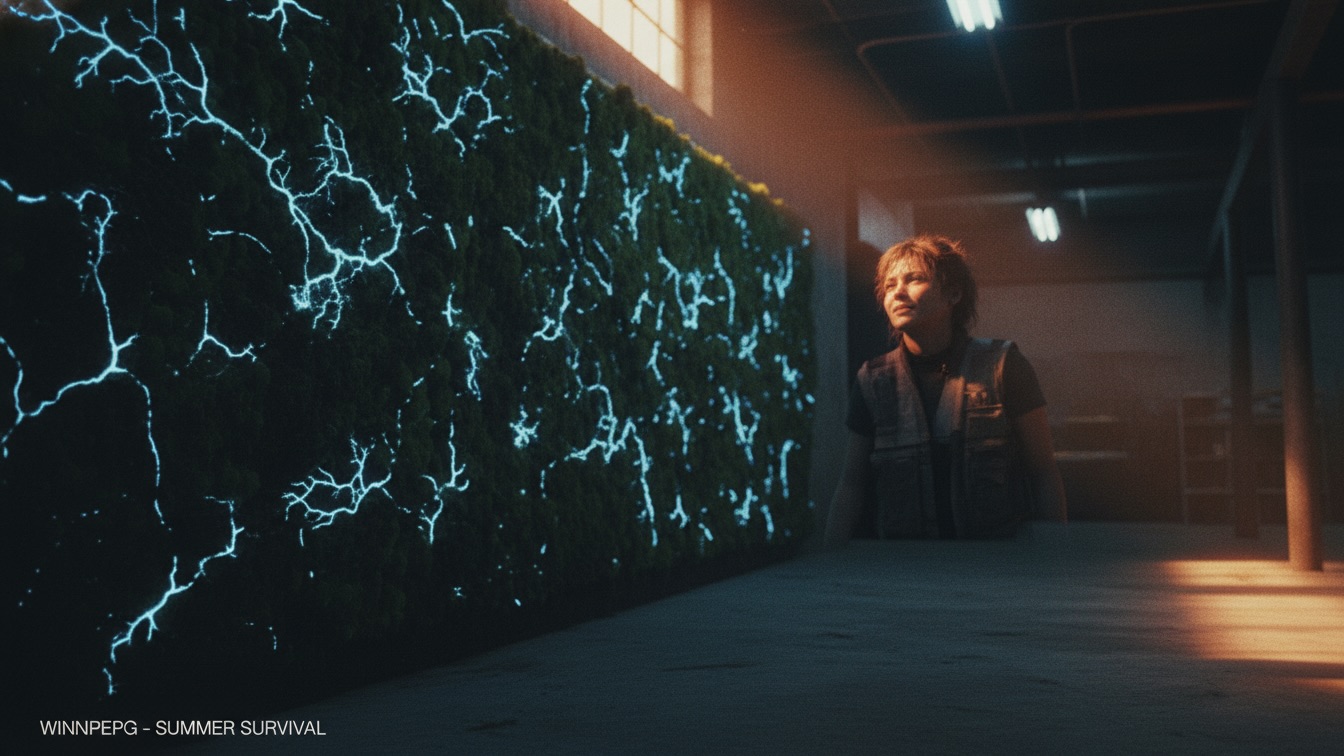
In a dystopian Winnipeg choked by "Code Purple" wildfire smoke, a former scientist named Kelli cultivates a clandestine solution to the environmental crisis. Operating out of a derelict community center with the help of a local food bank manager named Jake, she grows a genetically modified moss capable of purifying toxic air. This "Lung" becomes a sanctuary for vulnerable community members who cannot afford the corporate-sanctioned air canisters sold by BioGen. As the heat intensifies and the moss begins to integrate with the building’s infrastructure, the Air Police arrive to investigate the illegal bio-tech.
The tension peaks when Sergeant Lunne discovers the operation but ultimately chooses to report a sensor malfunction rather than destroy the life-saving greenery. This act of mercy allows Kelli and Jake to distribute spore kits throughout the neighborhood, sparking a grassroots ecological rebellion. The story concludes with the "Green Tide" spreading across the city, offering a glimmer of hope against a backdrop of corporate greed and climate catastrophe. Kelli’s personal mission to honor her late mother evolves into a widespread movement that challenges the status quo of survival.
One of the central themes in the narrative is the commodification of basic human necessities and the resulting class divide. In Kelli’s world, clean air is no longer a right but a subscription-based product controlled by corporations like BioGen. This creates a predatory environment where the poor are left to suffocate while the wealthy purchase safety. Kelli’s "Lung" represents a radical reclamation of the commons, asserting that life-sustaining resources should be accessible to all regardless of their economic status.
The story also explores the ethics of bio-engineering as a response to ecological collapse. Kelli’s moss is a modified Bryophyta, an invasive species designed to out-compete native flora to save human lives. This highlights a desperate pragmatism where the protagonist must weigh the risk of long-term ecological disruption against the immediate threat of mass respiratory failure. The moss serves as a metaphor for a necessary, perhaps aggressive, evolution required to survive in a world that has been fundamentally broken by human industry.
Finally, the theme of defiance against oppressive authority is woven into the interactions with the Air Police. The law, as represented by Sergeant Lunne, is designed to protect corporate intellectual property and maintain social control rather than ensure public safety. By choosing to ignore his orders, Lunne demonstrates that individual conscience can still function within a rigid system. The "Green Tide" suggests that true change comes from decentralized, community-led initiatives rather than the top-down regulations of a failing state.
Kelli is a complex protagonist driven by a potent mixture of scientific brilliance and deep-seated grief. Her history as a former BioGen employee provides her with the technical skills necessary to create the moss, but her motivation is entirely personal. The loss of her mother to respiratory illness serves as the emotional catalyst for her rogue status, transforming her from a corporate cog into a bio-hacker. She carries the weight of her mother’s death as a form of penance, viewing the moss as the miracle she was unable to provide in time.
Psychologically, Kelli exhibits a high degree of cognitive dissonance regarding the safety of her creation. She is acutely aware that her modified moss could be classified as an invasive pathogen, yet she prioritizes the immediate survival of the North End’s residents. This willingness to risk a secondary ecological disaster demonstrates her desperation and her loss of faith in traditional systemic solutions. Her defiance is not just against the Air Police, but against the feeling of helplessness that defined her mother’s final days.
Throughout the chapter, Kelli transitions from a secretive, frightened individual to a symbolic leader of a grassroots movement. Initially, she is focused on the technical stability of the moss and the fear of being caught by drones. However, as she witnesses the physical relief the moss brings to elders like Mrs. Gable, her resolve hardens. By the end of the narrative, she accepts the label of eco-terrorist with a sense of grim satisfaction, realizing that her survival and the survival of her community depend on this radical path.
The narrative employs a gritty, visceral style that emphasizes the sensory horrors of an environmental apocalypse. Descriptions such as "campfire's funeral" and "bruised, orange smudge" immediately establish a tone of atmospheric dread. The prose is thick with texture, contrasting the abrasive, dry world of the smoke-filled streets with the vibrant, humid sanctuary of the boiler room. This sensory contrast serves to heighten the reader’s appreciation for the moss as a literal and metaphorical oasis.
Pacing in the story is carefully managed to reflect the escalating tension of the Code Purple event. The initial scenes move with a cautious, rhythmic steadying as Kelli navigates the ruins of the North End. Once the heatburst hits, the narrative velocity increases significantly, mimicking the rapid, uncontrollable growth of the moss. This acceleration creates a sense of urgency that mirrors the protagonist’s own adrenaline-fueled efforts to distribute the spores before the authorities can intervene.
The narrative voice is characterized by a cynical yet resilient perspective that feels authentic to the setting. Kelli’s internal monologue is peppered with technical jargon and weary observations about subscription-model canisters and Air Police. This grounded voice prevents the more fantastical elements of the bio-engineered moss from feeling out of place. Instead, the magic carpet of greenery feels like a logical, if extreme, extension of a world where nature has been forced to adapt to human-made poisons.


