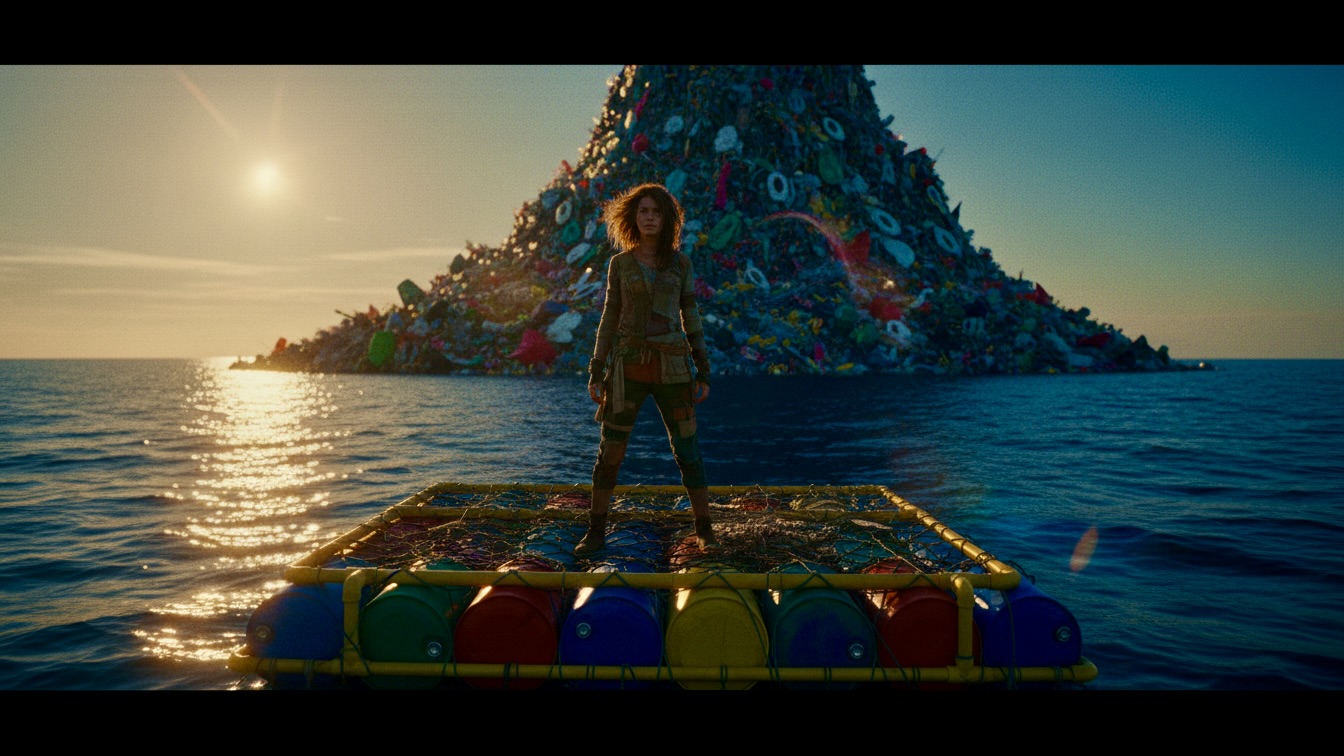
Imagine this story as a standalone installment in an anthology series titled Surface Tension, which explores the collision between digital artifice and the raw, unforgiving reality of the natural world. Each episode focuses on a different media personality forced into a survival situation where their curated persona is stripped away by environmental or social catastrophe.
Format: Short Film / Anthology Episode | Est. Length: 10-12 minutes
Surface Tension is a high-concept anthology series that deconstructs the "Attention Economy" through the lens of survival horror and psychological drama. Each episode follows a different protagonist—from tech moguls to lifestyle influencers—as they are thrust into high-stakes environments that their digital platforms have previously trivialized. The series serves as a contemporary Twilight Zone, focusing on the moment the "filter" of modern life is torn away to reveal a harsh, undeniable truth.
Zoe, a high-profile environmental influencer, steps off a boat onto a floating mass of Pacific garbage to film a "hero" video, only to realize the "island" is a shifting, unstable trap. As a sudden storm severs their link to the mainland, the performance of activism turns into a raw struggle for life.
An influencer’s staged environmental protest turns into a desperate fight for survival when a storm strands her team on a floating island of trash. To survive the night, she must abandon her digital persona and confront the hollow reality of her activism.
The story explores the dichotomy between digital curation and physical reality, highlighting how the "performance of care" can obscure genuine ecological crises. It critiques the commodification of activism, where environmental tragedy is reduced to an aesthetic backdrop for personal branding and social capital.
The narrative also delves into the theme of human connection in the absence of technology. As the digital signal dies, the characters are forced to move from being "collaborators" in a brand to being human beings in a shared crisis, suggesting that true community is built through shared struggle rather than shared feeds.
For Zoe, the stakes are both existential and professional: she faces literal death by drowning or exposure, but also the total collapse of the identity she has built for millions of followers. Her crew, Cathy and Jay, risk their lives for a narrative they don't fully believe in, highlighting the collateral damage of the attention economy. The ultimate stake is the truth—whether Zoe will succumb to the lie of her brand or emerge with a genuine, albeit "un-marketable," perspective on the world.
The primary external conflict is the indifferent and volatile Pacific Ocean, manifesting as a sudden storm and the unstable, razor-sharp terrain of the garbage patch. Internally, Zoe battles her own narcissism and the psychological addiction to digital validation, which initially prevents her from taking life-saving actions. A secondary antagonistic force is the "Spoonbill" itself—not a victim to be saved, but a territorial scavenger that represents nature’s refusal to comply with Zoe’s scripted narrative.
Zoe, an influencer, leads a small crew to the Great Pacific Garbage Patch to film a viral campaign about saving a rare bird, but the mission is driven more by aesthetics than ecology. When a sudden storm hits, their pilot is forced to retreat, leaving Zoe, her camerawoman Cathy, and biology student Jay stranded on a shifting raft of plastic waste with no signal and failing batteries.
Over the course of a harrowing night, the group is forced to dismantle their expensive gear to build a functional raft, stripping away their professional veneers in the process. Zoe eventually realizes that her "activism" was a hollow performance, and upon rescue, she chooses to upload a raw, unedited confession of her failure rather than the polished lie she came to produce.
Zoe Chen: A charismatic but shallow activist who begins the story obsessed with her "brand" and ends as a raw, blistered survivor who deletes her curated lies in favor of the ugly truth. Her arc is one of ego-death, moving from a state of constant self-perception to a state of direct, unmediated experience.
Cathy Miller: A weary, professional cinematographer who transitions from a tool in Zoe's kit to a vulnerable human being seeking genuine connection over the perfect shot. She represents the "enablers" of the digital age who find their own agency when the cameras finally stop rolling.
Jay Singh: A cynical biology student who serves as the story's moral compass, moving from passive observer to the practical leader who teaches the group how to survive the reality they came to exploit. He is the bridge between the academic understanding of the crisis and the physical reality of surviving it.
The crew arrives at the garbage patch, where Zoe immediately prioritizes her appearance and the "narrative" over the unsettling reality of the multicolored filth. She directs Cathy to capture the "wound" of the ocean, treating the environmental disaster as a high-fashion backdrop while Jay looks on with increasing disgust. This establishes the disconnect between the influencer's mission and the actual environment.
They find the bird, but Zoe's attempt to film a "savior" moment backfires when the aggressive scavenger attacks their gear, signaling that nature does not follow her script. As the storm hits, the boat is swept away, leaving the trio huddled under a tarp on a shifting mass of plastic as Zoe’s phone battery—her only link to her identity—slowly drains. This midpoint marks the shift from a media production to a survival scenario.
In the cold light of morning, the group abandons the performance to build a functional raft from the very trash Zoe claimed she wanted to "witness," leading to a moment of raw personal honesty. As a Coast Guard ship approaches, Zoe uses her final 4% of battery to post a grainy, unedited video of the truth, finally choosing reality over her curated image. The climax occurs not when they are saved, but when Zoe deletes the "perfect" footage, effectively killing her digital persona to save her soul.
The episode begins with a cold, clinical sense of artifice and high-saturation beauty, creating a feeling of detachment and irony. This shifts into high-tension terror and claustrophobia as the storm hits, stripping away the visual polish and replacing it with dark, wet, and gritty realism. The final act settles into a somber, grounded sense of clarity and rebirth, leaving the audience with a feeling of exhausted but genuine relief.
If expanded, the season would follow Zoe as she attempts to navigate the fallout of her "truth-telling" in a media landscape that prefers the lie, eventually becoming a whistleblower against the agencies that fund "performative activism." Her journey would serve as the connective tissue between other episodes, as she uses her platform to highlight the real stories of the people she met during her rescue and subsequent recovery.
Later episodes would introduce other characters from the anthology—a tech mogul in a failing bunker, a travel vlogger in a drought zone—whose paths eventually cross in a shared struggle against systemic collapse. The season finale would see these disparate survivors coming together to form a new kind of community, one based on physical necessity and radical honesty rather than digital metrics.
The visual style shifts from high-saturation, stabilized "influencer" cinematography with shallow depth-of-field to handheld, grainy, and desaturated realism once the storm arrives. The early scenes should feel like a commercial—too perfect and slightly "uncanny"—while the survival scenes should feel tactile, using extreme close-ups of plastic textures and raw skin to emphasize the physical world.
Tonal influences include the claustrophobic dread of Life of Pi mixed with the cynical media critique of Black Mirror. The sound design is crucial, moving from the rhythmic, musical clinking of plastic bottles in the beginning to a deafening, chaotic roar during the storm, and finally to a quiet, naturalistic soundscape during the rescue.
The target audience is Gen Z and Millennials (ages 18-35) who are digitally native and increasingly skeptical of social media authenticity and corporate environmentalism. This demographic values "de-influencing" and raw content, making the story's critique of curated activism particularly resonant for viewers who navigate these platforms daily.
The pacing is brisk and relentless, utilizing a three-act structure that mirrors the rapid escalation of a real-world squall. The first three minutes establish the artifice and the "mission," the next five minutes focus on the survivalist midpoint and the psychological breakdown of the group, and the final four minutes focus on the resolution and the "low-resolution" truth.
Production requires a specialized water tank or controlled coastal environment to safely simulate the "garbage island" without actual environmental contamination. The "trash" must be carefully constructed from safe, non-toxic materials that mimic the appearance of sun-bleached plastic and degraded nylon netting.
Practical effects should be prioritized for the trash raft to enhance the tactile, gritty reality of the characters' struggle, while the storm sequence will require heavy use of wind and rain machines. The bird should be a combination of a practical animatronic for close-ups and CGI for more complex movements to maintain the "uncanny" and aggressive feel described in the text.


