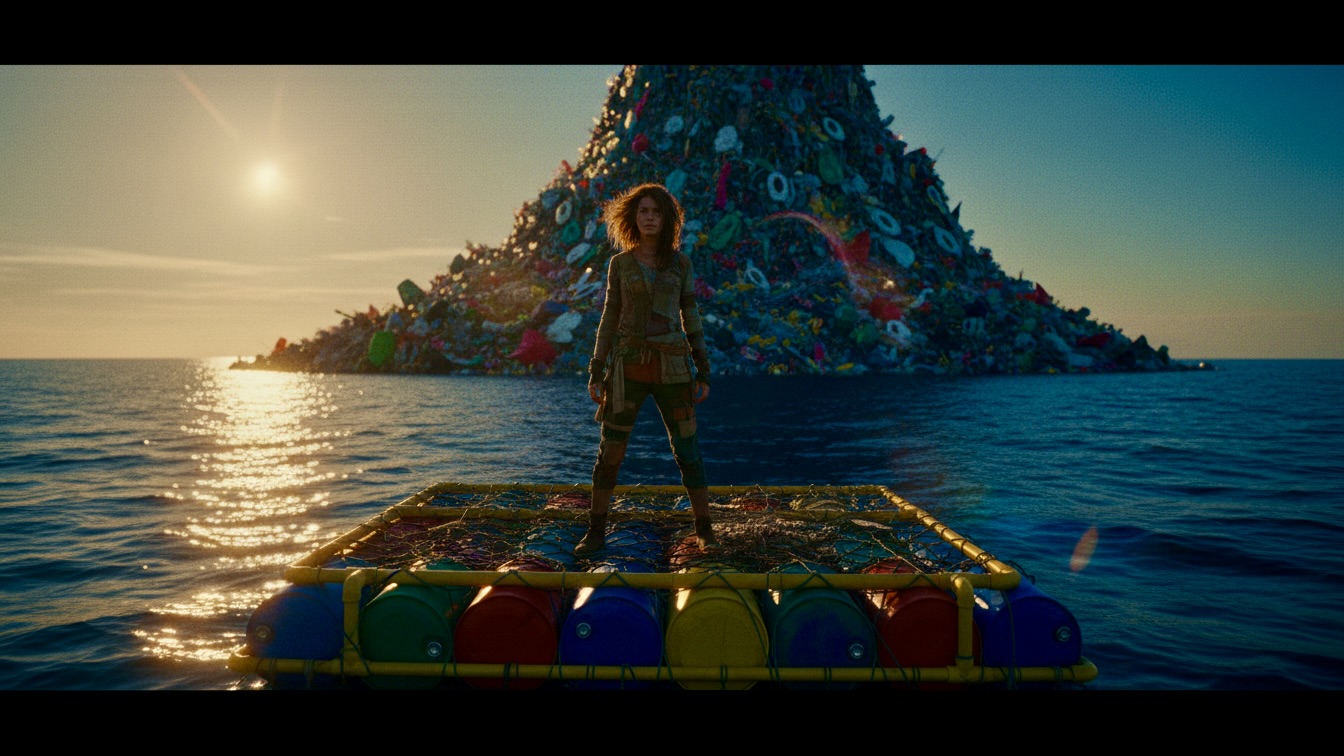
The story follows Zoe Chen, a high-profile social media influencer who travels to the Great Pacific Garbage Patch to film a promotional campaign for her #SaveTheSpoonbill initiative. Accompanied by a cynical videographer named Cathy and a pragmatic biology student named Jay, Zoe is initially focused on the aesthetic and narrative potential of the environmental disaster. She views the floating mass of plastic not as a tragedy, but as a backdrop for her personal brand of activism. The team encounters a bird that Zoe believes is an endangered Roseate Spoonbill, though the bird’s aggressive behavior and the harsh reality of the trash island soon begin to crack her carefully curated facade.
A sudden and violent storm hits the area, separating the group from their transport boat and leaving them stranded on the shifting, unstable raft of debris. During the long, terrifying night that follows, the trio is forced to discard their professional personas and confront their mortality. They build a makeshift vessel from the trash and are eventually rescued by the Coast Guard after Zoe posts a raw, unedited video of their plight. Upon returning to the mainland, Zoe rejects the polished, fake footage of the expedition. She chooses instead to speak the uncomfortable truth about the environment and the vanity of digital performance, marking a profound shift in her identity and purpose.
The central theme of the narrative is the tension between performative activism and the visceral reality of ecological collapse. Zoe initially views the garbage patch as a commodity, a "wound" that she can use to enhance her image as a savior. Her insistence on looking "expedition-ready" and her desire to frame the bird as a "hero" demonstrate how digital culture sanitizes crisis to make it palatable for consumption. This performance of care is exposed as hollow when a genuine life-or-death situation strips away the ability to curate the experience.
Another significant theme is the search for authentic human connection in a hyper-mediated world. Before the storm, the characters are separated by their roles and screens, with Zoe not even knowing Cathy’s last name despite working together for months. The survival situation forces them to communicate as individuals rather than as components of a production team. Their shared vulnerability on the trash raft becomes the catalyst for a genuine intimacy that a digital platform could never facilitate. This suggests that true connection requires the removal of the "filters" that modern society uses to mediate relationships.
Finally, the story explores the concept of a "fake" ecosystem through the image of the invasive bird thriving on plastic. Jay’s revelation that the bird is a scavenger rather than a rare victim subverts the traditional environmental narrative of pure nature being destroyed by man. It suggests that the world has been fundamentally altered into a new, grotesque reality where survival belongs to the opportunists who can stomach the refuse of consumerism. This grim reality serves as a psychological wake-up call for Zoe, leading to her eventual rejection of the curated lie in favor of a "low-resolution truth."
Zoe begins the narrative as a figure defined entirely by her digital footprint and the way she is perceived by her five million followers. Her psychological state is one of constant self-surveillance, where she evaluates her surroundings and her own physical appearance through the lens of a camera. She suffers from a profound dissociation, viewing the world as a series of thumbnails and captions rather than a tangible reality. This reliance on the "black mirror" of her phone suggests that her sense of self is fragile and entirely dependent on external validation.
The trauma of the storm and the subsequent survival ordeal serves as a psychological "ego death" for her. When her phone battery dies, she faces an existential crisis, questioning if she even exists if she is not being perceived by her audience. However, her decision to delete the "perfect" footage at the end of the story indicates a hard-won maturity. She moves from a state of performative narcissism to one of grounded integrity, finally accepting her unpolished, "un-on-brand" self as her true identity.
Jay serves as the narrative’s moral and scientific anchor, representing the voice of reality in a world of artifice. Unlike Zoe and Cathy, he is not motivated by digital fame but by a desire for data and a genuine understanding of the natural world. He is a pragmatist whose knowledge of biology and structural integrity becomes essential for the group's physical survival. His psychological makeup is characterized by a quiet resilience and a refusal to participate in the "performance of care" that Zoe demands.
Despite his initial cynicism toward Zoe’s brand, he demonstrates a high level of empathy and emotional intelligence. He is the first to bridge the gap between the team members, encouraging them to share their personal histories during the dark hours of the storm. He does not judge Zoe for her vanity but instead guides her toward a more honest way of being. His role is that of a catalyst, helping the others transition from a state of performance to a state of raw, human existence.
Cathy embodies the professional and physical toll of the attention economy on the younger generation. Despite being only nineteen, she looks much older, a physical manifestation of the stress inherent in constant content creation and technical perfection. Her identity is almost entirely subsumed by her equipment, and she initially views the garbage patch solely through the requirements of her 4K sensors. She is a victim of the same system as Zoe, sacrificing her personal life and family milestones for the sake of a professional "shot" that looks expensive.
During the crisis, Cathy’s professional facade crumbles, revealing a terrified young woman who simply wants to return to the safety of her normal life. Her breakdown and subsequent bonding with Zoe and Jay allow her to reclaim the humanity she had traded for technical proficiency. By the end of the story, she is no longer just a tool for Zoe’s brand but a participant in a shared human struggle. She finds a sense of belonging that is rooted in real-world experience rather than digital output.
The author utilizes a stark, clinical tone that effectively mirrors the harsh and unnatural environment of the garbage patch. The descriptions of the plastic mass as a "smudge of graphite" and a "chaotic mosaic of faded colors" create a sense of sensory overload that is both vivid and repulsive. This imagery emphasizes the artificiality of the setting, contrasting the beauty of the Pacific with the "multicolored filth" of human waste. The use of metallic and chemical scents further reinforces the theme of industrial intrusion into the natural world.
Pacing in the chapter shifts effectively from the slow, calculated movements of a film shoot to the frantic energy of a survival thriller. The initial scenes are heavy with dialogue and internal monologue, reflecting Zoe’s obsession with detail and her internal framing of the narrative. Once the storm hits, the prose becomes more urgent, with shorter sentences and more action-oriented verbs. This shift mirrors the characters' loss of control as they are forced to react to the environment rather than attempt to manipulate it for a camera.
The narrative voice is observant and slightly detached, which serves to highlight the irony of Zoe’s performative activism. By maintaining a critical distance from her internal justifications, the author allows the reader to see the absurdity of her actions without being told directly. The ending of the story provides a satisfying resolution by returning to a more grounded, direct style of communication. This stylistic evolution reflects Zoe’s own journey from the filtered, high-definition world of social media to the raw, low-resolution truth of reality.


